Showing posts with label 3D printing. Show all posts

Agnikul’s New 3D Printing Facility Promises Faster, Smarter Rocket Manufacturing in India

In a landmark moment for India’s private space sector, Chennai-based spacetech startup Agnikul Cosmos has commissioned the country’s first large-format 3D printing facility dedicated to aerospace and rocket systems, reported Times of India today. Located at the IIT Madras Research Park, the facility integrates design, simulation, printing, post-processing, and testing under one roof—dramatically accelerating the production of flight-ready hardware.

image Credits – News IADN@X

This is not just a milestone for Agnikul, it is a statement of national capability,” said Moin SPM, Co-founder & COO of Agnikul Cosmos.

Key Highlights 

  • Scale & Capability: First in India to enable 3D printing of aerospace components up to 1 metre in height, previously considered too complex for additive manufacturing.
  • Speed & Efficiency: Fully finished rocket engines can now be produced in just days, cutting development cycles and costs by up to 50%.
  • Indigenous Innovation: Includes a homegrown de-powdering machine for flawless post-processing, ensuring space-grade quality without external dependencies.
  • Patent Power: Agnikul holds a US patent for single-piece 3D-printed rocket engines. The new facility allows production of engines with seven times the thrust of earlier designs.
  • Strategic Vision: The facility strengthens India’s space manufacturing ecosystem, positioning it as globally competitive in terms of quality, speed, and affordability.
Founded in 2017 and incubated at IIT Madras, Agnikul previously made headlines by launching its Agnibaan rocket from Sriharikota’s first private launchpad, Dhanush. The startup has raised $45 million to date from investors including Celesta Capital, Rocketship.vc, and Pi Ventures.
Agnikul was started with the goal of making space available to everyone, said Srinath Ravichandran, Co-founder & CEO. “By developing not just printing capacity but also full-scale machines in-house, we are equipping ourselves to build space transportation systems faster.”

With over 250 space-tech startups now active in India, Agnikul’s new facility marks a pivotal step toward a self-sustaining, innovation-driven space economy.

Deeptech Co. Simpliforge with, Indian Army, Delivers World’s Highest On-Site 3D Printed Structure in Himalayan Range


In a monumental leap for defense infrastructure and construction technology, Simpliforge Creations and IIT Hyderabad, in collaboration with Indian Army represented by Arun Krishnan (who is also a PhD student at IIT-Hyderabad), have successfully delivered India’s first on-site 3D printed protective military structure at a staggering altitude of 11,000 feet above sea level in Leh under Project PRABAL.

This marks the world’s highest-ever in-situ 3D construction printing feat, accomplished under the extreme high altitude and low oxygen (HALO) conditions.

Under the guidance of Prof. K.V.L. Subramaniam of IIT-Hyderabad, Simpliforge Creations and IIT-Hyderabad Teams developed specialized 3D printing technology capable of operating under extreme environmental conditions. This innovation enabled the construction of a form-optimized protective bunker using locally sourced materials, completed over a total printing time of fourteen hours.

Deeptech Co. Simpliforge with Indian Army Deliver World’s Highest On-Site 3D Printed Structure in Himalayan Range
The PRABAL initiative showcases how homegrown technology and academic-industry collaboration can push the boundaries of construction science. The deployment of this 3D printed bunker is not only a first-of-its-kind in India but also sets the stage for rapid, on-site, deployable infrastructure in challenging terrains, further strengthening the country’s defense preparedness.

This groundbreaking project marks a convergence of engineering innovation, military utility, and the Make-in-India spirit—paving the way for future-forward infrastructure solutions.

Speaking on the occasion, Simpliforge Creations CEO Dhruv Gandhi stated "Executing this project in the high-altitude, low-oxygen environment of Ladakh was an immense operational challenge—for both our team and our machines. The Robotic printer system was set-up and commissioned in under 24 hours proving its agility & mobility. The reduced oxygen levels affected everything from power systems performance, which were delivering lower energy output than they would on normal plains, to human efficiency. The low humidity and high UV posed challenges in integrity of the built material. Despite these constraints, we were able to meet our production targets and deliver a robust structure within a record timeframe of 5 days.”

Prof KVL Subramaniam – IIT Hyderabad said, "One of the most critical aspects of this project was the development of specially engineered materials tailored to perform in extreme environmental conditions. Operating at high altitudes with low oxygen levels, low humidity and significant thermal variations required not just structural innovation, but also material science at its finest. Our team at IIT Hyderabad, in collaboration with Simpliforge Creations, designed a concrete mix that could be 3D printed on-site while offering superior mechanical performance, durability, and resilience. Before deployment, we conducted vigorous testing at IIT Hyderabad’s advanced facilities, including comprehensive studies on local sand and aggregates sourced from the region, rheology of mix. Understanding the material behaviour under simulated environmental stresses allowed us to optimize the mix design for on-site usage. This material innovation was fundamental to achieving the desired strength and structural integrity within such a challenging context."

Arun Krishnan commented, "Project Prabal was conceptualized and initiated during my M.Tech program at the Indian Institute of Technology Hyderabad. Several teams and companies had attempted to bring 3D printed construction to the high-altitude terrain of Leh, but the extreme conditions of Ladakh proved to be a formidable challenge. It was the unmatched synergy between Simpliforge Creations and IIT Hyderabad that finally made it possible. Their technical depth, adaptability, and relentless focus on innovation enabled the successful execution of Project PRABAL. Together, we didn’t just build a structure—we proved that indigenous, cutting-edge technology can overcome even the harshest operational environments and deliver tangible impact for our armed forces. The printed structure has undergone rigorous trials."

Hari Krishna Jeedipalli, MD - Simpliforge Creations said, “we've been pushing the boundaries of additive construction since 2022—from building India’s first 3D printed bridge, to the world’s first 3D printed place of worship, and the Indian Army’s first in-situ 3D printed medical facility using locally available material. Each project has been a leap forward, and this bunker in Ladakh marks a crucial milestone in our journey towards extra-terrestrial”.

“Looking ahead, we envision commercialising this technology for remote terrain applications and extending this beyond Earth—towards space habitats on the Moon and Mars. Printing in the extreme, open conditions of Ladakh has given us vital insights and validation for operating in extra terrestrial environments. It’s more than construction—this is a stepping stone on our journey into space deep tech. added Mr Hari

ISRO Successfully Tests 3D Printed Rocket Engine, Made by Wipro's 3D Printing Biz Unit

ISRO Successfully Tests 3D Printed Rocket Engine, Made by Wipro's 3D Printing Biz Unit

The Indian Space Research Organisation (ISRO) has achieved a significant milestone with the successful hot testing of a liquid rocket engine manufactured using 3D printing technology. This test represents a major breakthrough in rocket manufacturing.

The test was successfully conducted for a duration of 665 seconds on May 9, 2024, at the ISRO Propulsion Complex in Mahendragiri, Tamil Nadu. The engine tested is the PS4 engine, which is used in the upper stage of ISRO's Polar Satellite Launch Vehicle (PSLV).

The engine is a Made-in-India product, developed by ISRO's Liquid Propulsion Systems Centre (LPSC) and manufactured by WIPRO 3D, a 3D printing and additive manufacturing business of Wipro Limited. Started in 2012, Wipro 3D is a part of Wipro's strategic initiative for the future of manufacturing. Since its inception, Wipro 3D has quickly grown into a leading provider of metal Additive Manufacturing Solutions and Services to the Aerospace, Space, Defense, Industrial & Tooling, Heavy Engineering, Healthcare, Automotive, and Nuclear sectors.

The engine was manufactured using a technique called Laser Powder Bed Fusion, which reduced the number of parts from 14 to a single piece and eliminated 19 weld joints. This new manufacturing process saves 97% of raw materials and reduces production time by 60%.
 
3D printed PS4 engine
3d printed PS4 engine

The engine uses a bipropellant combination of Nitrogen Tetroxide as the oxidizer and Mono Methyl Hydrazine as fuel. This advancement not only enhances the efficiency of rocket production but also demonstrates ISRO's commitment to innovation and self-reliance in space technology.

The same engine is also used in the Reaction Control System (RCS) of the first stage (PS1) of PSLV. The engine was developed by the Liquid Propulsion Systems Centre (LPSC), ISRO.

LPSC redesigned the engine making it amenable to the Design for Additive Manufacturing (DfAM) concept thereby gaining considerable advantages. The Laser Powder Bed Fusion technique employed has brought down the number of parts from 14 to a single-piece, and eliminated 19 weld joints, saving significantly on the raw material usage per engine (13.7 kg of metal powder compared to the 565 kg of forgings and sheets for conventional manufacturing process) and reduced 60% in the overall production time.

It is planned to induct this AM PS4 engine into the regular PSLV program of ISRO. 

India's 1st 3D Printed Post Office Opened in Bengaluru


India's first post office constructed using 3D printing technology and robotic arm was inaugurated in Bengaluru on Friday by IT and Communications Minister Ashwini Vaishnaw.

Completely constructed in just 43 days, the 3D printed Post Office building is of 1021 square feet size and costed 2.6 million rupees ($31,249 approx.), which is 40% less than the conventional construction expcenditure.

Inaugurating the brand new post office at the residential Cambridge Layout area of Bengaluru, Union Minister Ashwini Vaishnaw said the building demonstrated “the spirit of development, the spirit of developing our own technology, the spirit of doing something which was considered impossible in the earlier times.”

The 3D printing construction was done by Larsen & Tubro with technical guidance from IIT Madras, which is known for its innovations to have built India's 1st 3D Printed Structure and first 3D printed house in 2018 and 2021 respectively.

“Having a 3D-printed concrete building constructed on site is a great initiative. This is a technology demonstrator. IIT Madras has done fabulous work on this. When this technology will become mainstream, we will see more such initiatives taking this technology forward,” Vaishnaw told reporters.

Prime Minister Narendra Modi also hailed the 3D printed Post Office. In a post on X (formerly Twitter), the Prime Minister said: “Every Indian would be proud to see India’s first 3D printed Post Office at Cambridge Layout, Bengaluru. A testament to our nation’s innovation and progress, it also embodies the spirit of a self-reliant India.”

Earlier, a couple of months back, Apsuja Infratech, a Hyderabad-based leading construction company, along with Simpliforge Creations, a 3D printed Construction startup, achieved a remarkable feat in architectural innovation - the creation of the world's first 3D printed place of worship — A 3D printed temple.

World's 1st 3D Printed Place of Worship Being Built in Telangana

Apsuja Infratech and Simpliforge Creations collaborate to build this one-of-its-kind architectural innovation positioning India as a global pioneer in 3D printed architecture.

Apsuja Infratech, a Hyderabad-based leading construction company has joined forces with Simpliforge Creations, an innovative 3D printed Construction Company, to achieve a remarkable feat in architectural innovation - the creation of the world's first 3D printed place of worship. The 3D printed temple resonates the pride of Telangana as it set to embark an architectural revolution in the nation.

World's 1st 3D Printed Place of Worship Being Built in Telangana
Situated within Charvitha Meadows, at Burugupally, Siddipet, Telangana the 3D printed temple serves as a testament to the harmonious integration of technology and nature with sustainability.

With this radical achievement, Apsuja Infratech and Simpliforge Creations have not only carved a niche for themselves in the construction industry but have also positioned India as a global pioneer in 3D printed architecture.

The groundbreaking three-part structure marvel, a Hindu temple, sprawling over an impressive 3,800 sq.ft, standing tall at about 30 feet is a unique architectural wonder, a one-of-its-kind innovation being built in Telangana. The three sanctums, or Garbhas within the structure represent a 'Modak' (a fig shaped delicacy) dedicated to Lord Ganesha, a Shivalay, a square abode devoted to Lord Shankar, and a Lotus shaped home for Goddess Parvati. The Structure is 3D printed by Simpliforge with their in-house developed system and indigenously developed material and software. This by far is the first 3D printed structure globally as a place of worship at this massive scale.

World's 1st 3D Printed Place of Worship Being Built in Telangana

World's 1st 3D Printed Place of Worship Being Built in Telangana

This landmark achievement not only showcases the immense potential of 3D printed construction but also demonstrates the architectural freedom and capabilities of the robotic arm system developed by Simpliforge team. “Completely printed on-site, the temple's striking dome-shaped structures including the Modak and the Lotus, presented formidable challenges that required the team to employ bespoke design techniques, meticulous analysis, and innovative construction methods, all the while following the principles of Temple architecture resulting in this awe-inspiring architectural marvel.” Said Mr. Hari Krishna Jeedipalli, MD, Apsuja Infratech.

“With the Shivalay and the Modak construction completed, phase II comprising of the Lotus and the tall spires (Gopurams) are already underway.” added Mr. Hari.

Simpliforge Creations, a leading turnkey solutions provider in 3D printed construction, has hailed this project as a testament to the possibilities within the industry. “This structure demonstrates Simpliforge’s ability to print 51º and 32º in outward and inward cantilever, respectively, especially while printing in-situ catering to the architectural/aesthetic requirements. This construction takes care of the structural requirements, principles of temple design, 3d printing requirements, while dealing with the challenges of in-situ construction. This proof of concept also sets the stage for future applications of Simpliforge's robust systems in inaccessible areas like frontiers, high altitude areas, desserts and snowy regions with applications in challenging terrain, disaster hit areas and defence applications.” Said Mr. Dhruv Gandhi, CEO, Simpliforge Creations. “The enclosed dome shaped structures eliminating the need for flat slab roofs paves the way for extra-terrestrial applications which is Simpliforge’s grander vision.”

The world's first 3D printed place of worship stands as an awe-inspiring testament to the harmonious union of human creativity, technological prowess, and architectural finesse. Having also delivered India’s first 3D printed bridge prototype at Charvitha Meadows previously, the 3D printed temple now adds a Global First to the crown of feats at this project.

India’s 1st Prototype Bridge Using Indigenous 3D Printing Technology Developed By Simpliforge Creations and IIT Hyderabad

India’s 1st Prototype Bridge Using Indigenous 3D Printing Technology Developed By Simpliforge Creations and IIT Hyderabad
  • A prototype of India’s first 3D Printed Bridge was developed and is being load tested.
  • Material and printing technology developed by Simpliforge Creations, a startup company in collaboration with IIT Hyderabad.
  • The bridge designed by IIT Hyderabad presents an efficient structural form that was optimized for strength and performance.
  • Technology demonstration for 3D printing technology for form-efficient structures in transportation sector.
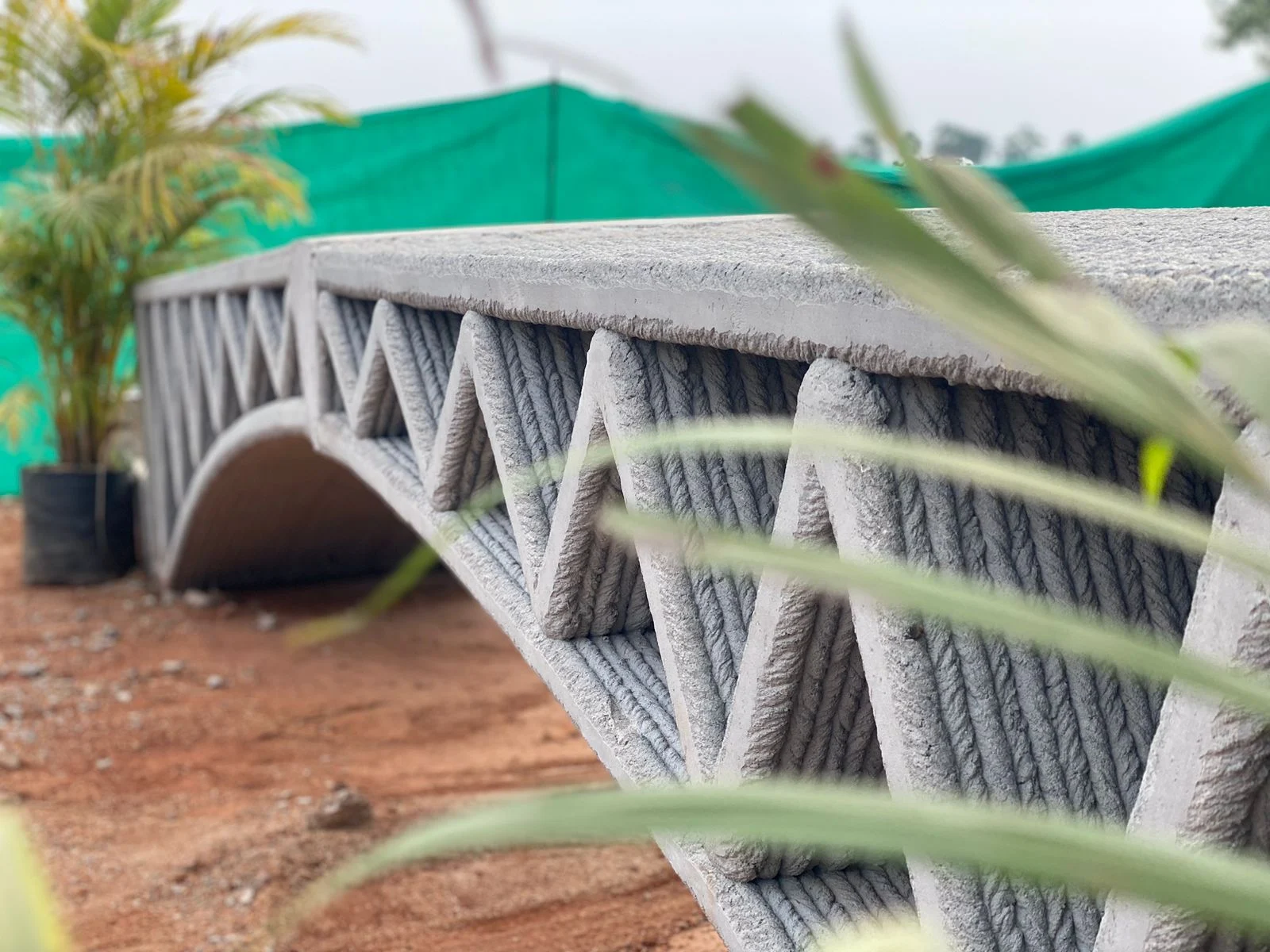
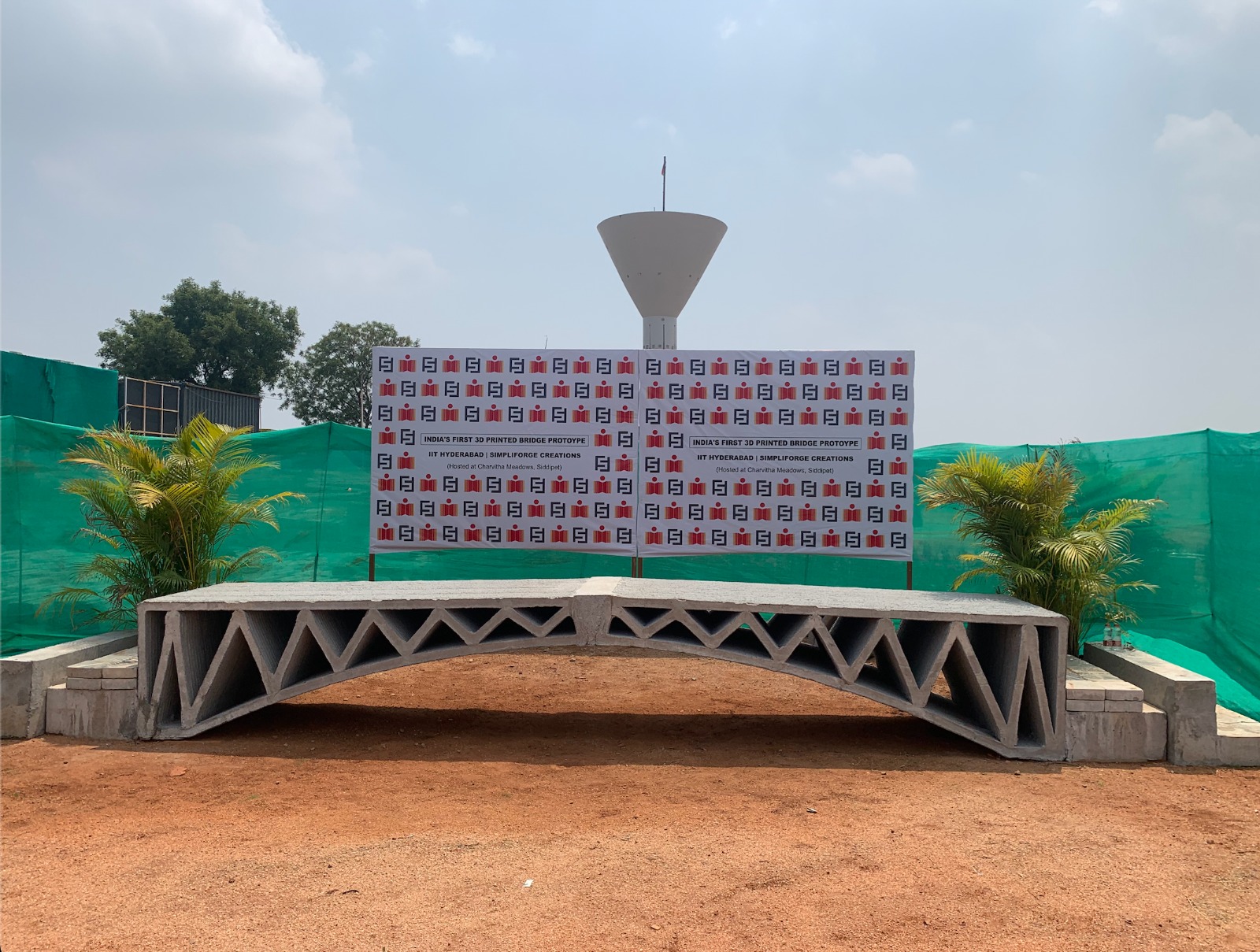
A prototype 3D printed bridge has been developed and printed as a collaboration between IIT Hyderabad and Simpliforge Creations. The concept and design were developed and evaluated by Prof. K.V.L. Subramaniam and his research group, Department of Civil Engineering, IIT Hyderabad.

The bridge was printed by Simpliforge, a startup company specializing in providing 3D concrete printing solutions. Designed as a pedestrian bridge, the prototype bridge is undergoing load testing and evaluation for functional use. The bridge has been designed at IIT Hyderabad broadly following form optimization to minimize the use of concrete and reinforcement.

The concept of the bridge was developed following the concept of ‘Material follows Force’. Simpliforge Creations developed an extrusion and software system specifically for the project to fully exhibit the merits of their 3D printing system.

Using the Industrial robotic arm 3d printer, the bridge was printed off-site in little under 2 hours at Simpliforge Printing facility and assembled on site at Charvitha Meadows, Siddipet.

 
India’s 1st Prototype Bridge Using Indigenous 3D Printing Technology Developed By Simpliforge Creations and IIT Hyderabad

India’s 1st Prototype Bridge Using Indigenous 3D Printing Technology Developed By Simpliforge Creations and IIT Hyderabad

India’s 1st Prototype Bridge Using Indigenous 3D Printing Technology Developed By Simpliforge Creations and IIT Hyderabad

Enlisting the uniqueness of the 3D Printing technology, Prof K.V.L. Subramaniam, IITH, said, “3D concrete printing is an emerging technology has the potential for transforming the construction industry with the promise of rapid, efficient, and free-form construction. Technology application in this space requires advancements in design methodologies, material processing, and delivery systems.”

We are proud to have been a part of this ground-breaking project” said Mr. Hari Krishna Jeedipalli, Managing Director, Simpliforge Creations. “This bridge is a testament to the capabilities of 3D construction printing technology and its potential applications in infrastructural requirements, defense, and disaster scenarios owing to its speed and ease. We hope that this project will inspire others to explore the possibilities of 3D concrete printing in infrastructure and other industries.”

Simpliforge is a holistic additive manufacturing Solutions Company with capabilities for Technology Development, System Integration and Service Solutions. Simpliforge provides complete prototyping and manufacturing solutions for products spanning the FMCG sector to niche domains. For Construction Industry, Simpliforge provides Technology & Materials Development, Equipment manufacturing & Integration and End-to-end construction solutions. Powered by manufacturing domain experts, localized production facilities and international design experts, Simpliforge delivers services in the afore mentioned domains.

First of its Kind 3D Printing Facility Opens at Bengaluru Airport City

State-of-the-Art 3D Printing Facility Opens at Bengaluru Airport City

Peekay Group’s State-of-the-art 3D Printing Facility opens at Bengaluru Airport City

This is the first-of-its-kind facility in India with a focus on engineering, design and collaboration. 

A state-of-the-art 3D printing facility is now operational at the Airport City that is being developed in the BLR Airport premises. The Peekay Group in partnership with Bengaluru Airport City Limited (BACL) inaugurated this first-of-its-kind facility, that focuses on engineering, design and collaboration.

"We are excited to inaugurate this state-of-the-art 3D printing facility at our Airport City and partner with the Peekay Group. This facility will act as a catalyst to help transform our Airport City into a technology hub. From healthcare to sustainable construction and aerospace, 3D printing helps develop a culture of creativity and scope for scaling innovation across industries. This technology will further help consolidate Bengaluru’s strategic position as a knowledge-based economy, and as the Silicon Valley of India. A technology hub coupled with upcoming world-class retail, dining, and entertainment facilities will make our Airport City a truly global destination,” says Rao Munukutla, CEO, BACL.

The facility houses a production centre and an experience zone that will train individuals and students in 3D printing. It will also be an incubation centre for those who want to ideate innovative solutions. One of the aims of this new set-up is to increase awareness about 3D printing applications and to train technology experts who want to upgrade their skills.

“With our vast experience and the trust for quality, delivery and cost which we have built over the last few decades, we are confident that Peekay can contribute immensely towards skill development, design-based thinking, and optimisation of products for customer benefit. Over and above this, we intend to tie up with world-renowned universities to embark on various training programs and symposiums to nurture the enthusiasm and creativity in today’s youth by utilising design-based reasoning as a foundation to synchronise all manufacturing processes,” says K.E. Shanavaz, Joint Managing Director, Peekay Group.

Additive Manufacturing popularly known as 3D Printing is used widely in industries like architecture, construction, automotive, aerospace, military, biotech (human tissue replacement) jewellery designing, education, and other fields. Going forward, the Peekay Group plans to install a 3D metal printing unit to cater to the niche demand from the aerospace industry. “With the various additive manufacturing processes, we are planning to add to this facility, we believe we can create a considerable number of high-quality jobs in the aerospace industry in the future. Furthermore, the social impact will be notable with the adoption of ‘The Go Green’ concept which will spearhead the reduction of our carbon footprint,” adds Shanavaz.

The global 3D printing market size is estimated to reach US$ 62.79 billion by 2028 and is expected to witness a CAGR of 21.0% from 2021 to 2028. McKinsey predicts that Additive Manufacturing could have an economic impact of $550 billion annually by 2025.

Traditional manufacturing impacts the environment negatively, however, 3D printing is an eco-friendly technology that reduces carbon footprint significantly. The giant 3D sand printing machine that is installed at Airport City is the first of its kind globally. It is the most efficient and environmental-friendly machine with no carbon emission-- in line with Bangalore International Airport Limited’s sustainability framework. The Airport City is developed as an international gateway to a Sustainable, Smart, Vibrant city celebrating a culture of innovation. The collaboration between BACL and Peekay is a significant milestone for future endeavours in this space.

“We are actively making our Airport City truly smart. Our smart streetlight system is the first of its kind in an airport ecosystem in India. We have been awarded the ‘Most Innovative Best Practice for Project Digitalisation of Infrastructure Development in Bengaluru Airport City’ by the Confederation of Indian Industries (CII),” added Rao Munukutla.

About Bengaluru Airport City Limited

Bengaluru Airport City Limited (BACL), incorporated on January 21, 2020, is a wholly owned subsidiary of Bangalore International Airport Limited, BIAL (operator of Kempegowda International Airport, Bengaluru).

BACL has been founded to develop the Airport City at BLR Airport as a world-class destination of a truly mixed-use development, consisting of Business Parks, Health District, Retail Dining & Entertainment Village, Concert Arena, Convention & Exhibition Centre, Knowledge Park, Hospitality & Central Park. The Airport City is developed as an international gateway to a Sustainable, Smart, Vibrant city celebrating a culture of innovation.

The Airport City will embrace Innovation 24x7 and will be the test bed for global urban solutions. This futuristic Airport City is being developed applying core principles of Work, Play, Live, Learn & Create which shall leverage airport accessibility for commercial development and economic growth. BACL is committed to establishing the Airport City as one of India’s leading projects in terms of quality and efficiency and setting a benchmark for future commercial developments in India.

About Peekay Group

Peekay Group is a leading industrial group from Kerala. They are one of the emerging players in South India, with manufacturing locations spread across four states. Over a decade, Peekay has expanded and diversified its activities consistently to remain a market leader in all the areas it operates in. Today Peekay Group’s activities cover different verticals ranging from engineering, metal, food, education, and healthcare. The total turnover of the group is over Rs. 1000 crores per annum.

Peekay Steel Castings Pvt. Ltd. is a flagship company of Peekay Group which produces industrial components and exports to over 32 countries today from its various manufacturing locations in India viz Calicut (Kerala), Coimbatore (Tamil Nadu), and Hindupur (Andhra Pradesh). The company caters to several global OEMs such as General Electric, Schlumberger, Komatsu, Wabtec, Baker Hughes, Siemens, Man Turbo, Emerson, and many others in The Fortune Global 500 list. Today, Peekay Steel is rated as one of the five best steel casting manufacturers globally, catering to oil & gas, power, mining, transportation, and other engineering sectors.


Soon A 3D Printing Lab and A Centre for Additive Manufacturing, in Telangana

Soon A 3D Printing Lab and A Centre for Additive Manufacturing, in Telangana

Telangana government is setting up of a lab exclusively for 3D printing, and a National Centre for Additive Manufacturing (NCAM). This was announced by Telangana Industries Minister K.T. Rama Rao while inaugurating the maiden national conference of 3D Printing in Medical Devices & Implants at the Hyderabad International Convention Centre (HICC) here on Friday.

3D printing and Additive Manufacturing are synonyms for the same process. Both terms reference the process of building parts by joining material layer by layer, from a CAD (Computer Aided Design) file, to form a geometric 3D objects with little waste.

While 3D Printing Lab will be set up in the new block of T-Hub, an India's largest incubation facility, the NCAM will be set up wihtin the university campus of Osmania University.

Mr. K.T Rama Rao, said, "T-works that has been using 3D printing for their prototyping efforts. Through all these efforts, Telangana intended to leverage the potential of 3D printing to get a jump start at this hugely promising sector and it is with this intent we established NCAM and conducted this key conference."

Manufacturing using 3D Printing is much faster compared to conventional manufacturing technologies. Many manufacturers use 3D printing or additive manufacturing technologies to produce airplane parts, prosthetic limbs, and even 3D-printed medications.

Advances in medical 3D printing technology have made splendid contributions to fields throughout healthcare. Recent Innovations that applied 3D Printing technologies include creating tissues and organoids, surgical tools, patient-specific surgical models and custom-made prosthetics.

One of the futuristic 3D Tech where India is still in nascent stage is — 3D Bioprinting, an extended application of additive manufacturing, which is now being used globally for tissue engineering and regenerative medicine as it involves the top-down approach of building the complex tissue in a layer by layer fashion. 3D Bioprinting has been used in varied fields from integration of live cells to biosensors and from stem cell fabrication to artificial organ generation.

In India, there are few government and private 3D Printing labs. National Institute of Electronics & Information Technology (NIEIT) has a state of the art 3D printing lab in Aurangabad, Maharashtra.

Last year in April, IIT-Madras incubated startup, Tvasta, built India’s first 3D printed house using concrete as 3d printing material.

Simpliforge Launches India’s 1st State-of-the-Art Robotic Concrete 3D Printer at Charvitha Meadows

India’s 1st State-of-the-Art Robotic Concrete 3D Printer at Charvitha Meadows

Minister for Finance, Health and Family Welfare, Govt. of Telangana, T. Harish Rao, inaugurated the Robotic Construction 3D Printer in Siddipet

Simpliforge Creations, provider of additive manufacturing solutions, today launched their first-of-its-kind, state-of-the-art Robotic Construction 3D Printer. Claimed to be India’s first and South Asia’s largest Robotic Construction 3D printer, the printer was inaugurated by Sri Thaneeru Harish Rao, Hon’ble Minister for Finance, Health and Family Welfare, Govt. of Telangana, at Charvitha Meadows in Siddipet. Present along with the Minister were Mr. Amit Ghule, Founder & COO, Simpliforge Creations, and Mr Dhruv Gandhi, Founder & CEO, Simpliforge Creations who shared the innovative aspects of the machine and spoke about plans for innovative constructions to be handled by the robotic arm printer.

Construction 3D Printing is a technology set to address the unique housing needs of India for remote constructions as well as innovative designs. Simpliforge’s Robotic Arm Construction 3D Printer is not only the largest Construction 3D Printer in India but also the first of this size in South Asia. The 3D Printer can print landscaping elements, furniture, statues, and wall façade, among others, to full-scale civil structures. The printer is capable of working with environment-friendly materials like geopolymers and clay, with Simpliforge launching its proprietary construction material ‘SIMPLICRETE’ as well. The advantages of Additive Manufacturing being minimal wastage, shortened supply chains, optimal resource utilization and decentralized manufacturing are being brought to the construction Industry.

Minister Harish Rao launching the robotic arm

Amit Ghule-COO and Dhruv Gandhi-CEO Simpliforge Creations with team

Speaking on the occasion, Hon’ble Minister Harish Rao said, "Innovation can happen anywhere, it need not be a Tier I Metro city, but even a small town like Siddipet. The 3D printer is one such milestone initiative. It gives me immense joy to be launching this state-of-the-art technology at Charvitha Meadows. I congratulate the entire team of Simpliforge for this remarkable landmark and wish them all the best to continue to contribute to the needs of their industry and position Siddipet as the hub of such advanced technology innovations."

Expressing his delight on the launch of this innovation, Mr. Amit Ghule, Founder & COO, Simpliforge Creations, said, “We are humbled by the presence of our Hon’ble Minister Harish Rao garu for launching our project. The current 3D printer can create structures up to 7m in size, making it the largest Robotic Concrete 3D Printer in India, and in fact, the entire South Asian region. Further, the range of the printer can be increased as required. Robotic Concrete 3D printer provides better design versatility and freedom to the designers whilst also being easy to deploy at project sites than gantry style printers, making it attractive to designers and project developers alike."

"Charvitha Meadows is a one-of-its-kind and new-age gated community with plots and villas in Siddipet, Telangana. It’s a futuristic world designed with a sustainable approach for holistic living. We are proud to collaborate with Simpliforge and excited to embark on this remarkable journey towards innovation", said Hari Krishna J, MD & CEO at Apsuja Infratech (Charvitha Meadows).

Mr Dhruv Gandhi, Founder & CEO, Simpliforge Creations adding more details on the technology said, “At Charvitha Meadows, we are printing a number of artistic elements for its Sanjeevani Park, positioning it to be India’s first park of its kind. The design philosophy of Charvitha Meadows is sustainable living with amalgamation of futuristic technologies. This Robotic 3D printing technology is chosen considering the ecological advantages of the technology and the design freedom it offers. We greatly appreciate the Telangana Government for always being the pioneer in promoting innovative technologies and also working towards setting up a ‘National Centre for Additive Manufacturing’, showing the government’s proactive interest in pushing this technology ahead.”

Amit Ghule (COO) & Dhruv Gandhi (CEO) Simpliforge Creations and Hari Krishna J

Equipped with a large materials library, niche design expertise and sound domain knowledge for technology applications, Simpliforge Creations aims to expand globally with its technology. The company envisions constructing unique civil structures while developing robotic technology to enable smart construction in India and abroad. This technology also gives design freedom to architects and structural engineers to experiment with unique structures for novel construction.

ABOUT SIMPLIFORGE CREATIONS

Simpliforge is a holistic additive manufacturing solutions company with capabilities for Technology Development, System Integration and Service Solutions. Simpliforge provides complete prototyping and manufacturing solutions for products spanning the FMCG sector to niche domains such as prototyping, prosthetics, jewellery, medical devices, etc. For Construction Industry, Simpliforge provides Technology & Materials Development, Equipment manufacturing & Integration and End-to-end construction solutions. Powered by manufacturing domain experts, localized production facilities and international design experts, Simpliforge delivers services in the aforementioned domains.

Pune-based Startup Launches 3D-Printed Masks Coated with Anti-Viral Agents, Claims To Be More Efficient than N-95

Representational

An integration of 3D printing and pharmaceuticals has resulted in a novel type of mask which attacks the virus when viral particles come in contact with it. Developed by Pune-based start-up firm Thincr Technologies India Private Limited, these masks are coated with anti-viral agents known otherwise as virucides

The virucidal mask project is among the earliest projects to have been selected for commercialization, by Technology Development Board (TDB), a statutory body of the Department of Science and Technology, Government of India, as part of the Government’s fight against COVID-19.

The project received financial support from TDB as part of its search for novel solutions to fight COVID-19, in May 2020. Following this, an agreement was signed on 8th July, 2020 for developing the masks. The 2016-incorporated firm claims that these cost-effective masks are more effective in checking the spread of COVID-19, in comparison with ordinary N-95, 3-ply and cloth masks.

Addressing the Need for High Quality More Effective Masks


Thincr Technologies India works in development of Fused Deposition Modeling (FDM) 3D-printers to discover new pharmaceutical formulations and drug-loaded filaments of different drugs. Founder Director Dr. Shitalkumar Zambad explains: “We started thinking of the problem and possible solutions, during the initial days of the pandemic. We sensed that use of face masks will become nearly universal as the most important tool to prevent infection. But we realized that most masks which were then available and within the reach of common people were homemade and of relatively low quality. It is this need for high-quality masks which led us to undertake a project to develop and commercialize cost-effective and more efficient virucidal coated masks, as a better approach to reduce the spread of infection”.

The Development Journey

With this aim, Thincr Technologies began to focus on developing virucidal coating formulations. It was developed with support from Merck Life Sciences located in Nerul, whose research facility was used for the purpose. The coating formulation has been utilized to coat the fabric layer and the 3D printing principle was employed to achieve uniformity of coating. The coated layer can be incorporated as an additional layer in N-95 masks, 3-Ply masks, simple cloth masks, 3D printed or other plastic cover masks, along with reusable filters. These masks thus provide an additional protection beyond the protection achieved by filtration mechanisms.


The coating has been tested and shown to inactivate the SARS-COV-2 virus. The material used for coating on the mask is a Sodium Olefin Sulfonate based mixture. It is a soap forming agent with hydrophilic and hydrophobic properties. In contact with enveloped viruses, it disrupts the outer membrane of the virus. The ingredients used are stable at room temperature and are widely used in cosmetics.

The filters of these reusable masks have also been developed using 3D printing. Further, Dr. Zambad says that the masks have been found to have bacterial filtration efficiency higher than 95%. “In this project, for the first time, we used 3D-printers to make multilayer cloth filters to precisely fit for plastic-moulded or 3D-printed mask covers”.

Thincr Technologies India Pvt. Ltd. has applied for a patent for this product. Commercial scale manufacturing has also started, informs Dr. Zambad. Meanwhile, 6,000 virucidal masks have been distributed by an NGO to four Government Hospitals in Nandurbar, Nashik and Bengaluru, for use by healthcare workers and also to a girls’ school and college in Bengaluru.

IIT Madras Startup Tvasta Builds India's 1st 3D Printed House


IIT-Madras startup Tvasta has built India’s first 3D printed house. It was inaugurated on the IIT Madras campus on Tuesday. The 1BHK house has a built-up area of 600 square feet, has a bedroom, a hall and a kitchen. The entire house was designed using software and printed using concrete 3D printing technology.

Using Tvasta's technology a new house can be built in 5 days against 4-5 months in conventional mode. Further, the cost of the house is reduced by around 30% and life of the building can exceed 50 years.


Earlier in October 2018, the 3D Printing startup has had successfully built India's first 3D Printed Structure -- A 3D room module.


Tvasta also made India’s first Concrete 3D Printer, an avant-garde system capable of generating myriads of architectural and constructional requirements. The startup has been recognized by the Ministry of Housing and Urban Affairs (MoHUA) as a part of the Make In India plan, along with being a part of the CIIE ShelterTech accelerator by IIM Ahmedabad.

Concrete 3D printing is an automated manufacturing method for constructing three dimensional real-life structures (at all realizable scales). The technique utilizes a concrete 3D printer which accepts a computerized three-dimensional design file from the user and fabricates a 3D structure in a layer-by-layer manner by extruding a specialized type of concrete specifically designed for the purpose.

Tvasta is an IIT M Alumni startup found by three founders namely Adithya, Vidyashankar and Parivarthan . Our founders initially established the 3D Printing Club of IIT Madras in Centre For Innovation (CFI) to build innovative products using 3D Printing and to spread awareness about this technology. They graduated in 2016 and Tvasta was born from the passion that the founders possessed towards Design and 3D Printing.

All Images - Tvasta.construction

What is 3D Printing and How Does It Help Healthcare?

Each person’s body is unique — 3D printing really shines in healthcare applications by enabling customized solutions. Whether it is a cast printed from a 3D scan of a child’s forearm, new tissue to repair an injury or entirely new organs manufactured with embedded vascular structure, researchers are creating new applications for 3D printing in healthcare at a lightning pace.

3D Printing, or additive manufacturing, is the process of taking a computer-designed 3D model and manufacturing it into a three-dimensional model by fusing material together. There are many different types of 3D printing, which use a variety of base materials: plastics, metals, even human cells. By building up the material, typically in layers, you can produce highly complex shapes and designs not possible in traditional manufacturing.

Because of the ability to individualize 3D printing in healthcare, surgeons can perform practice sessions on duplicate copies of patient’s organs to improve success rates. On the nanoscale, doctors can perform more precisely targeted drug delivery.


HOW HEALTHCARE IS USING 3D PRINTING GLOBALLY


3D printing in healthcare is a growing subsector. Some uses have reached global application, but many are still in the research phase. 3D printing of prosthetics, for example, has enabled more affordable custom prosthetic manufacturing in lower-income communities around the world.

The COVID-19 pandemic has reemphasized the need for open-source medical supply designs that can be shared globally, and 3D printed locally. Engineers have made personal protective equipment, ventilator supplies and manual tools to help our healthcare providers stay safe and effective as they fight the spread of the disease.

The adoption of 3D printing has a huge scope in India’s healthcare sector. Despite its introduction into the Indian market more than 25 years ago, the adoption rate has been quite slow. However, the market is gradually beginning to realise the advantages of 3D printing and additive manufacturing. Actionable steps are being taken to enhance emerging technologies like blockchain and 3D printing, artificial intelligence (AI) and the Internet of Things (IoT), all of which contribute to the efficiency of health care delivery. With these emerging technologies implemented, both the cost and way we treat certain ailments may begin to change.

THE FUTURE OF 3D PRINTING IN HEALTHCARE

Some of the research mentioned above can transform the way we treat organ failure. The idea of using a person’s own cells to 3D print new organs to reduce rejection rates like those seen in organ transplants, is intriguing.

As a new technology, improving consistency and reliability in 3D printing is hugely important as it moves into life-sustaining applications. We call a misplaced blob of plastic a print failure, but that would not be acceptable on the cellular level. Ideally, to improve the consistency and in-situ quality control of the 3D printing processes, especially for custom applications would enable greater expansion into medical fields.


Signify Launches India’s First Tailor-Made 3D Printed Luminaires for a Circular Economy

  • Company sets up 3D printing facility in Vadodara and a Design lab in Noida
  • On-demand tailor-your-luminaire online service launched for consumers
  • 47% lower carbon footprint than a traditionally built metal luminaire
  • Innovative designs with infinite choice in colours, textures and shapes

Signify (Euronext: LIGHT), the world leader in lighting, today launched India’s first tailor-made 3D printed luminaires. This highly flexible and more sustainable form of manufacturing, using a 100% recyclable polycarbonate material, enables the company to produce luminaires that have bespoke designs or are tailored to customer’s exact needs and recycled at the end of their life, supporting a circular economy.
 
Currently, Signify is the only major lighting manufacturer to be producing 3D-printed lighting products on an industrial and commercial scale in India. In alignment with the Indian government’s agenda of ‘Make in India’ and ‘Atmanirbhar Bharat’, the company has set up a 3D printing manufacturing facility at its existing lighting factory in Vadodara, in addition to a design lab at its R&D center in Noida where interior designers, architects and lighting designers can experience the technology first-hand and see their luminaire being printed in front of their eyes. They can also work together with Signify’s design experts to create a truly bespoke design that meets their specific requirements.
 
Signify’s investment in 3D printing further illustrates the company’s commitment to better serving its customers while reducing their, and its own, carbon footprint and to responsible consumption and production (SDG12) with products that can be reprinted, refurbished, reused or recycled. It is a key element of Signify’s commitment to doubling its circular revenues to 32% in 2025, as part of the Brighter Lives, Better World 2025 program launched in September 2020. 3D Printing is a Triple Bottom Line Technology – it's good for the climate, consumers and companies.
 
Consumers can design and order their 3D printed luminaires online on the company’s website or visit their nearest Philips Smart Light Hub to place their order. The combinations of materials and textures offered by 3D printing is countless and only limited by one’s imagination. Customers can choose their colour, finish and texture for a truly unique and bespoke design. Professional customers can design their luminaire on https://www.tailored.lighting.philips.com/en/in/  and get in touch with the sales team to place their order.
 
A 3D printed luminaire is also good for our planet as it has a 47% lower carbon footprint than a traditionally manufactured metal luminaire, excluding electronics and optics. The final product is also two-thirds in weight compared to a conventional luminaire, which ultimately translates to a 35% carbon emission reduction during shipping. Nearly every component of these luminaires may be reused or recycled at end of life and repurposed into new designs, thereby supporting the concept of a circular economy. 
 
Switching to 3D printing of luminaires can also help companies meet their sustainability goals and allow them the flexibility to co-create their lighting products with endless options for customization. Moreover, customers can also refresh their lighting design by returning their luminaires to have them recycled and reprinted in newer designs, enabling them to stay current and topical. As these luminaires are printed on-demand and as per specific requirements of the customer, there are no additional costs incurred for any adjustments or ceiling modifications during installation.
 
Commenting on the launch, Sumit Joshi, Vice Chairman and Managing Director, Signify Innovations India Limited said, “We are proud to be the first lighting manufacturer to produce 3D printed luminaires in India on an industrial scale in alignment with the Indian government’s agenda of a self-reliant India. It also reinforces our position at the forefront of lighting and sustainable innovation. Printing luminaires provides a more flexible, fast and environmentally friendly way to manufacture as we can create new, or customize existing designs, that fulfill customer needs quickly without huge investments and long development cycles. Customers can have their ideas brought to life in a matter of days rather than months and printing requires less energy.”
 
Signify has also set up 3D printing facilities in other parts of the world including United States, Belgium, the Netherlands and Indonesia. The company has already secured several customers like Marks and Spencer (M&S), Albert Heijn, SAS, Total and Praxis for these products.

For 3D Printing, Polymaker and Covestro Launches Versatile Materials

Polymaker, a market leader in advanced 3D printing products, announced the launch of three new polycarbonate-based 3D printing materials each with unique properties commonly used in various industries. Polymaker has partnered with Covestro to bring these new materials to market, thus enabling the access to materials well known to industry professionals and optimised for 3D printing.The three new materials consist of:

Polymaker™ PC-ABS – a blend of already commonly used 3D printing materials, polycarbonate and ABS. The advantages of this blend are high impact and heat resistantancy and easy processing. The polycarbonate boosts the heat resistance and toughness of the material while the ABS contributes to the good processing properties. This PC-ABS is also specialized for surface finishings, i.e. by electroplating and metallization, providing a good approach for post processing.

Polymaker™ PC-ABS uses Covestro’s Bayblend family as its base material which is a commonly used plastic in the automotive and information technology industry today. Polymaker™ PC-PBT – this polymer blend combines the good chemical resistance of PBT with the strength and toughness of polycarbonate. Polymaker™ PC-PBT performs very well under extreme circumstances whether in contact with hydrocarbon based chemicals or operating at subzero temperatures. The product maintains good toughness and its natural ductile fracture behavior at low temperatures.

Polymaker™ PC-PBT is created from Covestro’s Makroblend family which is widely used in various industries. Compared to PC resins and PC-ABS compounds, PC-PBT has better resistance to chemicals, which enables printed applications where resistance to intermittent contact with fuels, oils, lubricants, cleaners is necessary.

PolyMax™ PC-FR, a creation from Covestro’s Makrolon family, where the FR stands for flame retardant – the main feature of this polycarbonate based compound. This base material achieves V0 performance in the UL94 flame retardancy test and benefits applications where respective material approval is required. This allows PolyMax™ PC-FR to be applied for battery housings, motor mounts in aerospace and other industries. Within the automotive and electrical and electronics industry, many professionals are well accustomed with such FR materials.

Polymaker have introduced their nano reinforcement technology that is featured in all PolyMax™ materials. This boosts the fracture toughness of the FR material and produces a flame-retardant filament that can still perform in demanding applications. PolyMax™ PC-FR uses Covestro’s Makrolon showing a good balance between mechanical performance and safety, which has already been applied in electronic motorbikes, aerospace spare parts, and automotive production.

About Covestro:

With 2018 sales of EUR 14.6 billion, Covestro is among the world’s largest polymer companies. Business activities are focused on the manufacture of high-tech polymer materials and the development of innovative solutions for products used in many areas of daily life. The main segments served are the automotive, construction, wood processing and furniture, and electrical and electronics industries. Other sectors include sports and leisure, cosmetics, health and the chemical industry itself. Covestro has 30 production sites worldwide and employs approximately 16,800 people (calculated as full-time equivalents) at the end of 2018.

About Polymaker:
Polymaker is a company that produces advanced 3D printing materials specifically engineered for a wide range of applications across many industries. At the heart of Polymaker is a large research and development laboratory which drives the company forward through constant innovation and testing. All Polymaker materials are formulated and optimized for 3D printing while maintaining the unique properties inherent to the respective base polymer.

7 Technology Trends to Impact Business In 2019


With the increasing dependency on technology, hanging on to old methods of yesterday’s internet, even as an idea, seems obsolete. The current world of business welcomes you with wide open arms as long as your business is driven by good technology.

Interested to learn top trending technologies like AI & Blockchain?
Then Intellipaat's Artificial Intelligence Course and Blockchain Training Course is for you.

As for small businesses, the need for an innovative approach has become more of a mandate. Due to which, the start-up industry has witnessed an uprise in technology-driven ventures. The existing small businesses will have to move on to the latest tech breakthroughs. If they don’t catch up with the latest trends, they would soon find themselves fading away faster than the unportable telecom industry.

With augmented reality, automation, the internet of things and machine learning ruling 2018, the year 2019 seems all set to witness a technological revolution. There are predictions that 2019 will transform the consumption of tech-related products. Here are a few tech trends that are expected to lead the way for businesses in 2019:

1. AI v/s AI

Artificial Intelligence is already a hit in 2018. It turned out to capture nearly 40% of businesses through Automation. By integrating Artificial Intelligence solutions to execute specific tasks, businesses have gained a competitive edge and now provide a higher-quality service experience for consumers. The existing trends indicate the exceeding integration of chatbots into businesses. So much so that chatbots are now developed into everyday products for consumers. Amazon’s Alexa and Amy (the new virtual assistant from X.ai) are two of such examples.

Artificial Intelligence is also gaining popularity as chatbots across digital platforms are being integrated for on-the-go assistance to consumers. The year 2019 will see Artificial Intelligence taking off to the future with more intelligent integrations. As of now, Artificial Intelligence is being used to duel against Artificial Intelligence itself. That’s right. The best way to make Artificial Intelligence smarter is by putting it against itself. Today, Artificial Intelligence creates images of objects and the same technology is used to recognise the reality of it.

2. 3D Metal Printing

The last couple of years has been dedicated to Plastic 3D printing, which has now been taken from a prosumer to a consumer level. Now, it’s time for 3D metal printing to be the next big wave in this industry. The giants in business are already making it big in the 3D Metal Printing game. For one, GE is already printing metal fuel nozzles for its Leap Jet Engines. Sports and fitness market leader Nike is printing metal cleats. Fear not, small businesses will also benefit more than market giants with 3D Metal Printing. With the small accommodating size of a 3D Metal Printer, small businesses can venture into the jewellery or toys industry. This will change the competitive landscape within SMB’s across all industries. Companies entering the market with this technological breakthrough will be on solid ground to take on the next decade.

3. Internet of Things for Everything

Rumour has it that the internet of things will be a choice for every business on earth in no time. The IoT impact is more immediate than that any other consumer-built technology. While Virtual Reality (VR) and Artificial Intelligence (AI) provide in-depth knowledge and perspective, their technologies are at least one step behind from what someone is actually experiencing in the real world.

That is what the IoT offers. Within the country, small businesses have been using IoT to sell smart homes and workplaces. While across the world, IoT's impact on retail companies is especially significant. This year, Amazon opened a number of Amazon Go stores – ones that allow consumers to enter these stores with a scan through their smartphone.

Once they enter, in-store cameras and sensors track their purchases. When the customers leave, the system charges their account for the total amount, dispersing the role of a cashier. Other competitors have awakened to this move by Amazon and have started integrated IoT to their customer experiences.

For instance, Target is using customer-sensing overhead lights to guide app users around the store and help them find specific products they're looking for – all through an app. Other retailers aren’t far behind; they are deploying IoT solutions for an immediate competitive advantage. Retail is just the start; IoT is ready to disrupt other industries such as finance, healthcare and automotive. IoT will soon become the standard in nearly every industry. Small businesses can only take advantage of the situation and be the ones to get it to market as soon as possible.

4. Data-Driven Healthcare

For years, doctors and hospitals around the world have collected information on various diseases, their diagnoses and treatments for research. Most of this information is stored within individual databases. Today, healthcare has adopted big data analytics to harness the unique ability to link patient information from vast databases in a way where the privacy of the patient is secure. Soon, analytics will move from reporting to prescriptive practices. It will create the possibility for truly personalized healthcare by allowing providers to impact bigger health determinants such as genetics and behaviours.

5. Autonomous Driving

The year 2018 has seen automakers join Google, Uber, and a growing number of startups to harness the technological advances to power next-generation of autonomous vehicles. Soon autonomous driving will overtake the driving of conventional vehicles within the next decade. The arrival of self-driving technology has already begun changing the design possibilities for all types of vehicles. There have been talks on the creation of new vehicle categories that don't yet exist. It will also change the dynamics of the economy in transportation. The mode of transit will also improve with faster, self-driven buses, vans and more in-between created vehicles. Small businesses across the world are already designing futuristic cars that have built-in safety features for autonomous driving. In India, we are waiting for innovators and disrupters to take the plunge and drive the Autonomous Driving industry home.

6. Video Content & Growing Digitalization


Internet video will be the leading driver of global Internet traffic in 2019, completely blowing things like data, file sharing, and gaming out of the water. There is a claim of video content taking over more than 80 per cent of all the web traffic by 2019. It only makes senses for businesses to adopt this as part of their strategy to map themselves in the minds of consumers.

Research analysts also state 90% of customers making purchase decisions come from engaging product videos. With the exponentially growing rate of digitalization, customers have lesser time to invest and more retention of video content. Around 64% of customers are likely to buy a product online immediately after watching a video about it. Small businesses must start integrating video content into their business strategy and create a narrative. It is quickly proving to be one of the most effective ways to create a brand and weave a story that strategically places one’s business as a top-of-mind-product for customers.

7. Blockchain & Remittances

For those who don’t know what Blockchain technology is all about – it describes as a technology which enables a peer-to-peer network of interconnected devices to store data rather than rely on central computers and defined locations (Read more). It is also a distributed ledger system that lets transactions happen within less or no time through cryptographically secured blocks of data. From offering upgraded security and authentication in agreements and supply chains to building real peer-to-peer business networks across retail, energy, and more, Blockchain has a great influence on the way business is being channelled today.

SMBs have been adopting blockchain development rapidly. It helps SMBs with the capability to transact and authenticate large-scale transactions quickly. It is one of the trends that showed immense growth in 2018 and will continue to do so. As a matter of fact, Blockchain is the technology behind cryptocurrencies across the globe. One other such cryptocurrency that is growing rapidly is Ripple. It doesn’t use Blockchain, it rather uses hash tree aka Merkle tree to allow instant remittances across borders without added marginal fees. One such Ripple based digital payment service provider is InstaReM. It allows small and medium businesses to make international money transfers in 55+ countries and does not add any added FX margins to it. And the best part is that there are no hidden charges as well. The only charge is a nominal fee to cover the cost of processing your transaction. InstaReM ensures complete transparency and provides one with an accurate breakup of the remittance.

This is a great time for small businesses to take note of the expansion possibilities and to plan their path ahead. There are too many good choices and one hard decision to make. But technology is going to be a compulsion in whatever they decide to venture into. The year 2019 is going to be far more promising in technology than we all imagine it to be.


Germany's DMG Mori Acquires 30% Stake in Indian 3D Printing Startup 'INTECH' Famous for Making Jet Engine

DMG MORI, one of Germany's largest manufacturers of cutting machine tools and a manufacturer of CNC-controlled Lathes and Milling machines, has announced today that that it is boosting its already far-reaching global presence in metal additive manufacturing (AM) by taking a 30 percent stake in the Indian startup, INTECH, a developer of software for AM, machine learning and artificial intelligence.

INTECH was in news earlier last year for developing India's first indigenously developed jet engines. Developed by Intech’s R&D arm, ‘Poeir Jets’, the MJE20 engine starts small, powering unmanned aerial vehicles (UAVs) and remote-controlled aircraft.

Founded in 2013, INTECH is considered a pioneer in metal 3D printing in India. The firm already supplies software solutions for DMG MORI's LASERTEC SLM (selective laser melting) machines and also for other products as well as customers using the powder bed technology. Its new OPTOMET software, for example, automatically calculates optimal process parameters, simplifying programming and resulting in markedly improved surface quality as well as reproducible component properties.

Employing more than 60 software specialists and technology experts, INTECH was founded in 2012. It supplies not only innovative software solutions but also additively manufactured prototypes into the aerospace, medical, automotive and toolmaking sectors, as well as mechanical engineering. The company's staff has more than 30 years' metallurgical experience gained in the foundry business and over 25 years of machining and quality control expertise.

Christian Thönes, Chairman of the Executive Board of DMG MORI AG commented, "With INTECH we are strengthening our global footprint in India and accelerating our innovation in additive manufacturing. Right first time is our motto, which means producing the first good part quickly. We are actively pushing ahead with integrated solutions along the whole generative manufacturing process chain."

Mr Sridhar Balaram, CEO of INTECH added, “Leveraging synergies is key and our collaboration with DMG MORI is a perfect fit of hardware and software. OPTOMET can also be applied to other key technologies within additive manufacturing, such as directed energy deposition and binder jetting. We believe this software is a game-changer for the whole of the additive manufacturing market.”

IIT Madras Almuni Startup Constructs India's 1st 3D Printed Structure

Bangalore-based Tvasta Manufacturing Solutions (Tvasta), an emerging 3D Printing startup founded by Indian Institute of Technology, Madras (IIT-Madras) alumni, has developed India's first 3D Printing Construction Technology and have successfully built India's first 3D Printed Structure.

Tvasta, along with Civil Engineering Department, IIT Madras has constructed India’s first 3D room module in IIT Madras campus and this prototype structure will serve as a base foundational model for accelerating R&D and testing in the startup's ambitious plan of making affordable sanitation and affordable housing a reality in India.

India’s first 3D room module developed by Tvasta

Additionally, the startup and IIT Madras' Civil Engineering Department have together established a one-of-a-kind 3D printing laboratory - the IIT Madras Printability Lab, in order to formulate technological solutions for construction sector and take its indigenously-developed 3D Printing construction technology to the mass market.

Professor Manu Santhanam, Department of Civil Engineering, IIT Madras, who has been working with the Tvasta team, said, "3D printing of concrete gives a new dimension to construction. This technology can best meet the complex demands of modern architecture with concrete. The use of a combination of binders and optimally proportioned and sized aggregates, along with suitable chemical additives, the concrete mixture is fine tuned to achieve the rheological characteristics that make it possible for extrusion of the material and shape retention after placement."

Founded in 2016, by IIT-Madras alumni Adithya VS, Parivarthan Reddy, Santhosh Kumar and Vidyashankar C, Tvasta is aiming to completely automate construction, including placement of reinforcements and finishing, by re-envisioning the construction process.

Talking about their plans, Mr Adithya VS, Co-founder of Tvasta said, "Tvasta will be building India's first 3D printed house within the next one year. The impact of 3D printing in construction will be primarily focussed towards the 'Housing for All' scheme under the Pradhan Mantri Awas Yojana and Construction of Toilets for the 'Swachh Bharat Abhiyan'. Tvasta is working withmultiple stakeholders in the Construction Industry to make 3D Printing technology suitable and viable for the Indian construction industry."

The founding team of Tvasta see a lot of potential in the high-end Industrial 3D Printing market and also see a lot of potential for pushing the boundaries of the possibilities using 3D Printing technology. The startup also have proprietary 3D printers that are entirely designed and manufactured in-house.

Besides application of 3D Printing in construction industry, the startup is also working on 3D Bio-Printers to design, print and control living cell structures such as plant cells and hydrogels. The startup infact is working on designing, developing and manufacturing 3D Printing tech for various domains including manufacturing and aerospace industry.

IIT Madras is collaborating with several government agencies and industry to disseminate knowledge and establish standards, policies and processes to bring these technologies to the field.

Source - NDTV

Image Credits - Twitter.com/Tvasta_3DP

This Mumbai Startup Empower Enthusiasts To Turn Ideas Into Successful 3D Products

3-D printers have been around for a while now, but unfortunately the technology has been largely concentrated in the hands of big companies, mainly because of the affordability factor. Seeing this and the big potential that 3-D technology holds, Monik Shah started 3Dwalla in early 2015 with a tagline- "Prints Beyond Paper".

The Mumbai-based startup offers printing and prototyping services that help accelerate innovation and product development. With these services, the startup empowers manufacturers, designers, students and hobbyists to turn powerful ideas into successful 3-Dimensional products.

3Dwalla was founded in 2015 independently by Monik Shah, who is a post graduate with Masters in Commerce-Management and Bachelors in Accounting & Finance from Lala Lajpatrai College, Mumbai.

3Dwalla isn't the first startup working towards making 3-D printing more affordable and available to common man. In fact, the startup is facing stiff competition from companies like PrintOmake, Trikolaa Tech, Extrudify Technologies etc. to get a large share of the Indian 3-D printer market. But, 3Dwalla thinks their invaluable in-house team of talented 3D designers with vast experience in modelling and prototyping sets them apart from the rest. For instance, the 3Dwalla team walks each of their clients through the entire process of 3D Printing. When a client come with an idea, the team conducts researches, provides inputs and turns their powerful ideas into successful products. This is not the case with all 3D print houses, where clients are asked to directly submit files as 2D or 3D designs.

[caption id="attachment_117447" align="aligncenter" width="700"]Monik Shah Monik Shah -- Founder, 3Dwalla [/caption]

Though it has been just two years that they have opened their shop, but the startup has been receiving an overwhelming feedback from the market as it had successfully completed over 400 projects in such a short duration of time. In fact, in the very second month of its inception, the startup was involved with the making of the Air Intake Manifold (HRT-02) for a car. This is when they decided to bring their 3D printing and manufacturing services to the forefront, as well as getting their brand out into a national arena.

The startup which ensures its customers a strong collaboration from concept to creation, hasn't raised any capital as of yet. But, the startup does aspires to reach out to a larger audience, targeting more to the youth in order to lend them a hand to accelerate innovation and product development. The startup strongly believes that young creative talent can use their 3D printers and services to create exact functional prototypes of their ideas. In fact, the startup recently collaborated with a Fashion Designing student to print wearable garments. According to 3Dwalla, fashion enthusiasts can design their own textiles and manufacture their own clothes, as the world is now warming up to fashion innovation in 3D printing to create 3D couture.

With expertise in Fused Deposition Modeling (FDM) technology, Colour Jet Printing (CJP), Digital Light Processing (DLP), Stereo Lithography (SLA), Selective Laser Sintering (SLS), 3Dwalla believes that 3-D printers are capable of creating incredibly useful and clever objects that users may not have even considered possible in the past.

Market Reports

Market Report & Surveys
IndianWeb2.com © all rights reserved