Showing posts with label Aditya-L1. Show all posts

Aditya-L1: Solar Wind Ion Spectrometer (SWIS) in the ASPEX Payload Is Now Operational

Aditya-L1: Solar Wind Ion Spectrometer (SWIS) in the ASPEX Payload Is Now Operational

The Aditya Solar wind Particle Experiment (ASPEX) payload onboard India's Aditya-L1 satellite has commenced its operations and is performing normally.

Aditya L1 is carrying 7 different payloads to have a detailed study of the Sun. ASPEX comprises two cutting-edge instruments – the Solar wind Ion Spectrometer (SWIS) and STEPS (SupraThermal and Energetic Particle Spectrometer). The STEPS instrument was operational on September 10, 2023. The SWIS instrument was activated on November 2, 2023, and has exhibited optimal performance.

SWIS, utilizing two sensor units with a remarkable 360° field of view each, operates in planes perpendicular to one another. The instrument has successfully measured solar wind ions, primarily protons and alpha particles. A sample energy histogram acquired from one of the sensors over two days in November 2023 illustrates variations in proton (H+) and alpha particle (doubly ionized helium, He2+) counts. These variations were recorded with nominal integration time, providing a comprehensive snapshot of solar wind behaviour.

The directional capabilities of SWIS enable precise measurements of solar wind protons and alphas, contributing significantly to addressing longstanding questions about solar wind properties, underlying processes, and their impact on Earth.


The change in the proton and alpha particle number ratio, as observed by SWIS, holds the potential to provide indirect information about the arrival of Coronal Mass Ejections (CMEs) at the Sun-Earth Lagrange Point L1. Enhanced alpha-to-proton ratio is often regarded as one of the sensitive markers of the passage of interplanetary coronal mass ejections (ICMEs) at the L1 and hence considered crucial for space weather studies.

As researchers delve deeper into the collected data, the international scientific community eagerly awaits the wealth of knowledge that Aditya-L1's ASPEX is set to unveil about the enigmatic solar wind and its implications for our planet.
ISRO Successfully Launches Solar Mission, Aditya-L1 from Satish Dhawan Space Centre, Sriharikota

ISRO Successfully Launches Solar Mission, AdityaL1 from Satish Dhawan Space Centre, Sriharikota

India’s Polar Satellite Launch Vehicle-C57 (PSLV-C57) lifted off with the country’s Aditya-L1 from Satish Dhawan Space Centre in Sriharikota, Andhra Pradesh, on Saturday morning.

Aditya L1 is carrying seven different payloads to have a detailed study of the Sun.

The vehicle has placed the satellite precisely into its intended orbit, and with this, India’s first solar observatory has begun its journey to the destination of Sun-Earth L1 point.
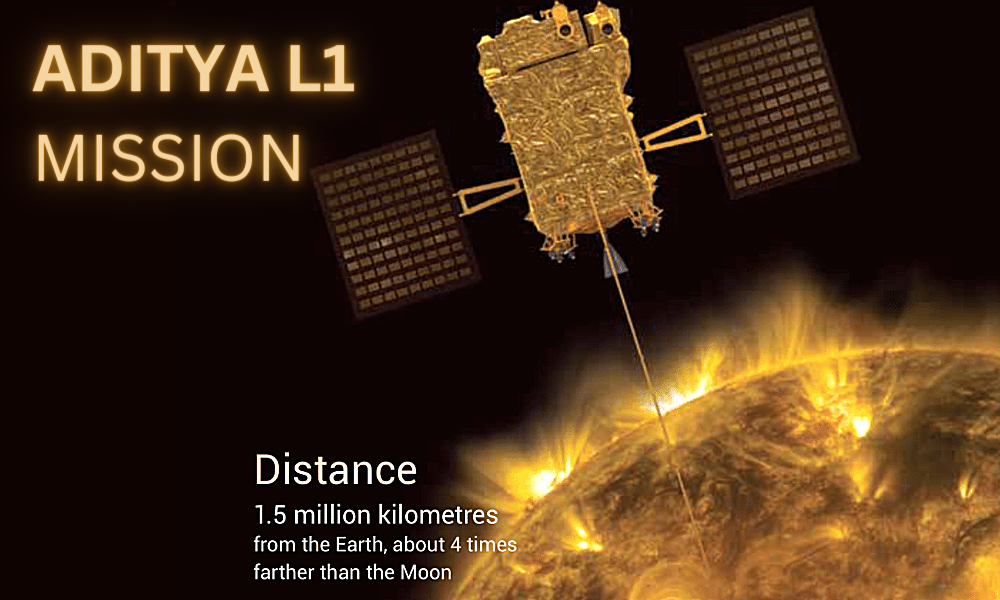
Aditya-L1 will stay approximately 1.5 million km away from Earth, directed towards the Sun, which is about 1% of the Earth-Sun distance. The spacecraft will take an approach similar to Chandrayaan-3 to reach its designated spot. It will stay in earth-bound orbit for 16 days as it undergoes five manoeuvres to gain the speed needed for the L1 jump. The total journey time for ISRO's Aditya-L1 solar mission from Sriharikota (Earth) to L1 is estimated to be about four months.

The Sun is a giant sphere of gas and Aditya-L1 would study the outer atmosphere of the Sun.

Aditya-L1 will neither land on the Sun nor approach the Sun any closer.

Aditya-L1 Mission – DST Institutes IIA, ARIES, CREST and IUCAA Key Drivers in Designing Payloads To Automated Algo for Detecting CMEs

Aditya-L1 Mission – DST Institutes IIA, ARIES, CREST and IUCAA Key Drivers in Designing Payloads To Automated Algo for Detecting CMEs

Aditya-L1, India's first observatory to study Sun, seeded in IIA - ISRO discussions to observe solar corona closely
  • Visible Emission Line Coronagraph (VELC), the primary payload developed by IIA
  • IIA & ARIES designed the first automated algorithm to detect CMEs on board Aditya-L1 using the VELC instrument
  • Aditya-L1 support cell established at ARIES to act as community service centre for analyzing science data
India’s Aditya-L1, a space observatory with 7 payloads heading for a vantage point to study the Sun has started countdown for its journey. It had its beginnings in preliminary/initial discussions between the Indian Institute of Astrophysics (IIA) and Indian Space Research Organisation (ISRO) about possible observations of the solar corona using indigenous space based telescopes.
Aditya-L1

Visible Emission Line Coronagraph (VELC)

VELC Engineering Team
VELC Engineering Team Members in front of the truck which had the VELC all packed and ready to go to ISRO

IIA, an autonomous institute of the Department of Science and Technology (DST), had initially proposed a ‘suitable coronagraph’ payload to be mounted on a small satellite offered by ISRO. This ‘suitable coronagraph’ later graduated to the Visible Emission Line Coronagraph (VELC) and still prevails as the primary payload, even as India’s Solar study ambitions expanded, making it a national initiative with multi-institutional collaboration.

The VELC will image the Sun's atmosphere, the corona, closer to the Sun than ever before, at high resolution and time cadence. The payload has 40 different optical elements of high precision and will be kept at a temperature of 22 degrees celsius in space.

Led by IIA, the VELC was designed, assembled, characterised, tested and integrated at Centre for Research and Education in Science and Technology (CREST) campus in Hosakote and delivered in close collaboration with ISRO. A Clean Room of international standard (India's first large-scale “Class 10” Clean Room) was constructed for the purpose inside its MGK Menon Laboratory. ISRO made the mirrors and detectors and provided them to IIA, while IIA delivered the completed VELC to ISRO on 26 Jan 2023.

Faculty, students, postdocs in IIA who work on solar astrophysics


Since VELC observes the Sun closest to its surface, many other Aditya-L1 payloads also need its data about new coronal mass ejections and other eruptions. The VELC Payload Operations Centre (POC) set up in IIA campus, will receive raw data from ISRO Indian Space Science Data Centre (ISSDC) and process them further to make it suitable for scientific analysis.

The processed data will be sent back to ISSDC for dissemination. The scientific team at IIA will use the Aditya-L1 data from its many payloads in conjunction with field station observations on the ground to gain a deeper understanding of the Sun-Earth links and, more crucially, the space-weather impact.

Kodaikanal Solar Observatory and Gauribidanur Radio Observatory of IIA will play a key role in this.

Automated Algorithm To Detect Coronal Mass Ejections (CMEs)

IIA and Aryabhatta Research Institute of Observational Sciences (ARIES), an another institute of DST, designed an automated algorithm to detect CMEs (Coronal Mass Ejections) on board Aditya-L1 using the VELC instrument. This algorithm will be the first of its kind to track the huge bubbles of gas threaded with magnetic field lines that are ejected from the Sun, disrupting space weather and causing geomagnetic storms, satellite failures, and power outages.

Solar physics group at ARIES

This algorithm has been hard-coded by ISRO and will be used to detect CMEs automatically on board Aditya-L1, making it one of the first onboard intelligence algorithms for this purpose as no similar thing has been attempted in previous NASA or ESA missions studying the Sun.

Aditya-L1 Support Cell (AL1SC)

ISRO has also collaborated with ARIES to establish the Aditya-L1 Support Cell at ARIES. The Aditya-L1 Support Cell (AL1SC) acts as a community service centre for the guest observers in preparing science observing proposals and analyzing science data.

This support cell will provide additional tools and train users about solar physics and provide help to understand, download and analyse the data from ISSDC/ISRO. AL1SC is conducting workshops in different parts of the country to familiarise students with the basic processes happening on the Sun, current open problems, the Aditya-L1 mission and observational data analysis.

X-ray Spectrometers and In-Situ Instruments

Aditya-L1 carries an ultraviolet imager, two X-ray spectrometers, and four in-situ instruments to measure plasma parameters. These are made by various centres of ISRO and the Inter-University Centre for Astronomy and Astrophysics (IUCAA) with contributions from many other institutions.

ISRO Launching Aditya-L1, India’s 1st Solar Mission This Week

ISRO Launching Aditya-L1, India’s 1st Solar Mission This Week

The first Indian space-based observatory-class solar mission to unlock the mysteries of the Sun

ISRO today announced that Aditya-L1, India's first space-based observatory to study the Sun, will be launched on this week on Saturday (September 2) at 11.50 AM from Andhra Pradesh's Satish Dhawan Space Centre, Sriharikota.

Late last week, ISRO Chairman S. Somnath, told reporters that the satellite had been integrated with the PSLV launch vehicle at Sriharikota. The spacecraft would take 125 days to reach the Lagrangian Point L1.

Initially, Aditya-L1 was scheduled to launch on August 26, but as per the latest update, the mission will now be launched on 2nd September.

The Aditya-L1 mission, aimed at studying the Sun from an orbit around the L1, would be launched by PSLV-C57 rocket and will be carrying 7 payloads to observe the photosphere, chromosphere and the outermost layers of the Sun, the corona, in different wavebands. Aditya-L1 is a fully indigenous effort with the participation of national institutions.

ISRO Launching Aditya-L1, India’s 1st Solar Mission This Week

The spacecraft is planned to be placed in a halo orbit around the Lagrangian point 1 (L1) of the Sun-Earth system, which is about 1.5 million km from the Earth.

The Aditya L1 spacecraft will be equipped with a Visible Emission Line Coronagraph (VELC) which will be used for imaging and spectroscopy of the Sun to better understand the science powering the star.

Uniqueness of Aditya-L1

  • First-time spatially resolved solar disk in the near UV band
  • CME dynamics close to the solar disk (~from 1.05 solar radius) thereby providing information in the acceleration regime of CME, which is not observed consistently
  • Onboard intelligence to detect CMEs and solar flares for optimised observations and data volume
  • Directional and energy anisotropy of solar wind using multi-direction observations
ISRO Launching Aditya-L1, India’s 1st Solar Mission This Week

ISRO Prepares for Its Next Launch 'Aditya-L1', India's 1st Space-based Mission To Study the Sun

After the sucessful launch of the Chandrayaan-3, the Indian Space agency, Indian Space Research Organisation (ISRO), is now preparing for its next launch — Aditya-L1— the first space-based Indian observatory to study the Sun.

ISRO Prepares for Its Next Launch 'Aditya-L1', India's 1st Space-based Solar Mission

The mission is scheduled to launch on 26th of this month or early next month, aboard a PSLV-XL launch vehicle.

ISRO has shared the first images of the Aditya-L1 satellite. 


On Monday ISRO announced that the spacecraft was assembled and integrated at the UR Rao Satellite Centre (URSC) in Bengaluru and has arrived at Satish Dhawan Space Centre in Sriharikota in Andhra Pradesh.

According to ISRO, the satellite shall be placed in a halo orbit around the Lagrange point 1 (L1) of the Sun-Earth system, which is about 1.5 million km from the Earth. A satellite placed in the halo orbit around the L1 point has the major advantage of continuously viewing the Sun without any occultation/eclipses. This will provide a greater advantage of observing the solar activities, and its effect on space weather in real time.

The Aditya-L1 mission will take around 109 Earth days after launch, to reach the halo orbit around the L1 point.

The mission will obtain near simultaneous images of the different layers of the Sun's atmosphere, which reveal the ways in which the energy may be channeled and transferred from one layer to another. Thus the Aditya-L1 mission will enable a comprehensive understanding of the dynamical processes of the Sun and address some of the outstanding problems in solar physics and heliophysics.

Market Reports

Market Report & Surveys
IndianWeb2.com © all rights reserved