Showing posts with label Astronauts. Show all posts

India Expands Astronaut Pool to Include Women and Civilians in Bold Space Push

India Expands Astronaut Pool to Include Women and Civilians in Bold Space Push

In a landmark move to democratize space exploration, India will now include women and professionals from diverse backgrounds in its astronaut pool, breaking away from its earlier reliance solely on Indian Air Force pilots. The announcement was made by Prime Minister Narendra Modi during his address on National Space Day, marking a new chapter in the country’s human spaceflight ambitions.

Prime Minister Modi addressed the country on the National Space Day, August 23, 2025. He announced plans to form a diverse astronaut pool and emphasized the need for 40–50 trained astronauts to support future missions like Gaganyaan, the Bharatiya Antariksh Station, and a manned Moon mission.

From Air Force to All Walks of Life

Until now, India’s astronaut training was limited to elite Air Force personnel. The first batch for the Gaganyaan mission—Group Captains Shubhanshu Shukla, Prashanth Nair, Angad Pratap, and Ajith Krishnan—underwent rigorous training in Russia and India. However, ISRO officials confirmed that future selections will be open to women and civilians, reflecting global trends in space participation.

"The astronaut pool will not be restricted to the Air Force alone. It will have people from all walks of life,” said a senior ISRO official. Globally, it’s not just researchers but also entrepreneurs who are travelling to space.

Vision for Human Spaceflight

The initiative aligns with India’s long-term space roadmap:
  • Gaganyaan Mission: First crewed flight expected by 2027
  • Bharatiya Antariksh Station: Indigenous space station planned by 2035
  • Manned Moon Mission: Targeted for 2040
PM Modi emphasized the need for a ready pool of 40–50 astronauts to support sustained missions and invited youth to join this national endeavor.

A New Era of Inclusivity

The decision to diversify the astronaut pool is seen as a major step toward inclusivity and innovation in India’s space program. It also fulfills a promise made by Modi in his 2018 Independence Day speech: “An Indian boy or girl will unfurl the Tricolour in space."

In my conversation with Group Captain Shubhanshu, I saw the boundless courage and infinite dreams of the youth of New Bharat. On this Space Day, I invite my young friends to join this astronaut pool and give wings to the dreams of Bharat. – PM Modi

Global Context

India joins a growing list of nations expanding astronaut eligibility beyond military ranks. NASA, ESA, and private companies like SpaceX have already sent scientists, engineers, and even artists into orbit.

India’s Historic Leap: Shubhanshu Shukla To Become 1st Indian on ISS in Multinational Space Mission

India’s Historic Leap: Shubhanshu Shukla To Become 1st Indian on ISS in Multinational Space Mission

History was made today as astronauts from India, Poland, and Hungary embarked on their first-ever mission to the International Space Station (ISS) aboard a SpaceX Crew Dragon capsule. The mission, dubbed Axiom Mission 4 (Ax-4), lifted off from NASA’s Kennedy Space Center in Florida and is expected to dock with the ISS after a 28-hour journey.


The four-member crew includes:
  • Group Captain Shubhanshu Shukla (India) – an Indian Air Force pilot and the first Indian to visit the ISS.
  • SÅ‚awosz UznaÅ„ski-WiÅ›niewski (Poland) – a physicist and ESA project astronaut.
  • Tibor Kapu (Hungary) – a mechanical engineer representing Hungary’s HUNOR program.
  • Peggy Whitson (USA) – a veteran astronaut and mission commander, holding the U.S. record for most days in space.
This privately funded mission, organized by Axiom Space, marks a return to human spaceflight for all three nations after more than four decades. Over the next 14 days, the crew will conduct around 60 scientific experiments spanning microgravity research, space agriculture, and biomedical studies.

And in a charming cultural touch, they’ve brought along national delicacies—Indian curry, Hungarian paprika paste, and Polish pierogies—to share aboard the ISS.

Launch Details:

  • Launch Time & Vehicle: 12:01 PM IST on June 25 from Launch Complex 39A, Kennedy Space Center using a SpaceX Falcon 9 rocket and Crew Dragon spacecraft.
  • Docking Schedule: Expected at 4:30 PM IST on June 26.

Crew Highlights:

  • Shubhanshu Shukla (India) – Pilot, first Indian to visit the ISS.
  • Peggy Whitson (USA) – Commander, record-holder for most days in space by an American.
  • SÅ‚awosz UznaÅ„ski-WiÅ›niewski (Poland) – ESA astronaut and physicist.
  • Tibor Kapu (Hungary) – Engineer from Hungary’s HUNOR program.

Scientific Goals:

  • 60 experiments across 31 countries.
  • Research in space agriculture, gut microbiota, microgravity physics.
  • India-specific studies on screen use, muscle atrophy, and neurofeedback.

Symbolism & Facts:

  • First government-sponsored human spaceflight in over four decades for India, Poland, and Hungary.
  • Fulfills diplomatic commitments for enhanced Indo.
  • Mission overcame six delays due to weather and a liquid oxygen leak.

ISRO and ESA Sign Agreement to Collaborate on Astronaut Training, Research Experiments

ISRO and ESA Sign Agreement to Collaborate on Astronaut Training, Research Experiments

The Indian Space Research Organisation (ISRO) and the European Space Agency (ESA) have signed a significant agreement to enhance cooperation in human spaceflight.

This collaboration focuses on astronaut training, mission implementation, and research experiments.

Key highlights of the agreement include:

1. Astronaut Training: Joint training programs for astronauts, including participation in ESA's human physiological studies and technology demonstration experiments.

2. Mission Implementation: Collaboration on the upcoming Axiom-4 mission, where an ISRO astronaut and an ESA astronaut will be part of the crew.

3. Research Experiments: Development and integration of experiments designed by Indian Principal Investigators aboard the International Space Station (ISS). This means that Indian astronauts can use ESA facilities ISS, cooperation on human and biomedical research experiment implementation as well as joint education and outreach activities.

4. Educational Outreach: Joint initiatives to promote space science and technology education.

5. Interoperability: Enhancing interoperability between human spaceflight platforms, including India's upcoming Bharatiya Antariksh Station (BAS).

Dr. S Somanath in his remarks highlighted that ISRO has defined a roadmap for human space flight activities and the recent approval of Bharatiya Antariksh Station (BAS) present an opportunity to develop interoperability between human spaceflight platforms. ESA Director General, Dr. Aschbacher, thanked Dr. Somanath for speaking at ESA Council and remarked that the agreement provides a strong basis of cooperation between the two agencies.

The leadership of both ISRO and ESA expressed satisfaction with the progress of joint activities for the upcoming Axiom-4 mission and underlined the need for continuing cooperative activities in the area of human spaceflight in future.

This partnership aims to boost India's human spaceflight capabilities and foster global collaboration in space exploration.

To recall, in late last month ISRO has also signed an Implementing Arrangement (IA) with Australian Space Agency (ASA) to strengthen cooperation in space activities. This agreement is focused on crew and crew module recovery for ISRO's Gaganyaan missions.

How Do Astronauts Vote From Space?

How Do Astronauts Vote From Space?

Fascinating blend of technology and democracy are working together to ensure everyone's voice can be heard, even from outer space.

Astronauts have the unique opportunity to vote from space, thanks to a special process set up by NASA.

The First Vote from Outer Space

David Wolf
David Wolf, the first American to vote in space, relaxes in the Spacehab module while Space Shuttle Atlantis was docked to Mir (10/16/1997)

The very first vote from space was cast by NASA astronaut David Wolf in 1997 while he was aboard Russia's Mir Space Station. This historic event was made possible by legislation passed by the Texas Legislature, which allowed NASA astronauts to cast ballots from orbit. The process involved sending an encrypted electronic ballot to the astronaut, which was then transmitted back to Earth and delivered to the appropriate county clerk's office.

Why Astronauts have to Vote from the Space?

The ability for astronauts to vote from space ensures that they can participate in the democratic process, even while they are on extended missions. It's a testament to the importance of civic duty and the innovative ways technology can support it.

Astronauts vote from space primarily because they may be on extended missions during election periods and cannot return to Earth to cast their ballots. This process ensures that astronauts can still participate in the democratic process while fulfilling their duties aboard the International Space Station (ISS) or other space missions.

The Setup

NASA astronaut Kate Rubins points to the International Space Station’s “voting booth” where she cast her vote from space this month. Credit: NASA

How to vote from space
Image Credits - NASA


1. Application for Absentee Ballot: Before their mission, astronauts fill out a Federal Post Card Application (FPCA) to request an absentee ballot.

2. Secure Transmission: NASA's Johnson Space Center in Houston sends the encrypted electronic ballot to the astronaut via a secure communication system.

3. Voting from Space: The astronaut fills out the ballot on an onboard computer, which is equipped with unique credentials to ensure security.

4. Transmission Back to Earth: The completed ballot is then encrypted and transmitted back to Earth using NASA's Tracking and Data Relay Satellite System (TDRSS).

5. Final Delivery: The ballot is relayed to the county clerk's office responsible for casting the ballot.

This process ensures that astronauts can participate in the democratic process even while they are orbiting Earth

Next-Gen Spacesuits to Allow Astronauts Communicate via Voice and Video

Next-Gen Spacesuits to Allow Astronauts Communicate via Voice and Video

Soon, Astronauts will be able to communicate more effectively with mission control and other crew members on the lunar surface. This real-time communication can improve safety, coordination, and decision-making during missions.

Artemis III, the first crewed NASA mission to set foot on the Moon in more than 50 years, will be a historic mission, returning astronauts to the Moon for the first time since Apollo 17 in 1972.

Axiom Space has partnered with Nokia to integrate advanced 4G/LTE communication capabilities into the next-generation spacesuits for the Artemis III lunar mission.

These spacesuits, known as the Axiom Extravehicular Mobility Unit (AxEMU), will support HD video, telemetry data, and voice transmission over multiple kilometers on the Moon. This advancement will allow Artemis III crewmembers to capture real-time video and communicate with mission controllers on Earth while exploring the lunar surface.

Next-Gen Spacesuits to Allow Astronauts Communicate via Voice and Video
Image credit: Axiom Space

Texas, US-headquartered privately funded space infrastructure developer, Axiom Space, has selected Nokia’s Lunar Surface Communications System (LSCS) for integration into its AxEMU spacesuits, which Artemis III astronauts will wear as they work on the lunar surface.

In its collaboration with Axiom Space on the Artemis III lunar spacesuit, Nokia intends to prove that the same cellular technologies that connect billions of devices on Earth can meet the critical communications needs of these seminal missions.

Together, Nokia and Axiom Space will incorporate high-speed cellular-network capabilities in AxEMU, supporting HD video, telemetry data and voice transmission over multiple kilometers on the Moon. This advancement will enable Artemis III crewmembers to capture real-time video and communicate with mission controllers on Earth while they explore the lunar surface.

The ability to transmit HD video and telemetry data over longer distances will facilitate scientific research, exploration, and documentation. Astronauts can share their experiences and findings with experts back on Earth.

Noki plans to deploy the first cellular network on the Moon as part of Intuitive Machines’ IM-2 mission, which is scheduled to be delivered to the launch site in this year only.

The Lunar Surface Communications System (LSCS)

Nokia’s Lunar Surface Communications System (LSCS), pioneered by Nokia Bell Labs’ research and innovation, will be deployed during IM-2 and will be further adapted for use in the AxEMU spacesuit.

While it is a 4G/LTE system at its heart, it is quite different to any cellular network on Earth.

4G/LTE Space Hardware


Nokia Bell Labs completely reconceptualized the hardware and software design of a 4G/LTE network, we experience on the Earth, to prepare the system for the unique operating parameters of a lunar mission and the harsh conditions of the Moon’s surface.

The LCS has been carefully engineered to withstand the extreme environmental conditions on the lunar surface, including radiation, extreme temperature variations and the Moon’s complete lack of atmosphere.

Finally, the equipment is designed to withstand the dynamic stresses of launch, spaceflight and lunar landing, as well as to meet Artemis III’s rigorous weight, size and power limitations.

Notably, the LSCS is the result of nearly two decades of research and innovation into automation, optimization, miniaturization and hardware and software integration. Nokia Bell Labs completely reconceptualized the hardware and software design of a terrestrial 4G/LTE network to prepare the system for the unique operating parameters of a lunar mission and the harsh conditions of the Moon’s surface.

The LSCS has two main components. First, a network-in-a-box combines the radio, base station, routing, security and core elements of a terrestrial network into a single highly resilient unit that will be integrated into the HLS. Second, device modules will be integrated into Axiom Space’s AxEMU spacesuits, providing mobile voice and broadband connectivity up to two kilometers away from the Artemis III human landing system (HLS).

The LSCS network system software is highly integrated and optimized, creating an extremely compact system that is fully autonomous and capable of self-deploying, self-configuring and self-healing.

As lunar missions become more frequent, this collaboration between Axiom Space and Nokia sets a precedent for developing lunar communication infrastructure. Future missions may build upon this technology or explore even more advanced communication systems.

Sunita Williams to Fly in Space for the 3rd Time

Sunita Williams to Fly in Space for the 3rd Time

Indian-origin NASA astronaut Sunita "Suni" Williams" is set to be part of the first crewed flight of Boeing's Starliner spacecraft to the International Space Station (ISS). This mission will mark Williams's third visit to the ISS, where she will join a team of astronauts to conduct various scientific experiments and missions during her stay.

Sunita, along with fellow astronaut Barry "Butch" Wilmore, will play a crucial role in this historic mission.

The mission — Boeing Crew Flight Test (CFT) — will have Sunita and Wilmore to fly aboard the Starliner spacecraft as part of the CFT mission.

The launch is scheduled for May 6, 2024

The Boeing CFT aims to demonstrate the spacecraft's capabilities and readiness for future crewed missions to the ISS. Completing the CFT will broaden NASA's capability for crew transportation to and from the ISS. If successful, this mission will pave the way for operational crew rotation flights using the Starliner spacecraft starting in 2025.

 
Barry Wilmore and Sunita Williams
(L-R) —  Barry Wilmore and Sunita Williams during T-38 pre-flight activities at Ellington Field. (Image Credit: NASA/Robert Markowitz) 

Sunita Williams to Fly in Space for the 3rd Time

The Starliner will launch atop a United Launch Alliance Atlas V rocket from the Kennedy Space Center in Florida.

Sunita is a seasoned astronaut with an impressive spaceflight history, including previous visits to the ISS. Barry Wilmore who is an another experienced astronaut, Wilmore will serve as the spacecraft commander.

After docking with the ISS, Sunita Williams and Barry Wilmore will conduct their mission aboard the station before returning to Earth.
 
Sunita Williams to Fly in Space for the 3rd Time
Suni Williams, pilot for Boeing’s Crew Flight Test (CFT), checks her spacesuit and helmet during a crew validation test inside the Astronaut Crew Quarters at NASA’s Kennedy Space Center in Florida on Oct. 18, 2022. (Image Credit: NASA/Kim Shiflett) 

Sunita's journey represents a significant milestone in space exploration, and her contributions continue to inspire us all.

Sunita's paternal family is from Jhulasan in the Mehsana district in Gujarat, India, whereas her maternal family is of Slovene descent. Sunita has taken the Slovenian flag, a samosa and Carniolan sausage to space in celebration of her Indian and Slovenian heritage

NASA is partnering with Boeing and SpaceX to build a new generation of human-rated spacecraft capable of taking astronauts to the International Space Station and expanding research opportunities in orbit. Boeing's upcoming Orbital Flight Test is part of NASA’s Commercial Crew Transportation Capability contract with the goal of returning human spaceflight launch capabilities to the United States.

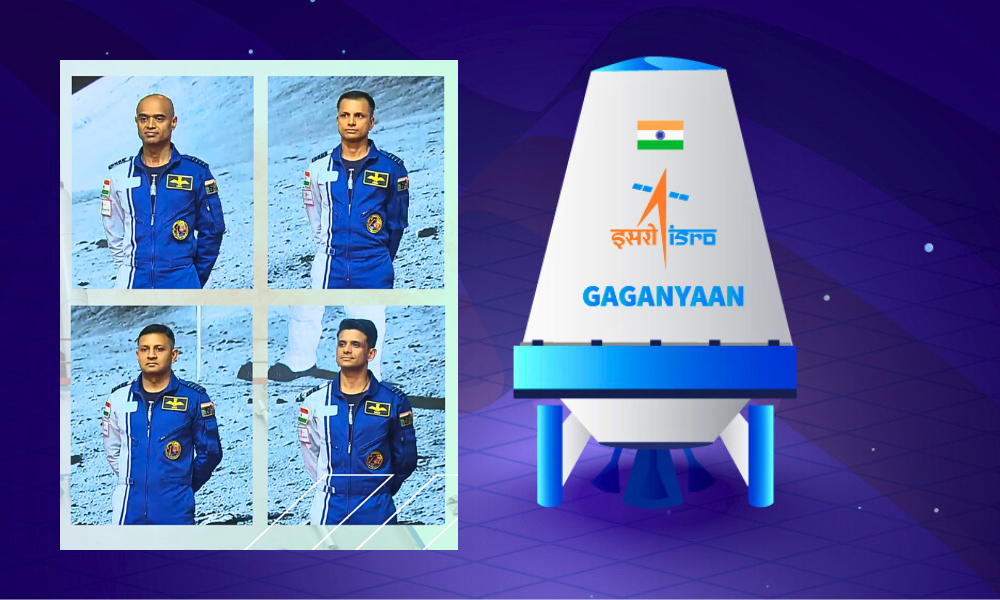
India Announces 4 Astronauts for Gaganyaan

India Announces 4 Astronauts for Gaganyaan

India has unveiled four Air Force pilots who have been shortlisted to travel on the country's maiden space flight — Gaganyaan — scheduled for next year.

During the inaugural ceremony held today at the Vikram Sarabhai Space Centre, Thiruvananthapuram, Hon'ble Prime Minister Narendra Modi unveiled the Indian Astronaut Logo and awarded the 'अंतरिक्ष यात्री पंख' to the four IAF Astronauts.

The four astronauts for the Gaganyaan mission to space are :
  • Group Captain Prashanth Nair
  • Group Captain Ajit Krishnan
  • Group Captain Angad Pratap
  • Wing Commander Shubhanshu Shukla
Indian Air Force (IAF) will be working in 'Mission Mode' along with the Indian Space agency ISRO to achieve the country’s ambitious goal of achieving its own manned Space Flight.

The Gaganyaan mission aims to send three astronauts to an orbit of 400km and bring them back after three days.

Officials said the men were selected from a pool of Air Force pilots and had undergone extensive physical and psychological tests before being shortlisted.

Prime Minister Narendra Modi and Isro chief S Somanath pinned badges with golden wings onto their shirts and Mr Modi described them as "India's pride".

NASA To Provide Advanced Training To Indian Astronauts

NASA To Provide Advanced Training To Indian Astronauts

A day after Prime Minister Narendra Modi completed his tour of the United States, a joint statement released welcomed the decision of NASA and ISRO to develop a strategic framework for human spaceflight cooperation by the end of 2023. NASA will provide advanced training to Indian astronauts at the Johnson Space Center in Houston, Texas, with a goal of mounting a joint effort to the International Space Station (ISS) in 2024.

The Indian astronauts will receive advanced training at NASA, as a part of the US-India initiative on Critical and Emerging Technologies (iCET) which was launched in February this year.

The iCET includes various bilateral initiatives and under the collaboration in the space sector between both countries, to strengthen cooperation on the human spaceflight mission, including establishing exchanges that will include advanced training for an Indian Space Research Organization (ISRO) or the Department of Space astronaut at NASA Johnson Space Center.

Additionally, under iCET, within next year, Indian aerospace companies and US Commercial Lunar Payload Services (CLPS) companies will work together for the advancement of NASA's Commercial Lunar Payload Services (CLPS) project initiative, which is a program to contract transportation services to send small robotic landers and rovers to the Moon's south polar region for scouting for lunar resources, testing in situ resource utilization (ISRU) concepts, and performing lunar science to support the Artemis lunar program.

Recently, ISRO’s U.R. Rao Satellite Centre in Bengaluru, India, got the delivery of the NASA-ISRO Synthetic Aperture Radar (NISAR) Satellite and the satellite will be be launched from India next year.

Space Travel Can Cause Anaemia, Destroying 3 Mn RBCs/Second


While space tourism is one of the new industries that grew up amid pandemic and lockdowns, and billionaires races on who's first to put civilians out of the Earth's gravity. A new study revealed that space travel can cause lower red blood cell counts -- known as space anaemia.

"Space anaemia" is something scientists have known since the very first missions returned to Earth - but exactly why it happens has been a mystery.

A latest study by University of Ottawa, studied 14 astronauts says --- 3 million red blood cells (RBCs) are destroyed per second in space, compared to 2  million on terra firma (dry land or solid ground). "Fortunately, the body can compensate. If it didn't, astronauts would become very ill in space."

The study published in Nature Medicine, investigated astronauts including Britain's Tim Peake - on six-month stays at the International Space Station (ISS). The study findings suggest that the destruction of RBCs, termed hemolysis, is a primary effect of microgravity in space flight and support the hypothesis that the anemia associated with space flight is a hemolytic condition that should be considered in the screening and monitoring of both astronauts and space tourists.

"As humankind plans extraterrestrial travel, understanding the health implications of living in space will be critical to planning safe journeys", said that study findings.

Earlier, Canadian researchers say that 50% more red blood cells are destroyed in space and this continues for however long the mission lasts. 

Dr Guy Trudel of the University of Ottawa, who led this study of funded by the Canadian Space Agency, said "If you are on your way to Mars and ... you can’t keep up...with the need to produce all those extra red blood cells, “you could be in serious trouble"

A year after returning to Earth, the astronauts’ red blood cells had not completely returned to pre-flight levels, Dr Trudel's team reported on Friday in Nature Medicine.

A total of 14 astronauts were studied (11 men and 3 women; 45 ± 7 years) between 2015 and 2020. The astronauts flew ISS missions of 167 ± 31 days duration. Each astronaut collected alveolar and ambient air samples as well as blood samples according to a prespecified schedule. The space samples were downmassed using automated reentry vehicles.

Market Reports

Market Report & Surveys
IndianWeb2.com © all rights reserved