Showing posts with label Astronomy. Show all posts

Watch Rare Green Comet Passing Near Earth, At A Special Event by Starscapes

Watch Rare Green Comet Passing Near Earth, At A Special Event by Starscapes

On-demand special shows will be held across all Starscapes observatories over the next two weeks

Starscapes, India's leading Astro tourism company, will be organising on-demand special viewing events for the rare green comet that will be passing near Earth.

The viewing events will take place over the next two weeks at Starscapes Observatories in Kausani, Bhimtal, Mukteshwar, and its mobile observatories located at St Regis in Goa and Club Mahindra in Coorg, Virajpet, Munnar, Goa, and Pondicherry The sessions will be led by experienced Starscapes Starguides who will provide information and answer any questions about the comet.

The comet, named Comet C/2022 E3 (ZTF) will be visible to the naked eye and is a once-in-a-lifetime opportunity for astronomy enthusiasts. Comet C/2022 E3(ZTF) is a rare and stunning spectacle, with a distinctive greenish hue and a broad dust tail. The vibrant streaks of green will stand out in stark contrast against the backdrop of the dark night sky, making for an unforgettable viewing experience. This comet orbits the sun every 50,000 years. The comet reaches its closest point to Earth, known as perigee, on February 1st. As a result, the best visibility of the comet will be over the next two weeks, typically around 3AM.

Watch Rare Green Comet Passing Near Earth, At A Special Event by Starscapes

Commenting on this, Paul Savio, CEO and Co-Founder, Starscapes, said, “ This is a rare and spectacular sight and it’s a great opportunity for everyone to experience celestial magic. We will be organising on-demand shows and we encourage everyone to come out and see it”

To book shows, visit: https://starscapes.zone/observatory/ or call 9667307015

IITH Scientists within InPTA Paving the Way To Charting Interstellar ‘Weather’

IITH Researchers within InPTA Measuring Interstellar Weather using Radio Telescope

The InPTA collaboration is the only PTA consortia which do simultaneous dual frequency observations of millisecond pulsars over widely separated lower and higher frequency bands, which is critical for our ultra-high precision measurement of interstellar noise.

No other radio telescope among the other PTA consortia has sensitivity equal to that of InPTA at low frequencies.

The Indian Pulsar Timing Array (InPTA) recently published its first official Data Release. Prof Shantanu Desai from the Physics department of IIT Hyderabad, PhD student Aman Srivastava, B.Tech student Divyansh Kharbanda, and IITH alumnus Raghav Girgaonkar have co-authored this research article which got published recently in the Publications of the Astronomical Society of Australia. The data release stems from three and a half years of observation using the upgraded Giant Metrewave Radio Telescope (uGMRT) near Pune. The Indo-Japanese team of thirty-eight radio-astronomers measures delays in the arrival of radio pulses from special types of neutron stars called millisecond pulsars, which are crucial for the discovery of low-frequency gravitational waves. InPTA has joined hands with similar teams from the USA, Europe and Australia to detect these tiny, elusive ripples in spacetime, named nanohertz gravitational waves.

Pulsar Radio Beam traversing clouds of Dynamic Interstellar Medium

Complementing the team’s efforts, Prof B S Murty, Director, IITH, said, “The research which we are doing should motivate young students to take up careers in science and engineering. The InPTA collaboration involves both Indian and Japanese scientists working at multiple institutes and people at all levels (faculty, PhD students, postdocs, UG students, Engineers, Computing professionals etc.) who have actively contributed towards it is a such amazing example.”.

“This research helps us better understand our Universe and our role in it. However, one should remember wifi (ubiquitous) in daily life was a spin-off of research in radio astronomy while searching for radio bursts from primordial black holes. The precision measurements which we are making use state of the art electronics and communication systems and also involve the application of novel data analysis and data mining tools. These could have potential industrial applications”, added Prof Shantanu.

The authors explain, “The universe is filled with gravitational wave background holding answers to deep secrets of nature. The waves that we detect now are strong but short-lived. We are listening to large waves crashing loudly upon the seashore, whereas space-time is continually brimming with tiny ripples. Imagine a symphony where high-pitched sections blare at crescendos while bass sections play the fundamental progressions throughout. The interplay of gravitational waves in the universe is similar to a symphony played by nature. We have been eavesdropping upon the crescendos while a persistent buzz forms the basis of this cosmic melody. These waves are generated by supermassive black hole binary pairs orbiting around each other for millions of years during their courses of collision. The primary hindrance in their detection is the vast ocean of interstellar medium lying in between. The InPTA data is critical for charting this interstellar ‘weather’ and paving the way to the discovery in the near future.”

Electronic Release (Video Abstract): 

About IIT Hyderabad

Indian Institute of Technology Hyderabad (IITH) is one of the eight new IITs established by the Government of India in 2008. In a short span of 14 years, the institute has become a top-ranker. It has 290+ full-time faculty, ~4,200 students, 18 Departments + Centre for Interdisciplinary Programs, nearly 200+ state-of-the-art laboratories, and five research and entrepreneurship centers. The institute has a strong research focus with approx. Rs ~700 crores of sanctioned research funding, with PhD scholars accounting for about 30% of total student strength. IITH has more than 8100+ research publications with 1,20,000+ Citations, 190+ Published Patents, 1,700+ sponsored/consultancy projects with 500+ running projects, and about 100+ startups.

Starscapes Expands its Presence in Uttarakhand, Launches New Observatory in Mukteshwar

Starscapes Mukteshwar Kids activity area

After an overwhelming response for their observatory in Kausani and Bhimtal, Starscapes, India's leading Astro tourism company, has launched its third public observatory in Uttarakhand.

Starscapes’ new observatory in Mukteshwar will offer tourists a holistic astronomical experience, with a variety of activities both during the day and at night, ranging from stargazing excursions to astrophotography, and sun observation. Located at Sargakhet in Mukteshwar, it is easily accessible from all the main tourist sites in the area. Additionally, the new observatory is only an 8-hour drive from Delhi for anyone looking to spend a weekend away from the city.


A trained astronomy expert will guide the visitors on their stargazing journey. The observatory has an astronomy experience centre where a number of engaging sessions will be conducted round the clock. The Experience Center has a virtual room that explains constellations and the night sky using Mukteshwar's precise GPS coordinates. Visitors can also take part in beginner-level astrophotography classes that teach them how to take pictures of star trails and constellations. There is also an on-site cafe, a dedicated activity zone for kids , and a sit-out area with a stunning view of the Himalayas.

Some of the other activities are
  • Stargazing sessions: A guided session by Starscapes ‘Starguides’ who will tell you all about the universe.
  • Sun Observation: Want to watch the sun without squinting in agony? Starscapes can arrange for safe viewing of the sun to discover some of the fascinating aspects you didn't know about the sun.
  • Star parties: Get your group along to experience the enigma of the cosmos with an up-close-and-personal viewing of the moon and other planetary objects. From stargazing safari to astrophotography, Starscapes’ Star parties will have it all.
  • Selfie with the stars: We're not talking about movie stars here; we're talking about real stars. Imagine a backdrop of star-studded night sky and a selfie with the stars? Starscapes can make it happen.
Starscapes Mukteshwar

Starscapes Mukteshwar

Commenting on the new launch, Paul Savio, CEO and Co-Founder, Starscapes, said, “A few months ago, we conducted an Astro-camp in Mukteshwar, for which we got an incredibly positive response from tourists as well as from the local community in Mukteshwar. The response we received was the deciding factor for opening a permanent observatory in Mukteshwar. A picturesque and charming location like Mukteshwar offers visitors a wonderful opportunity to experience the magic of the night sky and explore the great outdoors. Our observatories in Kausani and Bhimtal have been popular destinations for Astro tourism. We hope to receive a similar response for our new observatory in Mukteshwar

Location map: https://goo.gl/maps/zxfBos1RRaygUPHr5

To book tickets: Call 9667307015

About Starscapes Private Limited

Starscapes is a unique platform that offers a holistic astronomy experience to give voice to your curiosity about the vast skies beyond our stratosphere. Founded in 2017 by astronomy aficionado Ramashish Ray with Paul Savio joining him as Co-Founder and CEO in 2019, Starscapes is India’s first and only chain of observatories that gives travel enthusiasts an integrated astronomy experience.

Starscapes Launches ‘Cosmofluencer’- A Program That Gives A Voice To Young Astronomers

Starscapes Launches ‘Cosmofluencer’- A Program That Gives A Voice To Young Astronomers
  • A first of its kind initiative that gives young astronomy enthusiasts an opportunity to create content and undertake projects on various astronomical topics
  • Young individuals selected for the program will get a chance to be mentored by industry experts in the field of astronomy, astrophysics and space exploration
Starscapes, India's leading astro tourism venture, presents ‘Cosmofluencer’, a unique initiative that gives an opportunity for young astronomy enthusiasts to explore the possibilities that cosmos has to offer. Young individuals chosen for the three-month program will write, develop, curate, and share content related to astronomy. Furthermore, they also get a chance to work directly with industry veterans from the field of astronomy, astrophysics, and space Exploration.

The program is open to anyone between the ages of 13 to 19 years. To enroll for the program, visit Starscapes-Cosmofluencer.

The applicants selected for the program will create content that simplifies astronomy for the world. Their content will be research-based, fun, and packaged in a way that’s engaging for the audience. They will get the opportunity to interact with industry professionals and dive deep into the world of astrophysics and space exploration. Additionally, they’ll have the chance to participate in workshops and work on projects related to deep space exploration with the help of experts.

Commenting on the program, Paul Savio, CEO and Co-Founder, Starscapes, said, “We started Starscapes with an aim to make astronomy more accessible for everyone. We have been overwhelmed by the interest our customers have shown towards stargazing and astro-tourism. During our journey, we realised that young minds are especially more curious about space and everything it has to offer. With this insight, we launched the Cosmofluencer program to give voice to young astronomers and offer them a launchpad for a career in astronomy”

“Our program gives young people a chance to learn about astronomy by creating fun and engaging content, and sharing it to the world. We are thrilled to provide a platform to these young thinkers to become cosmo-influencers and spread their love for astronomy through their content”

Program detail

Any individual (13-19 years) with a smartphone and a passion for astronomy can be a part of the program. Once the enrollment form is filled, the applicant will go through an interview process for selection.

Below are a few perks of the program —
  • Each cosmofluencer will get a chance to virtually Meet & Greet a special guest expert from the industry to answer any questions about astronomy as a profession.
  • Lifetime access to any Starscapes Observatory across the country
  • A certificate of completion after 3 months of the program. They also stand a chance to win special awards for best performance in various categories. The winners will get a 12 month subscription to ‘Starscapes Astronomy Box’
  • 12 photographs of the sky taken by any 12 Cosmofluencers will be a part of Starscapes Limited Edition Calendar 2023. 
  • The Cosmofluencers will be a part of a team with an industry expert as a mentor. At the end of the three months, each team will present a project to be featured in this year’s Starscapes Hall of Fame.

For more information » https://cosmofluencer.starscapes.zone/ or contact +91 966730701

Visit ›› https://www.youtube.com/watch?v=n-VBgJpipYM


About Starscapes Private Limited

Starscapes is a unique platform that offers a holistic astronomy experience to give voice to your curiosity about the vast skies beyond our stratosphere. Founded in 2017 by astronomy aficionado Ramashish Ray with Paul Savio joining him as Co-Founder and CEO in 2019, Starscapes is India’s first and only chain of observatories that gives travel enthusiasts an integrated astronomy experience. With private observatories at Kausani and Bhimtal in Uttarakhand, Starscapes sports state-of-the-art equipment for observations, astrophotography and research projects.


To Boost Astro Tourism in India, Govt Setting Up India’s First-Ever "Night Sky Sanctuary" in Next 3 Months

To Boost Astro Tourism in India, Govt To Set Up India’s First-Ever "Night Sky Sanctuary"

In what could be called as unique and first-of-its-kind initiative in India's science & astronomy history, the Department of Science & Technology (DST) under Ministry of Science & Technology, Govt of India, has undertaken to set up India’s first-ever "Night Sky Sanctuary" in Ladakh in order to boost Astro tourism in India as one of the world’s highest-located sites for optical, infra-red, and gamma-ray telescopes.

The proposed Dark Sky Reserve, which will be completed within next three months, is situated at Hanle in Ladakh.

The upcoming Night Sky Sanctuary will be a part of Changthang Wildlife Sanctuary, informed Dr Jitendra Singh, the Union Minister of State (Independent Charge) Science & Technology.

Notably, Hanle is a historic village and home to the world's tallest astronomical observatory, and it was designated as a Dark Sky Sanctuary by The Union Territory administration in Ladakh, in early this year. Hanle is also home to a special "cherenkov telescope" called as "Major Atmospheric Cerenkov Experiment Telescope (MACE)". It is the highest (in altitude) and second largest Cerenkov telescope in the world.

For the launch of Night Sky Sanctuary the site, a tripartite MoU has been signed among the the Union Territory administration, Ladakh Autonomous Hill Development Council (LAHDC) Leh and the Indian Institute of Astrophysics (IIA).

The upcoming "Dark Space Reserve" site will have activities to help in boosting local tourism and economy through interventions of Science and Technology. All the stakeholders will jointly work towards the preservation of the night sky from unwanted light pollution and illumination, which is a serious threat to the scientific observations and natural sky conditions. It may be noted that Hanle is best suited for this project as it is located in Ladakh’s cold desert region, away from any form of human disturbance and clear sky conditions and dry weather conditions exist throughout the year, the Minister added.

Besides, few private companies are also working on boosting astro-tourism in the country. Starscapes, a leading astro-tourism company in India, has been actively working towards promoting Dark Sky Locations in India in a bid to boost interest in astro-tourism

Earlier in last month, IIT Hyderabad established its first astronomical observatory with a large telescope for public outreach.

Prior to this, in  June this year, India's 1st and Asia's largest liquid mirror telescope was launched in Uttarakhand at campus of Aryabhatta Research Institute of Observational Sciences (ARIES) to keep a watch on the overhead sky to identify transient or variable objects such as supernovae, gravitational lenses, space debris, and asteroids.

Indian Scientists with the Help of James Webb Telescope Formulate Model To Trace Elusive Exo-Moons

Indian Scientists With The Help of James Webb Telescope Formulate Model To Trace Elusive Exo-Moons

This may also help detect habitable exo-moons in the future and understand new worlds beyond our own.

NASA’s James Webb Space Telescope (JWST), which is touted as the most powerful telescope ever built, was successfully placed in outer space last year in December. And, with the help of this JWST, scientists at the Indian Institute of Astrophysics (IIA), Bangalore, have developed a model to trace the so far elusive exomoons – natural satellites that revolve around exoplanets (planets orbiting stars other than the Sun).

So far, five thousand exoplanets --- planets orbiting stars other than the Sun, have been discovered by using several ground-based and space telescopes such as Kepler, CoRoT, Spitzer, and Hubble space telescopes. However, the natural satellites or exomoon around any of these planets still remain untraced.

Scientists at the IIA, Bangalore, which is an autonomous institute of the Department of Science and Technology (DST), have demonstrated that the newly launched James Webb Space Telescope (JWST) is sufficiently powerful to detect the transit signal of exomoons in the photometric light curves of moon hosting exoplanets.

Schematic diagram of moon hosting exoplanet and its model photometric transit light curve


Professor Sujan Sengupta and his graduate student Suman Saha have developed an analytical model that uses the radius and orbital properties of the host planet and its moon as parameters to model the photometric transit light curve of moon-hosting exoplanets by incorporating various possible orientations of the moon-planet-star system. 

The co-alignment or non-coalignment of the orbits of the planet and the moon are used as parameters (using two angular parameters), and they can be used to model all the possible orbital alignments for a star-planet-moon system. Using these generic models and the analysis of photometric transit light curves of exoplanets that is being obtained by JWST, a large number of exomoons can be detected in near future. 

According to the researchers, an exo-moon around a gas giant planet like Jupiter in the habitable zone of the host star where temperature is appropriate for water to exist in liquid state may harbour life. Under favourable alignment of moon-planet-star, such exomoon may also be detected by JWST. The research has been accepted for publication in The Astrophysical Journal, which is published by the American Astronomical Society (AAS).

A First-of-Its-Kind Astro Camp by Starscapes at Mukteshwar, Nainital

A First-of-Its-Kind Astro Camp by Starscapes at Mukteshwar, Nainital

Guided night sky tours, sun observations, planetary parade are some of the activities planned for the Astro camp, which will take place from June 15 to June 30 at Mukteshwar 

Starscapes, India's leading Astro tourism company, is hosting an Astro Camp in Mukteshwar, Nainital from 15th June to 30th June. From celestial shows to planetary parades, the Astro Camp will have a series of astronomy related activities that quite literally offer an out of this world experience.

Mukteshwar, best known as the silent treasure of Uttarakhand, is an ideal location for stargazing due to low light pollution and minimal commercial activities. Located 2,171m above sea level, Mukteshwar is in Class 3 category on the Bortle Scale, making it one among the prime locations for stargazing.

Commenting on the camp, Paul Savio, CEO and Co-Founder, Starscapes, said, “Away from the hustle bustle of larger hill stations, a scenic and quaint place like Mukteshwar offers visitors a fantastic opportunity to witness the magic of the night sky and explore the great outdoors. With the last month of clear skies before the monsoons start, here’s a chance for visitors to experience the unexplored side of Mukteshwar with Starscapes’ Astro Camp. From astronomy enthusiasts to novices, the camp has something for everyone.”
 

The Astro Camp will include the following activities —

Celestial show - Guided Tour Across the Night Sky: Take a journey through the night sky in this 45 minute show as we explore the moon, the planets and the stars. Learn about the night sky and the science, the history and the mythology that make it up. Learn how to identify different celestial objects and constellations in the night sky.

Planetary Parade: Join the planets as they herald the sun at daybreak. Mercury, Venus, Mars, Jupiter and Saturn will be visible with the naked eye, but provide an even more stunning spectacle through the telescope.

The Moon - Earth’s companion: Get a chance to see the moon through a telescope. Learn about its formation, its influence on Earth, its significance in cultures across time and space, and its importance in our understanding of the universe. Look at its craters, and try to identify the different Apollo and Chandrayaan landing sites!

Sun observations: See the Sun in all its glory, without frying your eyes! Enjoy the marvelous beauty of the source of all our energy, through our telescope and state-of-the-art solar filters. You can also learn how to see the Sun with simple home aids like pinhole cameras, ball projectors or our solar goggles. If you’re lucky, you’ll get to see sunspots, and maybe even the elusive solar flares! 

STEM workshops: Learn how to build and launch your own rockets, with material at home. Make your own sun dials, understand how we learnt to tell time. Figure out for yourself the basic principles of a camera by actually making one.

Ticket: Starts at Rs 300/- 

To book tickets:  Call 9667307015 or visit https://starscapes.zone/astro-camp-mukteshwar/ 

India's 1st and Asia's Largest Liquid Mirror Telescope Formally Launched in Uttarakhand

India's 1st and Asia's Largest Liquid Mirror Telescope Formally Launched in Uttarakhand
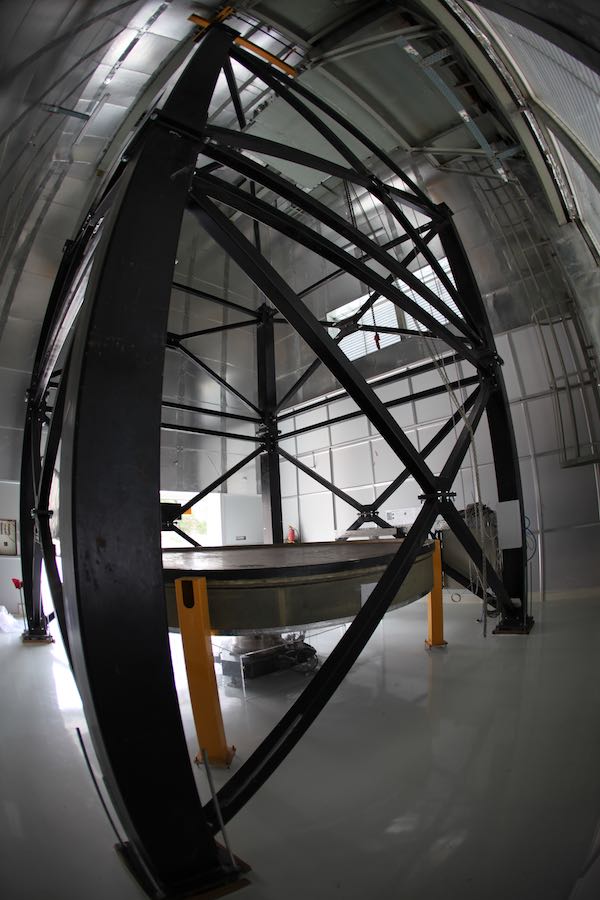
Top view of the ILMT showing the liquid mercury mirror covered by a thin mylar film.

A new telescope facility — International ​Liquid Mirror ​Telescope (ILMT) — has been formally launched in Uttarakhand at campus of Aryabhatta Research Institute of Observational Sciences (ARIES) to keep a watch on the overhead sky to identify transient or variable objects such as supernovae, gravitational lenses, space debris, and asteroids.

This new telescope is first liquid mirror telescope in India and the largest in Asia. It will help in surveying the sky making it possible to observe several galaxies and other astronomical sources just by staring at the strip of sky that passes overhead.

Built by astronomers from India, Belgium and Canada, the novel instrument employs a 4-meter-diameter rotating mirror made up of a thin film of liquid mercury to collect and focus light.

Prof. Dipankar Banerjee, Director, ARIES, said, "ILMT is the first liquid-mirror telescope designed exclusively for astronomical observations installed at the Devasthal Observatory of ARIES. The ILMT and the Devasthal Optical Telescope (DOT). Both are the largest aperture telescopes available in the country."

A ​4Kx4K ​CCD ​camera ​manufactured ​by ​'Spectral ​Instruments' ​and ​which ​can operate ​over ​the ​4000 ​to ​11000 ​Ã… ​spectral ​range ​(SDSS ​filters ​g', ​r', ​i' ​are ​available), ​will be ​positioned ​at ​the ​prime ​focus ​of ​the ​ILMT ​at ​about ​8m ​above ​the ​mirror. ​The ​mirror ​being parabolic ​in ​shape ​requires ​an ​optical ​corrector ​to ​get ​a ​flat ​focal ​surface ​of ​about ​27 ​arcminute in ​diameter. ​All ​these ​elements ​are ​mechanically ​coupled ​by ​an ​external ​structure ​and ​a ​spider.

India's 1st and Asia's Largest Liquid Mirror Telescope Formally Launched in Uttarakhand

Dr. Kuntal Misra, Project Investigator of ILMT at ARIES, said, "The wealth of data generated with the ILMT survey will be exemplary. In the future, several young researchers will be working on different science programs utilizing the ILMT data. When regular science operations begin later this year, the ILMT will produce about 10 GB of data every night, which will be quickly analyzed to reveal variable and transient stellar sources,” said Dr. Brajesh Kumar, ILMT Project Scientist at ARIES. The 3.6 metre DOT, with the availability of sophisticated back-end instruments, will allow rapid follow-up observations of the newly-detected transient sources with the adjacent ILMT."

The data collected from ILMT will be ideally suited to perform a deep photometric and astrometric variability survey over a period of typically 5 years,” notes Project Director Prof. Jean Surdej (University of Liège, Belgium and University of Poznan, Poland).

The ILMT achieved first light in the 2nd week of May 2022. Using the first light observations through the g, r and i Sloan filters, a colour composite image (shown below) of a small portion of the sky was prepared. 

To highlight the features of galaxies and other stellar objects, the green colour has been slightly enhanced in the image. NGC 4274 Galaxy can be seen in the top right corner.

Colour composite image obtained from first light observations of ILMT.

The ​4m ​International ​Liquid ​Mirror ​Telescope ​(ILMT) ​project ​results ​from ​a collaboration ​between ​Aryabhatta ​Research ​Institute ​of ​Observational ​Sciences ​(ARIES, ​India), the ​Institute ​of ​Astrophysics ​and ​Geophysics ​(Liege ​University), ​the ​Canadian ​Astronomical Institutes, ​University ​of ​Montreal, ​University ​of ​Toronto, ​York ​University, ​University ​of ​British Columbia ​and ​Victoria ​University.


Starscapes to Setup an Astro Observatory in Ooty

Starscapes to Setup an Astro Observatory in Ooty

Starscapes will first setup a mobile observatory, which will be followed by a permanent installation

Starscapes, India's leading Astro tourism company, will soon launch an astronomical observatory in Ooty, Tamil Nadu. Starscapes will first set up a mobile observatory at MindEscapes resort in Ooty, followed by a permanent setup right next to the resort.

The new observatory will offer tourists a holistic astronomical experience, with a variety of activities both during the day and at night, ranging from stargazing excursions to astrophotography, and sun observation. A trained astronomy expert will guide the visitors on their stargazing journey.

Commenting on the new launch, Paul Savio, CEO and Co-Founder, Starscapes, said, “ We are excited to set up our mobile observatory at a location like MindEscapes, which is known for creating niche experiences. MindEscapes’ motto of unwinding the mind and thinking beyond the ordinary is well aligned with our vision of creating offbeat experiences that rejuvenate the mind”

“Ooty has been one of the most sought-after and favourite vacation spots for tourists of all age groups. In addition to the beautiful gardens, spectacular mountains, colonial architecture, and mist-covered forests, Ooty has a lot more to offer. Located at an altitude of 2200 metres above sea level, Ooty has minimal light pollution, making it an ideal location to experience the enigma of stargazing. Our observatory adds a new dimension to the list of must-visit attractions in Ooty” Paul added.

Dipali Sikand, Founder, MindEscapes, said, “At MindEscapes, our entire philosophy revolves around enabling better thought, creating eureka moments, and to get individuals to think outside the box. In order to do so, we have some of the best thinkers with us who are curating these experiences. Through MindEscapes, we want to leave a legacy behind where people can think beyond the ordinary. One of the ways to do this is through Blue Sky thinking, often known as brainstorming with no limits. This can happen by creating an immersive experience where one can look at situations with a completely fresh eye. We are excited to provide a platform for Starscapes to offer an experience that takes people on a journey of the world and beyond. They are enabling experiences that go beyond the physical, allowing for meaningful dialogue, experiential learning, and scientific thinking.”

Starscapes to Setup an Astro Observatory in Ooty
 

Starscapes will regularly host a number of engaging sessions related to stargazing. Some of the activities are
  • Stargazing sessions: A guided session by Starscapes ‘Starguides’ who will tell you all about the universe.
  • Sun Observation: Want to watch the sun without squinting in agony? Starscapes can arrange for safe viewing of the sun to discover some of the fascinating aspects you didn't know about the sun.
  • Star parties: Get your group along to experience the enigma of the cosmos with an up-close-and-personal viewing of the moon and other planetary objects. From stargazing safari to astrophotography, Starscapes’ Star parties will have it all.
  • Selfie with the stars: We're not talking about movie stars here; we're talking about real stars. Imagine a backdrop of star-studded night sky and a selfie with the stars? Starscapes can make it happen.
During the day, visitors can participate in activities such as experiential science activities, which start at Rs. 200 and last for about 30 minutes to an hour. Apart from this, there are observation sessions and workshops around the sun. At night, there are stargazing sessions that last for about 45 minutes to an hour and cost between Rs. 300 and Rs. 1000.

Location map: https://goo.gl/maps/dk3vTKwzc17x5cfs5

To book tickets: Call 9667307015 or visit https://starscapes.zone/observatory

Starscapes is a unique platform that offers a holistic astronomy experience to give voice to your curiosity about the vast skies beyond our stratosphere. Founded in 2015 by astronomy aficionado Ramashish Ray with Paul Savio joining him as Co-Founder and CEO in 2019, Starscapes is India’s first and only chain of observatories that gives travel enthusiasts an integrated astronomy experience. Starscapes has observatories in Kausani and Bhimtal in Uttarakhand, and mobile observatories in Madikeri, Jaipur, and Pondicherry. The company plans to further expand its operations by setting up observatories in Virajpet, Munnar, Goa, and Shimla within the next two months

Starscapes Celebrates ‘International Dark Sky Week’ With a Series of Astronomy-related Events

Starscapes Celebrates ‘International Dark Sky Week’ With a Series of Astronomy-related Events

As a part of the celebration, Starscapes will host astrophotography sessions, a planetary parade, and the ‘Messier Marathon’ from 22nd April to 30th April

Starscapes, India's leading astro tourism company, will host a series of astronomy-related activities as a part of the ‘International Dark Sky Week’. Activities such as astrophotography sessions, planetary parade, and the ‘Messier Marathon’ will be held from 22nd April to 30th April at Starscapes’ observatories in Kausani, Bhimtal, and at their mobile observatories in Virajpet, Madikeri, Goa, Munnar, and Pondicherry.

What is International Dark Sky Week?

Endorsed by International Dark-Sky Association, a non-profit that works to preserve and protect the night sky, International Dark Sky Week is celebrated across the world during the New Moon week in April, which this year occurs from April 22nd to April 30th. The event, which began in 2003, aims to raise awareness about the night sky, the ecosystem that flourishes in the dark on Earth, and the universe that exists beyond our planet. Astronomy enthusiasts globally commemorate this week with activities such as switching off the light to minimise light pollution, stargazing sessions and astrophotography workshops.

Starscapes has been actively working towards promoting Dark Sky Locations in India in a bid to boost interest in astro-tourism. Very recently, Starscapes partnered with the Uttarakhand Tourism Board to develop Benital as India’s first astro village. Initiatives like these are slowly becoming a priority for many other state governments. Hanle, a historic village and home to the world's tallest astronomical observatory, was designated as a Dark Sky Sanctuary by The Union Territory administration in Ladakh a few months ago.

Commenting on the celebration, Paul Savio, CEO and Co-Founder, Starscapes, said “International Dark Sky week celebrates the magic of the nocturnal world and the importance of preserving and protecting our night sky from light pollution. To bring more awareness to this cause, Starscapes has curated a series of fun events for astronomy enthusiasts to learn all about the universe.

“A number of locations in India have low levels of light pollution and provide an undisturbed view of the night sky, making them ideal for a Dark Sky Park. At Starscapes, we aim to assist in opening many more Dark Sky locations across the country in a bid to promote Astro tourism.” he added. 

Events at Starscapes observatories for International Dark Sky Week celebration.

The Messier Marathon

Here’s your chance to learn who Charles Messier was and his contribution towards cataloguing the night sky. With Starscapes’ state-of-the-art telescopes, observe some of the galaxies, nebulas ,and star clusters that he catalogued. Go back home with a profound understanding of DSOs – Deep-Sky Objects that few people have seen!

Where: Starscapes observatory in Kausani and Bhimtal

Planetary Parade

Watch the planets as they line up in the eastern sky heralding the rising of the Sun, early in the morning. Marvel at once at the phases of Venus, the clouds, the satellites of Jupiter, and the rings of Saturn. Go home with a fascinating photo you will learn to click by yourself of the planets all lined up to offer you a rare spectacle!

Where: Starscapes observatory in Kausani and Bhimtal, and mobile observatories in Madikeri, Virajpet, Pondicherry, Goa, Munna

Astrophotography with Shikhar Gupta

Starscapes Light Painting at the Astrophotography Workshop
Here is your chance to put that DSLR to better use! Astrophotographer Shikhar Gupta will teach you all about night landscape photographs, using telescopes and mounts to capture images of deep sky objects; and learning how to process them to get the desired output. You’ll see galaxies and nebulas in colours you never thought existed!

Where: Starscapes observatory in Kausan

For more details, visit: https://starscapes.zone/event-dark-sky-week/

Contact: 9667307015

About Starscapes Private Limited

Starscapes is a unique platform that offers a holistic astronomy experience to give voice to your curiosity about the vast skies beyond our stratosphere. Founded in 2015 by astronomy aficionado Ramashish Ray with Paul Savio joining him as Co-Founder and CEO in 2019, Starscapes is India’s first and only chain of observatories that gives travel enthusiasts an integrated astronomy experience. With private observatories at Kausani and Bhimtal in Uttarakhand, Starscapes sports state-of-the-art equipment for observations, astrophotography and research projects.

Starscapes Launches New Mobile Astronomical Observatory in Pondicherry; To Expand in Virajpet, Ooty, Munnar, Goa, and Shimla

Starscapes Launches New Mobile Astronomical Observatory in Pondicherry

Starscapes expands its footprint with the launch of a new mobile observatory in Pondicherry

The company plans to further expand its operations by setting up observatories in Virajpet, Ooty, Munnar, Goa, and Shimla within the next two months

Starscapes, a platform for astronomy experiences and India's first and only chain of observatories, will be launching a new mobile observatory in Pondicherry as a part of its expansion plan. Within the next two months, the company plans to further strengthen its footprint by launching observatories across Ooty, Munnar, Goa, Virajpet and Shimla.

Starscapes’ mobile observatory in Pondicherry will be set up at the Club Mahindra property and it will offer guests and visitors a holistic astronomy experience. A similar model is already functional at Club Mahindra’s Madikeri property and in the next one week another mobile observatory will be set up at Club Mahindra, Virajpet. Over the next few months, Starscapes plans to expand its presence by setting up several other mobile observatories across Club Mahindra properties.

The mobile observatory in Pondicherry will offer a holistic astronomical experience, with a variety of activities both during the day and at night, ranging from stargazing excursions to astrophotography and sun observation, and will be open to both visitors and guests staying at the resort. A trained astronomy expert will guide the visitors and guests on their stargazing journey.

Starscapes will also regularly host a number of engaging sessions related to stargazing. Some of the activities include -
  • Stargazing sessions: A guided session by Starscapes ‘Starguides’ who will tell you all about the universe.
  • Sun Observation: Want to watch the sun without squinting in agony? Starscapes can arrange for safe viewing of the sun to discover some of the fascinating aspects you didn't know about the sun.
  • Star parties: Get your group along to experience the enigma of the cosmos with an up-close-and-personal viewing of the moon and other planetary objects. From stargazing safari to astrophotography, Starscapes’ Star parties will have it all.
  • Selfie with the stars: We're not talking about movie stars here; we're talking about real stars. Imagine a backdrop of star-studded night sky and a selfie with the stars? Starscapes can make it happen.
  • Experience Centre: From virtual moon walks to quirky setups that make you like you are on another planet, visitors can enjoy a host of unique adventures at the Experience Centre.
Commenting on the launch, Paul Savio, CEO and Co-Founder, Starscapes, said, “There has been an increasing interest in Astro-tourism over the last few years. A lot of domestic travellers are discovering the joys of stargazing and the magic of the night sky. To make stargazing easily accessible, we are also partnering with leading resorts and hospitality chains across India. Our partnership with Club Mahindra is a step in that direction. Pondicherry is our third mobile observatory setup at a Club Mahindra property, and we hope to be present in all their major properties across India in the immediate future."

"We have seen an overwhelming interest for all our observatories and we hope to receive a similar response for our upcoming observatory in Pondicherry. From pristine beaches to beautiful architecture, vibrant French-style streets to great food, Pondicherry has a lot more to offer than what meets the eye. With its minimal light pollution and scenic settings, it’s also an ideal location for offbeat experiences such as stargazing. We are thrilled to setup our first mobile observatory in Pondicherry and we hope to add a whole new dimension to the list of things to do in Pondicherry," he added

Location map: Starscapes Mobile Observatory

To book tickets: Call 9667307015 or visit www.starscapes.zone

In the next few weeks, Starscapes will launch a mobile observatory at MindEscapes resort in Ooty.

Starscapes is a unique platform that offers a holistic astronomy experience to give voice to your curiosity about the vast skies beyond our stratosphere. Founded in 2015 by astronomy aficionado Ramashish Ray with Paul Savio joining him as Co-Founder and CEO in 2019, Starscapes is India’s first and only chain of observatories that gives travel enthusiasts an integrated astronomy experience. With private observatories at Kausani and Bhimtal in Uttarakhand, Starscapes sports state-of-the-art equipment for observations, astrophotography and research projects.

Team of Indian and Int'l Scientists Derived Pluto's Accurate Atmospheric Pressure which is 80,000 Times < Earth

Pluto and its atmosphere seen by New Horizons (NASA)

A team of Indian and International scientists have derived the accurate value of Pluto’s atmospheric pressure at its surface. It is more than 80,000 times less than the atmospheric pressure at mean sea level on Earth.

After its discovery in 1930, Pluto was declared to be the ninth planet in our solar system. However later in 2006, it was given the status of dwarf-planet/ minor-planet in our solar system, by International Astronomical Union.

The pressure on the surface of Pluto was calculated from data obtained by observation of stellar occultation by Pluto on 6 June 2020 using 3.6-m Devasthal optical telescope (DOT) (India’s largest optical telescope) and 1.3-m Devasthal Fast Optical Telescope (DFOT) telescopes located at Devasthal, Nainital, said a press release from Ministry of Science & Technology, Government of India.

The work leading to these results has received funding from the European Research Council under the European Community's H2020 2014-2021 ERC Grant Agreement no. 669416  "Lucky Star." 

The "Lucky Star" project aims is to study the solar system beyond Neptune with stellar occultations. The project is led by Bruno Sicardy in collaboration with groups from Paris, Meudon, Granada and Rio.

In astronomy, an occultation happens when a celestial object gets hidden from the view of the observer due to another celestial object passing in between them. A compilation of twelve stellar occultations by Pluto observed between 1988 and 2016 showed a three-fold monotonic increase of atmospheric pressure during this period.

An international team of scientists, including members from Aryabhatta Research Institute of Observational Sciences (ARIES), used signal-to-noise ratio light curves obtained from the sophisticated instruments used in the observations to derive an accurate value of Pluto’s atmospheric pressure at its surface. It was found to be 12.23 μbar -- 80,000 times less than the atmospheric pressure at mean sea level on Earth. They also found that the pressure at the surface is close to the seasonal peak of Pluto.

The research published in ‘Astrophysical Journal Letters (ApJL)’ showed that since mid-2015, Pluto’s atmosphere is in a plateau phase close to peak and is in excellent agreement with the model values calculated earlier by the Pluto volatile transport model in 2019. The team explained further that this occultation was particularly timely as it can test the validity of the current models of Pluto’s atmosphere evolution.

The study also confirms earlier findings that Pluto suffers intense seasonal episodes because of large depression on Pluto, known as Sputnik Planitia. Pluto’s poles remain, for decades, in permanent sunlight or darkness over its 248-year long orbital period leading to strong effects on its Nitrogen (N2) atmosphere that is mainly controlled by vapour pressure equilibrium with the surface N2 ice. Moreover, as Pluto is now moving away from the Galactic plane as seen from Earth, stellar occultations by the dwarf planet are becoming increasingly rare, making this event a decisive one.

Publication link: https://iopscience.iop.org/article/10.3847/2041-8213/ac4249

For more details, Dr. Saurabh (ARIES) (saurabh[at]aries.res.in), Prof. N M Ashok (PRL) (ashoknagarhalli[at]gmail.com), Prof. Anandmayee Tej (IIST) (tej[at]iist.ac.in) can be contacted.

Scientists Spotted a New Star With a Heartbeat and Without a Magnetic Field


A group of Indian and international scientists have spotted a peculiar binary star called HD73619 in Praesepe (M44), that shows heartbeat but no pulsations contrary to the norm of binary stars of sporting both heartbeats as well as pulsations. 

A binary star is a system of two stars that are gravitationally bound to and in orbit around each other. Binary stars in the night sky that are seen as a single object to the naked eye are often resolved using a telescope as separate stars. 

Located in the Cancer constellation, called HD73619 is one of the closest open star clusters to the Earth.

A total of about 180 heartbeat stars are known to date. The name 'Heartbeat' stems from the resemblance of the path of the star to an electrocardiogram of the human heart. These are the binary star systems where each star travels in a highly elliptical orbit around the common centre of mass, and the distance between the two stars varies drastically as they orbit each other. When the stars are at closest passage of binary systems, a sudden increase in integrated brightness with amplitude of the order of several parts-per-thousand (ppt) is observed. 

As the components move apart, the light variation falls and finally becomes flat, indicating that combined flux is reduced, resulting in alternating peaks and troughs in their light curves. The pulsational activity of such stars is due to the oscillations in the component stars when they are at their closest approach.

A team of 33 scientists, led by Dr. Santosh Joshi from Aryabhatta Research Institute of Observational Sciences (ARIES), an autonomous institution under the Department of Science & Technology (DST), Govt of India, carried out analysis of photometric and high-resolution spectroscopic observations of HD73619 obtained using 8 ground-based telescopes located in different parts of the globe. They have found that HD73619 is the first member of heartbeat systems in binary chemically peculiar stars that does not show any pulsational/vibrational activity at their closest approach. Chemically peculiar stars are those stars which have an unusual abundance of elements heavier than hydrogen and helium on the surface. Their data also revealed that the newly discovered heartbeat star exhibits either very weak or no magnetic field. Absence of weak magnetic field means that any dark spots on the HD73619 may have different and hitherto unknown origin as compared to sunspots which are created by strong magnetic field. The findings have been accepted for publication by Monthly Notices of Royal Astronomical Society, a scientific journal of Oxford University Press.

The discovery is of vital importance for the study of inhomogeneities due to spots in non-magnetic stars and to investigate the origin of the pulsational variability. 

The research has been the result of the Nainital-Cape survey, one of the longest ground-based surveys to search and study the pulsation variability in a sample of CP stars which was initiated about two decades ago by astronomers of ARIES, Nainital, and South African Astronomical Observatory SAAO, Cape Town. As part of this survey, the group had monitored a few members of Praesepe in the past. 

The other members of this wide collaboration are from Uganda, Thailand, United States of America, Russia, Belgium, United Kingdom, France, Spain, South Africa, Poland, and Turkey. This joint work is supported by the Department of Science & Technology (DST), Govt. of India, and the Belgian Federal Science Policy Office (BELSPO), Govt. of Belgium under the Belgo-Indian Network for Astronomy and Astrophysics (BINA), project.

Publication link: https://arxiv.org/abs/2110.14275

For more details, please contact Dr. Santosh Joshi (santosh[at]aries.res.in).

Source - Pib.gov.in


Starscapes to Set Up an Astro Observatory in Jaipur

Starscapes Jaipur

The company will first setup a mobile observatory, which will be followed by a permanent installation

Starscapes, a platform for astronomy experiences and India's first and only chain of observatories, will soon launch an astronomical observatory at Jaipur in Rajasthan. As a part of its expansion plan, Starscapes will first set up a Mobile Stargazing Observatory opposite Amity International near The Tree House Resort on National Highway 11, which will be followed by a permanent setup equipped with state-of-the-art equipment for observations, astrophotography, and research projects.

Over the last several months, Jaipur has seen an increasing interest in Astro Tourism.According to the Bortle Scale, which measures the darkness of the night sky, Jaipur is in the class 5 category on a scale of 9, making it one among the prime locations for stargazing. A number of locations within the city and on the outskirts offer exceptional views of the night sky.

Starscapes Jupiter Image
 
The newly launched mobile observatory by Starscapes is surrounded by Nature Farms, making it an ideal stargazing location with dark skies and minimal light pollution. The new mobile observatory will offer city folks and tourists a preview of what's to come. The mobile observatory will offer a holistic astronomical experience, with a variety of activities both during the day and at night, ranging from stargazing safaris to astrophotography and sun observation. 

A trained astronomy expert will guide the visitors on their stargazing journey. Starscapes will also regularly host a number of engaging sessions related to stargazing. Some of the activities include

Stargazing sessions: A guided session by Starscapes ‘Starguides’ who will tell you all about the universe.
  • Sun Observation: Want to watch the sun without squinting in agony? Starscapes can arrange for safe viewing of the sun to discover some of the fascinating aspects you didn't know about the sun.
  • Star parties: Get your group along to experience the enigma of the cosmos with an up-close-and-personal viewing of the moon and other planetary objects. From stargazing safari to astrophotography, Starscapes’ Star parties will have it all.
  • Selfie with the stars: We're not talking about movie stars here; we're talking about real stars. Imagine a backdrop of star studded night sky and a selfie with the stars? Starscapes can make it happen.
Commenting on the new launch, Paul Savio, CEO and Co-Founder, Starscapes India Pvt Ltd, said “In addition to history and heritage, the pink city is also a great place for astro tourism. Our newly launched mobile observatory gives a sneak peek into our upcoming permanent setup that will be open to the public in the next few months. Our aim is to create avenues for people to rekindle their interest in our universe and make it a worthwhile experience. We have received an overwhelming response for all our observatories, and we hope to recreate the same with our upcoming launch in Jaipur."

The mobile observatory is easily accessible from Jaipur’s key tourist attractions. Situated close to The Tree House Resort and a number of other resorts in the area, the observatory can be a great place for some post-dinner stargazing adventure for guests staying at the resorts. For those planning a visit to Amer Fort, Hawa Mahal, Nahargarh fort and Jal Mahal, add an additional dimension to your trip with an offbeat stargazing experience. The mobile observatory is only a 30 minute drive from any of these places.

Location map to Starscapes Mobile Observatory - https://g.page/r/CSdAvE6YF-X0EAE

To book tickets: Call 9667307015 or visit www.starscapes.zone

About Starscapes Private Limited

Starscapes is a unique platform that offers a holistic astronomy experience to give voice to your curiosity about the vast skies beyond our stratosphere. Founded in 2015 by astronomy aficionado Ramashish Ray with Paul Savio joining him as Co-Founder and CEO in 2019, Starscapes is India’s first and only chain of observatories that gives travel enthusiasts an integrated astronomy experience. With private observatories at Kausani and Bhimtal in Uttarakhand, Starscapes sports state-of-the-art equipment for observations, astrophotography and research projects.

Max Planck Institute Uses Spectrum's Digitizer Cards in the World's Most Sensitive Cherenkov Telescopes

 MAGIC (Major Atmospheric Gamma-Ray Imaging Cherenkov) are the world's largest air-Cherenkov-telescopes each with a diameter of 17m. 

Max Planck Institute uses Spectrum's digitizer cards to measure diameters of distant stars

Ultra-clean signal handling and nanosecond data precision leads to unprecedented sensitivity of the world's largest Cherenkov telescopes

The MAGIC telescopes on the Canary Island of La Palma were built to observe cosmic objects that emit high-energy gamma rays, i.e. supernovae or black holes. Astronomers also use the twin telescope to measure the diameter of stars to investigate the processes throughout their life cycle. This is a challenging task for earthbound telescopes, since the angular diameter of stars is extremely small: only a few milli-arc-seconds. That is about the size of a coin on top of the Eiffel Tower as seen from New York! Not even the largest telescopes in the world are able to measure them directly. Instead, the researchers record the light intensity of an object by combining the light from several telescopes at a distance of tens of meters – a technique called intensity interferometry. However, the signals are very weak so any spurious signals and crosstalk would swamp them. Having evaluated several makes of digitizer card, Spectrum Instrumentation M4i.4450-x8 digitizer cards were selected.

For the uninitiated, Cherenkov Telescope Array (CTA) is a worldwide project for the next generation ground-based observatory for gamma-ray astronomy at very-high energies. With more than 100 telescopes located in the northern and southern hemispheres, CTA will be the world’s largest and most sensitive high-energy gamma-ray observatory.

In India, a cherenkov telescope is located in Hanle, Ladakh called "Major Atmospheric Cerenkov Experiment Telescope (MACE)". It is the highest (in altitude) and second largest Cerenkov telescope in the world.

"We found that these cards not only had the lowest levels of spurious signals and crosstalk of all the PC cards that we tested," said David Fink from the Max Planck Institute for Physics, who is in charge of Electronic Development on the project, "but the performance of each card was also identical. The latter is so important as you are trying to compare the differences between the signals from each telescope. The technique is very sensitive to correlated signals and crosstalk between channels including anything picked up along the way from the optical sensors through to the computer that the digitizer cards are mounted in. To put it into perspective, these Spectrum cards enable us to precisely measure fluctuations of the light intensity on nanosecond time scales giving unprecedented sensitivity that is around ten times better than that achieved in the 1970s with the Narrabri interferometer."

The twin telescope MAGIC at an altitude of over 2200m on the island La Palma.

"The other important factor in choosing Spectrum digitizer cards is their excellent reputation for reliability. The cards are located by the two telescopes that are high up in the mountains on the island of La Palma, one of Spain's Canary Islands, so it is not a simple matter to swap in a new card if there is an issue. Plus, there is the cost of instrument downtime and lost observation time. The fact that Spectrum provides a five-year warranty shows their faith in the high quality and reliability of their cards which was supported when we checked with other users in the scientific community. Lastly, Spectrum assured us that they can repair cards long after the five years have passed. That i very reassuring as long-term experiments can often be confronted with a large effort to redevelop a system because the original hardware at the heart of it is no longer available."

Spectrum M4i.4450-x8  2-channel digitizer with 500 MS/s speed
 
Because of the large quantities of data being handled, the system uses Spectrum's SCAPP software (Spectrum's CUDA Access for Parallel Processing). This is a way of sending all the collected data from the digitizer not to the CPU of a PC with 8 or 16 processor cores, but to an NVIDA PC graphic card because the GPU graphic processor has up to 5000 cores giving much faster data processing. This enables recordings to be run in high resolution with 500 Megasamples per second.

The diameter of a distant star is measured by digitizing the variations in the light received from a star. The cross correlation is then computed and averaged during observation to determine its variation as a function of the separation between telescopes. The geometry changes as the star moves across the sky. Measuring a shape requires observations along multiple axes. 

Background

Imaging Atmospheric Cherenkov Telescopes (IACTs) have large mirrors and in the order of one nanosecond time response to signals of a few photo-electrons produced by optical photons. This means that they are ideally suited for optical interferometry observations. Thanks to their sensitivity to visible wavelengths and long baseline optical intensity interferometry with IACTs, angular resolutions of tens to microarcseconds can be achieved. This project has installed a simple optical setup on top of the cameras of the two 17m diameter IACTs and observed coherent fluctuations in the photon intensity measured at the two telescopes for three different stars.

The link to the Institute's paper on this project that is called MAGIC (Major Atmospheric Gamma-Ray Imaging Cherenkov) is at: https://arxiv.org/abs/1911.06029

Further reading on Interferometry is at: https://arxiv.org/abs/1204.3624

The telescopes in the north of the island are currently not threatened by the volcanic eruption, as the volcano is located in the south of La Palma.

Photos courtesy of MAGIC Collaboration, photo 1 by Robert Wagner and photo 2 by Giovanni Ceribella.


About Spectrum Instrumentation

Spectrum Instrumentation, founded in 1989, uses modular design to create a wide range of digitizers and generator products as PC-cards (PCIe and PXIe) and stand-alone Ethernet units (LXI). In over 30 years, Spectrum has gained customers all around the world, including many A-brand industry-leaders and practically all prestigious universities. The company is headquartered near Hamburg, Germany, and known or its outstanding support that comes directly from the design engineers. More information about Spectrum can be found at www.spectrum-instrumentation.com


Indian Scientists Discover New Exoplanet Bigger Than Jupiter and 1.5 Times the Mass of the Sun

Representational Image

Scientists in India working at the Physical Research Laboratory (PRL), Ahmedabad, has discovered a new planet outside our solar system (thus an Exoplanet), which is orbiting too close to an evolved or aging star with a mass of 1.5 times that of our Sun and located 725 light years away. 

The discovery of the new exoplanet has been made by PRL's Exoplanet Research and Study Group led by Professor Abhijit Chakraborty. ISRO scientists including colleagues from Europe and America, were also involved in this.

According to ISRO, this newly discovered star-planet system is a very unique - the planet orbits the host star in just 3.2 days, thus placing it very-very close to the star at a distance of 0.05 AU (roughly one-tenth the distance between Sun and Mercury).There are less than 10 such close-in systems known among the zoo of exoplanets known so far.

The newly discovered exoplanet’s mass is found to be bigger than Jupiter, largest planet of our solar system. The exoplanet, known as TOI 1789b or HD 82139b, is 70% and size about 1.4 times that of the Jupiter.

Artistic impression of the TOI-1789 star-planet system, along with characteristics of planet
[Image ~ ISRO]

The exoplanet's close proximity to its host star makes it extremely hot with a surface temperature reaching up to 2000 K (approx. 1727 degree Celsius), and hence an inflated radius, making it one of the lowest density planets known (density of 0.31 gram per cc). Such close-in exoplanets around stars (with distance less than 0.1 AU) with masses between 0.25 to a few Jupiter mass are called "Hot-Jupiters". 

The discovery is made using PRL Advanced Radial-velocity Abu-sky Search (PARAS) optical fiber-fed spectrograph, the first of its kind in India, on the 1.2 metre Telescope of PRL at its Mt. Abu Observatory.

This is the second exoplanet discovered by PRL scientists using PARAS at 1.2 m Mt. Abu telescope; the first exoplanet K2-236b, a sub-Saturn size at 600 light-years away, was discovered in 2018. 

Founded in 1947 by Dr. Vikram Sarabhai, the Physical Research Laboratory ( PRL ) is known as the cradle of Space Sciences in India. As a unit of Department of Space, Government of India, PRL carries out fundamental research in selected areas of Physics, Space & Atmospheric Sciences, Astronomy, Astrophysics & Solar Physics, and Planetary & Geo-Sciences.

This discovery work has been published in the refereed journal Monthly Notices of the Royal Astronomical Society, titled "Discovery of an inflated hot Jupiter around a slightly evolved star TOI-1789”, authored by Akanksha Khandelwal, Priyanka Chaturvedi, Abhijit Chakraborty, Rishikesh Sharma, Eike W Guenther, Carina M Persson, Malcolm Fridlund, Artie P Hatzes, Neelam J S S V Prasad, Massimiliano Esposito, Sireesha Chamarthi, Ashirbad Nayak, Dishendra, Steve B Howell Monthly Notices of the Royal Astronomical Society, Published: 23 October, 2021 https://academic.oup.com/mnras/advance-article/doi/10.1093/mnras/stab2970/6409152 

India's 1st Space Museum to Open in Kolkata in January

Representative Image

Next year i.e. 2022 will be the 75th year of India's independence and on this occasion of platinum jubilee of India's Independence, the country's first space museum is being launched in Kolkata. The first of its kind space-based museum will open its doors for the general public in January, next year. The museum could have been launched by the end of this year but the work of the same was occasionally halted due to the Covid situation.

The space museum is being built on one floor of a 5-storey building being constructed on a part of  Indian Centre for Space Physics (ICSP) 's 36,000-square-foot land on the Eastern Metropolitan Bypass, a stone's throw from the Jyotirindra Nandi metro station. Indian Centre for Space Physics (ICSP) is an Indian non-profit research organisation dedicated to carrying out advanced research in astronomy, astrophysics and space science. It is a sister institute of the University of Calcutta.

The West Bengal government has provided Rs 4 million for the construction of the museum land and its infrastructure.

Earlier in late last month, the government has announced that it will be setting up Science Museums across the country to promote scientific temper, particularly among children and the younger generation. 

Speaking to Anandabazar Online, Sandeep Chakraborty, a professor of astronomy at the Indian Center for Space Physics (ICSP) in Kolkata, said that he has spent part of his earnings and savings to build the first space museum in India to procure rare, precious parts of the body of the moon, rare rocks of Mars and various asteroids scattered around the earth at different times.

The upcoming space museum in Kolkata will be full of space objects. Sandeep has mentioned a few special ones in his collection. One of them is a part of the rock of Mars, which crashed in 2016 in North-West Africa. Sandeep collected the part weighing 5.6 grams of that rock. One of the components is oxides of iron and titanium. 

The museum also houses a huge meteorite that struck 50,000 years ago in the Arizona desert of America. The meteorite struck a huge hole in the Arizona.

The museum also houses the rock fragments of the moon that hit Mali in Africa in 2016. Weighing 111 grams, the moon rock's body is made of materials like iron, nickel, aluminum.

Recently, in an addition to museums in the country, state government of Meghalaya is planning to set up a Museum on Climate Change to sensitize people and to inspire action on the climate crisis through this museum.

News Source - anandabazar.com

Starscapes Launches 2nd Astronomical Observatory in Uttarakhand


The new observatory at Bhimtal will offer tourists a holistic astronomy experience with live night sky shows, observations, astrophotography, audio-visual shows during the day and much more

Bangalore, 6th October 2021: Starscapes, India’s first and only chain of observatories, has launched its second public observatory in Uttarakhand. The new observatory ‘Stargate Observatory Bhimtal’ by Starscapes Experiences Pvt Ltd is located at Bhimtal, Naukuchiatal Main Road, and is easily accessible from all the main tourist sites in the district. Additionally, the new observatory is only a 7-hour drive from Delhi for anyone looking to spend a weekend away from the city.


The new observatory will offer tourists a holistic astronomical experience, with a number of activities both during the day and at night. While the Night Show is the observatory's main attraction, there will be plenty to do during the day. From sun observations to audio visual show of the night sky, and, stargazing safari to astrophotography, Stargate Observatory Bhimtal will offer an integrated astronomy experience to travel enthusiasts. The observatory also has an in-house store that offers merchandise related to astronomy.

 
Commenting on the new launch, Paul Savio, CEO and Co-Founder, Starscapes Experiences Pvt Ltd, said “After an overwhelming response for our first observatory in Kausani, we are excited to launch our second one in Uttarakhand. The observatory adds a new dimension to the list of must visit attractions in Bhimtal. Apart from trekking, sightseeing, paragliding activities during the day, tourists can now experience the enigma of stargazing at night. Our state-of-the-art equipment for observations along with detailed sessions with our in house experts will help tourists rediscover the universe”

For more information about ‘Stargate Observatory Bhimtal’ call 9667307015
Location map - Stargate Observatory Bhimtal
To book tickets: www.starscapes.zone

About Starscapes Experiences Pvt Ltd

Starscapes is a unique platform that offers a holistic astronomy experience to give voice to your curiosity about the vast skies beyond our stratosphere. Founded in 2015 by astronomy aficionado Ramashish Ray with Paul Savio joining him as Co-Founder and CEO in 2019, Starscapes is India’s first and only chain of observatories that gives travel enthusiasts an integrated astronomy experience. With public observatories at Kausani and Bhimtal in Uttarakhand, Starscapes sports state-of-the-art equipment for observations, astrophotography and research projects.

Market Reports

Market Report & Surveys
IndianWeb2.com © all rights reserved