Showing posts with label Black Hole. Show all posts

ISRO Begins 2024 with The Successful Launch of xPoSat Satellite

ISRO Begins 2024 with The Successful Launch of xPoSat Satellite

Indian space agency ISRO begins the new year with a successful launch of X-Ray Polarimeter Satellite (XPoSat) Satellite. The PSLV-C58 vehicle placed the satellite precisely into the intended orbit of 650 km with 6-degree inclination.

With this launch, India becomes the second nation in the world to launch an advanced astronomy observatory specifically geared to study black holes and neutron stars.

After injection of XPOSAT, the PS4 stage will be re-started twice to reduce the orbit into 350 km circular orbit to maintain in 3-axis stabilized mode for Orbital Platform (OP) experiments. The PSLV Orbital Experimental Module-3 (POEM-3) experiment will be executed meeting the objective of 10 identified payloads, supplied by ISRO and IN-SPACe.

The spectroscopic and timing information of sources such as blackhole, neutron star etc by various space based observatories provide a wealth of information, however the exact nature of the emission from such sources still poses deeper challenges to astronomers. XPoSat is touted as Indian science community's major contribution to understand the emission mechanism of these astronomical sources – blackhole, neutron stars, active galactic nuclei, pulsar wind nebulae etc.


XPoSat (X-ray Polarimeter Satellite) is India’s first dedicated polarimetry mission to study various dynamics of bright astronomical X-ray sources in extreme conditions. The spacecraft carried two scientific payloads in a low earth orbit (LEO) — POLIX and XSPECT.

POLIX is realized by Raman Research Institute and XSPECT is by Space Astronomy Group of URSC.

The primary payload POLIX (Polarimeter Instrument in X-rays) will measure the polarimetry parameters (degree and angle of polarization) in medium X-ray energy range of 8-30 keV photons of astronomical origin. The XSPECT (X-ray Spectroscopy and Timing) payload will give spectroscopic information in the energy range of 0.8-15 keV.
An International Centre for Space and Cosmology Launched at Ahmedabad University

Ahmedabad University announces the launch of a new International Centre for Space and Cosmology. The Centre will drive cutting edge research in the areas of Space, Astrophysics and Cosmology, train next generation of researchers, and advance the public understanding of this very exciting domain of Physics. The Centre seeks to reach out to young students to encourage them to consider a research career in Space and Cosmology and provide them with information regarding opportunities in these areas.
 
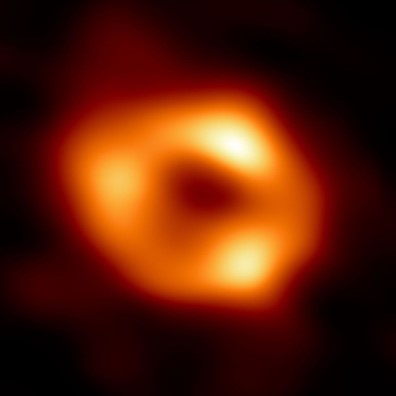
Sgr A* black hole at the centre of the Milky Way

The Centre will operate closely with other research clusters at Ahmedabad University. The International Centre for Space and Cosmology is also planning workshops and conferences, looking to host visitors for short and long durations, engage with students across the world who have an interest in Astrophysics, Space and Cosmology, and create academic programmes.

Anchored at Ahmedabad University's School of Arts and Sciences, the Centre will work in collaboration with colleagues nationally and internationally with related interests. The Director, Professor Pankaj Joshi, is a scientist acknowledged for his fundamental contributions in Black Hole Physics and Cosmology. One of his major topics of research is the possibility of gravitational collapse of massive stars into naked singularities rather than black holes. The other founding faculty members of the Centre are Professor Gaurav Goswami and Professor Raghavan Rangarajan, both of whom work on Cosmology and High Energy Physics, particularly in the context of early Universe physics and correlations with observations of the Universe today.

The launch of the new Centre coincides with recent observations by the Event Horizon Telescope (May 2022) of the highly compact and dense object at the centre of the Milky Way galaxy. Using an array of networked radio telescopes around the globe, an image has been obtained showing the ultracompact object at the centre of our galaxy. The JMN (Joshi-Malafarina-Narayan) naked singularity model proposed and published in 2011 by Professor Pankaj Joshi and colleagues contributed to the modelling that underlies this discovery.

About Ahmedabad University

Ahmedabad University is a leading private, non-profit research university offering students a liberal education focused on interdisciplinary learning and research thinking. The University, established in 2009, is rooted in the vision of one of India's finest educational foundations, the Ahmedabad Education Society, which was founded in 1935 by nationalist leaders. Programmes at the University range from bachelors to doctoral levels in humanities & social sciences, natural sciences, engineering and management through its ten Schools and Centres:

Amrut Mody School of Management | School of Arts and Sciences | School of Engineering and Applied Science | Centre for Heritage Management | VentureStudio | Centre for Learning Futures | Global Centre for Environment and Energy | Centre for Inter-Asian Research | Ahmedabad Design Lab | International Centre for Space and Cosmology.

An urban university, Ahmedabad promotes independent-mindedness and diversity across all dimensions of its activity and helps students mature into critical thinkers who are analytically equipped, practically oriented, and contextually-aware global citizens. The University provides a contemporary educational framework that brings liberal arts, sciences, and the professions to engage together in creating new knowledge for addressing complex challenges of the society and in offering majors that merge the boundaries of disciplines to prepare students for the new economy.

For more information, please visit: www.ahduni.edu.in. 

IIT Hyderabad Joins India’s Global Hunt for Einstein's Waves from Monster Black Holes

The Indian Pulsar Timing Array (a consortium of Indian institutes based mainly at NCRA-TIFR, TIFR(Mumbai), RRI, IMSc, and IITH) joined the global Pulsar timing array collaboration to search for nanoHz Gravitational waves.


Hyderabad March 27, 2021: An Indian initiative, Indian Pulsar Timing Array (InPTA), formally joined IPTA as a full member. InPTA is a collaboration of currently about 25 research scientists and students from 15 institutions in India and abroad. Dr. Shantanu Desai, Associate Professor, Dept. of Physics, Mr. Raghav Girgaonkar (BTech in Engineering Physics) and Mr. Ashwin Pandey (B.Tech in Mech. Engg.) are currently part of this prestigious collaboration from IIT Hyderabad. 

The collaboration also includes one IITH alum, Mr. Suryarao Bethapudi (BTech Engg. Physics, batch of 2018), and currently a PhD student in MPIFR, Germany. InPTA uses the uGMRT, operated by the National Centre for Radio Astrophysics of Tata Institute of Fundamental Research, for monitoring about 6 to 20-millisecond20 millisecond pulsars since 2015.

Recently, this consortium of mainly Indian researchers which regularly employs the upgraded Giant Metrewave Radio Telescope (uGMRT), situated near Pune, became a full member of the international effort to discover and study very low-frequency gravitational waves from monster black holes going around each other in orbit.

The largest radio telescopes in the world are routinely being used by an international experiment, called International Pulsar Timing Array (IPTA), to precisely measure the clock periods of a collection of these radio pulsars. The unique frequency range of the uGMRT, which is the largest steerable radio telescope at low radio frequencies, is helping to improve the precision of IPTA to detect nanohertz GWs. When discovered, these waves will refine evolutionary models of our universe as well as masses and orbits of members of our solar system and open a new window of GW astronomy. 

These clocks are observed between 300 - 800 MHz with the uGMRT, which is not covered by other big IPTA telescopes. The inclusion of uGMRT will allow removing the delays introduced by the interstellar medium in the arrival of radio pulses from these Galactic clocks by a factor of 5 more precisely than before, which should be crucial to improve the precision of IPTA. Therefore, the InPTA and the uGMRT are likely to play significant roles in the detection of nanohertz GWs and gravitational astronomy with these waves in future.

Highlighting the significance of this achievement, Dr. Shantanu Desai, Associate Professor, Dept. of Physics, said, "IITH has been part of the Indian Pulsar Timing array since 2017. Our students participate in the data collection using the unique capabilities of the uGMRT and are playing an important role in ongoing data analysis in partnership with NCRA-TIFR. Now that we are part of the global international effort to search for nanoHz gravitational waves, it provides plenty of opportunities for IITH students from science as well as engineering backgrounds to join this global effort to join this search and make ground-breaking discoveries. Moreover, IITH's participation in the detection of nanoHz gravitational waves would make it a premier institute for astrophysics and cosmology. I look forward to working with more IITH students across various departments on InPTA and participate in these monumental efforts."

About IIT Hyderabad


Indian Institute of Technology Hyderabad (IITH) is one of the six new Indian Institutes of Technology established by the Government of India in 2008. In a short span of 12 years, the institute built on an imposing 578-acre campus and has been ranked among the top 10 institutes for four consecutive years in the NIRF released by the Ministry of Education, GoI. 

IITH was also ranked under Top #20 in the recent edition ARIIA on indicators related to 'Innovation and Entrepreneurship Development' among students and faculties. IIT Hyderabad has close to 237 full-time faculty, 3,397 students of whom 20 per cent are women, nearly 200 state-of-the-art laboratories and five research and entrepreneurship centres. The Institute has a strong research focus with more than Rs. 500 crore of sanctioned research funding while PhD scholars account for about 30% of total student strength. IITH students and faculty are at the forefront of innovation with more than 1,500 research publications and patent disclosures, 300 sponsored/ consultancy projects and 50 industry & academic collaborations.

India Part of the World's Biggest Research in the Field of Black Holes - Raychaudhury

Black Holes don't move around sucking in objects like a vacuum cleaner: Director, IUCAA


“Unlike being portrayed in many science-fiction movies, Black Holes don't move around sucking in objects like a vacuum cleaner. If the Sun turns into a black hole today, it won't suck the other planets; the earth will still be revolving around the sun as if nothing happened, except that there won't be any light and that the earth will turn very cold…but still we will be revolving.” 

Director, Inter University Centre for Astronomy and Astrophysics, Pune, Somak Raychaudhury began his Nehru Science Centre, Mumbai lecture by busting some myths about Black Holes. NSC Mumbai, Ministry of Culture’s online lecture on 'The Nobel Prize 2020: Physics' – Unravelling the Mythical Black Holes by Somak Chaudhury, focussed on how the contribution of different scientists over different periods of time, right from Isaac Newton till date, have resulted in a better understanding of the black holes. 

The lecture can we watched here 


This year, three scientists have won the 2020 Nobel Prize in Physics for their contribution in understanding Black Holes: Roger Penrose (for the discovery that black hole formation is a robust prediction of the general theory of relativity), Andrea Ghez and Reinhard Genzel (for the discovery of a supermassive black hole at the centre of our galaxy).

While talking about the relevance of the lecture being organised, Shri Chawdury also pointed out the ‘Calcutta connection’ of Nobel Prize for Black Holes. He mentioned that in their study about black holes, both Stephen Hawking and Roger Penrose used the formalism laid down in 1955 by Amalkumar Raychaudhuri, a famous professor of physics at Ashutosh College under the University of Calcutta. His paper ‘Relativistic Cosmology Paper 1’ is about Einstein’s theory of general relativity.

“The paper says nothing about black holes, instead it is a concept of ‘differential geometry’. Hawking used this concept to define how a spinning star with angular momentum collapses and distorts the space time to finally end up in a singularity, and showed how singularity is quite natural and that it is not an unusual happening in the universe. This was explained by both Hawkins and Penrose in their paper, which was cited by Nobel committee this year.” said Chaudhury.

A black hole has two basic parts: the singularity and the event horizon. The singularity is at the centre and is where the mass resides. It was Stephen Hawking and R. Penrose who wrote the first paper on Singularities”, he added.

Black holes are of three types, classified on the basis of their mass - Stellar mass black holes, Mid- size black holes and Super Massive black holes.

“Findings of Andrea Ghez and Reinhard Genzel have shown the super massive black hole in the middle of our galaxy. One cannot see the black hole since no light comes from it. Hence the scientists thought of watching the stars very close to the black holes and observe their movement and believed that from their mass, the mass of the galaxy and the black holes can be measured. They have been observing the movement of stars in the galaxy since 30 years”, he added. Shri Chaudhury also said that how technologies like adaptive optics helped in getting a clear image of the black holes, even when it is tough to obtain one, due to dust.

He also mentioned about Laser Interferometer Gravitational Wave Observatory - India and the role of India in the findings and research of black holes. “India is part of the biggest research in the world that is working in the field of black holes. The construction of the LIGO is coming up in Hingoli district, Maharashtra. Land has been acquired for this purpose and work has already started”, he added.

Shri Somak Raychaudhury proudly claimed that all three of the eminent personalities who had contributed to the black holes were his teachers. “I learnt my General Relativity from Amalkumar Raychaudhuri, I took mathematics course at Oxford University from Penrose and studied about black holes from Stephen Hawking.”

Laser Interferometer Gravitational Wave Observatory - India is a planned advanced gravitational-wave observatory to be located in India as part of the worldwide network. The LIGO-India project will be built by the Department of Atomic Energy and the Department of Science and Technology, Government of India, with a Memorandum of Understanding with the National Science Foundation (NSF), USA, along with several national and international research and academic institutions. The three institutes leading the project in India are Inter-University Centre for Astronomy and Astrophysics in Pune, Raja Ramanna Centre for Advanced Technology in Indore and the Institute of Plasma Research in Ahmedabad.


Scientists from India's ARIES Suggests New Formula to Help Estimate the Mass of Black Hole


A new study has suggested a formula that can help probe black holes. Black holes (BH) cannot be observed directly, but their presence can be detected by the huge amount of energy that is liberated through temporary accumulation of matter outside the BH, before it dives into the BH, a process called accretion.

Scientists have found the formula that can assess the spectrum emitted from the accretion discs around black holes. Spectra of accretion discs can help estimate the mass of the black hole.

Accretion flow around BH is composed of ionised plasma, which is a soup of bare electrons and protons. Since electrons are more prone to radiative losses than the protons, it is expected that around a BH, electrons and protons would settle down into two separate temperature distributions. Therefore, the two-temperature equations are generally solved to obtain the emitted spectrum from the electron temperature distribution. This is known as two-temperature modeling of accretion flows. 


Scientists from Aryabhatta Research Institute of Observational Sciences (ARIES), an autonomous institute under the Department of Science and Technology (DST), Govt. of India, investigated the nature of these two-temperature flows.

The research led by Shilpa Sarkar and Indranil Chattopadhyay from ARIES along with Philippe Laurent from IRFU / Service d’ Astrophysique and Laboratoire Astroparticule et Cosmologie, which has been recently accepted for publication in the journal Astronomy & Astrophysics (A&A), found that the number of unknown variables in the two-temperature regime exceeds the number of equations present. Hence, we get multiple solutions for the same set of constants of motion, like total energy or mass-inflow rate.

Looking for a unique solution, scientists have developed a new formula called the Sarkar & Chattopadhyay form of entropy formula that can only be applied near the horizon where gravity overpowers any other interactions like energy exchange terms between ions and electrons. This novel approach helped in selecting a unique solution out of the multiple solutions of accretion disc spectrum emission around a BH. Entropy is the measure of randomness in any system. In two temperature solutions, the formula for measure of entropy does not exist. This new formula allows to measure the entropy of the flow close to the black hole horizon. According to the second law of thermodynamics, nature selects or prefers those processes which maximize entropy. ARIES team showed that there exists one solution for which the entropy is maximum and thereby broke the multiplicity of solutions.

Using this formula, they found that with the increase of the mass supply to the central BH, the accretion disc becomes brighter and more high energy photons are emitted. With the increase of mass of the BH, luminosity increases, and the bandwidth of the emitted spectrum, both in the high energy and low energy range, increases, but the spectral shape does not change. In other words, matter around a massive BH will produce a lot of photons in the low energy and high energy band, but around a smaller BH, it will emit predominantly in the X-rays.

According to the ARIES team, this is the first time any approach of removing degeneracy from two-temperature theory has been proposed. It is necessary to obtain a correct solution, and hence a correct spectrum for any accretion flow around BH as any arbitrary choice of solution would give us a wrong picture of the system. The results could contribute in the understanding of physical processes around extreme objects like BHs.

A Cartoon Diagram of Accretion Disc


the Mach number, and temperature variation with the distance from the BH is plotted. Also, in panel Fig. 2c, the total spectrum and the contribution to the spectrum from various regions of accretion disc are shown.


For more details, contact: Shilpa Sarkar (shilpa@aries.res.in) and Indranil Chattopadhyay

(indra@aries.res.in). ]

Market Reports

Market Report & Surveys
IndianWeb2.com © all rights reserved