Showing posts with label China. Show all posts

China Accuses India of Unfair EV Subsidies at Global Trade Body

China Accuses India of Unfair EV Subsidies at Global Trade Body

China has officially lodged a complaint with the World Trade Organization (WTO) against India, alleging that its electric vehicle (EV) and battery subsidy programs unfairly favor domestic manufacturers and violate global trade rules.

Key Allegations from China

Violation of WTO principles: China claims India’s subsidies breach the principle of national treatment and constitute import substitution subsidies, which are explicitly prohibited under WTO rules.

Discrimination against imports: The complaint highlights that India’s Production Linked Incentive (PLI) schemes for EVs and advanced chemistry cell (ACC) batteries are contingent on the use of domestic goods, thereby disadvantaging foreign products—especially Chinese exports.

Schemes under scrutiny:

  • ₹18,100 crore National Programme on ACC Battery Storage. 
  • ₹25,938 crore PLI Scheme for Automobile and Auto Components. 
  • Additional schemes promoting domestic EV manufacturing

India’s Position (Implied)

India offers some of the world’s highest subsidies on electric cars. For example, the Tata Nexon EV reportedly receives subsidies amounting to nearly 46% of its price, including reduced GST and other incentives.

What Happens Next?

China has requested consultations under the WTO’s dispute settlement mechanism—a formal first step in resolving trade disputes. If unresolved, the case could escalate to a WTO panel and potentially lead to retaliatory measures or mandated policy changes.

Tata Deepens Apple Ties with $100M Buyout of Chinese Supplier’s India Unit

Tata Deepens Apple Ties with $100M Buyout of Chinese Supplier’s India Unit

Tata Electronics, a Tata Group company, has acquired the India operations of Chinese industrial automation firm Justech Precision for approximately $100 million. This strategic move strengthens Tata’s position in Apple’s global supply chain, especially as Apple ramps up iPhone production in India.

Key Details:

  • Justech Precision: Headquartered in Kunshan, China, Justech has supplied high-precision CNC machinery to Apple vendors like Foxconn since 2008.
  • India Presence: Justech launched its Indian subsidiary in Tamil Nadu in 2019, aligning with Apple’s growing manufacturing footprint in the region.
  • Deal Finalized: The acquisition was completed in August 2025, with HSBC Bank and HDFC Bank advising on the transaction.
  • Tata’s Apple Ambitions: This follows Tata’s earlier acquisition of a majority stake in Pegatron’s India operations, signaling its aggressive push to become a key iPhone assembler.
This acquisition not only boosts Tata’s manufacturing capabilities but also reflects Apple’s broader strategy to diversify its supply chain away from China and deepen its India operations.

Hhh

Move Description Strategic Impact
Acquisition of Wistron’s iPhone plant (2023) Tata took over Wistron’s iPhone assembly facility in Karnataka Became India’s first homegrown iPhone assembler
Majority stake in Pegatron India (2024–25) Tata acquired a controlling interest in Pegatron’s Chennai operations Strengthened iPhone assembly capacity and workforce
Acquisition of Justech India (2025) Bought Chinese supplier Justech’s Tamil Nadu unit for ~$100M Gained precision tooling and automation capabilities
Hiring push for iPhone production Tata plans to hire 20,000+ workers for iPhone lines Supports Apple’s goal to shift 25% of iPhone production to India
Diversification into components Tata is exploring semiconductor packaging and camera module production Aims to become a vertically integrated Apple supplier

Intel, Samsung’s China Chip Plants Targeted in New U.S. Export Rules

Intel, Samsung’s China Chip Plants Targeted in New U.S. Export Rules

The U.S. Department of Commerce has officially revoked the Validated End-User (VEU) authorization for three major semiconductor firms operating in China:
  1. Intel Semiconductor (Dalian) Co. Ltd.
  2. Samsung China Semiconductor Co. Ltd.
  3. SK Hynix Semiconductor (China) Ltd.
What VEU Authorization Meant
  • The VEU program allowed Intel, Samsung, and SK Hynix to import U.S.-origin chipmaking equipment into China without individual export licenses.
  • It streamlined operations for large-scale semiconductor manufacturing in China.
What Changed
  • The U.S. Department of Commerce revoked VEU status for:
    • Intel Semiconductor (Dalian) Co. Ltd.
    • Samsung China Semiconductor Co. Ltd.
    • SK Hynix Semiconductor (China) Ltd.
  • Companies now have 120 days before the waivers expire.
  • After expiration, they must apply for individual licenses for each shipment.
  • The U.S. has stated it will not approve licenses for expansion or tech upgrades at these Chinese facilities.
Strategic Implications
  • Washington’s rationale: Part of a broader effort to tighten export controls and close “Biden-era loopholes.”
  • China’s response: Condemned the move, calling it a misuse of export controls and warning of global supply chain disruptions.
  • South Korea’s position: Working to minimize impact on Samsung and SK Hynix, which rely heavily on Chinese fabs for memory chip production.

This decision could reshape global chip supply chains and intensify the tech decoupling between the U.S. and China.

Foxconn’s Engineer Recall Exposes India’s Manufacturing Growing Pains

Foxconn’s Engineer Recall Exposes India’s Manufacturing Growing Pains

Foxconn’s recent and repeated recall of 300 Chinese engineers from its Tamil Nadu facility has cast a spotlight on India’s evolving role in global tech manufacturing—and the growing pains that come with it.

The first recall of Chinese engineers by Foxconn from its Indian facilities occurred between May and July 2025, according to Bloomberg reports. This initial wave involved over 300 engineers and technicians, primarily from the Yuzhan Technology unit in Tamil Nadu, which manufactures enclosures and display modules for older iPhone models.

The second recall, involving another 300 engineers, took place in August 2025, making it the second such incident in just a few months.

What Happened?

  • Foxconn, Apple’s key assembly partner, recalled 300 Chinese engineers from its Yuzhan Technology unit in Tamil Nadu.
  • This is the second such recall in recent months, reportedly prompted by Chinese government pressure to limit technology transfer and equipment exports to India and Southeast Asia.
  • Foxconn is now replacing the Chinese engineers with Taiwanese counterparts, signaling a strategic pivot in its workforce sourcing.

Impact on Apple’s India Expansion

  • The Yuzhan facility produces metal enclosures and display modules for older iPhone models—not the latest iPhone 17 line.
  • Apple plans to manufacture all four iPhone 17 models in India, marking a major milestone in its supply chain diversification.
  • However, the loss of experienced Chinese technicians could slow down efforts to localize production and maintain quality standards.

Spotlight on Indian Workforce

  • Apple has consciously chosen to work with Indian suppliers, notably the Tata Group, which is now the only Indian iPhone assembler.
  • While Indian firms are scaling up, they still face teething issues in precision manufacturing compared to their Chinese counterparts.
  • The recall underscores both the opportunity and challenge of building a high-tech manufacturing ecosystem in India.

Geopolitical Undercurrents

  • China’s move is seen as a silent sanction to discourage manufacturing migration to India.
  • India and China are attempting to reset diplomatic ties, including easing visa rules and exploring cooperation in strategic sectors like rare earths.
  • Meanwhile, Apple is balancing its global strategy with $100 billion in new U.S. manufacturing investments, aiming to appease American policymakers.

China’s Hellobike, Ant, and CATL Team Up to Reboot Urban Mobility with Robotaxis

China’s Hellobike, Ant, and CATL Team Up to Reboot Urban Mobility with Robotaxis

In a bold stride toward redefining urban transportation, China's Hellobike has teamed up with Ant Group and CATL to launch a dedicated robotaxi venture. With an investment of over 3 billion yuan (approximately $417 million), this collaboration aims to go beyond autonomous vehicles, laying the foundation for a green, intelligent, and deeply integrated mobility ecosystem.

Founded in 2016 by Han Mei, Jiang Wei, Li Kaizhu, and Yang Lei, Hellobike—officially Hello TransTech—has rapidly evolved from a modest bike-sharing startup into a shared mobility powerhouse. Headquartered in Shanghai, the company initially caught attention with its focus on accessible and scalable bike services. Its acquisition by Youon Bike in 2017 didn’t slow its pace; instead, Hellobike expanded into e-bikes, carpooling, and ride-hailing—building the operational backbone that now supports its robotaxi ambitions.

So, what’s behind this high-octane trio?
  • Hellobike contributes its deep operational know-how and user-facing mobility infrastructure.
  • Ant Group injects cutting-edge digital technologies like AI, blockchain, and carbon credit tracking into the venture.
  • CATL, the battery titan, powers the vision with its advanced energy solutions—including sodium-ion batteries and battery-swap innovation.
Their combined goal is a smart “vehicle-battery-cloud” system aimed at slashing 150,000 tons of carbon emissions annually while increasing operational efficiency by 30%. The first phase includes deploying 100,000 electric vehicles and 500 intelligent battery-swap cabinets across 20 cities, including Shanghai and Chengdu.

This isn’t just another autonomous driving experiment—it’s a blueprint for how fintech, clean energy, and shared mobility can converge to create scalable solutions for 21st-century cities. For markets like India watching from afar, the Hellobike model might offer inspiration for how homegrown mobility players and tech giants could team up to catalyze similar change.

Mass Production of World's First Non-Binary AI Chip Marks a New Era in Computing

Mass Production of World's First Non-Binary AI Chip Marks a New Era in Computing

China has commenced mass production of the world’s first non-binary AI chip, a groundbreaking development that challenges traditional computing limitations. Developed by Professor Li Hongge’s team at Beihang University, this innovation integrates binary logic with stochastic computing, paving the way for energy-efficient, high-performance AI hardware.

What Is a Non-Binary Chip?

For decades, computers have operated on binary logic, where every calculation relies on sequences of 0s and 1s. While highly efficient, binary computing faces growing challenges in power consumption and adaptability. A non-binary chip introduces Hybrid Stochastic Numbers (HSN) —a fusion of traditional binary numbers with probability-based values. This means that, instead of solely relying on rigid binary operations, these chips leverage randomness to optimize calculations, enhancing efficiency and fault tolerance.

A Solution to Major Tech Roadblocks

This non-binary chip addresses two critical hurdles in computing:
  • The Power Wall: Traditional chips consume excessive energy, limiting scalability. Non-binary chips significantly reduce power consumption while maintaining speed.
  • The Architecture Wall: Many experimental non-silicon chips struggle to integrate with existing systems. This new technology seamlessly aligns with CMOS-based architectures, ensuring compatibility.

Real-World Applications and Strategic Advantages

China is deploying these chips across various industries, including aviation, industrial control systems, and intelligent displays, enabling real-time AI processing with superior efficiency.

Moreover, the chip’s domestic production circumvents U.S. semiconductor export restrictions, reinforcing China’s push for technological self-reliance. The U.S. has imposed strict export restrictions on Nvidia’s AI chips, including the H20 model, which was specifically designed to comply with earlier regulations but is now banned. With China developing its own advanced AI chips, it can bypass these restrictions and continue AI development without relying on U.S. technology.

What’s Next?

This breakthrough could reshape the future of AI hardware, creating faster, smarter, and more energy-efficient systems. As global competition in semiconductor technology intensifies, non-binary computing may soon become the new standard.

Could this revolutionize AI-powered industries? Comment below to have your opinion.... 

India’s iPhone Production Lags Behind China: Scaling Bottlenecks and Supply Chain Realignment

India’s iPhone Production Lags Behind China: Scaling Bottlenecks and Supply Chain Realignment

Journalist Patrick McGee's book Apple in China highlights how India's iPhone production ramped up much more slowly than China's. Between 2016 and 2023, India produced 15 million iPhones, accounting for 7% of global shipments, whereas China, between 2006 and 2013, surged from zero to 153 million units—ten times India's pace.

A key reason is that India's role in Apple's supply chain is still largely Final Assembly, Test, and Pack (FATP), meaning most components are imported from China and assembled locally by partners like Wistron and Foxconn. This dependency limits India's ability to scale as rapidly as China did.

Apple has made progress—India now assembles flagship models, including the iPhone Pro, and distribution timelines have improved. However, full supply chain independence could take another 5–10 years, as India builds up infrastructure and local component sourcing.

McGee’s book, Apple in China, highlights both the loopholes and strengths in India’s iPhone manufacturing journey.

To start with, China's factories operate with highly optimized workflows, allowing rapid scaling. In contrast, India’s iPhone Production, as mentioned above, is still largely Final Assembly, Test, and Pack (FATP), meaning most components are imported from China. This dependency slows scaling efforts.

Unlike China’s deep manufacturing ecosystem, India lacks the same level of supplier clustering, making logistics more complex. Moreover, China builts a vast electronics manufacturing ecosystem over decades, while India is still developing its supply chain. Most components are imported from China, adding logistical complexity and costs.

Apple’s diversification into India hasn’t fully reduced reliance on China. The Shanghai lockdown in 2022 accelerated India’s role, but parallel operations have increased complexity rather than true supply chain independence.

Apple initially faced hurdles due to India’s 30% local sourcing requirement, which was relaxed in 2017 but still affects supply chain efficiency.

As of now, India has moved beyond entry-level models and now assembles iPhone Pro variants, matching China’s distribution timeliness.

Meanwhile, Apple’s $22 billion investment in India signals long-term commitment, with Foxconn and Tata playing key roles in scaling production. Apple aims to make India a full-fledged manufacturing hub, but experts estimate it could take 5–10 years before India reaches China's scale.

Rising US-China tensions and tariff policies make India a more attractive alternative for Apple’s supply chain diversification.

India’s expanding middle class and increasing iPhone adoption create a strong domestic market, encouraging further investment.

Foxconn’s recent $1.5 billion investment in India signals progress, but deep manufacturing (chips, displays, batteries) is still lacking.

India is making strides, but full-scale manufacturing independence could take another 5–10 years. It's an interesting case study, for the world to see, in manufacturing dynamics. Do you think India can eventually match China's scale, or will structural challenges persist? Do comment below....

Adani Cuts Ties with Turkey & China based Companies

Adani Cuts Ties with Turkey & China based Companies

Adani Airports has terminated agreements with both Turkish ground handling firm Çelebi and Chinese lounge access provider DragonPass due to national security concerns.

The Indian government revoked Celebi's security clearance, citing national security risks. Adani Airports directed Celebi to hand over all ground handling facilities at Mumbai and Ahmedabad International Airports.

Çelebi Aviation

Celebi was responsible for ground handling at Mumbai and Ahmedabad International Airports. Adani Airports has directed the company to hand over all facilities, ensuring seamless service through new agencies.

Çelebi Aviation is a Turkish-origin ground handling firm that has operated in India for over 15 years.

Termination of agreement with Celebi is a shake-up in India’s aviation sector which could lead to new players entering the ground handling space considering the fact that the firm entered India in 2009 and its presence in India has been significant, handling 58,000 flights annually and employing 7,800 people.

Celebi initially partnered with Mumbai International Airport to provide ground handling services. Over the years, it grew to operate at nine major airports, including Mumbai, Delhi, Cochin, Kannur, Bangalore, Hyderabad, Goa, Ahmedabad, and Chennai

Celebi Aviation India claims it is not a Turkish firm, stating that 65% of its ownership lies with international investors from Canada, the US, the UK, Singapore, the UAE, and Western Europe.

However, Celebi Havacılık Holding A.Ş., a Turkish entity, holds 50% ownership, raising concerns about its Turkish affiliations.

DragonPass

Adani Airports terminated its association with DragonPass, which provided digital airport lounge access. DragonPass customers can no longer access lounges at Adani-managed airports.

Announced just in last week, the Adani-Dragonpass collaboration would have had allowed Dragonpass to gain access to all Adani-managed airport lounges, along with additional key lounges across India.

According to news agency IANS, Adani's association with DragonPass, which provided access to airport lounges, has been terminated with immediate effect.

The move comes amid heightened tensions between India and Turkey, following Ankara’s support for Pakistan after India's recent military action, Operation Sindoor.


The termination of these partnerships could reshape India’s aviation sector, affecting ground handling operations and digital lounge access services.

This decision reflects India’s tightening stance on foreign partnerships, particularly in critical infrastructure sectors. What do you think about this shift? Comment your opinion below...

Modi’s Message on Indigenous Defense Wipes Billions from Chinese Stocks


Chinese defence stocks, including China Aerospace Times Electronics, AVIC Aircraft, and Bright Laser Technologies, have been experiencing a sharp decline following Prime Minister Narendra Modi's speech. The Hang Seng China A Aerospace & Defence Index dropped for the second consecutive session, losing 1.3%, with individual stocks falling between 1% and 4%.

One of the most notable declines was Avic Chengdu Aircraft, the manufacturer of J-10 fighter jets, which saw its share price plummet over 9% in two days. This downturn comes after India's Operation Sindoor, which showcased the effectiveness of indigenous defence systems like the Akash Surface-to-Air Missile (SAM) and electronic warfare systems.

PM Modi emphasized that Pakistan's drones and missiles were neutralized by India's air defence systems, reinforcing confidence in India-made defence equipment.

The Prime Minister's address reinforced confidence in India-made defense equipment, stating that Pakistan's drones and missiles were neutralized by India's air defense systems. This has led to investor skepticism about the reliability of Chinese defense exports.

Investors are reassessing the credibility of Chinese defense exports, especially after India's strong pushback against misinformation regarding airbase attacks. This has resulted in Chinese defense stocks tumbling upto now 9%.

The Hang Seng China A Aerospace & Defence Index has been on a downward trajectory, with major Chinese defense firms experiencing losses between 1% and 4.5%.

The market reaction suggests a shift in investor sentiment, with Indian defence stocks rallying while Chinese defence exporters face uncertainty.


China Achieves Historic First: Refueling a Running Nuclear Reactor

China Achieves Historic First: Refueling a Running Nuclear Reactor
  • China Revives Abandoned U.S. Nuclear Tech to Achieve Energy Breakthrough
  • China now has world's first operational thorium nuclear reactor
Chinese scientists have achieved a major breakthrough in nuclear energy by reviving old research from the United States. They built a unique reactor in the Gobi Desert that runs on thorium, a different and safer fuel compared to uranium.

Unlike traditional reactors, the Chinese scientists built one that produces less nuclear waste. The most impressive part of their achievement is that they managed to refill the reactor while it was still running, something no one had done before.

Chinese scientists have successfully refueled an experimental thorium molten salt reactor without shutting it down—an unprecedented breakthrough in nuclear energy.

This technology was originally developed in the U.S. in the 1950s, but it was abandoned, leaving the research publicly available. China picked up where the U.S. left off and successfully made it work. If this innovation can be scaled up, it could lead to cleaner and safer nuclear power, helping the world transition to better energy solutions with less pollution. This marks a significant step toward sustainable energy and reducing carbon emissions.

As mentioned above, thorium reactors were originally developed in the United States in the 1950s, but the U.S. shifted focus to uranium-based reactors, leaving this research publicly available. Chinese scientists capitalized on this abandoned knowledge, refining it into a working prototype.

Comic Timing

The timing of China’s nuclear breakthrough is almost poetic, given the ongoing tariff war with the U.S. Right now, Washington and Beijing are locked in a tense trade battle, with the U.S. imposing up to 145% tariffs on Chinese goods, while China retaliates with 125% tariffs on American imports.

Against this backdrop, China’s successful revival of abandoned U.S. nuclear research feels like a strategic flex. It’s as if Beijing is saying, “You may have left this behind, but we’ve turned it into a game-changer.” The fact that the U.S. originally developed thorium reactor technology in the 1950s, only to abandon it, makes this moment even more ironic.

While trade tensions escalate, China is making strides in energy independence, potentially reducing reliance on foreign fuel sources. If thorium reactors prove viable on a large scale, China could strengthen its energy security, making it less vulnerable to external pressures—including economic sanctions.

It’s an interesting mix of scientific progress and geopolitical maneuvering.

Nuclear Technology

This reactor can generate 2 megawatts (MW) of energy, enough to power around 2,000 households, and it significantly reduces nuclear waste compared to conventional uranium reactors. Given China’s goal of carbon neutrality by 2060, this breakthrough could play a crucial role in its clean energy transition.

China’s breakthrough in nuclear energy revolves around a thorium molten salt reactor (TMSR), a next-generation nuclear system that operates differently from traditional uranium-based reactors. Here are the key technical details:
  • Fuel Source: Instead of solid uranium rods, this reactor uses liquid thorium dissolved in molten salt.
  • Refueling Innovation: Scientists successfully refueled the reactor while it was still running, a feat never achieved before.
  • Safety Features: The molten salt system prevents overheating, making meltdowns nearly impossible.
  • Efficiency: Thorium reactors extract more energy per unit of fuel compared to uranium reactors.
  • Waste Reduction: Produces minimal long-lived radioactive waste, unlike conventional nuclear reactors.
  • Self-Regulating Mechanism: If the reactor overheats, the molten salt expands, automatically reducing nuclear reactions.
  • Emergency Shutdown System: A freeze plug at the reactor’s base melts in emergencies, draining the fuel into a safe storage chamber to stop reactions instantly.
  • Power Output: The experimental reactor generates 2 megawatts (MW) of thermal power, enough to supply around 2,000 households
This breakthrough could redefine nuclear energy by making it safer, cleaner, and more sustainable. What’s your take on this? Comment below....

Nvidia Faces $5.5 Billion Hit as U.S. Tightens AI Chip Export Rules to China

Nvidia Faces $5.5 Billion Hit as U.S. Tightens AI Chip Export Rules to China

Nvidia is facing a $5.5 billion charge after the U.S. government restricted exports of its H20 Al chips to China. Nvidia's shares dropped about 6% following the announcement. 

The H20 was designed to comply with earlier export limits, but officials now fear it could be used in Chinese supercomputers, prompting indefinite licensing requirements.

China previously accounted for 20% of Nvidia's revenue, but this has now shrunk to about 10%, with expectations that it could drop to near zero.

This move is part of Washington's broader strategy to limit China's access to advanced Al hardware, escalating tensions in the global tech race. Nvidia's stock dropped about 6% following the announcement.

The H20 was Nvidia's most advanced chip available in China, widely used by companies like Tencent, Alibaba, and ByteDance. These firms had ramped up orders due to growing demand for Al models.

While the H20 has lower computing capabilities than Nvidia's top-tier chips, its high-speed memory and connectivity raised concerns that it could be used in Chinese supercomputers, prompting the U.S. to impose indefinite licensing requirements.

Meanwhile, Nvidia is pivoting towards its Blackwell-series Al chips, which are expected to be the next major product line. Besides, the company has recently announced plans to build AI servers worth up to $500 billion in the U.S. over the next four years, aligning with efforts to boost domestic tech infrastructure.

Nvidia is bracing for additional U.S. export controls under proposed "AI diffusion rules," which could further limit its ability to sell advanced AI hardware globally. Revenue from China has halved compared to pre-restriction levels, with Huawei emerging as a key competitor.

Analysts predict that Chinese firms may pivot to Huawei or other domestic alternatives, accelerating China’s push for semiconductor independence.

The U.S. government now requires indefinite export licenses for H20 shipments to China, citing concerns over potential use in Chinese supercomputers.

Next-Level AI Training: Quantum Computing Fine-Tunes Billion-Parameter Model

Chinese researchers have achieved a global first by using a real quantum computer to fine-tune an Al model with one billion parameters. The experiment was conducted on Origin Wukong, China's third-generation superconducting quantum computer with 72 qubits.

Next-Level AI Training: Quantum Computing Fine-Tunes Billion-Parameter Model
Workers calibrate and install the China's independently developed third-generation superconducting quantum computer. Photo:Courtesy: Anhui Quantum Computing Engineering Research Center

This breakthrough led to an 8.4% improvement in training performance while reducing the number of parameters by 76%. The Al model also showed better results in specific tasks-when trained on mental health conversation data, it made 15% fewer mistakes, and in a math problem-solving test, its accuracy jumped from 68% to 82%.

The fine-tuning process traditionally requires high computing power, but quantum computing offers unique Chinese researchers have achieved a global first by using a real quantum computer to fine-tune an Al model with one billion parameters. The experiment was conducted on Origin Wukong, China's third-generation superconducting quantum computer with 72 qubits.

This breakthrough led to an 8.4% improvement in training performance while reducing the number of parameters by 76%. The Al model also showed better results in specific tasks-when trained on mental health conversation data, it made 15% fewer mistakes, and in a math problem-solving test, its accuracy jumped from 68% to 82%.

The fine-tuning process traditionally requires high computing power, but quantum computing offers unique advantages. By leveraging superposition and entanglement, quantum computers can explore vast combinations of parameters simultaneously, making Al training faster and more efficient.

This development could be a game-changer for Al training, reducing computational costs and improving model efficiency.

Experts have reacted with cautious optimism to China's breakthrough in using a quantum computer to fine-tune a billion-parameter AI model.

Some experts remain skeptical, pointing out that while the results are promising, the research is still in the demonstration phase and lacks peer-reviewed validation.

In A Major Shift, India Now Exporting Apple Components To China And Vietnam

In A Major Shift, India Now Exporting Apple Components To China And Vietnam

For the first time, India has started exporting electronic components for Apple products to China and Vietnam. This marks a notable shift in India's role within the global supply chain, transitioning from a net importer to an exporter of these components.

Thanks to Government of India's initiatives like Make in India and Product Linked Incentive (PLI), Apple suppliers like Motherson Group, Jabil, Aequs, and Tata Electronics are producing key components in India, contributing to the development of a local electronics manufacturing ecosystem. This initiative is part of Apple's broader strategy to diversify its supply chain and deepen domestic value addition in India.

This move is expected to boost India's electronics manufacturing sector and help the country achieve its component exports target of $35-40 billion by 2030. It's a fascinating example of how global supply chains are evolving and how strategic investments can reshape economic landscapes.

China and Vietnam, which have been major hubs for Apple's manufacturing, will now receive components from India for final assembly. This could lead to a reconfiguration of their supply chains and potentially reduce their reliance on other component suppliers.

Countries like Taiwan, South Korea, and Japan, which are also significant players in the electronics manufacturing sector, might experience competitive pressure as India strengthens its position in the supply chain.

Moreover, for Apple, which is a US-based company, this shift aligns with its strategy to diversify its supply chain and reduce dependency on China. This move could also influence other US tech companies to explore similar strategies.

Domestically, this shift is expected to boost India's electronics manufacturing sector, create jobs, and attract further investments. It aligns with the Indian government's "Make in India" initiative and its goal to become a major electronics exporter.

Apple and Alibaba Collaborate for AI Features for China's iPhone Users

Apple and Alibaba Collaborate for AI Features for China's iPhone Users

Apple has partnered with Alibaba to develop AI features specifically for iPhone users in China. This collaboration aims to address Apple's declining market share in China, where competitors like Huawei have already integrated AI tools into their devices.

The partnership is significant because it allows Apple to navigate China's strict regulatory landscape by leveraging Alibaba's extensive experience in AI and its vast user data from platforms like Taobao and Tmall. The jointly developed AI features are currently awaiting regulatory approval, and if approved, they could be integrated into future iOS updates.

This move is seen as a potential game-changer for Apple's position in the Chinese market, where iPhone sales have been struggling since 2024. It could also help Apple regain lost ground by offering more personalized and intuitive AI-powered features for Chinese users.

The partnership between Apple and Alibaba could lead to several AI features for iPhone users in China. Some potential features include Enhanced Siri Responses where in Siri could provide more accurate and context-aware responses by leveraging Alibaba's AI models and vast user data.

With this partnership, Apple Intelligence, which has been unavailable in China, could be reintroduced with features tailored specifically for Chinese users. Notably, Apple has set an internal target to roll out Apple Intelligence in simplified Chinese by April for users outside China. However, bringing the service to mainland China still requires regulatory approval.

Besides, with this partnership iPhone users in China might receive personalized content recommendations based on their browsing and purchasing habits from platforms like Taobao and Tmall.

This collaboration aims to address Apple's declining market share in China by integrating localized AI services that comply with the country's strict regulatory landscape. Apple has been facing declining market share in China, partly due to the lack of AI features in its devices. Competitors like Huawei have already integrated AI tools into their smartphones, putting Apple at a disadvantage.

Before partnering with Alibaba, Apple explored collaborations with other Chinese tech giants like Baidu, Tencent, and ByteDance. However, these partnerships did not meet Apple's standards due to various reasons, including privacy concerns and technical challenges.

Alibaba was chosen as the ideal partner due to its extensive experience in AI and its vast user data from platforms like Taobao and Tmall – two of the largest e-commerce platforms in China, both owned by Alibaba Group.

The jointly developed AI features are currently awaiting regulatory approval, but if approved, they could significantly enhance user experiences with smarter Siri responses, improved search capabilities, and more personalized services.

These features aim to provide a more personalized and intuitive user experience, helping Apple regain its competitive edge in the Chinese market.

Chinese Startup's Cheaper AI Model Creates Ripples Causing US Stock Market to Drop by $1 Trillion in Single Day

Chinese Startup's Cheaper AI Model Creates Ripples Causing US Stock Market to Drop by $1 Trillion in Single Day

China's DeepSeek AI has recently made headlines by shaking up the U.S. stock market. Here's a brief overview of what happened:

DeepSeek AI, a Chinese artificial intelligence startup, announced a breakthrough in AI technology with its R1 model, which can rival the performance of leading U.S. AI models like OpenAI's GPT-4 but at a fraction of the cost. This announcement caused a significant drop in the stock market, particularly affecting tech giants like Nvidia, which saw a historic $589 billion loss in market value in a single day. The overall impact on the tech-heavy Nasdaq index was a drop of nearly $1 trillion in global market value.

On 10 January 2025, DeepSeek released its first free chatbot app, based on the DeepSeek-R1 model, for iOS and Android. By 27 January, DeepSeek-R1 had surpassed ChatGPT as the most-downloaded free app on the iOS App Store in the United States, causing Nvidia's share price to drop by 18%. Besides United States, the Deepseek effect could also be seen in Japan as SoftBank stock price also fell by 8% during trading hours in Tokyo.

The key factors contributing to these market reaction include:
  • Cost Efficiency: DeepSeek's AI model was developed for $5.6 million, much less than the billions spent by U.S. companies on similar models.
  • Technological Leap: DeepSeek's model challenges the dominance of U.S. tech firms and raises questions about the sustainability of high capital expenditures in AI development.
  • Market Panic: The sudden rise of a competitive AI model from China led to investor uncertainty and a sell-off in tech stocks.
This event has sparked debates about the economic and geopolitical competition between the U.S. and China in the AI industry. It's indeed a significant development in the tech world!

Headquartered in Hangzhou, Zhejiang, DeepSeek is a Chinese AI startup founded by Liang Wenfeng in May 2023. As for investors, DeepSeek is funded by the Chinese hedge fund High-Flyer, which was co-founded by Liang Wenfeng. High-Flyer focuses on developing and using AI trading algorithms.

The 20-months old Chinese start-up has quickly gained attention with its DeepSeek-V3 and DeepSeek-R1 models, which have been praised for their efficiency and cost-effectiveness. Here are some key points about DeepSeek:

Cost-Effective Development: DeepSeek-V3 was trained using approximately 2,000 Nvidia H800 chips over 55 days, costing around $5.58 million. This is significantly less than the billions spent by other companies on similar models.

Advanced Capabilities: DeepSeek-R1 focuses on logical inference, mathematical reasoning, and real-time problem-solving, achieving performance comparable to OpenAI's o1 model.

Open Source: DeepSeek's models are available for free, making them accessible to a wider audience.

Global Impact: The launch of DeepSeek has caused a significant reaction in global markets, particularly affecting U.S. tech stocks.

DeepSeek's innovative approach to AI development has sparked discussions about the future of AI technology and its potential to democratize access to advanced AI tools.

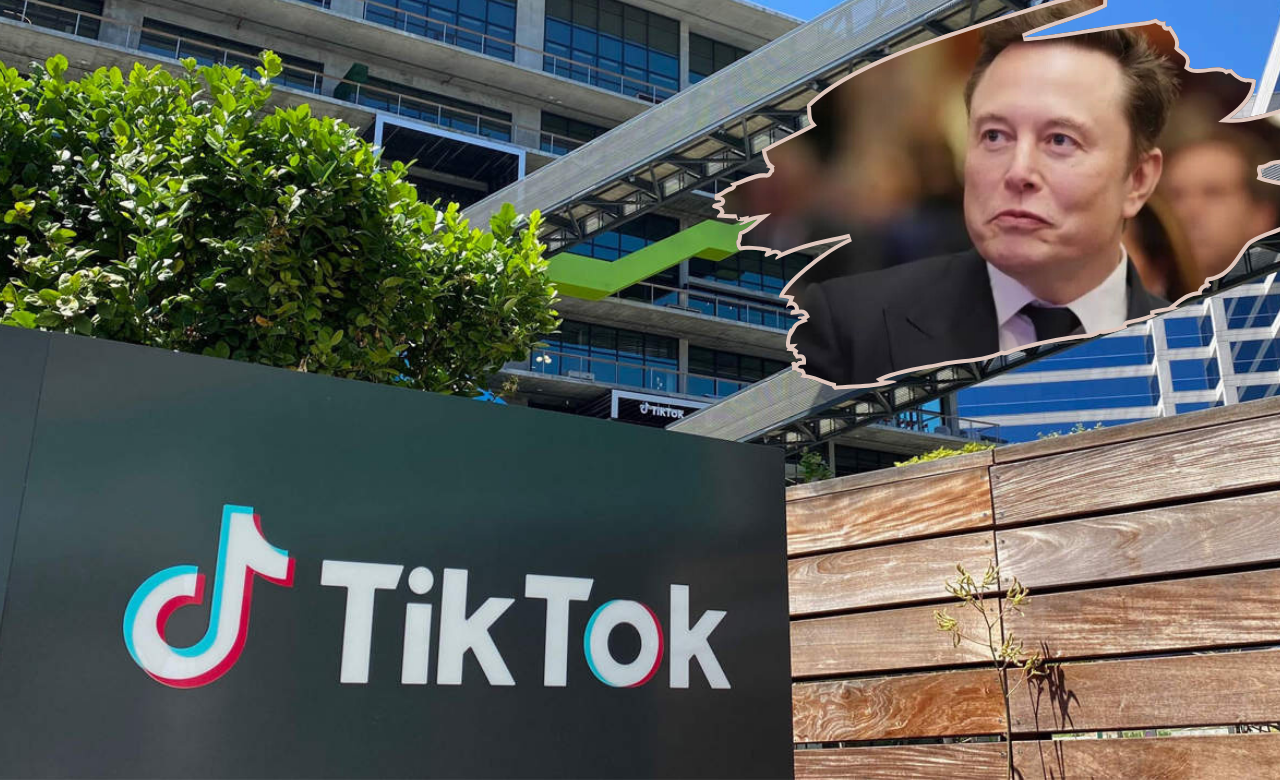
China in Early Talks to Sell Tiktok US to Elon Musk

China in Early Talks to Sell Tiktok US to Elon Musk

China is reportedly considering selling TikTok's US operations to Elon Musk if the platform faces a potential ban in the United States, said a Bloomberg News reported on Monday. The discussions are still in the preliminary stages, and Chinese officials are evaluating various contingency plans.

Summarized Points:

Potential Buyer: Elon Musk, who recently rebranded Twitter as "X," is being considered as a potential buyer.

Reason for Sale: The US government has passed a law requiring TikTok's parent company, ByteDance, to either sell the platform or shut it down due to national security concerns.

Geopolitical Factors: The sale is seen as a strategic move to maintain TikTok's presence in the US while navigating complex geopolitical and financial factors.

Musk's Stance: Musk has expressed his opinion that TikTok should remain available in the US, citing freedom of speech and expression.

The situation is still evolving, and it remains to be seen how the negotiations will unfold.

TikTok's presence in the US has been a topic of significant debate and legal scrutiny.

The US government passed a law requiring TikTok's parent company, ByteDance, to either sell its US operations or shut down the app due to national security concerns. The law is set to take effect on January 19, 2025.

TikTok has challenged the ban, arguing that it violates the First Amendment's free speech protections. However, the US Supreme Court appears poised to uphold the legislation.

It is to be noted that, TikTok has dismissed reports of a potential sale to Elon Musk as "pure fiction". The company has stated that it cannot comment on speculative discussions.

TikTok has over 170 million users in the US, making it a significant platform for content creators and advertisers.

The potential sale could have broader implications for US-China relations and the global tech industry.

China Approves World's Biggest Hydropower Dam Close To India Border

China Approves World's Biggest Hydropower Dam Close To India Border

China has recently approved the construction of the world's largest Hydropower dam on the Brahmaputra River, also known as the Yarlung Zangbo River in Tibet.

This project is part of China's 14th Five-Year Plan and is expected to cost around $137 billion. The dam aims to generate 300 billion kWh of electricity annually, which could power over 300 million people.

The Brahmaputra River a.k.a Yarlung Zangbo River has a steep descent of approximately 25,152 feet (7,667 meters) from its source to India, making it one of the most "hydropower-rich" rivers in the world. The project will take advantage of this steep gradient to maximize energy production.

However, this project has raised concerns in India and Bangladesh, as it could give China control over the flow of the river, potentially impacting water availability downstream. Both the countries have expressed concerns about the potential impact on water flow and local ecology. Any alteration in water flow could disrupt agriculture and water availability in both India and Bangladesh.

Large dams often block the flow of silt, which is essential for maintaining fertile agricultural land downstream. Changes in river flow can also affect local biodiversity and ecosystems, potentially disrupting the livelihoods of communities that depend on the river.

There are also concerns about the dam's location in a seismically active region, which could pose significant engineering challenges. The project will require drilling multiple long tunnels to divert the river, which flows at a rate of 70,600 cubic feet per second (2,000 cubic meters).

The dam is expected to generate 300 billion kilowatt-hours (kWh) of electricity annually, which is nearly three times the capacity of the current record-holder, the Three Gorges Dam.

This ambitious project is part of China's efforts to boost renewable energy and achieve its carbon neutrality goals. However, it has raised concerns in India and Bangladesh about potential impacts on water flow and local ecology downstream.

Indian officials have expressed their concerns regarding the Yarlung Tsangpo Hydroelectric Project. Randhir Jaiswal, spokesperson for India's Ministry of External Affairs (MEA), stated that India has consistently raised its concerns through expert-level and diplomatic channels. India has urged China to ensure that the interests of downstream states are not harmed by activities in upstream areas. The Indian government has emphasized the need for transparency and consultation with downstream countries to protect their interests.

India will continue to monitor the situation and take necessary measures to safeguard its interests. The MEA has also highlighted the importance of maintaining dialogue with China on trans-border rivers to address any potential issues.

It's a delicate situation that requires ongoing communication and cooperation between the two countries.

This project is a significant step towards China's renewable energy goals, but it also brings a host of environmental and geopolitical challenges.

China Dam Slowing Down Earth's Rotation, Says NASA

China Dam Slowing Down Earth's Rotation, Says NASA

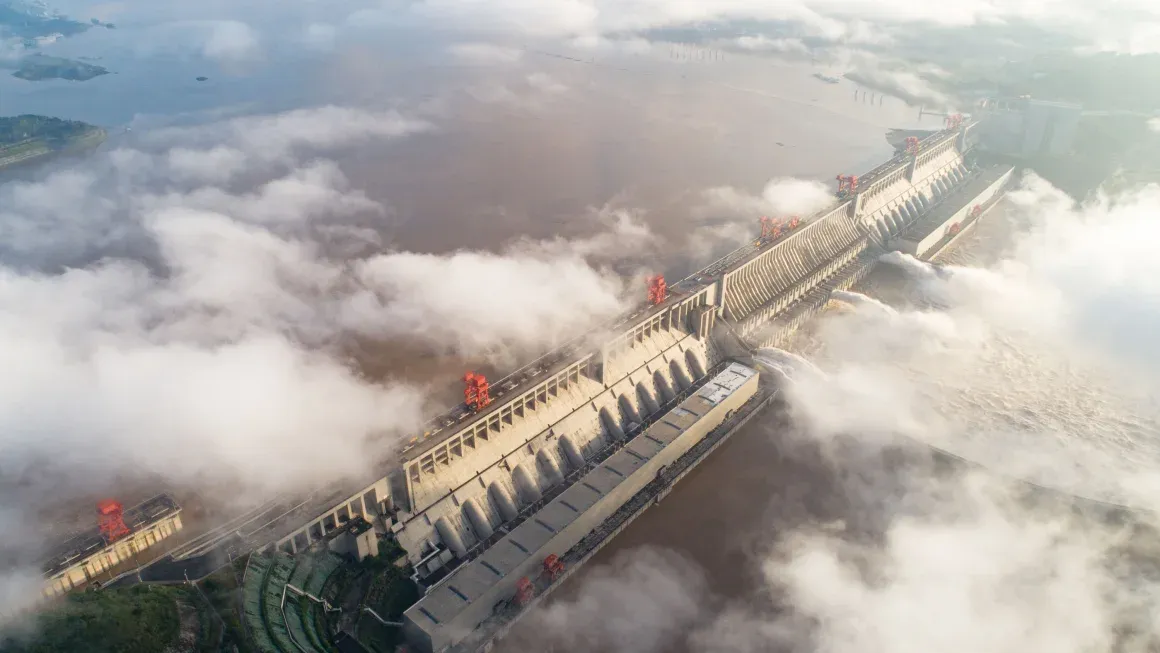
The Three Gorges Dam in China had a measurable impact on Earth's rotation, says scientists from the US space agency NASA. The dam spans the Yangtze River in Hubei province, China. It is about 2,335 meters (7,660 feet) long and 185 meters (607 feet) high. The reservoir created by the dam is 600 kilometers (370 miles) long and can hold up to 39.3 cubic kilometers (9.43 cubic miles) of water.

The primary purpose of the dam is to generate electricity. It has an installed capacity of 22,500 megawatts, making it the largest hydroelectric power station in the world.

The massive weight of the water stored in the dam's reservoir has increased Earth's moment of inertia. This means that the distribution of Earth's mass has changed, causing a slight decrease in the speed of Earth's rotation.

As a result, the length of a day has increased by about 0.06 microseconds. While this change is incredibly small and not noticeable in daily life, it is scientifically significant.

Three Gorges Dam

Three Gorges Dam

 If filled, the dam would hold 40 cubic kilometers (10 trillion gallons) of water. That shift of mass would increase the length of day by only 0.06 microseconds and make the Earth only very slightly more round in the middle and flat on the top. It would shift the pole position by about two centimeters (0.8 inch).

Other Effects

Power Generation: The dam generates a massive amount of electricity, approximately 88.2 billion kWh annually, making it the world's largest hydroelectric power station.

Environmental Impact: The construction and operation of the dam have led to significant environmental changes, including the relocation of over 1.2 million people and the flooding of large.

Future Projects

China is planning to build an even larger dam on the Yarlung Tsangpo River, which could have even more pronounced effects on Earth's rotation and the environment.

It's fascinating how human engineering can have such a profound impact on our planet. 

Chinese-owned Loan Apps' Companies Turn Rs 1 Cr to Rs 6 Cr in 90 Days, Finds ED Investigation

Chinese-owned Loan Apps' Companies Turn Rs 1 Cr to Rs 6 Cr in 90 Days, Finds ED Investigation

The Enforcement Directorate (ED) recently conducted an investigation into several Chinese-owned fintech companies operating in India. The investigation revealed that these companies were able to turn an investment of Rs 1 crore into Rs 6 crore in just 90 days by offering short-term loans through mobile apps.

These companies charged 30%-40% of the sanctioned loan amount as an upfront processing fee.

Interest rates on these loans were as high as 36%, making the effective annual interest rate reach up to 2,000%, eventually making repayment extremely difficult. This fee is charged every time a borrower takes a loan. These short-term loans are for anywhere between a week to four months.

According to an Indian Express report, the ED Investigation found that the borrowers and their contacts are also sent fake legal notices, messages labelling them as thieves, apart from adding them to Whatsapp groups where abusive messages are sent. Women contacts are harassed with obscene messages.

Borrowers often found themselves in a debt trap, taking new loans to pay off previous ones due to the high costs involved.

Despite the high costs, these companies managed to achieve a net profit margin of Rs 5.2 crore in just three months.

The ED sources said that, although such fintech companies have Indian employees, the ultimate owners are Chinese who take the decisions. In the recent case of PC Financial Services (PCFS) which ran the Cashbean app, ED found that Rs 429 crore was sent to Chinese owners allegedly through bogus transactions which are violations under FEMA.

Earlier this year, the ED conducted raids across 19 locations in Delhi, Chandigarh, Haryana, Punjab, and Gujarat and conducted investigation of several Chinese-owned fintech companies, including Shinebay Technology India Private Limited (STIPL) and Mpurse Services Private Limited (MSPL).

These companies were involved in unethical lending practices through mobile apps, leading to significant penalties and asset seizures. Borrowers were harassed through threatening phone calls, unauthorized access to personal information, and circulation of morphed photographs.

In April 2022, the ED had taken action by attaching assets worth Rs 6.17 crore belonging to these fintech companies. This investigation highlights the need for stricter regulations and oversight in the fintech sector to protect consumers from predatory lending practices.

The ED has initiated investigations under various sections of the Indian Penal Code (IPC) and the Information Technology Act, 2000.

The ED investigation has also found that these Fintech companies get into the lending business after entering into agreements with non-banking finance companies (NBFC) which have valid RBI licences. The NBFCs themselves earn a guaranteed return without investing anything by virtue of just holding the licences.

Tata Plant Fire Accident Is China's Opportunity in Disguise?

Tata Plant Fire Accident Is China's Opportunity in Disguise?

A recent fire accident at Tata Group's Apple iPhone component plant in Hosur, Tamil Nadu, and that too when festive season is very close has mushroomed number of questions on this incident.

Given the timing around the festive season, there are concerns and speculations on the reasons behind the accident. The investigation will help clarify the situation and ensure that appropriate measures are taken to prevent such incidents in the future.

Hong Kong-based Counterpoint Research told Reuters it estimates local sales of 1.5 million units of iPhone 14 and 15 models during the Indian festive season which runs from late October to early November, with Apple struggling to fulfil as much as 15% of that demand due to the fire.

As the fire at Tata Electronics’ factory in Hosur has caused significant disruptions in the production of iPhone components, particularly ahead of the festive season. Due to the extensive damage, Apple is considering shifting some of its production back to China to meet the demand.

This move is seen as a temporary measure to ensure that the supply chain remains intact and that there are no major delays in the availability of iPhones. Apple has been diversifying its manufacturing base beyond China, but incidents like this highlight the challenges of such a transition.

Apple's reliance on the Tata Electronics factory in Hosur is part of its broader strategy to diversify its supply chain beyond China. This factory plays a crucial role in manufacturing components for iPhones, particularly as Apple aims to reduce its dependence on a single country for production.

However, Apple still maintains significant production capabilities in China, which allows it to mitigate disruptions like the recent fire at the Tata Electronics factory. The incident underscores the challenges of diversifying the supply chain but also highlights the importance of having multiple production sites to ensure continuity.

Opportunity for China

The fire at Tata Electronics’ factory in Hosur has created an opportunity for China to benefit in several ways.

With the disruption in India, Apple may need to shift more production back to China to meet demand, especially ahead of the festive season. This could lead to increased orders for Chinese manufacturers like Foxconn and Pegatron.

China’s economy however is experiencing a slow and uneven recovery from the COVID-19 pandemic. Recent data shows slower-than-expected growth in retail sales, industrial production, and urban investment.

The urban jobless rate in China has risen to a six-month high, reflecting ongoing struggles in the labor market.

As a result of the recent fire incident at Tata's factory, increased production orders (Apple in this case) can provide an economic boost to the regions in China where the manufacturing plants of Foxconn, Pegatron, and Wistron are located, supporting local economies and employment.

The incident also underscores the challenges Apple faces in diversifying its supply chain. As a result, Apple might continue to rely heavily on its well-established Chinese supply chain to ensure production stability.

Apple's production capabilities in China are extensive and play a critical role in its global supply chain. The iPhone maker relies heavily on several key manufacturing partners, including Foxconn, Pegatron, and Wistron, which operate large-scale factories in various regions of China. These facilities are responsible for assembling a significant portion of Apple's products, including iPhones, iPads, and MacBooks.

China's well-established infrastructure, skilled labor force, and efficient logistics network make it an ideal location for high-volume production. Despite efforts to diversify its manufacturing base to countries like India and Vietnam, China remains a central hub for Apple's production due to its capacity to handle large-scale operations and rapid production cycles.

While Apple aims to diversify its supply chain, incidents like this fire demonstrate the complexities and risks involved, often leading to a temporary reversion to more established production bases.

The recent fire at the Tata Electronics factory in Hosur emphasized the importance of having a diversified supply chain, but it also highlights why China continues to be a vital part of Apple's manufacturing strategy.

Market Reports

Market Report & Surveys
IndianWeb2.com © all rights reserved