Showing posts with label Government of India. Show all posts

India to Invite Financial Bids for IDBI Bank Stake Sale in Q3 FY26

India to Invite Financial Bids for IDBI Bank Stake Sale in Q3 FY26

India is set to invite financial bids for the strategic stake sale of IDBI Bank during the October–December quarter of FY26, according to DIPAM Secretary Arunish Chawla.

Key Highlights:

  • Stake on offer: 60.72% jointly held by the Government of India (45.48%) and LIC (49.24%).
  • Due diligence completed: All data room protocols and consultations with qualified bidders are finalized.
Expected timeline:
  • Financial bids: Q3 FY26 (Oct–Dec 2025)
  • Winning bidder announcement: By March 2026.
  • Potential buyers: Include Fairfax India Holdings, Emirates NBD, and Kotak Mahindra Bank.
  • Estimated proceeds: Around ₹50,000 crore for the government and LIC.
This sale marks a major step in India’s broader privatization agenda, especially for public sector banks.

Govt Stake in Vodafone Idea to Rise to 48.99% As Spectrum Dues Convert to Equity

Govt Stake in Vodafone Idea to Rise to 48.99% As Spectrum Dues Convert to Equity

The Indian government's stake in Vodafone Idea is set to increase significantly from 22.60% to approximately 48.99%. This change comes as part of a telecom sector relief package introduced in September 2021. The government will convert outstanding spectrum auction dues worth ₹36,950 crore into equity.

Vodafone Idea will issue 3,695 crore equity shares at a face value of ₹10 each. Despite the government's increased stake, the promoters—Vodafone Plc and Aditya Birla Group—will retain operational control of the company.

The government will convert outstanding spectrum auction dues worth ₹36,950 crore into equity shares. Vodafone Idea will issue 3,695 crore equity shares at a face value of ₹10 each.

The equity conversion process will be completed within 30 days, subject to approvals from the Securities and Exchange Board of India (SEBI) and other relevant authorities.

This move is expected to provide liquidity support to Vodafone Idea, helping it manage its debts and sustain operations in a highly competitive telecom market.

The government's intervention is seen as a strategic effort to prevent market consolidation into a duopoly and maintain healthy competition in the telecom sector. This development highlights the government's proactive approach to stabilizing the telecom industry while ensuring that private players remain operationally independent.

This move aims to alleviate Vodafone Idea's financial distress and ensure its sustainability in the competitive telecom market.

This move may provide much-needed financial relief to Vodafone Idea, helping it manage its debts and spectrum dues. It could also improve investor confidence in the company's ability to sustain operations.

With the government holding a significant stake, there might be increased scrutiny and regulation, potentially influencing the competitive landscape of the telecom sector.

Despite the government's larger shareholding, operational control remains with the promoters, Vodafone Plc and Aditya Birla Group. This ensures continuity in management but raises questions about the government's role in strategic decisions.

Modi Govt Issues Notice to Wikipedia Over Alleged Bias and Inaccuracies

Modi Govt Issues Notice to Wikipedia Over Alleged Bias and Inaccuracies

The Narendra Modi-led central government of India has issued a notice to Wikipedia, raising concerns about alleged bias and inaccuracies in its content. The notice questions Wikipedia's editorial control and whether it should be classified as a publisher rather than an intermediary. This move follows complaints from Indian users and a Delhi High Court ruling that criticized Wikipedia's open editing feature as "dangerous".

The government highlighted that a small group of editors appears to have significant control over the content, which could lead to skewed narratives on sensitive topics. The notice is part of a broader effort to regulate online platforms in India and ensure the accuracy and neutrality of Information.

It's a significant development in the ongoing debate about the responsibilities of online platforms in managing user-generated content.

Wikipedia has not yet issued an official statement in response to the Indian government's notice. However, in previous instances, Wikipedia's legal representatives have assured that the platform has established policies to govern user contributions and ensure compliance with legal guidelines. They emphasized that users must adhere to these guidelines when creating or updating content.

In July 2024, news agency ANI filed a defamation lawsuit against Wikipedia in the Delhi High Court. ANI alleged that the Wikipedia page about it contained defamatory content, describing the news agency as a "propaganda tool for the incumbent central government" and accusing it of distributing materials from fake news websites and misreporting events.

The Delhi High Court has ordered Wikipedia to disclose information about the users who made the edits on ANI's page. This case has raised concerns about online free speech in India and the responsibilities of online platforms in managing user-generated content.

Notably, there is an existing research, including the analysis of Wikipedia’s co-founder Larry Sengar, which has detailed how Wikipedia is not neutral.

The research cites three prior researches to bolster its case. Research by the Manhattan Institute published in June 2024 by David Rozado concluded that Wikipedia heavily leans towards the Left.

Beside these development, a very recent dossier published by media outlet, OpIndia, on Wikipedia highlights several concerns regarding the platform's content and editorial practices.

OpIndia alleges that Wikipedia exhibits significant bias against India and Hindus, often blocking corrections perceived as biased against India.

The dossier claims that Wikipedia censors content that does not align with certain ideological perspectives, leading to skewed narratives. It points out that a small group of editors wields significant control over the content, which can lead to biased information.

Moreover, OpIndia raises concerns about the sources of funding for Wikipedia, suggesting potential conflicts of interest. OpIndia also argues that Wikipedia's open editing model lacks accountability, making it difficult to ensure the accuracy and neutrality of content.

These points have contributed to the Indian government's decision to issue a notice to Wikipedia, questioning its status as an intermediary and raising concerns about its editorial practices.

It's a complex situation that highlights the challenges of balancing free speech and accountability on the internet.

Founded on January 15, 2001, by Jimmy Wales and Larry Sanger, Wikipedia is owned by the Wikimedia Foundation, a non-profit organization based in San Francisco, California. The foundation was established in 2003 to support Wikipedia and its sister projects, such as Wiktionary and Wikibooks. 

Govt to Set Up a New Not-for-Profit Company to Consolidate All Startup India Entities

Govt to Set Up a New Not-for-Profit Company to Consolidate All Startup India Entities

Commerce and Industry Minister Piyush Goyal announced that the Indian government will establish a not-for-profit company under Section 8 of the Companies Act to consolidate all initiatives and bodies of Startup India under one roof.

This move aims to further strengthen the startup ecosystem by fostering innovation and creating a self-sufficient structure for the sector.

Launched on January 16, 2016, the Startup India initiative encompasses a variety of programs and schemes designed to support and nurture startups in India. Under this, several programmes have been rolled out to support entrepreneurs, build a robust startup ecosystem and transform India into a country of job creators instead of job seekers.

The new company will be industry-led, similar to Invest India, and will manage its affairs independently. It will also involve the National Startup Advisory Council and potentially SIDBI. This initiative is expected to support entrepreneurs and transform India into a country of job creators.

The Small Industries Development Bank of India (SIDBI) is expected to play a significant role in the new not-for-profit company being set up by the Indian government to consolidate all Startup India initiatives.

Section 8 of the Companies Act, 2013, pertains to the formation of not-for-profit organizations in India. These companies are established with the objective of promoting fields such as commerce, art, science, sports, education, research, social welfare, religion, charity, and environmental protection.

The Non-profit companies are formed to promote charitable purposes rather than to earn profits. Profits, if any, are reinvested in the company’s objectives and not distributed as dividends to members. Such companies enjoy certain exemptions and benefits under the Companies Act, such as reduced compliance requirements.

At present, Startup India is housed in Invest India, which is a national body to promote investments.

"We will support it as a catalyst so that policy-wise, it is on the right track. It will have an independent board and organisation structure and we would do a little oversight. The National Startup Advisory Council can also be a part of it," Goyal said.

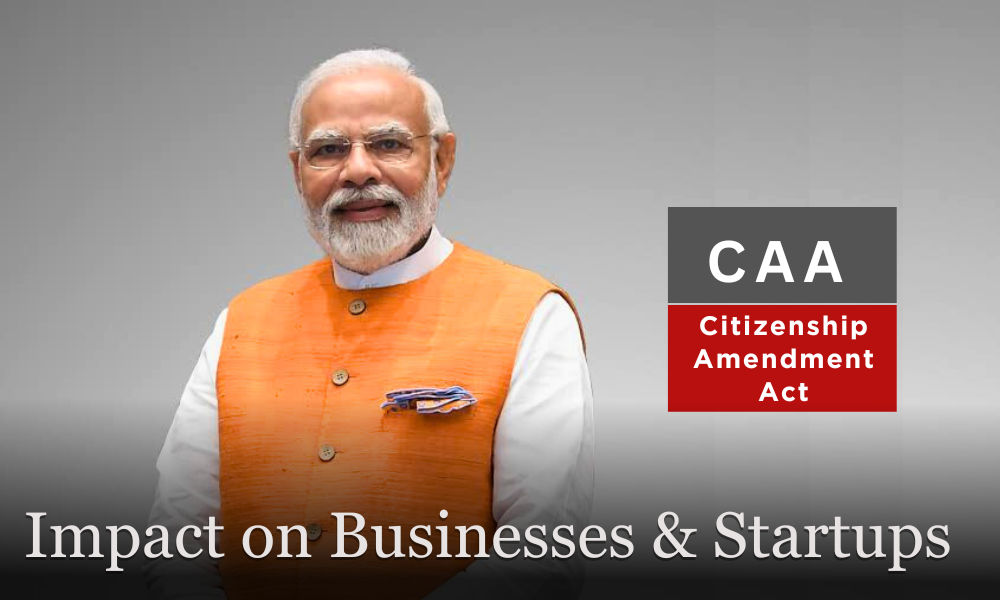
CAA (Citizenship Amendment Act): Impact and Influence on Businesses and Start-ups in India

CAA (Citizenship Amendment Act): Impact and Influence on Business and Start-ups in India

The Citizenship Amendment Act (CAA) has been implemented in India as of March 11, 2024. The Union Home Minister notified the rules for the CAA, which expedites the citizenship process for six religious minorities from Afghanistan, Bangladesh, and Pakistan who migrated to India due to religious persecution. This implementation comes ahead of the Lok Sabha elections and follows significant discussions and protests across the country since the act's passage in 2019.

The CAA primarily affects the process of granting citizenship to persecuted minorities from neighboring countries. The act has been a topic of significant discussion and has led to various forms of social and political mobilization. While the act itself is focused on the citizenship status of individuals from certain neighboring countries, its broader implications can indirectly influence the business environment. The implementation of such policies can have indirect effects on businesses and startups in the country.

For businesses, especially those operating in diverse sectors or with international ties, the political and social climate influenced by such policies can impact market stability and consumer sentiment. Startups may consider the broader implications of the act, such as shifts in the labor market or changes in the regulatory environment that could affect their operations or growth strategies.

It's important for businesses and startups to stay informed about the developments related to the CAA and assess any potential impacts on their operations, workforce, and long-term plans. However, the specific influence would vary depending on the nature of the business, its location, and its market demographics. For a detailed analysis, businesses may consult legal and market experts to understand the nuances of the CAA's impact on their specific context.

For businesses and startups, the impact can manifest in several ways:

Market Sentiment: The social and political discourse surrounding the CAA might affect consumer sentiment, which in turn could influence market trends and consumer behavior.

Workforce Diversity: Companies with diverse workforces might need to navigate the complexities of the act and its reception among their employees.

Investor Perception: Domestic and international investors often consider the stability and inclusivity of a country's social and political climate when making investment decisions.

Regulatory Environment: Any legislative change can lead to shifts in the regulatory environment that businesses must adapt to.

Startups, in particular, may need to be agile and responsive to the changing socio-political landscape to maintain their growth trajectories and ensure a stable operating environment. It's advisable for businesses to seek expert analysis and legal advice to fully understand the CAA's implications for their specific context.

The full extent of the CAA's impact on India's business environment and startup ecosystem will likely to unfold over time, and it remains a subject of significant interest and debate in global diplomatic circles.

Education Ministry Issues Guidelines for Coaching Centres, Can't Enrol Student Below 16 Years

Education Ministry Issues Guidelines for Coaching Centres, Can't Enrol Student Below 16 Years

Ministry of Education, Government of India, has issued latest guidelines for Coaching Centres in the country for better guidance and assistance to the students in any study programme, competitive examinations, or academic support.

In the context of rising student suicides cases, fire incidents, lack of facilities as well as methodologies of teaching have been engaging the attention of the Government from time to time, the ministry said.

The number of unregulated private coaching centers in the country continues to grow in the absence of any laid down policy or regulation. Instances of such centers charging exorbitant fees from students, undue stress on students resulting in students committing suicides, loss of precious lives due to fire and other accidents, and many other malpractices being adopted by these centres are widely reported in the media. These issues have also been raised many times through debate, said the guidelines document issued by education ministry.

For Registration of coaching centers, the Ministry issued following conditions –
  • Should NOT engage tutors having qualification less than graduation.
  • Should NOT make misleading promises or guarantee of rank or good marks to parents/students for enrolling them in the coaching center.
  • Should NOT enroll student below 16 years of age or the student enrolment should be only after secondary school examination.
  • Should NOT publish or cause to be published or take part in the publication of any misleading advertisement relating to any claim, directly or indirectly, of quality of coaching or the facilities offered therein or the result procured by such coaching center or the student who attended such class.
  • Should NOT be registered, if it has less than minimum space requirement per student.
  • Should NOT hire the services of any tutor or person who has been convicted for any offence involving moral turpitude.
  • Should NOT be registered unless it has counselling system as per the requirement of this guidelines.
  • Coaching center shall have a website with updated details of the qualification of tutors, courses/curriculum, duration of completion, hostel facilities (if any), and the fees being charged.
Furthermore, the ministry has also suggested that coaching centres be penalised up to ₹1 lakh or their registration be cancelled for charging exorbitant fees that cause undue stress leading to student suicide or for other malpractices.

The state government will be responsible for monitoring the activities of the coaching centre and enquiring about any coaching centre regarding the fulfilment of required eligibility of registration and satisfactory activities of the coaching centre.

"Considering that regulation of +2 level education is the responsibility of State/Union Territory Governments, these institutions are best regulated by the State / UT governments,” the document stated.

To recall, National Testing Agency (NTA), an Indian government agency, had earlier launched a Mobile App called —‘National Test Abhyas’— to help the students to practice well for NEET (UG) and JEE (Main) entrance examinations. The app facilitate candidates’ access to high quality mock tests online free of cost.

The guidelines' document also mentions PIL in WP No. 456 of 2013 in the matter of Student Federation of India Vs UOI and others was filed in the Hon’ble Supreme Court in which Ministry of Education was one of the respondents.

The PIL was disposed-off vide Order dated 03.02.2017 inter-alia with direction that issue raised in the petition, though important, is basically a policy matter. It will be open to the petitioners to raise the issue before the concerned authorities who may consider the same in accordance with law.

In the context of the issue of regulation of the private coaching having subject of elaborate discussion both in the Parliament and in the Ashok Mishra Committee Report, vide letter no. 32-6/2017-TS I dated 04.04.2017 Deptt. of Higher Education had requested States / UTs to take action for regulation and strict penalty system for deviant institutions. In this letter States / UTs were requested to take into consideration 12 measures suggested by Justice Roopanwal Commission of Enquiry to address the student suicide.

Centre May Soon Announce ₹60,000 Cr Subsidy on Housing Loans

India May Soon Announce $7.2 Bn Subsidy on Housing Loans

The Central Government of India is planning to give subsidy on Housing Loan. According to the report by news agency Reuters, the government is planning to spend Rs 60,000 crore (~ US$7.2 billion) to provide subsidized loans for small urban housing for the next 5 years.

Prime Minister Narendra Modi announced the plan in a speech in August on the country's Independence Day, but its details have not been previously revealed.

In this yet-to-be-announced scheme, annual interest subsidy between 3 to 6.5% will be provided on the loan amount up to Rs 9 lakh. Sources said home loans of less than Rs 50 lakh, with a tenure of 20 years, will be eligible for the scheme.

According to Reuters, banks are likely to roll out the scheme in a couple of months, ahead of key state elections later this year and general elections due in mid-2024.

The interest subsidy will be deposited upfront directly into the housing loan account of the beneficiaries,” said the Reuters report citing a government official. This scheme, proposed till year 2028, is being finalized and will require Cabinet approval. The official said that this scheme can benefit 25 lakh loan applicants from low income groups in small-urban areas but the quantum of subsidised credit will depend on demand for such homes.

PM Modi had said in his speech in August, "We are coming up with a new scheme in the coming years, which will benefit those families who live in cities, but are living in rented houses, or in slums. Are living, or are living in chawls and unauthorized colonies."

Lenders have not been provided any specific lending targets about this scheme but a meeting with government officials is likely soon, two bank officials told Reuters.

Earlier in 2017-2022, the Government had ran similar scheme under which 12.27 million homes were sanctioned.


Govt Mulls To Reduce Import Duties on Fully-Built EVs Into India

Govt Mulls To Reduce Import Duties on Fully-Built EVs Into India

Consumers in India will soon be able to buy relatively cheaper foreign-made electric vehicles. As the Government of India has been working to promote electric vehicles, in a latest, the central government is reportedly planning to drastically reduce import tax on electric cars being imported into the country.

According to Reuters report, electric vehicle (EV) Import tax can be reduced from 100% to 15%. Apart from this, it is believed that EV import tax can be reduced on some of the cars of foreign brands.

Citing an official, the Reuters report further said that the government is movin slowly in considering the policy proposal as any lowering of taxes on imported EVs could disrupt the market and upset local players like Tata and Mahindra that are investing to build electric cars locally in India.

The policy, which is still in the initial stages, could allow automakers to import fully-built EVs into India at a reduced tax as low as 15%, compared to the current 100% that applies to electric cars which cost above $40,000 and 70% for the rest, said the report citing two of its sources, including a senior Indian government official.

However, Finance Minister Nirmala Sitarama has denied the report, and told reporters "there is no proposal in front of me" to reduce import duties on electric vehicles.

This policy is said to be a 'push' to bring Tesla to India. To recall, just after Prime Minister Narendra Modi's US tour and a meeting with Elon Musk, India had rejected China's $1 billion offer to set up EV manufacturing plant in India.

In an another report by CNBC Voice, the Government of India is working on a new "Electric Vehicle Policy". The policy is being prepared keeping in mind the proposal of Tesla, in which the government can give tax exemption to the imported car of some of the companies. This policy is also being made keeping in mind the companies which plan to plant in India or to promote "Make in India" Initiative of Government of India.

It is to be noted that currently 100% tax applies to cars that cost more than $40,000. At the same time, cars of lower price are taxed at 70%. Tesla is projected to benefit the most from this new policy. To recall, Tesla has recently proposed to set up plants for the production of electric cars in the country. Currently, Tesla's most popular car Model Y is priced at $47,740 in the US. After the implementation of the new policy, only 15% of Tesla car will be taxed in India.

Government e-Marketplace Surpasses ₹1 Trillion GMV Milestone in Record 145 Days of FY 2023-24

Government e-Marketplace Surpasses ₹1 Trillion GMV Milestone in Record 145 Days of FY 2023-24

Government e-Marketplace (GeM) has achieved an impressive milestone, crossing INR 1 lakh crore (₹1 Trillion or US$ 1,000 Billion) in Gross Merchandise Value (GMV) within a remarkable span of 145 days in the current financial year, FY 2023-24. GeM has achieved this feat through accelerated growth, increased efficiency and unwavering trust.

Government e-Marketplace is a 100% Government owned Section 8 company setup under the aegis of Department of Commerce, Ministry of Commerce and Industry for procurement of common use goods and services by government ministries, departments and CPSEs

In previous year, this GMV landmark was reached in 243 days. The average GMV per day has also witnessed significant growth from INR 412 crore per day in FY 22-23 to INR 690 crore per day in FY 23-24.

This notable milestone firmly establishes GeM as one of the largest public procurement portals globally, both in terms of transaction value and the breadth of the buyer-seller network within its unified digital ecosystem. Since inception, GeM has crossed INR 4.91 Lakh Crore in GMV and has facilitated over 1.67 crore orders on the platform.

Among the noteworthy contributors to this remarkable GMV achievement, the contribution of Central Public Sector Enterprises (CPSEs), Central Ministries and State Governments has been 54%, 26% and 20% respectively.

Additionally, GeM's efforts to foster inclusivity and accessibility have been commendable. The platform's integration with e-Gram Swaraj to streamline Panchayat-level procurement exemplifies its commitment to reaching last-mile sellers and optimizing costs at the grassroots level of administration.

Looking ahead, GeM's vision encompasses a wider federal reach, customized processes, and policies that will enhance public savings while upholding the highest quality standards for products and services. Its remarkable performance in achieving the INR 1 lakh crore GMV milestone within an accelerated time frame not only reflects its growth trajectory but also solidifies its position as the key player in transforming government procurement practices in the country.

The past financial year concluded with a GMV of INR 2 lakh crore, setting a formidable foundation for this year's achievement. GeM's strategic focus in FY 2023-24 centers on expanding its reach by integrating government buyers across all tiers into its robust e-procurement infrastructure. The portal's extended range of service offerings has contributed significantly to its widespread adoption during this period.

The platform's integration with e-Gram Swaraj to streamline Panchayat-level procurement exemplifies its commitment to reaching last-mile sellers and optimizing costs at the grassroots level of administration.

Looking ahead, GeM's vision encompasses a wider federal reach, customized processes, and policies that will enhance public savings while upholding the highest quality standards for products and services. Its remarkable performance in achieving the INR 1 lakh crore GMV milestone within an accelerated time frame not only reflects its growth trajectory but also solidifies its position as the key player in transforming government procurement practices in the country.

The past financial year concluded with a GMV of ₹2 lakh crore, setting a formidable foundation for this year's achievement. GeM's strategic focus in FY 2023-24 centers on expanding its reach by integrating government buyers across all tiers into its robust e-procurement infrastructure. The portal's extended range of service offerings has contributed significantly to its widespread adoption during this period.

With a vast assortment of over 30 lakh listed products and an impressive portfolio of over 300 service categories, GeM is well-equipped to meet the diverse product and service needs of government departments nationwide. Consequently, the platform has also witnessed a substantial surge in orders from various State Governments and affiliated entities, firmly establishing GeM as a go-to solution for government procurement.

About GeM:

Government e-Marketplace (GeM) is an online public procurement portal developed facilitate the procurement of goods and services by various government departments, agencies, and public sector undertakings. It was launched in August 2016 as a part of the government's "Digital India" initiative to bring transparency, efficiency, and cost-effectiveness to public procurement. GeM aims to simplify the public procurement process, reduce paperwork, and promote the use of digital technology for government procurement.


Govt To Sell Its Entire Stake In BPCL For $6.9 Billion - Report


Government of India is moving with plans to sell its entire stake in Bharat Petroleum Corporation Limited (BPCL), India's second-biggest state refiner, according to people familiar with the matter, said a Bloomberg report.

Mumbai-headquartered BPCL is an Indian government oil and gas corporation under the ownership of Ministry of Petroleum and Natural Gas, Government of India. The government has 53% stake in the BPCL, which is valued at about INR 509 billion ($6.9 billion).

Since the last week of April, government has allowed bidders access to the financial data of BPCL and some bidders have even held meetings with BPCL management, said the report citing one of the people privy to the development.

Privatization of BPCL could be the India’s biggest and crucial at the same time as the government needs to raise capital to make up the fall in tax revenues as the pandemic hits the Indian economy. Finance Minister Nirmala Sitharaman said last month the plan to raise about $23 billion from selling stakes in state-run companies, including BPCL.

BPCL is India's 2nd largest downstream oil company and is ranked 275th on the Fortune list of the world's biggest corporations as of 2019. BPCL ranked 672 in the Forbes 2018 list. It also has its subsidiaries -- Indraprastha Gas Limited (IGL), Petronet LNG and Bharat Renewable Energy Limited.

Besides central government, the government of Madhya Pradesh also has a minor stake in BPCL through compulsorily convertible warrants. 

On Mar 2021, Bharat Petroleum Corporation Ltd (BPCL) sold its entire 61.5% stake in Numaligarh Refinery in Assam to a consortium of Oil India Ltd. and Engineers India Ltd. and Government of Assam for ₹9,876 crore.

Govt Blocks 118 Mobile Apps including PUBG, Baidu and WeChat Work


The Ministry of Electronics and Information Technology, Government of India invoking it’s power under section 69A of the Information Technology Act read with the relevant provisions of the Information Technology (Procedure and Safeguards for Blocking of Access of Information by Public) Rules 2009 and in view of the emergent nature of threats has decided to block 118 mobile apps (see Appendix below of this post) since in view of information available they are engaged in activities which is prejudicial to sovereignty and integrity of India, defence of India, security of state and public order.

The Ministry of Electronics and Information Technology has received many complaints from various sources including several reports about misuse of some mobile apps available on Android and iOS platforms for stealing and surreptitiously transmitting users’ data in an unauthorized manner to servers which have locations outside India. The compilation of these data, its mining and profiling by elements hostile to national security and defence of India, which ultimately impinges upon the sovereignty and integrity of India, is a matter of very deep and immediate concern which requires emergency measures.

The Indian Cyber Crime Coordination Centre, Ministry of Home Affairs has also sent an exhaustive recommendation for blocking these malicious apps.. Likewise, there have been similar bipartisan concerns, flagged by various public representatives, both outside and inside the Parliament of India. There has been a strong chorus in the public space to take strict action against Apps that harm India’s sovereignty as well as the privacy of our citizens.

On the basis of these and upon receiving of recent credible inputs that information posted, permissions sought, functionality embedded as well as data harvesting practices of above stated Apps raise serious concerns that these Apps collect and share data in surreptitious manner and compromise personal data and information of users that can have a severe threat to security of the State.

In the interest of sovereignty and integrity of India, defence of India and security of the State. And using the sovereign powers, the Government of India has decided to block the usage of certain Apps, used in both mobile and non-mobile Internet enabled devices. These apps are listed in the attached appendix.

This move will safeguard the interests of crores of Indian mobile and internet users. This decision is a targeted move to ensure safety, security and sovereignty of Indian cyberspace.

Appendix

  1. APUS Launcher Pro- Theme, Live Wallpapers, Smart
  2. APUS Launcher -Theme, Call Show, Wallpaper, HideApps
  3. APUS Security -Antivirus, Phone security, Cleaner
  4. APUS Turbo Cleaner 2020- Junk Cleaner, Anti-Virus
  5. APUS Flashlight-Free & Bright
  6. Cut Cut – Cut Out & Photo Background Editor
  7. Baidu
  8. Baidu Express Edition
  9. FaceU - Inspire your Beauty
  10. ShareSave by Xiaomi: Latest gadgets, amazing deals
  11. CamCard - Business Card Reader
  12. CamCard Business
  13. CamCard for Salesforce
  14. CamOCR
  15. InNote
  16. VooV Meeting - Tencent Video Conferencing
  17. Super Clean - Master of Cleaner, Phone Booster
  18. WeChat reading
  19. Government WeChat
  20. Small Q brush
  21. Tencent Weiyun
  22. Pitu
  23. WeChat Work
  24. Cyber Hunter
  25. Cyber Hunter Lite
  26. Knives Out-No rules, just fight!
  27. Super Mecha Champions
  28. LifeAfter
  29. Dawn of Isles
  30. Ludo World-Ludo Superstar
  31. Chess Rush
  32. PUBG MOBILE Nordic Map: Livik
  33. PUBG MOBILE LITE
  34. Rise of Kingdoms: Lost Crusade
  35. Art of Conquest: Dark Horizon
  36. Dank Tanks
  37. Warpath
  38. Game of Sultans
  39. Gallery Vault - Hide Pictures And Videos
  40. Smart AppLock (App Protect)
  41. Message Lock (SMS Lock)-Gallery Vault Developer Team
  42. Hide App-Hide Application Icon
  43. AppLock
  44. AppLock Lite
  45. Dual Space - Multiple Accounts & App Cloner
  46. ZAKZAK Pro - Live chat & video chat online
  47. ZAKZAK LIVE: live-streaming & video chat app
  48. Music - Mp3 Player
  49. Music Player - Audio Player & 10 Bands Equalizer
  50. HD Camera Selfie Beauty Camera
  51. Cleaner - Phone Booster
  52. Web Browser & Fast Explorer
  53. Video Player All Format for Android
  54. Photo Gallery HD & Editor
  55. Photo Gallery & Album
  56. Music Player - Bass Booster - Free Download
  57. HD Camera - Beauty Cam with Filters & Panorama
  58. HD Camera Pro & Selfie Camera
  59. Music Player - MP3 Player & 10 Bands Equalizer
  60. Gallery HD
  61. Web Browser - Fast, Privacy & Light Web Explorer
  62. Web Browser - Secure Explorer
  63. Music player - Audio Player
  64. Video Player - All Format HD Video Player
  65. Lamour Love All Over The World
  66. Amour- video chat & call all over the world.
  67. MV Master - Make Your Status Video & Community
  68. MV Master - Best Video Maker & Photo Video Editor
  69. APUS Message Center-Intelligent management
  70. LivU Meet new people & Video chat with strangers
  71. Carrom Friends : Carrom Board & Pool Game-
  72. Ludo All Star- Play Online Ludo Game & Board Games
  73. Bike Racing : Moto Traffic Rider Bike Racing Games
  74. Rangers Of Oblivion : Online Action MMO RPG Game
  75. Z Camera - Photo Editor, Beauty Selfie, Collage
  76. GO SMS Pro - Messenger, Free Themes, Emoji
  77. U-Dictionary: Oxford Dictionary Free Now Translate
  78. Ulike - Define your selfie in trendy style
  79. Tantan - Date For Real
  80. MICO Chat: New Friends Banaen aur Live Chat karen
  81. Kitty Live - Live Streaming & Video Live Chat
  82. Malay Social Dating App to Date & Meet Singles
  83. Alipay
  84. AlipayHK
  85. Mobile Taobao
  86. Youku
  87. Road of Kings- Endless Glory
  88. Sina News
  89. Netease News
  90. Penguin FM
  91. Murderous Pursuits
  92. Tencent Watchlist (Tencent Technology
  93. Learn Chinese AI-Super Chinese
  94. HUYA LIVE – Game Live Stream
  95. Little Q Album
  96. Fighting Landlords - Free and happy Fighting Landlords
  97. Hi Meitu
  98. Mobile Legends: Pocket
  99. VPN for TikTok
  100. VPN for TikTok
  101. Penguin E-sports Live assistant
  102. Buy Cars-offer everything you need, special offers and low prices
  103. iPick
  104. Beauty Camera Plus - Sweet Camera & Face Selfie
  105. Parallel Space Lite - Dual App
  106. "Chief Almighty: First Thunder BC
  107. MARVEL Super War NetEase Games
  108. AFK Arena
  109. Creative Destruction NetEase Games
  110. Crusaders of Light NetEase Games
  111. Mafia City Yotta Games
  112. Onmyoji NetEase Games
  113. Ride Out Heroes NetEase Games
  114. Yimeng Jianghu-Chu Liuxiang has been fully upgraded
  115. Legend: Rising Empire NetEase Games
  116. Arena of Valor: 5v5 Arena Games
  117. Soul Hunters
  118. Rules of Survival


Indian Govt wants Tech Giants Google, Amazon and Facebook to Provide Source Code and algorithms


India’s government is working on a policy which include tough rule that will require tech giants like Google, Amazon and Facebook to provide source code and algorithms, said a report by Bloomberg.


The proposed rules aims to build a wall against unfair monopolistic practices and create a more competitive business environment for local businesses.


The proposed 15-page policy draft (as seen by Bloomberg), prepared by DPIIT, includes a mandate that allows government to access online companies’ source codes and algorithms, which the ministry of commerce says would help ensure against “digitally induced biases” by competitors.


The proposed draft also talks of ascertaining whether e-commerce businesses have “explainable AI,” referring to the use of artificial intelligence.


The draft further states - "There’s a tendency among some of the leading companies to exercise control over most of the information repository"


E-commerce companies will be required to make data available to the government within 72 hours, which could include information related to national security, taxation and law and order, the proposed draft said.


The report by Bloomberg states that -- for at least last two years the government of India has been working on the e-commerce policy in order to fulfill calls of local businesses/startups, wherein they wants to reduce the dominance of global tech giants like Amazon, Google and Facebook.


Notably, in the previous drafts the data localization was the primary point but it got criticism for being insensitive towards local startups and businesses. Surprisingly, the new draft leaves the question -- as which e-commerce platforms would have to keep data locally -- unanswered.


File Sharing Website WeTransfer Blocked by Govt

The government has ordered internet service providers to block computer file sharing website WeTransfer on request of the Delhi Police due to security reasons.

The order issued by the Department of Telecom on May 18 directed all ISP to block two download links on Dutch website WeTransfer and also the entire website www.wetransfer.com.

"Delhi Police had requested the IT ministry to block two download links and the entire We Transfer website immediately. Following which orders were issued to the website and links suggested by the Delhi Police," an official source told PTI.

Meity asked the DoT to direct internet service providers to block the website.

"The compliance be submitted immediately failing which shall inter-alia invite initiation of actions under licence conditions," the DoT order e-mailed to several ISPs said.

Government to Announce New Cyber Security Policy Soon

While speaking at the 6th Cyber Security India Summit 2020 held at New Delhi Lt. Gen. (Dr.) Rajesh Pant National Cyber Security Coordinator Prime Minister Office Government of India said that Government of India is working on a new Cyber Security Policy.

According to Lt. Gen. Pant the new policy is expected to touch all aspects related with the cyber ecosystem. The policy is expected to be announced within two to three months time. The Cyber policy would address the issues of standardization testing auditing and capacity building around Cyber ecosystem. The most important aspect of the policy would be to address the cyber threat and synergies between various stake holders he added. India is 2nd most cyber attacked country in the world.

[caption id="attachment_142793" align="aligncenter" width="746"] Left to Right:
Mr. Sivarama Krishnan Leader Cyber Security PwC
Shri Amit Sharma Advisor (Cyber) Director at the Office of Secretary Department of Defence
Mr. Shashi Dharan Managing Director Bharat Exhibitions
Lt. Gen. (Dr.) Rajesh Pant National Cyber Security Coordinator Prime Minister Office Government of India
Mr. Vijay K. Devnath GM (IS MDMS CISO) Center for Railway Information Systems (CRIS)
[/caption]

As India has become one of the most data usage country in the world there has been a considerable increase in the cyber risk vulnerability which according to panelists could impact the GDP growth of the Country if not addressed. The other important point of discussion during the Summit was the ownership of the data. As an Organisation we are exposed to appoxmately 30 million people on daily basis of which we collect date of about 3 million people and also we have to manage the data of 1.4 million employees for over 45-50 years. While we have to provide service and also are required to manage the data it becomes extremly difficult for us to manage both. Moreso when ownership and privacy of the data is concerned said Mr.Vijay K. Devnath GM (IS) MDMS CISO) Centre for Railway Information System (CRIS) Government of India.

The issue of who own the data and where should data be kept has become an important issue said Shashi Dharan Managing Director Bharat Exhibitions.

According to Mr. Amit Sharma Advisor (Cyber) Director at the Office of Secretary Department of Defence the Government of India has put in place various checks and balances to protect the data getting vunerable to cyber leakage. The ownership of data is very critical. There are discussion happening around this aspect on international level. Our government proactive on this front informed Mr. Sharma.

On the issue of CSO (Cyber Security Officer) Mr. Sharma said If this issue would have come up five years back then we were putting make a headway. However today at least every department of Government of India has a CSO. Supporting Mr. Sharma statement on CSO Mr. R. Shakaya DDG (Security Assurance) DoT Ministry of Communications said Besides the Government departments CSO has become part of many private sectors also like Banking and Telecommunication industries. However a lot needs to be done on this front so as to reach a more secure cyber environment.

The common concern amongst the top cyber security experts gathered at the 6thInternational Summit on Cyber Security India 2020 was that the country was extremely vulnerable to cyber-attacks and how to put the counter measures in place.

Cyber Security India Summit 2020 was sponsored by IPification Arcserve Forcepoint RamoGnee Technologies and Astrikos Consulting and Supported by Ministry of Electronics Information Technology (MeitY) COAI and ITU-APT Foundation of India.

For more details on the event please visit www.bharatexhibitions.com/en/CSI2020.

About Bharat Exhibitions

In a world where technology is erasing borders it is indeed ironical that professionals find it increasingly difficult to maintain peer to peer contact on regular basis. Bharat Exhibitions fills in this space by managing and hosting some of India premier Telecom IT events. We own niche and prestigious conference properties in the new generation technology arena such as 100 Smart Cities India Cloud Network Virtualisation India 5G India FTTH India Summit SDN NFV Summit Data Centre India Unified Communications India Open Source Summit WiFi India Broadband Tech India Smart-Sustainable Cities Technology Innovation Summit Cyber Security India SMC Technology India and Telecom CXO Summit. We have a simple mission: Establish deliver contacts that create value for your business.

For further details please visit www.bharatexhibitions.com.

Govt may Restore 2% Additional Duty Incentive on Mobile Phones Export

The government is likely to restore 2 per cent additional duty incentive on mobile phones export with effect from January 1, a source said.

This duty benefit, which will help boost exports, is expected to continue till March 31, 2020. A notification in this regard is likely to be issued soon.

The Directorate General of Foreign Trade (DGFT) on December 7 had reduced export incentive from 4 per cent to 2 per cent.

"There is a proposal to give 2 per cent additional export incentive on mobile phones till March 31. It will be effective from January 1, 2020 onward. The order is likely to be issued in this regard within a week," a source aware of the development told PTI.

The India Cellular and Electronics Association (ICEA) had written to the government expressing disappointment on reduction of the incentive, saying it will lead to massive job losses.

When contacted ICEA Chairman Pankaj Mohindroo said that "mobile phone exports have taken off. The growth from Rs 1,300 crore in 2017-18 to over Rs 25,000 crore this year is staggering to say the least. The reduction of Merchandise Export from India Scheme (MEIS) from 4 per cent to 2 per cent for such a deserving sector was a rude shock to the industry and extremely disruptive to supply chain. An immediate restoration is not only necessary but well deserved too."

The Manufacturers' Association for Information Technology (MAIT) has proposed incentive in the range of 8-10 per cent and also expressed concern on the reduction of export incentives.

Reacting to the proposal, MAIT CEO George Paul said the government had been sensitised on the need for a support framework as "we do not expect MEIS to continue".

"It is critical we do this as the industry waited till December 30, 2019 for a new framework. None came, now it awaits the budget to address this need. This new framework is very critical for India as if a reverse flow starts, it will not only see a reduction in exports, but also halt in new investments," Paul said.

India Ranks 2nd in Govt Requests for Facebook User Data, Spike in Emergency Requests in H1'19

India came in second after the US in terms of nations asking Facebook to divulge information related to user accounts, with such requests increasing by moe than 9 per cent to 22,684 in the first half of 2019, according to a report by the social networking giant.

In January-June 2019, India made 22,684 requests for user data of 33,324 users/accounts from the social media company.

This was only behind the US that asked the social media giant for 50,714 user data requests of 82,461 users/accounts in the period.

Facebook, in its half-yearly Transparency Report, noted that government requests for user data were at an all-time high at 1.28 lakh total requests in the first half of 2019. This is up by over 16 per cent from 1,10,634 requests in July-December 2018 time frame.

The UK (7,721), Germany (7,302), France (5,782) and Brazil (5,683) were also in the tally.

In the first half of 2019, India made 21,069 requests under 'legal process' and 1,615 emergency requests with 33,324 users/accounts requested. The US-based company said some data was produced in 54 per cent of the requests.

Requests from India in the July-December 2018 quarter was at 20,805, of which 861 were emergency requests, and 19,944 requests were under legal process.

"Facebook responds to government requests for data in accordance with applicable law and our terms of service. Each and every request we receive is carefully reviewed for legal sufficiency and we may reject or require greater specificity on requests that appear overly broad or vague," it said.

The company added that it accepts government requests to preserve account information pending receipt of formal legal process.

"When we receive a preservation request, we will preserve a temporary snapshot of the relevant account information but will not disclose any of the preserved records unless and until we receive formal and valid legal process," it added.

Facebook said it restricted access to 1,233 items of content, including 1,211 posts, two profiles, 19 Pages and Groups and one comment on its social media platform.

It added that the company permanently restricted access to content in India in response to legal requests from law enforcement agencies, court orders, and the Ministry of Electronics and Information Technology.

Content restricted was alleged to violate Indian laws on the grounds listed under to Section 69A of the Information Technology Act, 2000, and was primarily in the categories of hate speech, anti-religion content constituting incitement to violence, defamation, extremism, anti-government, and anti-state content, it added.

"We also restricted access to 217 items in response to private reports related to defamation," Facebook noted.

The company, which has faced flak previously over breach of user data, said it also "temporarily restricted access to 448 items in response to reports received from the Elections Commission of India alleging that the content was subject to election blackout periods".

Access to this content was restored following the end of the applicable blackout period, it added.

India also topped the list of Internet disruptions, with 40 disruptions in the first half of 2019, lasting cumulative period of over eight weeks. This included regions like Jammu and Kashmir, Tripura, Manipur, Arunachal Pradesh, Assam, Uttar Pradesh and Rajasthan. PTI SR

Agatsa Raises $1 Mn in Funding led by IAN and Technology Development Board, Govt of India

Agatsa, India’s most agile health solutions innovator, has raised $1 million in funding from Indian Angel Network (IAN) and the Technology Development Board (TDB), Department of Science and Technology, Government of India. The start-up is working in the field of creating affordable and pocket-sized healthcare devices that help in the early diagnosis and management of lifestyle diseases.

With this funding, Agatsa will scale up its operations and marketing along with expanding its global outreach. Their flagship products under the name of SanketLife 2.0 and SanketLife Pro+ are the world’s first and only portable medical-grade 12-LEAD ECG devices that can be carried around in the pocket.

Speaking about this, Mr. Rahul Rastogi & Ms. Neha Rastogi, Co-Founders, Agatsa, said, “Our first line of products under the label SanketLife are aimed at addressing the delay in getting cardiac care post the appearance of a symptom. Going forward, we plan to create a range of products including wearables that help in the timely diagnosis and management of non-communicable diseases. Our AI capabilities make us one of the very few companies in the world to have implemented the procedures and variables under the Minnesota Code. We are delighted to get support from IAN & TDB. We will leverage the capital infusion to bolster our platform, build a robust network of doctors, and find innovative ways to further reduce the response time.”

Speaking on the investment, Priyank Agarwal, IAN lead investor, said, “Everybody is privy to the alarming rise of heart-related problems in India amongst both the elderly and the young. Against such a backdrop, it is heartening to see start-ups such as Agatsa using cutting-edge technology to provide Indians with innovative and low-cost cardiac care products and services. Its unique, tech-led approach to affordable healthcare is solving some of the most pressing problems for a large consumer base comprising the general public, GPs, paramedics, healthcare companies, etc. We hope our contribution will help the company realize its potential to the fullest and wish the founders continued success.”

“There is an essential requirement to develop cutting-edge technology based Medical Devices indigenously, that are easy-to-use, affordable and accessible even in the far-flung areas of the Indian sub-continent. Agatsa Software Pvt Ltd is set to play a crucial role in achieving this objective. Technology Development Board (TDB) recognizes excellence in individuals and organizations for contributing to the development and commercialization of indigenous technologies. TDB is pleased to support SanketLife project by Agatsa, a start-up company which commenced its journey as a Department of Science & Technology (DST) supported incubatee. TDB wishes Agatsa’s team all the very best in their quest to manufacture advanced and affordable healthcare devices domestically,” representatives of the Technology Development Board (TDB), Government of India said in an official statement.

In a short span, Agatsa has recorded ECG readings for over 100,000 users and more than 6,000 doctors are using the SanketLife devices. These devices are clinically validated to have 98% accuracy compared to traditional ECG devices and provide swift reports that are authenticated and reviewed by doctors within 10 minutes. Going forward, Agatsa is planning to introduce a wearable device offering early detection of 17 different diseases such as diabetes, epilepsy, obesity, anxiety, and neuropathy, etc.

Agatsa has cracked partnership deals with various B2B clients, offering emergency response to elderly population and cardiac patients. The start-up further plans to bolster its service portfolio by integrating an emergency ECG review services into the Agatsa app to ensure seamless cardiac support to B2B users like hospitals, PHCs, Polyclinics etc. The start-up will also expand into other devices that help in the management of other non-communicable diseases like blood pressure, diabetes etc.

Agatsa, is a technology-driven company founded by husband and wife duo - Neha and Rahul Rastogi in 2014. The company’s products currently provide affordable and connected health management support. Inspired by the gaps in early identification of cardiac issues and effective care in India, Agatsa embarked on creating its first range of products to address this critical area of Cardiac disease diagnosis and management. Agatsa’s first line of products under the label of SanketLife, are the world's first and only 12 LEAD devices small enough to fit into a pocket and capture complete medical-grade ECG data on the go. Agatsa has won numerous ‘Best Innovation' awards like the Mashelkar award, mBillionth award in the healthcare category and Frost & Sullivan Award for cardiac services best practices. SanketLife devices are available on www.amazon.com, www.sanketlife.in and www.agatsa.com.

Indian Angel Network has been a pioneer in the seed and early-stage investing. It has now launched a ₹450 Crores VC fund making it now, the single largest platform for seed & early stage, where entrepreneurs can raise from Rs. 25 lakhs to Rs. 50 crores (with co-investors), thus making IAN the platform of choice!

About Technology Development Board

The Technology Development Board (TDB) provides financial assistance to Indian industrial concerns and other agencies, attempting development and commercial application of indigenous technology, or adapting imported technology to wider domestic applications. With its proactive stance, the board facilitates interaction between industry, scientists, technocrats and specialists; facilitates the creation of new generation of entrepreneurs; assists partnerships with other, similar technology financing bodies; and creates new job opportunities. TDB’s goal is to make the weak zone of technology development and commercialization strong in selected sector by supporting technology development in the industry with short, medium and long term risk horizon.

Govt unveils Draft E-Commerce Norms, Seeks views from Industry

To protect consumers' interest, the Centre has proposed guidelines for e-commerce firms that entail a 14-day deadline to effect refund request, mandate e-tailers to display details of sellers supplying goods and services on their websites and moot the procedure to resolve consumer complaints.

The consumer affairs ministry has sought views of stakeholders on the draft guidelines on e-commerce by September 16. Meanwhile, the government is planning to come out with a national e-commerce policy to facilitate achieving holistic growth of the sector.

Among key guidelines, the e-commerce companies will also be required to ensure that personally identifiable information of customers are protected. "Such data collection and storage and use comply with provisions of the Information Technology (Amendment) Act, 2008," the ministry said.

That apart, e-commerce firms should be a registered legal entity under Indian laws and should submit a self-declaration to the ministry stating that it is conforming with guidelines.

The proposed rules outlined that a promoter or key management personnel should not have been convicted of any criminal offence punishable with five years imprisonment.

The companies should also comply with the provisions of IT Rules, 2011. They are also required to display on their websites details about sellers supplying goods and services. The industry said it is still studying the broad contours of the guidelines.

"We are evaluating the draft guidelines and look forward to participating in the deliberations to help finalise an operating framework," a Snapdeal spokesperson said in a statement. The spokesperson said this will enable the sector to offer a high standard of consumer protection at every stage of an e-commerce transaction.

Flipkart and Amazon India spokesperson said the company is still examining the draft guidelines.

Social community LocalCircles founder Sachin Taparia said currently, consumers face difficulty in holding e-commerce firms accountable in case of fake products as platforms do not disclose seller details or their general terms. These guidelines if enforced will change that.

"The key areas that have been covered in the rules include preventing price influencing, addressing counterfeit, improving integrity of reviews as well as increasing transparency of terms e-commerce have with sellers and disclosure of seller information," he added.

The draft guidelines state that e-commerce companies should not directly or indirectly influence the price of the goods or services and "maintain a level playing field."

The companies should not adopt any unfair methods, falsely represent themselves as consumers, post reviews about goods and services in their name or exaggerate the quality of goods and services.

To ensure transparency in dealing, the companies are required to display terms of contract between them and the seller to enable consumers to make informed decisions. They should also mention safety and health care information of the goods and service advertised for sale and give information on payment methods.

The companies are required to effect all payments towards accepted refund requests of the customers within a period of maximum of 14 days.

On sellers liabilities, the norms proposed sellers to display total as well as break up price for the goods or service including charges like delivery, postage and taxes.

They should also comply with mandatory display requirements as per Legal Metrology (amendment) rules 2017 for pre-packaged commodities. They should also provide mandatory safety and health care warnings and shelf life that a consumer would get at any physical point of sale. These companies are also proposed to be held responsible for any warranty/guarantee obligation of goods and services sold.

The draft guidelines laid down that every e-Commerce entity will publish on its website the name of the Grievance Officer and his contact details as well as mechanism by which users can notify their complaints about products and services. The Grievance Officer shall redress the complaints within one month from the date of receipt of complaint, it said.

The move comes even as the government has tightened norms for e-commerce firms having foreign investment, earlier this year.

The e-commerce sector in India has been witnessing an explosive growth fuelled by the increase in the number of online users, growing penetration of smartphones and the rising popularity of social media platforms.

According to a February 2019 Morgan Stanley report, India is adding one Internet user every three seconds and the e-commerce sector in India is estimated to reach USD 230 billion by 2028, accounting for 10 per cent of India's retail. PTI LUX MBI

India Constitutes Committee to Examine FDI Issues in E-Commerce

A committee has been constituted under the Department for Promotion of Industry and Internal Trade to examine issues related to FDI in the e-commerce sector, Parliament was informed on Wednesday.

The committee was constituted on July 12 under an additional secretary level officer from the Department for Promotion of Industry and Internal Trade (DPIIT) with members from the departments of commerce, consumer affairs, legal affairs and MSME.

They will examine issues related to FDI (foreign direct investment) in the e-commerce sector and give suggestions, Commerce and Industry Minister Piyush Goyal said in a written reply in the Lok Sabha.

"A committee has been constituted on 12th July, 2019 under Additional Secretary, DPIIT...to examine issues related to FDI in e-commerce and give its suggestions," he said.

According to the current policy, 100 per cent FDI is allowed in the marketplace format of e-commerce retailing. However, FDI is prohibited in the inventory-based model.

In a separate reply, the minister said from 2006 till March 29, 2018, 112 brands have obtained approval of the government for single-brand retail trading activities.

FDI policy on single-brand retail trade has been in operation since 2006. FDI up to 100 per cent under automatic route has been allowed in the sector subject to certain conditions. PTI RR

Govt Issues Norms for $5 Bn Scheme that Encourages Farmers to Generate Solar Power in Farms

The Ministry of New and Renewable Energy (MNRE) Monday issued guidelines for rollout of the Rs 34,422-crore PM-KUSUM scheme, which would encourage farmers to generate solar power in their farms and use the clean energy to replace their diesel water pumps.

The Pradhan Mantri Kisan Urja Suraksha evam Utthaan Mahabhiyan (PM-KUSUM) scheme entails setting up of 25,750-MW solar capacity by 2022 with the total central financial support of Rs 34,422 crore.

The Cabinet Committee on Economic Affairs (CCEA) in February approved the launch of the scheme with the objective of providing financial and water security.

PM-KUSUM scheme

The scheme has three components:


  1. The Component-A provides for setting up of 10,000 megawatt of decentralised ground/ stilt-mounted grid-connected solar or other renewable energy-based power plants.


  2. The Component-B of the scheme provides for installation of 17.50 lakh stand-alone solar agriculture pumps,


  3. The Component-C envisages solarisation of 10 lakh grid-connected agriculture pumps.


The guidelines issued on Monday stated that the Component-A and Component-C will be implemented initially on a pilot mode for 1,000 megawatt (MW) capacity and one lakh grid-connected agriculture pumps, respectively, while the Component-B will be implemented in full-fledged manner with total central government support of Rs 19,036.5 crore.

After the successful implementation of pilot project of Components A and C, the same shall be scaled up with necessary modifications based on the learning from the pilot phase with the total central government support of Rs 15,385.5 crore, it added.

It said these guidelines have been formulated to provide broad implementation framework of the scheme. PTI KKS

Market Reports

Market Report & Surveys
IndianWeb2.com © all rights reserved