Showing posts with label IBM Heron. Show all posts

India’s Largest Quantum Computer To Be Deployed in the Country’s First Quantum Valley Tech Park

India’s Largest Quantum Computer To Be Deployed in the Country’s First Quantum Valley Tech Park
  • IBM, Tata Consultancy Services and Government of Andhra Pradesh Unveil Plans to Deploy India’s Largest Quantum Computer in the Country’s First Quantum Valley Tech Park
  • The Quantum Valley Tech Park will be anchored by next-generation IBM Quantum System Two
  • Tata Consultancy Services partnering with IBM to advance India’s quantum algorithm and application development
IBM (NYSE: IBM) and Tata Consultancy Services (BSE: 532540, NSE: TCS) are partnering to further develop India’s quantum computing industry as part of the State of Andhra Pradesh’s Quantum Valley Tech Park, currently being built in the capital city of Amaravati. The tech park will be anchored by an IBM Quantum System Two installation, with a 156-qubit Heron quantum processor, the largest quantum computer in India. Tata Consultancy Services (TCS) is partnering with IBM to support the development of algorithms and applications that will help the Indian industry and academia solve some of the nation’s most challenging problems. The Government of Andhra Pradesh, IBM and TCS hope to accelerate the development of India’s quantum ecosystem through this initiative.

“Our National Quantum Mission is to make India a global hub in the quantum industry; a true center of innovation and job creation with access to the technology capable of solving some of our country’s and the world’s most pressing and complex challenges,” said N. Chandrababu Naidu, Chief Minister of Andhra Pradesh. “With IBM, TCS, L&T, and other members, the Quantum Valley Technology Park represents how India’s industry and academia will soon be able to take an important step forward in accelerating the achievement of the mission’s goals.”

“We are excited about our plans with the state of Andhra Pradesh to deploy our latest IBM Quantum System Two at the Quantum Valley Tech Park. Our collaboration with TCS will help attract the country’s thriving ecosystem of developers, scientists, and industry experts to develop algorithms and applications. Combining this with India’s National Quantum Mission we could see an acceleration of the next critical milestone – a successful demonstration of quantum advantage,” said Jay Gambetta, Vice President, IBM Quantum.

Members of the Quantum Valley Tech Park can work with TCS for the opportunity to access IBM’s cloud-based quantum computers, and once completed, the Quantum Valley Tech Park will include access to an IBM Quantum System Two with IBM’s latest 156-qubit Heron processor.

“Hybrid architectures are the key to overcoming intractable computing challenges, with quantum computing serving as a catalyst. TCS’s Hybrid Computing strategy is creating what we believe is a breakthrough software layer that intelligently decomposes programs across current systems — CPUs, GPUs and emerging computing architectures — such as quantum. We’re excited to be partnering with IBM, and the Government of Andhra Pradesh at the Quantum Valley Tech Park and support India’s National Quantum Mission to accelerate the development of quantum algorithms and applications that solve complex intractable problems and drive both economic growth and technological innovation,” said Dr. Harrick Vin, Chief Technology Officer, Tata Consultancy Services.

The capabilities of IBM’s quantum computers, Qiskit software, and other resources look to enable India’s growing ecosystem of innovators across academia and industry to discover how quantum computers could be applied toward solutions to complex challenges — such as those goals being pursued by the Government of Andhra Pradesh, via the Quantum Valley Tech Park, in contribution to the country’s National Quantum Mission.

By establishing a vibrant quantum ecosystem encompassing research, access to quantum computers, and industry applications, the Government of Andhra Pradesh intends to create high-end jobs, attract top-tier talent, and draw global investments.

As part of this collaboration, TCS will play a pivotal role in driving India’s applied research and innovation by developing quantum use cases across sectors such as life sciences, materials science, supply chain resilience, energy optimization, cryptography, and sustainable manufacturing. The goal is to unlock applications capable of a quantum advantage in solving practical industry problems that are currently beyond the reach of classical computing. TCS’s role within the Quantum Valley Tech Park will give researchers from TCS, domain experts across Indian industry, and academic institutions alike the opportunity to leverage IBM’s quantum computers and resources.
IBM and Japan's RIKEN To Connect Quantum Computing with the Supercomputer Fugaku

IBM and Japan's RIKEN To Connect Quantum Computing with the Supercomputer Fugaku

IBM Next-Generation Quantum System to be Integrated With the Supercomputer Fugaku

IBM has announced a significant collaboration with RIKEN, a leading Japanese national research laboratory, to integrate IBM's next-generation quantum system with the supercomputer Fugaku. This integration is set to take place at the RIKEN Center for Computational Science in Kobe, Japan.

The integration marks a significant step towards quantum-centric supercomputing, where quantum and classical computing resources work together. This could revolutionize how computational tasks are approached and solved.

Fugaku is a petascale supercomputer at the RIKEN Center for Computational Science in Kobe, Japan. It was completed in 2021 and is named after an alternative name for Mount Fuji. Fugaku is among the world's fastest supercomputer and is used to solve major challenges, such as researching COVID-19 therapies and providing real-time tsunami predictions. 

Supercomputer Fugaku

The IBM Quantum System Two, which is IBM's latest quantum computer architecture, will be co-located with Fugaku. This marks the only instance where a quantum computer will be integrated with Fugaku, aiming to accelerate the development of applications for quantum-centric Supercomputing.

This project is part of a larger initiative supported by the New Energy and Industrial Technology Development Organization (NEDO) under Japan’s Ministry of Economy, Trade and Industry (METI). The goal is to demonstrate the benefits of hybrid computational platforms in the post-5G era, potentially revolutionizing science and business in Japan.

IBM Quantum System Two includes an expandable cryogenic infrastructure, modular quantum control electronics, and advanced system software. It's designed to work alongside traditional high-performance computing (HPC) services, embodying IBM's vision for quantum-centric Supercomputing.

IBM Quantum Heron
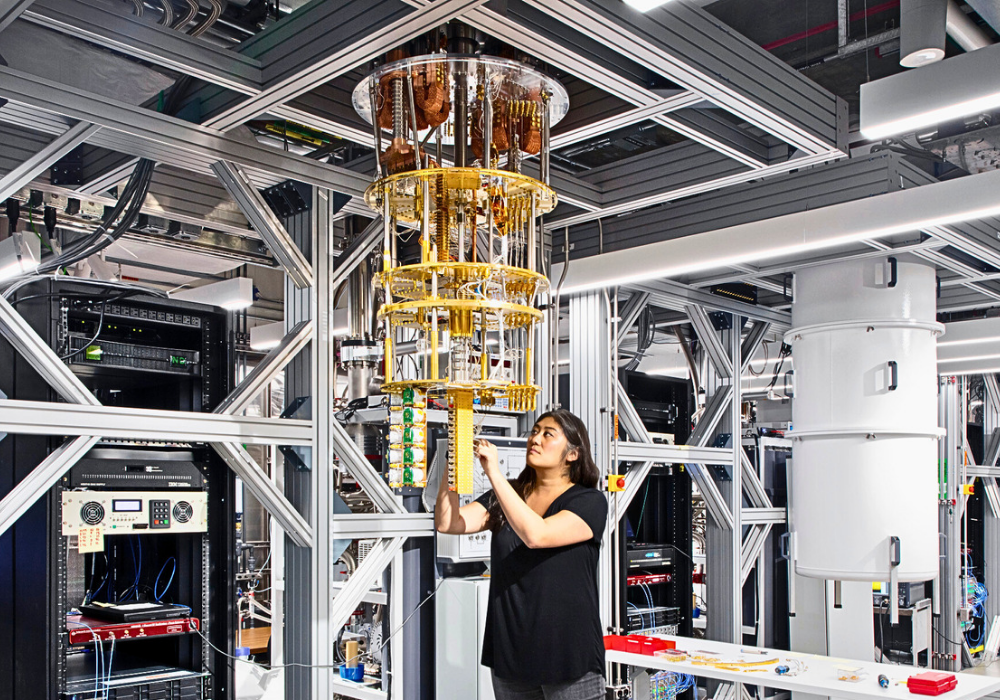
At IBM Quantum Summit 2023, ‘IBM Quantum Heron’ was released as IBM’s best performing quantum processor to date, with newly built architecture offering up to five-fold improvement in error reduction.(Credit: Ryan Lavine for IBM)

The system will be powered by a 133-qubit ‘IBM Quantum Heron’ processor. IBM Heron is the first in a new series of quantum processors with an architecture that delivers the highest performance metrics of any IBM Quantum processor that has been released, to date. Now available to users via the cloud, experiments on IBM Heron also had the lowest error rates of any IBM Quantum processor, offering a five-fold improvement over the previous best records set by IBM Eagle.

Moreover, IBM plans to develop a software stack dedicated to generating and executing integrated quantum-classical workflows within a heterogeneous quantum-HPC hybrid computing environment. These advancements are expected to deliver improvements in algorithm quality and execution times.

The deployment of IBM Quantum System Two at RIKEN and its integration with Fugaku represents a significant step towards the future of quantum-centric supercomputing, where quantum and classical computing resources work in tandem to tackle computations beyond current capabilities.

The hybrid system will combine the strengths of quantum computing with those of classical supercomputing, leading to unprecedented computational capabilities. This will enable researchers to tackle complex problems that were previously beyond reach. 

To recall, in last month NVIDIA announced that it has been working on quantum accelerated supercomputing, which leverages quantum processing units (QPUs) to perform quantum computing tasks alongside traditional supercomputing infrastructures.

With this integration of quantum computing +Supercomputer, Fields such as materials science, drug discovery, and climate modeling could benefit greatly from the enhanced computational power, potentially leading to breakthroughs in these areas

In addition, the IBM & RIKEN project involves collaboration with other institutions like the University of Tokyo and Osaka University, fostering a collaborative environment that could accelerate innovation and discovery.

Overall, the integration of IBM's Quantum System Two with Fugaku is expected to open up new horizons in scientific research, enabling researchers to explore and solve complex problems with greater efficiency and precision.

Besides this, Japan's National Institute of Advanced Industrial Science and Technology has also integrated quantum computing with a supercomputer. The institute has deployed ABCI-Q, one of the largest supercomputers dedicated to research in quantum computing. This system expands the ecosystem for hybrid quantum-classical computing.

IBM Releases Its Most Performant Quantum Processor and 1st Modular Quantum Computer

IBM’s Releases Its Most Performant Quantum Processor and 1st Modular Quantum Computer

  • IBM Quantum Heron’ is released as IBM’s most performant quantum processor in the world, with newly built architecture offering up to five-fold improvement in error reduction over ‘IBM Quantum Eagle’
  • IBM Quantum System Two begins operation with three IBM Heron processors, designed to bring quantum-centric supercomputing to reality
  • Expansion of IBM Quantum Development Roadmap for next ten years prioritizes improvements in gate operations to scale with qualityp towards advanced error-corrected systems

IBM (NYSE: IBM) has debuted 'IBM Quantum Heron,' the first in a new series of utility-scale quantum processors with an architecture engineered over the past four years to deliver IBM's highest performance metrics and lowest error rates of any IBM Quantum processor to date.

IBM also unveiled IBM Quantum System Two, the company's first modular quantum computer and cornerstone of IBM's quantum-centric supercomputing architecture. The first IBM Quantum System Two, located in Yorktown Heights, New York, has begun operations with three IBM Heron processors and supporting control electronics.

IBM Quantum
At IBM Quantum Summit 2023, ‘IBM Quantum Heron’ was released as IBM’s best performing quantum processor to date, with newly built architecture offering up to five-fold improvement in error reduction. (Credit: Ryan Lavine for IBM)


With this critical foundation now in place, along with other breakthroughs in quantum hardware, theory, and software, the company is extending its IBM Quantum Development Roadmap to 2033 with new targets to significantly advance the quality of gate operations. Doing so would increase the size of quantum circuits able to be run and help to realize the full potential of quantum computing at scale.

"We are firmly within the era in which quantum computers are being used as a tool to explore new frontiers of science," said Dario Gil, IBM SVP and Director of Research. "As we continue to advance how quantum systems can scale and deliver value through modular architectures, we will further increase the quality of a utility-scale quantum technology stack – and put it into the hands of our users and partners who will push the boundaries of more complex problems."

Earlier this year, IBM demonstrated that IBM Quantum systems on a 127-qubit 'IBM Quantum Eagle' processor can serve as a scientific tool to explore utility-scale classes of problems in chemistry, physics, and materials beyond brute force classical simulation of quantum mechanics.

Since that demonstration, leading researchers, scientists, and engineers from organizations including the U.S. Department of Energy's Argonne National Laboratory, the University of Tokyo, the University of Washington, the University of Cologne, Harvard University, Qedma, Algorithmiq, UC Berkeley, Q-CTRL, Fundacion Ikerbasque, Donostia International Physics Center, and the University of the Basque Country, as well as IBM, have expanded demonstrations of utility-scale quantum computing to confirm its value in exploring uncharted computational territory.

This includes experiments already running on the new IBM Quantum Heron 133-qubit processor, which IBM is making available for users via the cloud.

IBM Heron is the first in IBM's new class of performant processors with significantly improved error rates, offering a five-times improvement over the previous best records set by IBM Eagle. Additional IBM Heron processors will join IBM's industry-leading, utility-scale fleet of systems over the course of the next year.

IBM Quantum System Two and Extended IBM Quantum Development Roadmap


IBM Quantum System Two is the foundation of IBM's next generation quantum computing system architecture. It combines scalable cryogenic infrastructure and classical runtime servers with modular qubit control electronics. The new system is a building block for IBM's vision of quantum-centric supercomputing. This architecture combines quantum communication and computation, assisted by classical computing resources, and leverages a middleware layer to appropriately integrate quantum and classical workflows.

As part of the newly expanded 10-year IBM Quantum Development Roadmap, IBM plans for this system to also house IBM's future generations of quantum processors. Also, as part of this roadmap, these future processors are intended to gradually improve the quality of operations they can run to significantly extend the complexity and size of workloads they are capable of handling.

Qiskit and Generative AI to Increase Ease of Quantum Software Programming

IBM has also detailed its plans for a new generation of its software stack, within which Qiskit 1.0 will be a pivot point defined by stability and speed. Additionally, and with the goal of democratizing quantum computing development, IBM is announcing Qiskit Patterns.

Qiskit Patterns will serve as a mechanism to allow quantum developers to more easily create code. It is based in a collection of tools to simply map classical problems, optimize them to quantum circuits using Qiskit, executing those circuits using Qiskit Runtime, and then postprocess the results. With Qiskit Patterns, combined with Quantum Serverless, users will be able to build, deploy, and execute workflows integrating classical and quantum computation in different environments, such as cloud or on-prem scenarios. All of these tools will provide building blocks for users to build and run quantum algorithms more easily.

Additionally, IBM is pioneering the use of generative AI for quantum code programming through watsonx, IBM's enterprise AI platform. IBM will integrate generative AI available through watsonx to help automate the development of quantum code for Qiskit. This will be achieved through the finetuning of the IBM Granite model series.

"Generative AI and quantum computing are both reaching an inflection point, presenting us with the opportunity to use the trusted foundation model framework of watsonx to simplify how quantum algorithms can be built for utility-scale exploration," said Jay Gambetta, Vice President and IBM Fellow at IBM. "This is a significant step towards broadening how quantum computing can be accessed and put in the hands of users as an instrument for scientific exploration."

With advanced hardware across IBM's global fleet of 100+ qubit systems, as well as easy-to-use software that IBM is debuting in Qiskit, users and computational scientists can now obtain reliable results from quantum systems as they map increasingly larger and more complex problems to quantum circuits.

Market Reports

Market Report & Surveys
IndianWeb2.com © all rights reserved