Showing posts with label Physics. Show all posts

Time Reversal: Scientists Achieves A Real-Life Sci-Fi Breakthrough

Time Reversal:  Scientists Achieves A Real-Life Sci-Fi Breakthrough

Austrian scientists have pulled off something that sounds straight out of science fiction: they’ve successfully reversed time for a single photon using a device called a quantum switch. This isn’t about building a time machine to visit the dinosaurs—it’s about manipulating the flow of time within quantum systems, where the rules of reality bend in mind-boggling ways.

What They Did

  • Researchers from the Austrian Academy of Sciences (ÖAW) and the University of Vienna used a photon (a particle of light) and sent it through a crystal.
  • With the help of the quantum switch, they were able to rewind the photon’s state—returning it to how it was before the journey began.
  • This process, called a rewind protocol, works even without knowing what happened to the particle during its journey—a feat previously thought impossible in quantum mechanics.

Quantum Switch
Image Credits – S. Kelley/JQI


Fast-Forwarding Time Too

  • The team didn’t stop at rewinding. They also discovered how to accelerate time for a quantum system.
  • By redistributing “evolutionary time” among identical systems, they made one system age 10 years in just one, while the others remained unchanged.

Why It Matters

  • While reversing time for humans is far beyond reach (it would take millions of years to rewind even one second of a person’s life), this discovery could revolutionize quantum computing.
  • It opens the door to undoing errors in quantum processors, making them more powerful and reliable.

A New Way to Watch Reality

Physicist Miguel Navascués likened classical physics to watching a movie in a theater—linear and unchangeable. Quantum physics, he said, is like watching at home with a remote: you can rewind, fast-forward, or skip scenes.

Ghost Waves Beneath the Ice: NASA's ANITA Hears What Shouldn't Exist

Ghost Waves Beneath the Ice: NASA's ANITA Hears What Shouldn't Exist

High above Antarctica, a NASA experiment called ANITA (Antarctic Impulsive Transient Antenna) detected radio waves coming from beneath the ice — at angles around 30° below the surface. That’s a big deal because, according to the Standard Model of particle physics, such signals should be absorbed by thousands of kilometers of rock before ever reaching the surface. Yet, somehow, they made it through.

Initially, scientists thought these might be caused by neutrinos, those ghostly subatomic particles that rarely interact with matter. But the angles and behavior of the signals don’t match what we’d expect from neutrinos. Researchers have ruled out known particle interactions, background noise, and even checked data from other observatories like Pierre Auger in Argentina — still no satisfying.

Ghost Waves Beneath the Ice: NASA's ANITA Hears What Shouldn't Exist
The unusual radio pulses were detected by the Antarctic Impulsive Transient Antenna (ANITA) experiment, a range of instruments flown on balloons high above Antarctica that are designed to detect radio waves from cosmic rays hitting the atmosphere. (Credit: Stephanie Wissel / Penn State creative commons)

Some theorists are now floating ideas that range from dark matter interactions to new physics beyond the Standard Model. Others suggest we might be seeing an unknown behavior of radio waves near ice or the horizon. A new balloon-based detector called PUEO is expected to launch soon to gather more data and hopefully crack the case.

Ghost Waves Beneath the Ice: NASA's ANITA Hears What Shouldn't Exist
ANITA was placed in Antarctica because there is little chance of interference from other signals. To capture the emission signals, the balloon-borne radio detector is sent to fly over stretches of ice, capturing what are called ice showers. Credit: Stephanie Wissel / Penn State.


After ANITA's balloon-borne detectors picked up those impossible upward-traveling radio pulses (in both 2006 and 2014), researchers ruled out neutrinos as the cause. The angles were just too steep — around 30° below the horizon — meaning any particle would’ve had to pass through nearly 3,000 km of solid Earth. That’s a feat no known particle can pull off.

To double-check, scientists turned to other observatories like IceCube in Antarctica and Pierre Auger in Argentina. Neither found matching events, reinforcing the anomaly. Theories now range from exotic particles to unknown radio propagation effects near ice or the horizon — but none fully explain the signals.

Enter PUEO — the Payload for Ultrahigh Energy Observations. It’s ANITA’s successor, slated to launch soon with five times the sensitivity. It’ll carry more antennas and upgraded electronics to hunt for similar signals and hopefully determine whether we’re seeing new physics or just misunderstood phenomena.

Stephanie Wissel, a lead physicist on the project, summed it up best:
It's one of those long-standing mysteries. We’ve ruled out what it’s not — now we’re trying to figure out what it is


It’s like the ice is whispering secrets from a realm we haven’t yet mapped. Want to dive deeper into the theories — dark matter, exotic particles, or even the more speculative ones? Follow IndianWeb2.com on X, LinkedIn or Facebook.

Odisha & Kolkata Scientists Win $3M Breakthrough Prize, by CERN, Dubbed as 'Oscars of Science'

Odisha & Kolkata Scientists Win $3M Breakthrough Prize, by CERN, Dubbed as 'Oscars of Science'
Eight scientists from leading research institutions in Odisha—NISER, IIT Bhubaneswar, the Institute of Physics, and IISER Berhampur—have been honored with the 2025 Breakthrough Prize in Fundamental Physics, awarded by CERN.

Additionally, five scientists from Kolkata’s Bose Institute have also been recognized for their contributions to the ALICE experiment at CERN.

The Breakthrough Prize is one of the most prestigious awards in science, often called the "Oscars of Science". It recognizes groundbreaking discoveries in Fundamental Physics, Life Sciences, and Mathematics, celebrating researchers who push the boundaries of human knowledge.

The $3 million prize recognizes the contributions of thousands of researchers from over 70 countries who worked on four major experimental collaborations at CERN’s Large Hadron Collider (LHC) —ATLAS, CMS, ALICE, and LHCb.

Among the awardees from Odisha are Bedangadas Mohanty, Ranbir Singh, Sanjay Swain, Prolay Mal (NISER Bhubaneswar), Seema Bahinipati (IIT Bhubaneswar), Aruna Kumar Nayak, Pradip Kumar Sahu (Institute of Physics, Bhubaneswar), and Natasha Sharma (IISER Berhampur).

The Stars of Science at the 2025 Breakthrough Prize Ceremony


The prize acknowledges groundbreaking research in particle physics, including studies on the Higgs boson, matter-antimatter asymmetry, and rare particle interactions. The award money will be used to support doctoral students, allowing them to conduct research at CERN and bring back expertise to their home institutions.

This recognition highlights India’s growing role in high-energy physics and inspires young scientists to pursue careers in fundamental research.
 
Odisha & Kolkata Scientists Win $3M Breakthrough Prize by CERN, Dubbed as 'Oscar of Science'

CERN, the European Organization for Nuclear Research, which is directly connected to the Breakthrough Prize in Fundamental Physics award, recognizes groundbreaking research conducted at CERN’s Large Hadron Collider (LHC).

CERN is the world’s largest particle physics laboratory, and its experiments push the boundaries of fundamental physics, making it a key player in scientific advancements. These experiments have contributed to major discoveries, including studies on the Higgs boson, matter-antimatter asymmetry, and rare particle interactions.

Scientists from Odisha and Kolkata were part of these collaborations, earning recognition for their contributions.

The 2025 Breakthrough Prize was awarded to thousands of researchers involved in four major Large Hadron Collider (LHC) experiments—ATLAS, CMS, ALICE, and LHCb.

The Breakthrough Prize is awarded by the Breakthrough Prize Foundation, which was founded by Sergey Brin, Priscilla Chan & Mark Zuckerberg, Yuri & Julia Milner, and Anne Wojcicki.

The winners are selected by committees of previous laureates, and the awards are funded by the personal foundations of the founders. The prize recognizes outstanding contributions in Fundamental Physics, Life Sciences, and Mathematics.

A 12-Year Old Achieves Nuclear Fusion in His Home Lab

A 12-Year Old Achieves Nuclear Fusion in His Home

Jackson Oswalt's journey to achieving nuclear fusion at the age of 12 is both inspiring and fascinating. Jackson has now became the youngest person to achieve nuclear fusion.

In his home lab in Memphis, Tennessee, Jackson Oswalt successfully fused deuterium atoms using a fusor he built himself. This achievement was verified by Fusor.net and recognized by Guinness World Records.

Inspired by Taylor Wilson, an another young scientist who, in 2023, achieved nuclear fusion when he was 14 years of age. Jackson sourced materials like a turbomolecular pump and deuterium (legally, of course!) to construct his reactor. His dedication and ingenuity highlight the incredible potential of young minds when supported and encouraged.

He built an inertial electrostatic confinement nuclear fusion reactor in his home lab. The reactor works by creating an electric potential difference within a vacuum chamber, allowing deuterium atoms to collide and fuse under intense conditions.

Jackson sourced most of the materials for his reactor from eBay, including a turbomolecular pump and deuterium for fuel. He also designed and calibrated his own system for detecting neutrons, which served as proof of the fusion reaction.

His achievement was validated by Fusor.net and recognized by Guinness World Records, making him the youngest person to achieve nuclear fusion.

His parents played a crucial role by supporting his passion for science, even though they initially had limited understanding of his project. They ensured safety measures were in place and encouraged his curiosity.

While his reactor isn't capable of generating sustainable electricity, it serves as a valuable tool for research and the production of medical isotopes. Jackson's story highlights the importance of perseverance, creativity, and parental support in nurturing young talent.


Scientists Discover Evidence of 'Negative Time'

Scientists Discover Evidence of 'Negative Time'

Imagine you have a magic trick where something strange happens with light. In a recent scientific experiment, researchers observed something very unusual with tiny particles of light called photons.

Photons are tiny particles of light that travel through different materials. Researchers experimented by sending these photons through a super-cold material made of rubidium atoms.

In a strange observation, some photons seemed to come out of the material before they actually went in. This is like a person leaving a room before they entered it!

This strange behavior is called "negative time." It doesn't affect our everyday experience of time, but it's very interesting for scientists studying the very tiny, quantum world.

The Experiment

Scientists Discover Evidence of 'Negative Time'

Researchers from the University of Toronto conducted an experiment involving photons and ultracold rubidium atoms. They observed that some photons appeared to exit the material before they even entered it, suggesting a negative transit time.

The researchers observed that photons, the basic particles of light, appeared to exit a material before entering it, defying traditional notions of time. This unusual behavior was detected as the photons passed through a cloud of ultracold atoms, where their journey seemed to end before it had even begun.

Aephraim Steinberg, a physicist at the University of Toronto, in a post on X (formerly Twitter) about the new study, which was uploaded to the preprint server arXiv.org on September 5 and has not yet been peer-reviewed.


This phenomenon, known as atomic excitation, occurs when photons absorbed by a material experience a time delay before exiting due to their interactions with atoms within it. In this case, the transit time of some photons was negative, making it seem as though they exited the material before entering it.

These findings challenge established theories of time in quantum mechanics, hinting that under certain conditions, time may function in unconventional ways.

While this discovery doesn't impact our everyday understanding of time, it does raise intriguing questions about the nature of time in the quantum realm. It's a fascinating development that could inspire further research in quantum physics.

Kolkata's Bose Institute's Scientists Led Experiment to Explore Quantum Theory's Limits

Kolkata's Bose Institute's Scientists Led Experiment to Explore Quantum Theory's Limits

An international team of scientists, led by researchers from the Bose Institute in Kolkata, has devised an experiment to explore the limits of quantum theory for objects much more massive than typical microphysical objects. This experiment aims to understand the boundary between quantum mechanics and classical mechanics for larger objects.

The experiment seeks to test the domain of validity of quantum theory for arbitrarily massive objects. This involves demonstrating quantum behavior in objects much larger than those previously tested.

This could help bridge the gap between quantum mechanics and classical mechanics, providing insights into how quantum principles apply to macroscopic objects.

Quantum theory, also known as quantum mechanics, is a fundamental theory in physics that describes the behavior of particles at the smallest scales, such as atoms and subatomic particles. It's one of the most successful theories in science, having been confirmed by numerous experiments and observations.

Notably, the boundary between the quantum mechanical microworld and the large scale macroscopic classical world of everyday objects obeying Newtonian Laws remains unspecified. The question--up to what level the quantum mechanical principles be valid for macroscopic objects-- continues to be one of the most fundamental open questions in contemporary physics.

Prof. Dipankar Home from Bose Institute, Kolkata, an autonomous institute of the Department of Science and Technology (DST), in collaboration with D. Das, S. Bose (University College London) and H. Ulbricht (University of Southampton, UK) have formulated a novel procedure for demonstrating an observable signature of quantum behaviour for an oscillating object like pendulum having any large mass.

He emphasized that the findings could pave the way for developing high-precision quantum sensors, which are crucial for emerging quantum technologies.

The team performing experiment, include researchers from University College London and the University of Southampton, used lasers to suspend a single nanocrystal of silica (a microscopic glass bead) as it oscillates around the focal point of a small parabolic mirror. This setup allows them to detect measurement-induced disturbances in the quantum mechanical pendulum.

The findings could pave the way for developing high-precision quantum sensors, which are crucial for emerging quantum technologies. It also addresses fundamental questions about the applicability of quantum principles to macroscopic object.

This experiment is a significant step towards understanding the quantum mechanical nature of larger objects and could have practical applications in quantum technology.

Quantum theory has led to many technological advancements including Semiconductors, Quantum Computing, and medical imaging.

The famous Double-Slit experiment demonstrated wave-particle duality by showing that particles create an interference pattern when not observed, but act as particles when observed.

Quantum theory continues to be an area of active research, with scientists exploring its implications for our understanding of the universe.

For the 1st Time Scientists Found Experimental Evidence of Graviton-like Particle

For the 1st Time Scientists Found Experimental Evidence of Graviton-like Particle

Gravitons are fascinating hypothetical particles that play a pivotal role in our understanding of gravity. These are the fundamental particles that mediate the force of gravitational interaction in the realm of quantum field theory.

In simpler terms, they carry the gravitational force, much like how photons carry the electromagnetic force. When you toss something upward, and it gracefully descends due to gravity, it's essentially the gravitons at work.

Like photons, gravitons are expected to be massless and electrically uncharged. Gravitons too travel at the speed of light, zipping through the fabric of spacetime. Their existence is rooted in the quest for a unified theory that combines quantum mechanics and gravity.

Gravitons are the focus of the search for the "theory of everything", which would unify Einstein's General Relativity (GR) theory of gravity with quantum theory

Gravitons remain elusive and unobserved and continue to intrigue scientists as we seek to unravel the mysteries of gravity and the cosmos.

In a latest however, scientists have glimpsed into graviton-like particles and these particles of gravity have shown their existence in a semiconductor.

An international research team led by Chinese scientists has, for the first time, presented experimental evidence of a graviton-like particle called chiral graviton modes (CGMs), with the findings published in the scientific journal Nature on Thursday.

By putting a thin layer of semiconductor under extreme conditions and exciting its electrons to move in concert, researchers from eastern China’s Nanjing University, the United States and Germany found the electrons to spin in a way that is only expected to exist in gravitons.

Despite the breakthrough, Loren Pfeiffer at Princeton University, who wrote the paper of this findings, said "This is a needle in a haystack [finding]. And the paper that started this whole thing is from way back in 1993." He wrote that paper with several colleagues including Aron Pinczuk, who passed away in 2022 before they could find hints of the gravitons.

The discovery of chiral graviton modes (CGMs) and their shared characteristics with gravitons, a still-undiscovered particle predicted to play a critical role in gravity, could potentially connect two subfields of physics: high-energy physics, which operates across the largest scales of the universe, and condensed matter physics, which studies materials and the atomic and electronic interactions that give them their unique properties.

Scientists in China, the US and Germany used polarised laser light to measure graviton-like excitation and spin in a quantum material. (Image - SCMP.org)

The ability to study graviton-like particles in the lab could help fill critical gaps between quantum mechanics and Einstein’s theories of relativity, solving a major dilemma in physics and expanding our understanding of the universe.

The term "graviton" was coined in 1934 by Soviet physicists Dmitrii Blokhintsev and F. M. Gal'perin. Paul Dirac later reintroduced the term, envisioning that the energy of the gravitational field should come in discrete quanta—these quanta he playfully dubbed "gravitons."

Just as Newton anticipated photons, Laplace also foresaw "gravitons," albeit with a greater speed than light and no connection to quantum mechanics or special relativity.

In A Breakthrough, Google Quantum AI Creates Anyon, A Particle That Remembers Its Past

In A Breakthrough, Google Quantum AI Creates Anyon, A Particle That Remembers Its Past

A mysterious and long-sought particle than can remember its past has been created using a quantum computer. The Particle created, called an anyon, could improve the performance of quantum computers in the future.

Thee anyon is unlike any other particle we know because it keeps a kind of record of where it has been.

Assume that you’re shown two identical objects — of atomic sizes — and then asked to close your eyes. Open them again, and you see the same two objects. How can you determine if they have been exchanged/swapped or not? Human intuition says that if the objects are truly identical, there is no way to distinguish.

Normally, repeatedly swapping particles like an electron or a photon renders them completely exchangeable, making it impossible to distinguish or to tell that even the swap has occurred or not.

Now interestingly there is one such particle called 'Anyons', which got its name recently in pandemic period, that can theoretically exist only in 2-dimensional world.

Unlike other particles, swapping anyons fundamentally changes them, with the number of swaps influencing the way they vibrate, thus making it theoretically possible to distinguish.

Groups of a particular variety of Anyons, called a non-Abelian anyon, bear a memory of the order in which they were swapped, just as a braided piece of rope retains the order in which its strands have been crossed over.

In a research paper posted on the preprint server arXiv last October and published in Nature late last week, researchers at Google Quantum AI announced that they had used one of their superconducting quantum processors to observe the peculiar behavior of non-Abelian anyons for the first time ever.

They also demonstrated how this phenomenon could be used to perform quantum computations. Earlier this week the quantum computing company Quantinuum released another study on the topic, complementing Google's initial discovery. These new results open a new path toward topological quantum computation, in which operations are achieved by winding non-Abelian anyons around each other like strings in a braid.

Topological quantum computations are accomplished by entwining the world-lines of non-Abelian anyons. Credit: Google Quantum AI

In a series of experiments, the researchers at Google observed the behavior of these non-Abelian anyons and how they interacted with the more mundane Abelian anyons. Weaving the two types of particles around one another yielded bizarre phenomena—particles mysteriously disappeared, reappeared and shapeshifted from one type to another as they wound around one another and collided.

With this, the research team at Google demonstrated how braiding of non-Abelian anyons might be used in quantum computations. By braiding several non-Abelian anyons together, they were able to create a well-known quantum entangled state called the Greenberger-Horne-Zeilinger (GHZ) state. GHZ states for large numbers of qubits are theorized to give enhanced performance for metrology compared to other qubits superposition states.

The current record for largest GHZ state is 32 qubits and was achieved by Quantinuum's ion trap quantum computer. Quantinuum is a quantum computing company formed from the merger between Honeywell Quantum Solutions and Cambridge Quantum Computing.

Besides Google and Quantinuum, Microsoft is also said to be working for its quantum computing effort using Anyons. Microsoft is attempting to engineer material systems that intrinsically host these anyons.

India's 1st and Asia's Largest Liquid Mirror Telescope Formally Launched in Uttarakhand

India's 1st and Asia's Largest Liquid Mirror Telescope Formally Launched in Uttarakhand
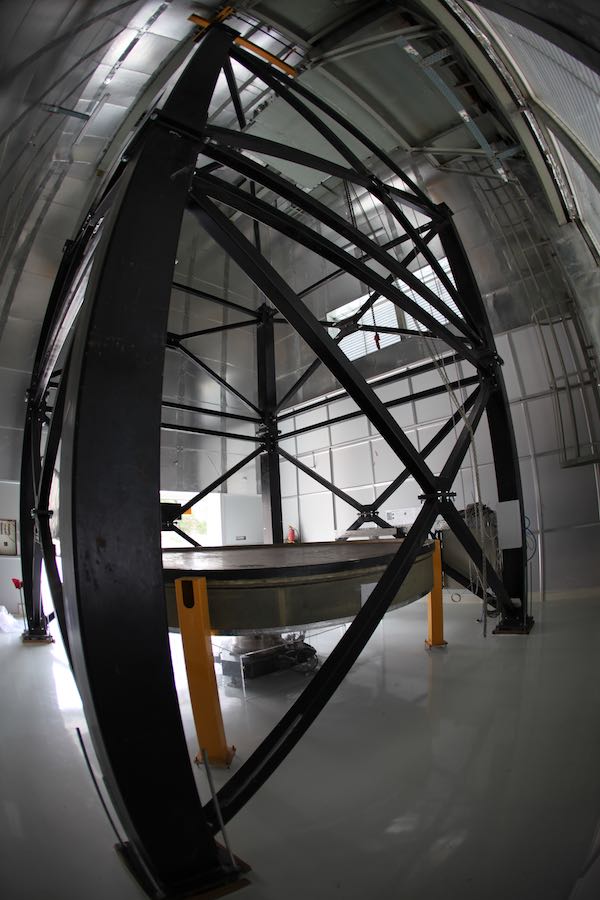
Top view of the ILMT showing the liquid mercury mirror covered by a thin mylar film.

A new telescope facility — International ​Liquid Mirror ​Telescope (ILMT) — has been formally launched in Uttarakhand at campus of Aryabhatta Research Institute of Observational Sciences (ARIES) to keep a watch on the overhead sky to identify transient or variable objects such as supernovae, gravitational lenses, space debris, and asteroids.

This new telescope is first liquid mirror telescope in India and the largest in Asia. It will help in surveying the sky making it possible to observe several galaxies and other astronomical sources just by staring at the strip of sky that passes overhead.

Built by astronomers from India, Belgium and Canada, the novel instrument employs a 4-meter-diameter rotating mirror made up of a thin film of liquid mercury to collect and focus light.

Prof. Dipankar Banerjee, Director, ARIES, said, "ILMT is the first liquid-mirror telescope designed exclusively for astronomical observations installed at the Devasthal Observatory of ARIES. The ILMT and the Devasthal Optical Telescope (DOT). Both are the largest aperture telescopes available in the country."

A ​4Kx4K ​CCD ​camera ​manufactured ​by ​'Spectral ​Instruments' ​and ​which ​can operate ​over ​the ​4000 ​to ​11000 ​Ã… ​spectral ​range ​(SDSS ​filters ​g', ​r', ​i' ​are ​available), ​will be ​positioned ​at ​the ​prime ​focus ​of ​the ​ILMT ​at ​about ​8m ​above ​the ​mirror. ​The ​mirror ​being parabolic ​in ​shape ​requires ​an ​optical ​corrector ​to ​get ​a ​flat ​focal ​surface ​of ​about ​27 ​arcminute in ​diameter. ​All ​these ​elements ​are ​mechanically ​coupled ​by ​an ​external ​structure ​and ​a ​spider.

India's 1st and Asia's Largest Liquid Mirror Telescope Formally Launched in Uttarakhand

Dr. Kuntal Misra, Project Investigator of ILMT at ARIES, said, "The wealth of data generated with the ILMT survey will be exemplary. In the future, several young researchers will be working on different science programs utilizing the ILMT data. When regular science operations begin later this year, the ILMT will produce about 10 GB of data every night, which will be quickly analyzed to reveal variable and transient stellar sources,” said Dr. Brajesh Kumar, ILMT Project Scientist at ARIES. The 3.6 metre DOT, with the availability of sophisticated back-end instruments, will allow rapid follow-up observations of the newly-detected transient sources with the adjacent ILMT."

The data collected from ILMT will be ideally suited to perform a deep photometric and astrometric variability survey over a period of typically 5 years,” notes Project Director Prof. Jean Surdej (University of Liège, Belgium and University of Poznan, Poland).

The ILMT achieved first light in the 2nd week of May 2022. Using the first light observations through the g, r and i Sloan filters, a colour composite image (shown below) of a small portion of the sky was prepared. 

To highlight the features of galaxies and other stellar objects, the green colour has been slightly enhanced in the image. NGC 4274 Galaxy can be seen in the top right corner.

Colour composite image obtained from first light observations of ILMT.

The ​4m ​International ​Liquid ​Mirror ​Telescope ​(ILMT) ​project ​results ​from ​a collaboration ​between ​Aryabhatta ​Research ​Institute ​of ​Observational ​Sciences ​(ARIES, ​India), the ​Institute ​of ​Astrophysics ​and ​Geophysics ​(Liege ​University), ​the ​Canadian ​Astronomical Institutes, ​University ​of ​Montreal, ​University ​of ​Toronto, ​York ​University, ​University ​of ​British Columbia ​and ​Victoria ​University.


Prof Deepak Dhar from IISER-Pune Becomes 1st Indian Physicist to Receive Boltzmann Medal

Prof Deepak Dhar Boltzmann Medal

Indian physicist and Emeritus Professor at the Department of Physics, IISER, Pune, Professor Deepak Dhar becomes first ever Indian physicist to receive the prestigious Boltzmann Medal for his contribution in the field of statistical physics. Prof Deepak is one of the two physicists selected for the prestigious award, the second awardee being Prof. John Hopfield from Princeton University.

The award will be given during  International Conference on Statistical Physics - Statphys 28 - to be held in Tokyo from August 8 to 12.

The Boltzmann Medal award honours outstanding achievements in Statistical Physics. The recipient should be a scientist who has not received the Boltzmann Medal or the Nobel Prize before.

Prof Deepak is also a Senior Scientist at National Academy of Sciences, India (NASI), which is the first Science Academy of India established in 1930. He is an alumnus of University of Allahabad and IIT Kanpur.

The Boltzmann Medal is awarded once every three years by the Commission on Statistical Physics of the C3 Commission on Statistical Physics of the International Union of Pure and Applied Physics (IUPAP) at the Statphys Conference.

Prof Dhar will receive the medal for his seminal contributions to several areas of statistical physics, including exact solutions of self-organized criticality models, interfacial growth, universal long-time relaxation in disordered magnetic systems, exact solutions in percolation and cluster counting problems and definition of the spectral dimension of fractals.

To recall, in May last year, Young scientists at the IISER of Bhopal have invented 'Oxycon', an oxygen concentrator for supplying Oxygen to Covid-19 patients, at a reasonable price of under INR 20,000. Oxycon is claimed to supply 95% pure oxygen.

Principal Scientific Adviser to the Government of India, K VijayRaghavan also tweeted, saying --
Professor Dhar is one of the brightest physicists around. He shares the prize with John Hopfield, of whom the same can be said. From Allahabad University, IIT Kanpur, California University and then TIFR, he has left a great imprint in each place.

More Information at IISER website

Big Step Forward in Researching Interstellar Materials As Smithsonian Institute Creates New Powerful Microwave Spectrometer

The new spectrometer will be a big step forward in the research of interstellar materials between stars.

Digitizer card by Spectrum Instrumentation is a core part of the strongly improved spectrometer

Microwave spectroscopy is a very powerful tool for discovering molecular structures and operates at very low temperatures near absolute zero (1 to 5 Kelvin). The spectrometers generally either operate with high sensitivity over a very narrow bandwidth or a wide frequency with reduced sensitivity. Researchers at the Harvard Smithsonian Center for Astrophysics have used a Spectrum Instrumentation digitizer card to create a next generation molecular spectrometer with both high resolution and high sensitivity that is capable of capturing sample data substantially faster.

 A groundbreaking step forward: The new developed microwave spectrometer at the Harvard Smithsonian Center for Astrophysics 

Brandon Carroll, a Post Doctoral Fellow on the project, explained, "The new design for cooling the sample chamber enables us to have a sampling rate much greater than the usual design, and do so over a wide bandwidth. We therefore needed a means to rapidly capture a large amount of data over a wide bandwidth. Some colleagues at the University of California in Davis recommended a Spectrum Instrumentation digitizer card. We chose an M4i.2230-x8 card as it has a huge amount of on-board memory, a bandwidth up to 1.2 GHz, and the ability to average extremely quickly. We looked at cards from other companies but they were more expensive or did not meet our specifications as well as the Spectrum card did. Plus, it was really easy to integrate with our software to fully automate the data acquisition process unlike the others we considered."

Microwave spectroscopy is used to detect molecules' shape and structure, and this gives unique information about the changes that occur during chemical reactions. "Until we built this spectrometer, it required very complex instruments to use microwave spectroscopy to investigate chemical reactions," Brandon added. "Now we are able to investigate the detailed reaction dynamics of intermediary steps to see how it actually happens. The processes that dominate chemistry and physics change from those of higher temperatures when you are close to absolute zero, i.e., the temperature in many parts of space, hence this research by the Smithsonian Astrophysical Observatory."

The M4i.2230-x8 digitizer card from Spectrum Instrumentation acquires analog signals with 5 Gigasamples per second.

This new spectrometer will provide insights into the chemistry of the interstellar medium, i.e., what is in the space between planets and stars. That material is the feedstock for new solar systems and has a profound effect on how planets are formed - and even the origins of life.

He concluded, "The insights we obtain from this new design will give us a much greater understanding of interstellar chemistry, and we are finding that complex mixture analysis at ultra-cold temperatures is an exciting new direction for our us.”

Two recent papers on the instrument can be found at:

https://arxiv.org/pdf/1902.05852

https://pubs.rsc.org/en/content/getauthorversionpdf/c8cp02055h

About Spectrum Instrumentation

Spectrum Instrumentation, founded in 1989, uses a unique modular concept to design and produce a wide range of more than 200 digitizers and generator products as PC-cards (PCIe and PXIe) and stand-alone Ethernet units (LXI). In 30 years, Spectrum has gained customers all around the world, including many A-brand industry-leaders and practically all prestigious universities. The company is headquartered near Hamburg, Germany, known for its 5-year warranty and outstanding support that comes directly from the design engineers. More information about Spectrum can be found at www.spectrum-instrumentation.com

Coldest Temperature Ever Achieved In A Lab


Scientists in Germany have broke the record for the coldest temperature ever measured in a lab.

In a strange experiment that involved dropping a quantum gas and switching a magnetic field on and off to bring its atoms to an almost complete standstill. German physicist achieved the temperature of 38 trillionths of a degree above -273.15 Celsius by dropping magnetized gas 393 feet (120 meters) down a tower.

It is to be noted however that the experiment only managed to achieve this record-breaking temperature for up to 2-seconds. Although simulations showed that it should be possible to maintain this coldest of coldest temperature for up to 17 seconds in a weightless environment, such as onboard the ISS or a satellite.

Researchers was investigating the quantum properties of a so-called fifth state of matter: Bose-Einstein condensate (BEC), a derivative of gas that exists only under ultra-cold conditions. While in the BEC phase, matter itself begins to behave like one large atom, making it an especially appealing subject for quantum physicists who are interested in the mechanics of subatomic particles.

As per scientific definition 'Temperature' is a measure of molecular vibration – the more a collection of molecules moves, the higher the collective temperature.

In this record-breaking experiment, scientists trapped a cloud of around 100,000 gaseous rubidium atoms in a magnetic field inside a vacuum chamber. Then, they cooled the chamber way down, to around 2 billionths of a degree Celsius above absolute zero, which would have been a world record in itself.

This ultra-cold temperatures achieved is useful in enhancing quantum computers' power as it may help scientists build better quantum computers, says to researchers at MIT.

Particle Physics Lab CERN to Build Massive 100 Km Super-Collider worth €21 Billion


CERN, a European research organization that operates the largest particle physics laboratory in the world, has decided to build a 100-kilometre circular super-collider to uncover the Higgs boson’s secrets.

On on 19 June, the CERN Council unanimously endorsed and approved an update to the European Strategy for Particle Physics that recommends further work on a huge 100 km collider - dubbed the Future Circular Collider (FCC), which would be built in an underground tunnel near CERN’s location in Geneva, Switzerland. It is to be noted however that the approval is not yet a final go-ahead.t2

A schematic map showing where the Future Circular Collider tunnel is proposed to be located (Image: CERN)

In particle physics, colliders are used as a research tool, as they accelerate particles to very high speed (kinetic energies) and let them collide with other particles. with this, physicistsacross the globe hope that it will help answer some of the fundamental open questions in physics, which concern the basic laws governing the interactions and forces among the elementary objects, the deep structure of space and time, and in particular the interrelation between quantum mechanics and general relativity.

The new collider, FCC, is expected to cost at least €21 billion (US$23.4 billion) and would be a follow-up to the lab’s much famous Large Hadron Collider, which is the world's largest and most powerful particle accelerator, first started up in September 2008.

The goal of the FCC is to greatly push the energy and intensity frontiers of particle colliders, with the aim of reaching collision energies of 100 TeV, in the search for new physics.

The FCC Study, hosted by CERN, is an international collaboration of more than 150 universities, research institutes and industrial partners from all over the world.

The new machine would collide electrons with their antimatter partners, positrons, by the middle of the century. The design will enable physicists to study the properties of the Higgs boson and, later, to host an even more powerful machine that will collide protons and last well into the second half of the century.

As per the European Strategy for Particle Physics Update, the approved document strategize the FCC into two stages of development --

1) CERN would build an electron-positron collider with collision energies tuned to maximize the production of Higgs bosons and understand their properties in detail.

2) Later in the century, the first machine would be dismantled and replaced by a proton-proton smasher. That would reach collision energies of 100 teraelectronvolts (TeV), compared with the 16 TeV of the LHC, which also collides protons and is currently the most powerful accelerator in the world.

The goal would be to search for new particles or forces of nature and to extend or replace the current standard model of particle physics. Much of the technology that the final machine will require has yet to be developed, and will be the subject of intensive study in coming decades.

Via ~ Nature.com

Market Reports

Market Report & Surveys
IndianWeb2.com © all rights reserved