Showing posts with label QKD. Show all posts

DST Supported QNu Labs Demonstrates India’s 1st 500 km Quantum-Safe Network Under National Quantum Mission

DST Supported QNu Labs Demonstrates India’s 1st 500 km Quantum-Safe Network Under National Quantum Mission

India’s Department of Science & Technology (DST), under the National Quantum Mission (NQM), announced that Bengaluru-based startup QNu Labs has successfully demonstrated a 500 km quantum-safe communication network — the country’s first extensive Quantum Key Distribution (QKD) deployment.

Key Facts

  • Startup: QNu Labs Pvt. Ltd., incubated at IIT Madras and supported under DST’s National Quantum Mission (NQM).
  • Achievement: Demonstrated India’s first 500 km Quantum Key Distribution (QKD) network over existing optical fiber infrastructure.
  • Event: Officially announced at the Emerging Science, Technology and Innovation Conclave (ESTIC 2025).
  • Stakeholders Present: Dr. Jitendra Singh, Prof. Ajay K. Sood, Dr. Ajai Chowdhry, Prof. Abhay Karandikar.

What is Quantum Key Distribution (QKD)?

  • QKD uses quantum mechanics to securely share cryptographic keys between two parties.
  • Any attempt to intercept the quantum signal disturbs the system, alerting legitimate users.
  • QKD is provably secure against classical and future quantum attacks, unlike conventional encryption.

Strategic Importance

  • Cybersecurity Leap: A 500 km QKD backbone is a milestone for India’s digital security, especially for defense and critical infrastructure.
  • Collaboration: Indian Army facilitated access to fiber networks in Rajasthan for testing.
  • Global Positioning: Positions India alongside China, the US, and EU in building quantum-secure communication networks.
  • Commercial Potential: QNu Labs expected to commercialize quantum-safe products for government, defense, and enterprise clients.

Why It Matters

This demonstration is a proof-of-concept for India’s quantum-secure future, showing that indigenous startups can deliver cutting-edge infrastructure. It strengthens India’s strategic autonomy in cybersecurity, reduces reliance on imported encryption technologies, and aligns with the National Quantum Mission’s vision of building a robust quantum ecosystem.

India Moves Toward Ultra-Secure Telecom: C-DOT & Synergy To Develop Drone-based Secure Communication

India Moves Toward Ultra-Secure Telecom: C-DOT & Synergy To Develop Drone-based Secure Communication

Big move for India's quantum-secure communication! The Centre for Development of Telematics (C-DOT), the premier telecom R&D institution under the Department of Telecommunications (DoT), Government of India, has recently announced partnership with Synergy Quantum India to develop drone-based Quantum Key Distribution (QKD) systems.

Drone-based Quantum Key Distribution (QKD) is a cutting-edge method for securely transmitting encryption keys using quantum mechanics, but with the added mobility of drones.

This collaboration aims to enhance secure telecom infrastructure using the BB84 protocol with polarization encoding, targeting Technology Readiness Level (TRL) 6 or higher.

Technology Readiness Level (TRL) 6 refers to a stage in technology development where a system or prototype has been validated in a relevant environment. This means it has moved beyond basic lab testing and is being tested in conditions that closely resemble real-world applications.

How It Works:

Drone QKD
The drone based quantum communication system consists of a drone (left) that generates entangled photon pairs and distributes them to ground stations. From each pair, one photon (purple beam) goes directly to the ground, while the other (pink beam) is relayed through the second drone (right).
[Image - TheQuantumInsider.com

  1. Quantum Key Distribution (QKD) ensures secure communication by using quantum properties to generate encryption keys that cannot be intercepted without detection.
  2. Drones act as mobile quantum communication nodes, enabling secure key exchange over long distances, even in areas lacking traditional telecom infrastructure.
The system typically employs the BB84 protocol with polarization encoding, making it resistant to eavesdropping.

Why It Matters:

  • Defense & Security: Enables encrypted communication for military and government operations.
  • Emergency Response: Provides secure data transmission in disaster zones.
  • Mobile Networks: Expands quantum-secure communication beyond fixed fiber-optic setups.
As part of the collaboration, C-DOT and Synergy Quantum will jointly pursue the development of quantum communications technologies optimized for drone-based deployment. The partnership will also include co-creation of research proposals for national and international grant applications and dissemination of outcomes through scholarly publications, white papers, and other platforms.

Key representatives from both organizations may also engage in delivering expert talks, short courses, and organizing symposia, conferences, and meetings on timely research themes.

The initiative aligns with India's Atmanirbhar Bharat vision, fostering indigenous innovation in quantum communication. The QKD systems will be optimized for drone-based deployment, making them valuable for defense, emergency services, and government networks.

C-DOT CEO Rajkumar Upadhyay emphasized the importance of merging public R&D with private innovation, while Synergy Quantum CEO Jay Oberoi highlighted India's potential to lead in drone-based quantum-secure communications.

This partnership could be a game-changer for secure mobile data transmission as it is expected to lay the foundation for next-generation quantum-safe telecom infrastructure, revolutionizing secure data transmission for applications in defence, emergency response, critical infrastructure, and secure government communication.

SAC, ISRO Inks MoU with Ahmedabad-based Nav Wireless Technologies for Satellite Communication in Space

SAC, ISRO Inks MoU with Ahmedabad-based Nav Wireless Technologies for Satellite Communication in Space
Hardik Soni, Co-founder & CTO, Navwireless Technologies signing MoU with Nilesh Desai, Director, Space Applications Centre (SAC), Ahmedabad

SAC, ISRO signs MoU with Nav Wireless Technologies for Optical Wireless Communication - LiFi | FSO & Quantum Key Technologies

The MoU envisages the use of the high speed secured communication technology for the upcoming space exploration programs of ISRO.

Pioneer in Light Fidelity (LiFi) technology, the Ahmedabad-based Nav Wireless Technologies Pvt Ltd (NavTech) has signed an MoU with Space Applications Centre, Indian Space Research Organization (ISRO). One of the major centers of ISRO, SAC has joined hands with Nav Wireless Technologies to use light-based high-speed communication for satellite communication in space.

Space agencies have already started using optical wireless technologies instead of Radio Frequency for space communication. SAC will use high speed secure quantum key communication using light from base station to satellite in space & terrestrial communication.

Through this technology, SAC will be able to do the quantum key distribution (QKD) & pointing acquisition and tracking (PAT) for satellite-to-satellite communications in the space. The technology is all set to be used in ISRO’s upcoming space exploration programs.

The MoU signed between SAC/ISRO and Nav Wireless Technologies, has a tenure of three years. Recommended by Department of Telecom (DoT), Nav Wireless Technologies is the first company in India to provide this technology to SAC, ISRO.

Commenting on this development, Hardik Soni, co-founder and CTO of Nav Wireless Technologies Pvt Ltd. said “It is a proud moment for Nav Wireless Technologies as it will contribute to the great projects of ISRO. Very few space agencies in the world are currently using LiFi technology for secured communication between base stations and for satellite communications around the globe.”

Li/Fi, also known as Light Fidelity, utilizes the transmission of data through a light beam spectrum in both indoor and outdoor environments. This technology enables ultra-fast data connections and proves especially valuable in urban areas with congested radio spectra, as well as in rural regions where fiber optic cables or networks are not available.

For over a year, Nav Wireless Technologies Pvt Ltd has been at the forefront of LiFi research and development in India. The company has positioned itself as the sole registered entity in the country dedicated to exploring the potential of LiFi technology. Through their groundbreaking work, Nav Wireless Technologies Pvt Ltd has showcased the most viable and practical solution for the nationwide launch of 5G services & BharatNet rural connectivity, utilizing Optical Wireless Communication (OWC).

First-of-Its-Kind Quantum Solution Lab Coming Up at IIIT Hyderabad in Partnership with Synergy Quantum India

First-of-Its-Kind Quantum Solution Lab Coming Up at IIIT Hyderabad in Partnership with Synergy Quantum India
Synergy Quantum Solution Lab to be set up by IIIT Hyderabad in partnership with Synergy Quantum India Ltd.

First-of-its-kind solution lab will design and build quantum solutions, starting with quantum encryption, QKD, quantum communications, and more

The proposed lab at IIIITH is poised to make significant contributions to the field

International Institute of Information Technology, Hyderabad (IIITH) entered a strategic partnership with Synergy Quantum India (SQ India) to establish the Synergy Quantum Solution Lab (SQSL@IIITH).

The collaboration aims to develop financially feasible quantum technologies and their applications in both military and civilian use cases.

The Synergy Quantum Solution Lab will focus on researching and developing quantum communications technologies, with a special focus on post-quantum encryption, quantum key distribution (QKD), quantum random number generators, quantum sensing, including quantum navigation.

The partnership is a significant milestone for IIITH as it continues to drive innovation and make an impact in the world of quantum technologies.

Prof. P J Narayanan, Director, IIIT Hyderabad said, “IIITH has one of the most extensive quantum computing research groups in the country”. He further mentioned that the new Quantum Solution Lab will add a significant dimension to the research, making it yet another research translation lab for the institute. He expressed enthusiasm for the quantum solutions that could be developed for defense and other sectors through this initiative."

The Synergy Quantum Solution Lab on the IIITH campus will employ full-time engineers, work alongside academicians and research students, and feature business development managers, all of whom will work together to conduct professional translational research, development, and commercialization of quantum solutions. This one-of-a -kind Lab in India is being jointly funded by Synergy Quantum and IIITH.

The Lab will be under the leadership of Prof. Arun Pati, who has been in the World Rank List of Top 2% of Scientists recently published by Stanford University. He is among the Top 1% of Scientists in General Physics which includes Quantum Computing, as reported by Stanford University. He is also no 1 of World’s most famous Quantum Information Scientists in Google search. Speaking about the initiative, Prof. Arun K. Pati welcomed the idea, noting that “it would pave the way for the translation of fundamental research in quantum information into practical technological developments.

SQ is a leader in the quantum revolution, developing high-impact industry solutions that utilize advanced quantum communications technologies.

According to Jay Oberai, founder & CEO of Synergy Quantum India, "We are very excited in partnering with IIIT Hyderabad on developing and commercialising some very interesting technologies within the field of Quantum secure communication, Quantum secure Data storage and Quantum-Safe Private 5G Networks. This alliance is poised to advance the development of quantum technologies and contribute to the growth of the quantum industry in India.”

To recall, it was in late 2020 when "Quantum Key Distribution (QKD)" was unveiled as a new technology developed by DRDO's Centre for Artificial Intelligence and Robotics (CAIR) and DRDO Young Scientist Laboratory (DYSL-CT).

Last year in August, it was reported that QNu Labs, a Bengaluru-based Deep Tech Start-up, supported by the Defence Ministry's iDEX, has done successful trials of QKD system and even equipping Indian Army with Quantum Communication technology. 

Defence Ministry's iDEX Supported Startup To Equip Indian Army with Quantum Communication Tech

Defence Ministry's iDEX Supported Startup QNu Labs To Equip Indian Army with Quantum Communication Tech

Back in year 2020, in the month of December, a quantum-powered secure communication trials were conducted between two physically distant DRDO labs and the milestone was achieved as a secure  quantum communication was successfully established in the presence of Defence minister of India.

The technology called "Quantum Key Distribution (QKD)" has been developed by DRDO's Centre for Artificial Intelligence and Robotics (CAIR) and DRDO Young Scientist Laboratory (DYSL-CT).

While CAIR is a premier laboratory of DRDO involved in the Research & Development of high quality Secure Communication, Command and Control, and Intelligent System, DYSL-CT with emphasis on Cognitive technologies, works in the area of design and development of Cognitive Radio and Cognitive Radar Systems, realising through Deep Neural Networks and Reinforcement learning algorithms.

DRDO developed this technology to enable startups and SMEs in the domain of Quantum information technologies, as one of the objectives. The quantum tech will also serve to define standards and crypto policies that can leverage QKD system in a unified Cipher Policy Committee (CPC) framework for more secure and pragmatic key management for current and future military cryptographic systems.

Now after two odd-years, QNu Labs, a Bengaluru-based Deep Tech Start-up, has broken distance barriers by innovating advanced secured communication through Quantum Key Distribution (QKD) systems. The project was curated by iDEX-DIO with Indian Army.

After the successful trials, now the Indian Army has initiated the process of procurement of QKD systems developed by QNu Labs by issuing commercial Request For Proposal (RFP) and its deployment.

QNu Labs is touted as the first India company to successfully develop commercial cybersecurity products using quantum physics. It also has a subsidiary in the United States called QNu Labs Inc, which was set up in Massachusetts, back in year-2019.

Quantum technology has a huge potential for military application and a disruptive impact on modern-day warfare. A QKD system allows creation of a quantum secure secret pair of symmetric keys between two end points, separated by certain distance (in this case, over 150 Kms) in terrestrial optical fiber infrastructure. The QKD helps create a non-hackable quantum channel for creating un-hackable encryption keys which are used to encrypt critical data/voice/video, across the end points.

Buoyed with the success of the start-up, Defence Secretary Dr Ajay Kumar termed the development of indigenously QKD technology as a milestone achievement in ‘Azadi Ka Amrit Kaal’ and a befitting success story of ‘Aatmanirbhar Bharat’. He appreciated the efforts of iDEX start-ups working in deep tech as they are equipping the Armed Forces with innovative solutions for modern and futuristic warfare.

The Defence Secretary also applauded the efforts of the Department of Defence Production, Ministry of Defence, iDEX-DIO, Army Design Bureau and the Indian Army Signals Directorate, which have contributed in development of high end Quantum Technology in the country for the first time. He added that iDEX revolutionises the defence innovation and helps foster creation of new tech solutions at a fraction of cost and time.

QNu Labs’ co-founder and CEO Shri Sunil Gupta stated that the vision of putting India on the forefront of deep technologies in the field of data security through the use of Quantum technology has finally borne fruits. He added that winning the Open Challenge-2 of iDEX has provided a launching pad to QNu Labs to achieve this stellar success.

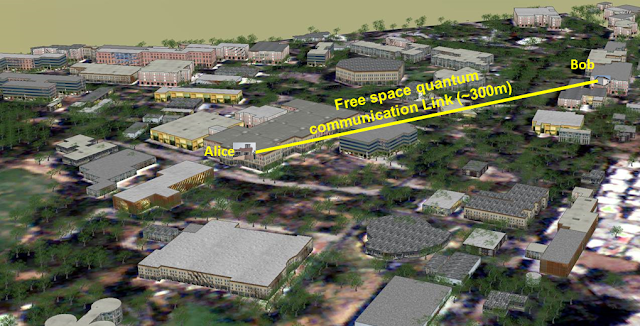
Earlier in February this year, in a major breakthrough for India, scientists from Space Applications Centre (SAC) and Physical Research Laboratory (PRL), both from the city of Ahmedabad, have jointly demonstrated quantum entanglement based real time Quantum Key Distribution (QKD) over 300m atmospheric channel along with quantum-secure text, image transmission and quantum-assisted two-way video calling. 

Breakthrough: India Conducts Demo of Free-Space Quantum Communication Over 300m for Future-Proof Data Security

Representational Image

In December 2020, DRDO developed Quantum Key Distribution (QKD) technology that undergone trials in Hyderabad between two DRDO labs (DRDL and RCI) to show secure communication using quantum-based technologies.

Now in a latest, on a day after this year's republic day, scientists from Space Applications Centre (SAC) and Physical Research Laboratory (PRL), both from the city of Ahmedabad, have jointly demonstrated quantum entanglement based real time Quantum Key Distribution (QKD) over 300m atmospheric channel along with quantum-secure text, image transmission and quantum-assisted two-way video calling. 

SAC and PRL are both the premier laboratories of Department of Space (DOS), Government of India.

The demonstration was conducted at SAC, Ahmedabad, between two buildings separated by a distance of 300 m. 

Department of Space demonstrates entanglement based quantum communication over 300m free space along with real time cryptographic applications (Image Credit - www.isro.gov.in)

With this, India has reached a milestone towards the development of the planned Satellite Based Quantum Communication (SBQC). This feat comes after the earlier breakthrough demonstration of quantum secure videoconferencing by SAC-ISRO using ‘prepare-and-measure’ quantum communication technology, in free space, over a distance of 300 m on 19 March 2021.

This experiment and demonstration were repeated over several nights to ensure the repeatability and robustness of indigenously developed QKD system capable of seamlessly generating and utilizing secure keys for various applications.  

Shri. S. Somanath, Chairman, ISRO & Secretary of DoS has witnessed this live breakthrough demonstration at SAC, Ahmedabad.  

Various images were encrypted using generated quantum key and transmitted over classical channel from one building to another building separated by 300m and decrypted at the receiving terminal in real time.

In order to achieve this technology feat, scientists developed various key technologies like robust & high brightness entangled photon source (EPS), BBM92 protocol implementation, NavIC -- the Indian version of Global Positioning System (GPS) -- enabled synchronization, polarization compensation technique etc. A cryptographic application software suite with integrated quantum security has also been developed and demonstrated for text, image, video encryption/decryption.

The BBM92 protocol based quantum communication link was demonstrated in the experiment. The secure-key-rate achieved was ~1.8 kbps, with Quantum Bit Error Rate (QBER) of less than 10%. Quantum entanglement was achieved with Bell’s parameter and quantum visibility greater than 2.2 and 80% respectively.

With these developments, ISRO, Department of Space is getting ready for satellite based demonstrations of fundamental quantum mechanics experiments as well as quantum communication for future-proof data security.

Prior to the demo in last year, Indian institutes & departments including DRDO, Department of Space (DoS) and ISRO, were developing a number of key indigenous technologies to accomplish this major feat, which included the use of indigenously developed NAVIC -- the Indian version of Global Positioning System (GPS) -- receiver for time synchronization between the transmitter and receiver modules, and gimbal mechanism systems instead of bulky large-aperture telescopes for optical alignment.

Market Reports

Market Report & Surveys
IndianWeb2.com © all rights reserved