Showing posts with label robotics. Show all posts

Capgemini and Orano Deploy 1st AI-Powered Humanoid Robot in Nuclear Industry

Capgemini and Orano Deploy 1st AI-Powered Humanoid Robot in Nuclear Industry

Orano, a recognized industrial leader in the recovery and transformation of nuclear materials, and Capgemini, an AI-powered global business and technology transformation partner, announce the deployment of the first intelligent humanoid robot in the nuclear sector. This project marks a major step forward for a strategic industry that has long been a pioneer in innovation.

Deployed at the Orano Melox Ecole des Métiers [Created in early 2018, Ecole des Métiers is dedicated to promoting and developing the Orano’s technical training] in the Gard region of France, the robot named Hoxo is equipped with embedded artificial intelligence (AI) and advanced sensors for real-time perception, autonomous navigation, execution of technical gestures, and interaction. Its purpose is to replicate human movements and operate alongside teams within nuclear facilities, including in challenging intervention environments.

Over the next four months, Orano Melox’s innovation teams will conduct a testing phase to validate the robot’s range of applications, combining mobility, precision, and artificial intelligence (AI). By offering an agile, scalable robotic platform, this initiative is expected to enhance industrial performance and potentially support operators through robotic assistance.

"Hoxo opens new perspectives for our operations by combining an intelligent and ergonomic robotic solution with the expertise of our on-site teams. It’s an innovation we aim to evolve to meet our industrial needs, contributing to both safety and competitiveness as we tackle the challenges of today and tomorrow," said Arnaud Capdepon, Director of Orano Melox.

"This project, led by our AI Robotics & Experiences Lab, embodies the convergence of robotics, artificial intelligence, computer vision, and digital twins. It redefines human-machine interaction in sensitive environments and pushes the boundaries of industrial automation. Through this initiative, we harness the potential of physical AI to address Orano’s most demanding industrial challenges," added Pascal Brier, Chief Innovation Officer at Capgemini and member of the Group Executive Committee.

About Orano

As a leading international operator in the field of nuclear materials, Orano delivers solutions to address present and future global energy and health challenges. Its expertise and mastery of cutting-edge technologies enable Orano to offer its customers high value-added products and services throughout the entire fuel cycle. Every day, the Orano group’s 18,000 employees draw on their skills, unwavering dedication to safety and constant quest for innovation, with the commitment to develop know-how in the transformation and control of nuclear materials, for the climate and for a healthy and resource-efficient world, now and tomorrow. Orano, giving nuclear energy its full value.

About Capgemini

Capgemini is an AI-powered global business and technology transformation partner, delivering tangible business value. We imagine the future of organizations and make it real with AI, technology and people. With our strong heritage of nearly 60 years, we are a responsible and diverse group of 420,000 team members in more than 50 countries. We deliver end-to-end services and solutions with our deep industry expertise and strong partner ecosystem, leveraging our capabilities across strategy, technology, design, engineering and business operations. The Group reported 2024 global revenues of €22.1 billion.

Discover the humanoid robot Hoxo in pictures:

humanoid robot Hoxo


Amazon Unveils Blue Jay and Project Eluna to Revolutionize Warehouse Robotics and AI

Amazon Unveils Blue Jay and Project Eluna to Revolutionize Warehouse Robotics and AI

Amazon has just unveiled two cutting-edge technologies—Blue Jay and Project Eluna—designed to transform its operations network by enhancing safety, efficiency, and decision-making for front-line employees.

Blue Jay: Multi-Arm Robotics System

Blue Jay
  • Functionality: Coordinates multiple robotic arms in a single station to perform picking, stowing, and consolidating tasks simultaneously.
  • Efficiency Boost: Replaces three separate robotic stations with one streamlined unit, handling ~75% of item types stored at Amazon sites.
  • Design: Ceiling-mounted system that moves packages at high speeds, already deployed in select fulfillment centers.

Project Eluna: Agentic AI for Smarter Decisions

Project Eluna
Project Eluna – An Agentic AI system
  • Project Eluna will be piloted at a fulfillment center in Tennessee to assist operators this holiday season, working initially on sortation optimization. Operators can ask questions like, “Where should we shift people to avoid a bottleneck?” and receive clear, data-backed recommendations. The goal: less putting out fires, more foresight.
  • Purpose: Supports front-line employees by simplifying complex decisions and optimizing workflows.
  • Agentic AI: Goes beyond traditional automation by acting as a collaborative decision-making partner, not just a tool.
  • Impact: Helps reduce repetitive tasks, improve safety, and open new career pathways for employees.
Project Eluna

Project Eluna
Blue Jay and Project Eluna join other new robotics and AI systems we launched this year, including Vulcan, Amazon’s first robot with a sense of touch designed to assist with ergonomically challenging tasks, and DeepFleet, an AI foundation model that coordinates large fleets of mobile robots across facilities.

Humanoid Robotics Heats Up: Agility Reportedly Raising $400M with SoftBank Backing


SoftBank’s latest robotics move signals a renewed push into humanoid automation. Earlier in 2025, the Japanese tech giant reportedly held acquisition talks with Oregon-based Agility Robotics, exploring a deal valued at over $900 million. While the acquisition didn’t materialize, SoftBank pivoted to a strategic investment — joining Agility’s $400 million Series C funding round, which valued the company at $1.75 billion pre-money.

SoftBank has long been bullish on robotics and AI, with past investments in Boston Dynamics and its own humanoid robot, Pepper. Its renewed interest in Agility signals a pivot toward humanoid logistics automation.

As of now, Agility Robotics has not released an official press release confirming the $400 million funding round. However, multiple reputable outlets — including The Information, GeekWire, and Tech Funding News — have reported on the deal based on insider sources and term sheet details.

Who Is Agility Robotics?

  • Agility Robotics is the maker of Digit, a bipedal humanoid robot designed for warehouse and logistics tasks.
  • Digit can walk, climb stairs, and handle packages — making it a strong candidate for augmenting or replacing human labor in fulfillment centers.
  • The company is already piloting Digit with major retailers like Amazon, giving it a real-world edge.

Deal Breakdown

  • Acquisition Talks: SoftBank considered buying Agility outright for over $900M.
  • Funding Pivot: Instead, it joined a $400M round led by WP Global Partners.
  • Strategic Goal: Scale mass production of Digit and expand commercial deployment.

Competitive Landscape

Company Flagship Robot Focus Area Funding/Valuation (2025)
Agility Robotics Digit Warehouse logistics $400M round, $1.75B pre-money
Figure AI Figure 01 General-purpose labor Backed by OpenAI, Microsoft
Tesla Optimus Factory automation Internal R&D, no external funding

Why It Matters

  • SoftBank’s move reflects a strategic shift — from owning robotics IP to backing scalable platforms with real-world traction.
  • With humanoid robotics moving from R&D to commercialization, logistics and manufacturing are emerging as the first battlegrounds.
  • Agility’s Digit is no longer just a prototype — it’s a product on the verge of mass deployment.
  • With SoftBank’s backing, the humanoid race just got a lot more interesting.

Tesla Halts Plans for Thousands of Humanoid Bots Over Hand Design Flaws


Tesla has officially scaled back its ambitious plans to produce thousands of Optimus humanoid robots in 2025 due to significant design challenges—especially with the robot's hands.

Optimus, also known as the Tesla Bot, is a general-purpose humanoid robot developed by Tesla. It was first announced at Tesla’s AI Day in August 2021, with a prototype unveiled in 2022.

Designed to perform tasks humans don’t want to do, like factory work, sorting, lifting, and navigating terrain, the Optimus bot is powered by Tesla’s onboard AI brain (based on Autopilot hardware), it learns through simulation-based reinforcement learning. The latest Gen 3 version stands 173 cm tall, weighs 57 kg, and can walk at 5 mph. It has 22 degrees of freedom in each hand, enabling human-like dexterity.

In 2025, Tesla showcased Optimus performing Kung Fu movements—learned entirely through AI, without human programming. The robot demonstrated balance, coordination, and agility, marking a leap in real-time movement control.

Tesla initially planned internal deployment in 2025, with external sales starting in 2026. The projected cost is under $30,000, though skepticism remains about its timeline and mass-market viability.

What went wrong?

Tesla Halts Plans for Thousands of Humanoid Bots Over Hand Design Flaws
Tesla originally aimed to produce at least 5,000 Optimus bots this year, up from just a few dozen in 2024. However, technical issues with the hands, which are the most complex part of the design, have caused delays. Engineers are struggling to create dexterous, human-like hands.

The company has reportedly stockpiled Optimus bodies missing hands and forearms, with no clear timeline for completion. Tesla has now lowered its production target to 2,000 units, but even that revised goal appears to be in jeopardy.

Strategic implications

Elon Musk had previously described Optimus as a transformative technology that could eventually surpass Tesla’s EV business in impact. This setback may delay that vision, though development continues behind the scenes.

Figure 03: The Next Leap in Humanoid Robotics

Figure 03: The Next Leap in Humanoid Robotics


Figure 03 is the latest humanoid robot developed by Figure AI, a California-based robotics startup founded in 2022 by Brett Adcock. Designed for real-world environments—from homes to warehouses—Figure 03 is a full-sized, bipedal robot capable of performing everyday tasks like folding laundry, washing dishes, and navigating complex spaces.

About Figure AI

Figure AI is backed by major tech investors including OpenAI, Microsoft, and Jeff Bezos. Its mission is to create scalable, general-purpose humanoid robots that can fill labor gaps and assist in daily life.
  • Founded in 2022 by Brett Adcock
  • Headquartered in California
  • Focused on real-world deployment of humanoid robots
  • Backed by OpenAI, Microsoft, and Jeff Bezos

Architecture Highlights

At the heart of Figure 03 is Helix, a proprietary Vision-Language-Action (VLA) model that enables real-time decision-making without pre-scripted commands.
  • Vision: Wide field of view and high frame rate
  • Language: Natural language comprehension and contextual reasoning
  • Action: Dexterous hands and stable locomotion for task execution
  • Unified System: Integrates perception, planning, and control
Helix makes Figure 03 one of the first humanoids capable of unscripted, adaptive behavior in dynamic environments.

What Makes Figure 03 Revolutionary?

Figure 03 isn’t just a robot with limbs—it’s a general-purpose AI agent powered by Helix, a proprietary vision-language-action (VLA) model that allows it to understand, reason, and act in real time. It doesn’t follow scripts. It learns, adapts, and responds to the world like a human would.
  • Vision Upgrade: 60% wider field of view and 2× faster frame rate
  • Latency: Reduced by 75% for near-instant reactions
  • Mobility: Walks, balances, and navigates complex environments
  • Hands: Redesigned for dexterity—capable of folding laundry, pouring drinks, and more
Watch the full reveal in Introducing Figure 03, where the team showcases the robot’s capabilities and design philosophy.

Built for the Real World

Unlike its industrial predecessors, Figure 03 is engineered for human-centric environments. It’s 5'6" tall, weighs 60 kg, and is designed to operate safely around people.
  • Home Integration: Wireless charging, soft-touch materials, and voice interaction
  • Safety First: Advanced sensors and AI-driven motion planning
  • Household Tasks: From dishwashing to plant watering, it’s your new domestic ally
Curious how it performs in a real home? Is the Figure 03 Robot Ready to Clean Your House? puts it to the test in a domestic setting.

Beyond the Home: A Workforce Revolution

Figure AI envisions a future where humanoid robots fill labor gaps in logistics, manufacturing, and elder care. With a modular design and scalable production, Figure 03 is built for mass deployment.
  • Production-Ready: Designed for large-scale manufacturing
  • Cost Target: Estimated between $20,000–$30,000 per unit
  • Job Impact: Analysts predict up to 8 million jobs could be augmented or replaced by 2040

Explore the broader implications in Figure 03 – The Humanoid Robot Built for the Home and the ...

Watch Figure 03 in Action

🧩 The Bigger Picture

Figure 03 is more than a machine—it’s a symbol of the AI-human future. With backing from OpenAI, Microsoft, and Jeff Bezos, Figure AI is betting big on a world where robots are not just tools, but teammates.

As the humanoid revolution accelerates, one thing is clear: the future isn’t just coming—it’s walking right through your front door.

Marine Robotics Startup EyeROV Bags ₹47 Cr Order from Indian Navy to deliver Underwater Remotely operated Vehicles (UWROVs)

Marine Robotics Startup EyeROV Bags ₹47 Cr Order from Indian Navy to deliver Underwater Remotely operated Vehicles (UWROVs)

EyeROV, India’s pioneering underwater robotics startup, has announced the signing of a landmark ₹47 Cr contract with the Indian Navy for advanced Underwater Remotely Operated Vehicles (UWROVs). The deal strengthens India’s naval capability with field-tested, indigenously built technology.

EyeROV’s UWROVs have been tested in the most demanding environments, from the turbulent seas for deep water missions as deep as 400+ m for underwater volcanic studies to the coldest depths of the Antarctic Sea. These successful tests prove that the Navy receives systems designed for real-world challenges where precision, safety and reliability are paramount.

EyeROV TROUT, a 300m depth rated, is a military grade rugged ROV developed for dual applications of defence as well as commercial. It can deep dive equipped with advanced payloads to carry out multiple missions like underwater surveillance & reconnaissance to monitor naval environments and more.

Commenting on the development, Johns T. Mathai, Co-Founder & CEO, EyeROV, said, “This recognition is a true reward for our dedicated efforts over the past eight years. We sincerely thank the iDEX and Navy teams for their support in fostering advanced indigenous solutions. Our vision has always been to serve the nation by delivering technologies that are at par with global standards.”


EyeROV brings nearly a decade of field experience delivering underwater intelligence in mission-critical projects — from disaster & recovery to dam safety inspections to offshore energy operations and naval operations.

EyeROV’s indigenous technology stack is fully developed in India, reinforcing the nation’s push towards self-reliance in defence. Beyond cost efficiency, EyeROV’s systems deliver operational resilience, strategic autonomy, and global competitiveness — making the company a national asset in India’s defence deep-tech landscape.

Kannappa P., Co-Founder & CTO, EyeROV, added, “For eight years, EyeROV has engineered underwater systems tested in the harshest conditions. This partnership with the Navy is proof that Indian innovation can set benchmarks globally in defence deep-tech.”

Founded in 2017, EyeROV has completed more than 100 successful deployments across India, West Asia, APAC and Europe. The Company has more than 80 customers including some of the most prestigious names like DRDO, Indian Coast Guard, CSIR and NCPOR. Key product portfolio includes EyeROV TUNA (ROV), EyeROV TROUT (ROV), iBoat Alpha (USV) serving sectors like Defence & Security, Hydro & Marine Infrastructure, Disaster Management, Energy, Environmental Conservation. The Company also raised a Pre Series A round of $1.2 million from Unicorn India Ventures last year. EyeROV has been recognised among the top 5 def-tech startups in India and has won the National Startup Award in 2022.

About EyeROV

EyeROV is India’s pioneering deep-tech company specializing in underwater robotics and marine technology solutions. Founded in 2017 and headquartered in Kochi, EyeROV designs, develops, and deploys indigenously built Remotely Operated Vehicles (ROVs) and Unmanned Surface Vessels (USVs) that serve critical applications across Defence & Security, Hydro & Marine Infrastructure, Disaster Management, Energy, and Environmental Conservation. With over 100 successful deployments across India, West Asia, APAC, and Europe, EyeROV has earned the trust of 80+ customers including DRDO, Indian Coast Guard, CSIR, and NCPOR. Recognized among the Top 5 Defence Startups in India, EyeROV continues to drive innovation, delivering mission-critical systems that combine precision, resilience, and cost efficiency. EyeROV’s vision is to empower nations with strategic autonomy in underwater intelligence and contribute to global advancements in marine robotics.

NATO Leads €12 Mn Funding of Underwater Robotics Startup to Protect 160,000km of Seafloor Networks

NATO Leads €12 Mn Funding of Underwater Robotics Startup to Protect 160,000km of Seafloor Networks

In a decisive move to bolster subsea infrastructure security, the military alliance NATO, through its NATO Innovation Fund, has led €12 million financing round of Norway-based startup Kongsberg Ferrotech, whose innovative underwater robotics technology is poised to redefine pipeline maintenance and vessel repairs on the ocean floor.

The robot, developed to operate in extreme underwater conditions, creates a “dry habitat” that enables safe inspections and repairs—eliminating the need for human divers or disruptive production shutdowns. This tech isn't just theoretical; it's currently in action off the coast of Abu Dhabi, supporting the oil and gas sector by reducing operational emissions and costs.

Strategic Implications:

With over 160,000 kilometers of subsea pipelines crisscrossing the globe, the risk to vital infrastructure has drawn heightened attention—especially after incidents like the 2022 Nord Stream sabotage. NATO’s investment signals a growing commitment to protect these networks from geopolitical threats, cyber interference, and physical disruption.

Naval Benefits:

Experts believe this tech could also revolutionize naval logistics by allowing vessel maintenance directly at sea. “Repairing warships without docking could extend fleet lifespans and enhance readiness,” says a NATO spokesperson familiar with the deal.

Beyond Borders:

The move reflects a broader trend in global defense: combining robotics, AI, and clean tech to create agile, resilient infrastructure solutions in a rapidly evolving security landscape.

As nations deepen their investments in digital and physical infrastructure protection, underwater robots like those from Kongsberg Ferrotech may soon be as common in marine defense as satellites are in the sky.

The NATO Innovation Fund (NIF) is a €1 billion multi-sovereign venture capital fund launched in 2023 by 24 NATO member countries. The fund aims to invest in deep tech startups that enhance the Alliance’s long-term security, resilience, and technological edge.

Late last month, the NATO Innovation Fund and Earlybird led a $35 million Series A round in Portal Biotech, a pioneering biotechnology company headquartered in London. The NATO Innovation Fund invested in Portal Biotech because its protein sequencing platform has the potential to unlock the next frontier of biological data, critical for biosecurity and healthcare resilience.

NATO, or the North Atlantic Treaty Organization, is a political and military alliance formed in 1949 to ensure the collective defense of its member countries—primarily from North America and Europe. Its guiding principle is that an attack on one member is considered an attack on all, as outlined in Article 5 of its founding treaty. Headquartered in Brussels, NATO works to maintain global peace and stability by coordinating defense strategies, conducting joint military operations, and addressing modern threats like cyberattacks, terrorism, and infrastructure sabotage.

Robotics Tech Startup Peppermint Raises $4 Mn in Series A Funding

Robotics Tech Startup Peppermint Raises $4 Mn in Series A Funding

Peppermint, a leader in autonomous robotic solutions for commercial and industrial applications, has raised a Series A funding round of ₹34 crore (~$4 million). The round was participated in by JDSS, ENRISSION INDIA CAPITAL, IAN, Vinners, and angel investors participated in the round. Peppermint develops autonomous solutions for commercial and industrial use cases, focusing on floor cleaning robots, material handling systems, and support accessories like docking stations. The company helps businesses address labor shortages, streamline operations, and improve sustainability via its energy-efficient robotic solutions backed by the proprietary Peppermint OS and "Skateboard" electronics framework.

The easy-to-deploy and easy-to-manage systems are further supported by cloud-connected dashboards and mobile apps, delivering real-time analytics for data-driven decision-making.

Runal Dahiwade, Founder & CEO, Peppermint

"Today, as industries worldwide face increasing labor shortages and sustainability demands, our autonomous solutions are uniquely positioned to deliver both operational efficiency and environmental benefits. Our current round of funding will help us drive four strategic priorities — enhancing our international product offerings & compliances, expanding into the EU, Japan and APAC regions, advancing our proprietary operating system to support both our robots and OEM partners, and building the infrastructure needed to meet growing demand," said Runal Dahiwade, Founder & CEO, Peppermint.

Peppermint started its journey at SINE IIT Bombay in 2019. Since then, It has received support from investors, including NKK Group, SINE, Venture Catalysts, IAN, Voxtur Ventures, Vinners, JDSS, ENRISSION INDIA CAPITAL and others. The latest investment brings the company's total funding to ₹49 crore ($5.6 million), including previous funding rounds. Following its successful US market debut in 2024, Peppermint plans to use the new capital to accelerate its expansion into European and Asia-Pacific markets through 2026. The funding will also help further enhance Peppermint technologies, includes OS and Skateboard.

Floor cleaning robot

These innovations align with Peppermint's vision of automating repetitive workflows across industries that are increasingly seeing workers migrate from unskilled to higher-skill roles. The company also aims to strengthen its leadership and core engineering teams while simultaneously investing in production and supply chain, thereby enabling new products like the restroom cleaning robot scheduled for release in 2025-2026.

As successful deployments already prove the value proposition, Peppermint Robotics' Series A funding arrives at a pivotal moment of market readiness and technological maturity. The startup is now uniquely positioned to deliver multi-functional autonomous robots designed to perform numerous workflows in a single pass while being intuitive to deploy and manage.

Founded in 2019 by Runal Dahiwade, and based in Pune, India, Peppermint is a leading robotics technology company with a global presence in six countries. Specializing in automating labour-intensive tasks within commercial and industrial environments, the company aims to tackle challenges such as skilled manpower shortages, rising costs, and high attrition rates.

By delivering advanced robotic solutions, Peppermint Robotics helps clients achieve enhanced accountability, significant cost savings, and sustainable operations. Its innovative approach addresses key issues in applications like commercial cleaning and material handling, positioning the company as a pivotal player in the evolution of automation technology. With a focus on practical, impactful solutions, Peppermint Robotics is dedicated to transforming the future of work through cutting-edge robotics.

iHub Robotics Set to Establish India’s Largest Humanoid Robotics Manufacturing Facility As It Raises ₹4.3 Crore in Funding

iHub Robotics Set to Establish India’s Largest Humanoid Robotics Manufacturing as It Raises ₹4.3 Crore in Funding
  • iHub Robotics Raises ₹4.3 Crore in Pre-Seed Funding
  • With this fresh capital, the company is set to establish India’s largest humanoid robotics manufacturing facility in Kerala.
  • The company also expects to create over 150 jobs in the next 2 years, contributing to India’s deep-tech ecosystem.
  • The company has launched iHub School of Learning, a platform dedicated to educating and training students in AI & robotics with a mission to empower 100,000 students with future-ready skills in deep-tech.
iHub Robotics, India’s pioneering humanoid robotics startup, has successfully raised ₹4.3 crore ($520K) in pre-seed funding from U.S. investors. With this fresh capital, the company is set to establish India’s largest humanoid robotics manufacturing facility in Kerala, reinforcing its vision to make India a global leader in robotics and AI-driven automation. The company also expects to create over 150 jobs in the next two years, contributing to India’s deep-tech ecosystem.

iHub Robotics has already made a significant international impact, exporting its semi-humanoid robot, Tara Gen-1, to the UAE and Saudi Arabia. Tara Gen-1 is the most advanced semi-humanoid robot in India, built with cutting-edge AI and robotics technology. It is designed to operate in hospitality, healthcare, airports, railway stations, and various customer service roles, enhancing efficiency and automation in these Industries.

iHub Robotics Set to Establish India’s Largest Humanoid Robotics Manufacturing as It Raises ₹4.3 Crore in Funding

iHub Robotics Set to Establish India’s Largest Humanoid Robotics Manufacturing as It Raises ₹4.3 Crore in Funding

What sets Tara Gen-1 apart is its advanced human behavior intelligence, allowing it to:
  • Recognize and respond to human emotions
  • Engage in natural conversations using AI-powered speech recognition
  • Adapt to different environments with real-time decision-making
  • Assist customers with navigation, inquiries and personalized service
  • Function seamlessly in multi-language settings
Additionally, in January 2025, iHub Robotics became India’s first company to be officially recognized by NVIDIA and was selected for the NVIDIA Humanoid Robotics Program. This milestone validates the company’s cutting-edge work in robotics and AI, granting it access to NVIDIA’s advanced technologies, research collaborations, and global networking opportunities.

Beyond humanoid robotics, iHub Robotics is also committed to empowering the next generation of AI and robotics innovators. The company has launched iHub School of Learning, a platform dedicated to educating and training students in AI and robotics with a mission to empower 100,000 students with future-ready skills in deep-tech.

iHub Robotics Set to Establish India’s Largest Humanoid Robotics Manufacturing as It Raises ₹4.3 Crore in Funding
Sarath S, ATHIL Krishna, Akhil k Haridasan

“This funding is a significant step toward realizing our dream of Physical AI, where intelligent robots seamlessly integrate into industries to enhance human capabilities. By setting up India’s biggest humanoid robotics manufacturing facility, we are not just building robots, we are shaping the future of AI-driven automation globally. Additionally, with our expansion, we aim to generate over 150 new jobs in the next two years, driving India’s deep-tech revolution forward,” said Athil Krishna, CEO of iHub Robotics.

TCS, IIT Kharagpur to Setup Advanced Research Center Focusing Digital Health, Robotics and Intelligent Systems

TCS, IIT Kharagpur to Setup Advanced Research Center for Research in Digital Health, Robotics and Intelligent Systems

Tata Consultancy Services (TCS) and the Indian Institute of Technology Kharagpur (IIT Kharagpur) have partnered to establish an Advanced Research Center focused on digital health, robotics, and intelligent systems. The center is located in the IIT Kharagpur Research Park in New Town, Kolkata.

The center will house three labs specializing in Sensing and Communications, Edge Computing and Analytics, and Robotics and Visual Computing.

Over 150 TCS scientists will work on cutting-edge projects, leveraging edge computing, embedded systems, and Al.

The center will also feature a customer experience center where TCS clients from various industries can gain insights into original research concepts.

Additionally, workshops will be held to foster collaboration between TCS scientists, industry experts, and IIT Kharagpur faculty to solve industry problems.

This partnership aims to drive innovation and address some of the most pressing challenges in healthcare and automation.

Dr Harrick Vin, Chief Technology Officer, TCS, said: “TCS is transforming the way in which industry has traditionally engaged with elite institutes of research and learning. One of our focus areas is to co-locate our research and innovation labs in academic institutions to enable a more efficient exchange of knowledge and talent. We initiated this journey with our move into the IIT Madras Research Park in Chennai a few years back. The establishment of our research and innovation lab at the IIT Kharagpur Research Park is the next step of this strategic journey. At IIT KGP, we are funding several research programs; co-innovating with them will lead to vastly improved outcomes for both parties.”

Professor Virendra Kumar Tewari, Director, IIT Kharagpur, said: “The Advanced Research Center will strengthen our strategic collaboration with TCS, underscored by their presence in the newly established IIT KGP Research Park, Kolkata. This partnership represents a significant leap forward in harnessing cutting-edge technologies to address some of the most pressing challenges in healthcare and automation. By combining IIT Kharagpur’s world-class research capabilities with TCS’s industry-leading expertise, we aim to drive transformative innovations that can enhance quality of life, improve healthcare delivery, and contribute to the growing field of intelligent systems. This center will not only foster groundbreaking research but also create opportunities for interdisciplinary collaborations, empowering the next generation of technologists and researchers to shape the future.”

Besides this research center, TCS has also set up a research and innovation lab at the IIT Madras Research Park in Chennai. And this lab too focuses on areas like digital health, robotics, and intelligent systems.

TCS has also collaborated with IIT Bombay on various research projects, particularly in the fields of data science and artificial intelligence.

CMC-Vellore and IIT-Madras Jointly Develop Portable, Affordable Robotic Device for Stroke Survivors

CMC-Vellore and IIT-Madras Jointly Develop Portable, Affordable Robotic Device for Stroke Survivors

Christian Medical College (CMC) Vellore and IIT Madras have developed a portable robotic device named PLUTO (Plug-and-Train Robot for Hand Neurorehabilitation) to aid stroke survivors in their recovery through hand movement therapy. This innovative device is designed to be affordable and user-friendly, making it accessible for use in various settings, including hospitals, small clinics, community centers, and even at home.

Pluto employs a single motor with multiple attachments to train different hand functions, inspired by the design of a mixer grinder⁴. It has already been used by over 1,000 patients across nine clinics in India, showing promising results. The technology has been licensed to Thryv Rehab Solutions for commercialization.

This development is a significant step forward in neurorehabilitation, potentially enhancing the quality of life for many stroke survivors.

This project was led by Prof. Sivakumar Balasubramanian from the Department of Bioengineering at CMC Vellore and Prof. Sujatha Srinivasan from the Department of Mechanical Engineering at IIT Madras.

Pluto was developed in collaboration with the Departments of Physical Medicine and Rehabilitation and Neurological Sciences at CMC Vellore. Initial funding came from the Department of Biotechnology, Government of India, with additional support from CSR grants provided by Tata Boeing Aerospace Limited ( TBAL) and Tata Elxsi Limited, which further enhanced PLUTO’s technological readiness.

The innovation has secured an Indian patent, with patents pending in the US and Canada.

Pluto, the physiotherapy robot, stands out in several ways compared to other rehabilitation devices:

1. Affordability: Pluto is designed to be cost-effective, making it accessible to a broader range of patients, including those in rural or low-income areas. Many advanced rehabilitation devices can be prohibitively expensive.

2. Portability: Unlike many bulky rehabilitation machines, Pluto is portable and can be used in various settings, including at home. This flexibility is crucial for continuous therapy, which i often needed for effective stroke recovery.

3. User-Friendly Design: Inspired by the simplicity of a mixer grinder, Pluto uses a single motor with multiple attachments to train different hand functions. This design makes it easy to use without extensive training.

4. Proven Effectiveness: Pluto has already been tested on over 1,000 patients across nine clinics in India, showing promising results. This real-world usage provides a strong foundation for its effectiveness.

5. Customization: The device can be tailored to individual patient needs, which is essential for personalized rehabilitation plans.

In comparison, other rehabilitation devices might offer more advanced features or higher precision but often at a higher cost and with less portability. Pluto's balance of affordability, portability, and effectiveness makes it a valuable tool for stroke rehabilitation.

US-based Robot Delivery Firm Kiwibot Acquires Taiwan-based Chipmaker

US-based Robot Delivery Firm Kiwi Acquires Taiwan-based Chipmaker

The delivery robotics firm Kiwibot has acquired Auto Mobility Solutions, a Taipei Taiwan-based chipmaker that specializes in robotics and autonomous driving technologies, reported Techcrunch.com
This strategic move is partly in response to the increasing tensions between the U.S. and China.

The acquisition aims to enhance Kiwibot's cybersecurity measures for AI-powered robotics and establish a stronger presence in Asia. The details of the transaction have not been disclosed, but the merger is seen as a significant step in innovation and privacy protection within the robotics industry.

The development comes within few days after Taiwan got struck by an earthquake, which was the most powerful earthquake to hit the region in last 25 years. The earthquake halted some chipmaking operations including the Taiwan Semiconductor Manufacturing Co. (TSMC), the world's largest maker of advanced chips, that had to evacuate staff and stop machinery as a precaution.

Kiwibot calls this acquisition deal a “significant milestone in both companies" journeys toward innovation and safeguarding privacy in the robotics industry, particularly for intelligent robots sourced from China and deployed in the Western markets.

This move also signifies Kiwibot's expansion and increased presence in the Asian market.

Founded in 2017, Kiwibot is a company that uses autonomous robots to deliver food and packages at over 35 universities and locations worldwide. The company's robots are designed to navigate and drive on sidewalks without human intervention in certain environments. Kiwibot's robots are powered by AI and a team of humans.

US-based Robot Delivery Firm Kiwibot Acquires Taiwan-based Chipmaker
Kiwibot delivery robots

Kiwibot launched its first pilot at the University of California-Berkeley campus. With a presence at 27 US college campuses and 41 cities worldwide, the company aims to revolutionize food delivery with high-driving autonomous robots. They’ve delivered fresh food for restaurants like Dunkin Donuts, Subway, Pizza Hut, and Mr. Beast Burgers, and the service lets customers launch last-mile deliveries at a fraction of the time and cost without the hassle of hiring a courier. Having served 6,942 students and connected 133 restaurants with customers in 2022, Kiwibot is committed to a zero-carbon future eliminating the gas emissions of common delivery vehicles.

Auto Mobility Solutions is a Taipei-based company that specializes in robotics and autonomous driving technologies. The Taiwanese company focus on creating chips for robotics and autonomous conditions, with a strong emphasis on robot cybersecurity. The company was incorporated on April 10, 2018, and operates as a private limited company. Their services include the maintenance and repair of motor vehicles, as indicated by their SIC code 45200.

Back to Kiwibot, the robots delivery firm has raised a total of $45.6 million over various funding rounds. The last known funding round was a Series A for $10 million on February 22, 2023. The company has received investments from a diverse group of investors. Some of the notable investors include Kineo Finance, Bay Wharf Capital Cibersons, Socialatom Ventures, and Sodexo. These investors have contributed to Kiwibot's funding rounds, supporting their development of on-demand delivery robots designed for various services like food delivery.
 

Accenture and Japan's Mujin Setup JV 'Accenture Alpha Automation' To Bring AI, Robotics to Manufacturing and Logistics

Accenture and Japan's Mujin Setup JV 'Accenture Alpha Automation' To Bring AI, Robotics to Manufacturing and Logistics

New joint venture will use AI and machine learning to connect operational and management data and accelerate data-driven management

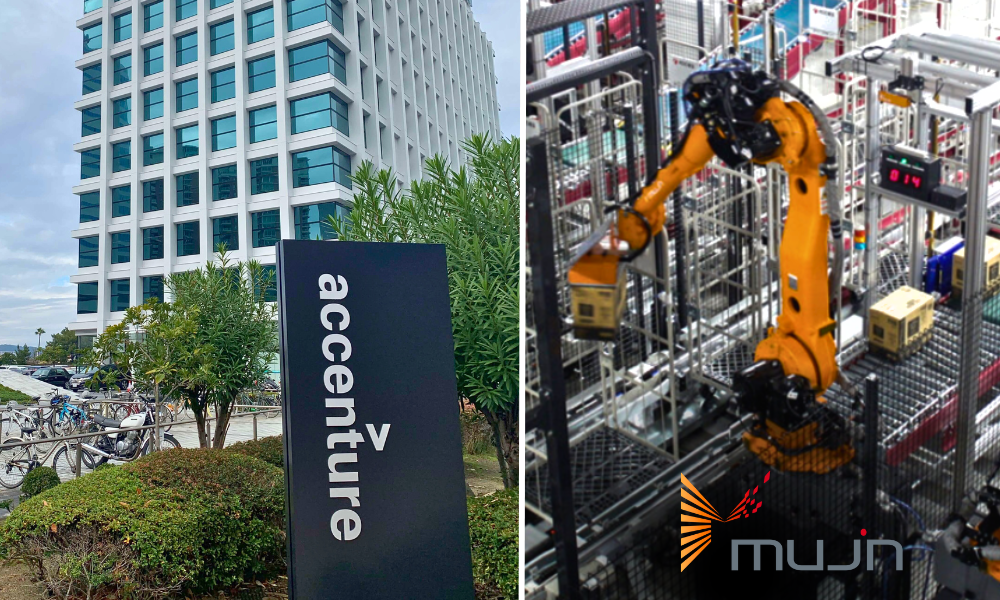
Accenture and Mujin, a Japan based company engaged in intelligent robotics for manufacturing, logistics and supply chain operations, have established Accenture Alpha Automation, a joint venture for the manufacturing and logistics industries. Accenture Alpha Automation will help companies automate their management infrastructure with data-driven solutions that seamlessly combine data from manufacturing and logistics operations with management data. The joint venture is owned 70% by Accenture and 30% by Mujin.

Mujin provides intelligent automation solutions for industrial sites. Its intelligent robotics platform enables companies to deploy industrial robotics systems without the typical complex advance settings and integration, including motion settings and peripheral equipment, often required for other robotics systems.

The joint venture will combine Mujin’s experience in industrial robotics and automation with expertise from Accenture’s digital engineering and manufacturing service, Industry X. Accenture Alpha Automation’s solutions will integrate previously disconnected operational data from manufacturing and logistics sites with business management data, such as the company-wide supply chain status, financial information and market information. Accenture and Mujin will bring these solutions to clients to help them make faster, better decisions and hyper-automate their manufacturing and logistics processes.

Atsushi Egawa, who leads Accenture’s business in Japan, said: “Manufacturing is the cornerstone of Japanese industry. Driving sophistication and efficiency in manufacturing and the logistics that support manufacturing is essential for Japan's further growth. By teaming with Mujin, a leader in robotics technology, Accenture will be able to help our clients take advantage of AI and robotics to connect data throughout the manufacturing and logistics value chain, further contributing to the data-driven transformation of Japan’s important manufacturing and logistics industries.”

Mujin Inc. CEO, Issei Takino adds: “Our mission is to make industrial robots intelligent and easy to use so they can improve productivity and quality and help create new value in an aging society. The new joint venture, which builds on our agreement with Accenture, will utilize our robot automation technology to drive a paradigm shift in the manufacturing and logistics industry and bring new value to customers first in Japan, then around the world.”

Accenture has also invested directly in Mujin through Accenture Ventures, marking its first Project Spotlight investment in Asia. Project Spotlight is an engagement and investment program focused on companies that create or apply disruptive enterprise technologies. The program offers extensive access to Accenture’s domain expertise and its enterprise clients, helping technology companies adapt their solutions to the enterprise market and scale faster and more effectively.

About the Joint Venture

Company name: Accenture Alpha Automation
Location:
Sumitomo Fudosan Azabu Juban Building, 1-4-1 Mita, Minato-ku, Tokyo
Operation starts: January 15, 2024
Scope of Operation:
  • Consult and develop automation concepts in the manufacturing and logistics industries
  • System integration in the manufacturing and logistics industries
  • All businesses incidental to the preceding items
Share: Accenture 70%, Mujin 30%


Accenture is a leading global professional services company that helps the world’s leading businesses, governments and other organizations build their digital core, optimize their operations, accelerate revenue growth and enhance citizen services—creating tangible value at speed and scale. We are a talent- and innovation-led company with approximately 743,000 people serving clients in more than 120 countries. Technology is at the core of change today, and we are one of the world’s leaders in helping drive that change, with strong ecosystem relationships. We combine our strength in technology and leadership in cloud, data and AI with unmatched industry experience, functional expertise and global delivery capability. We are uniquely able to deliver tangible outcomes because of our broad range of services, solutions and assets across Strategy & Consulting, Technology, Operations, Industry X and Song. These capabilities, together with our culture of shared success and commitment to creating 360° value, enable us to help our clients reinvent and build trusted, lasting relationships. We measure our success by the 360° value we create for our clients, each other, our shareholders, partners and communities.


Samsung Unveils New Ballie, An AI Companion Robot for the Home

Samsung Introduces Ballie, An AI Companion Robot for the Home

A new, smart home companion is welcoming users home by taking care of household tasks, displaying the day’s events and sharing weather updates.

Samsung Electronics introduced a new version of its AI home companion robot Ballie at a press conference at the Mandalay Bay Hotel in Las Vegas on January 8 (local time) — ahead of the Consumer Electronics Show (CES) 2024. First introduced at CES 2020, Ballie has been revamped with new advanced features to help users intelligently navigate their lives.


Ballie acts as a personal home assistant, autonomously driving around the home to complete various tasks. By connecting to and managing home appliances, Ballie can provide a helping hand to users in many situations — continually learning from users’ patterns and habits to provide smarter, more personalized services. Ballie provides peace of mind by sending video updates of pets or loved ones to users’ devices when they’re away from home. What’s more, Ballie can set the mood for any home activity whether users are exercising, working or relaxing. From projecting workout videos on the wall or floor in an optimal size to playing music and answering phone calls, Ballie makes life at home more productive and enjoyable.

Learn more about Ballie’s unique AI functionalities in the video below.


S. Korea's EveR 6 Becomes World's 1st Robotic Orchestra Conductor

S. Korea's EveR 6 Becomes World's 1st Robotic Orchestra Conductor

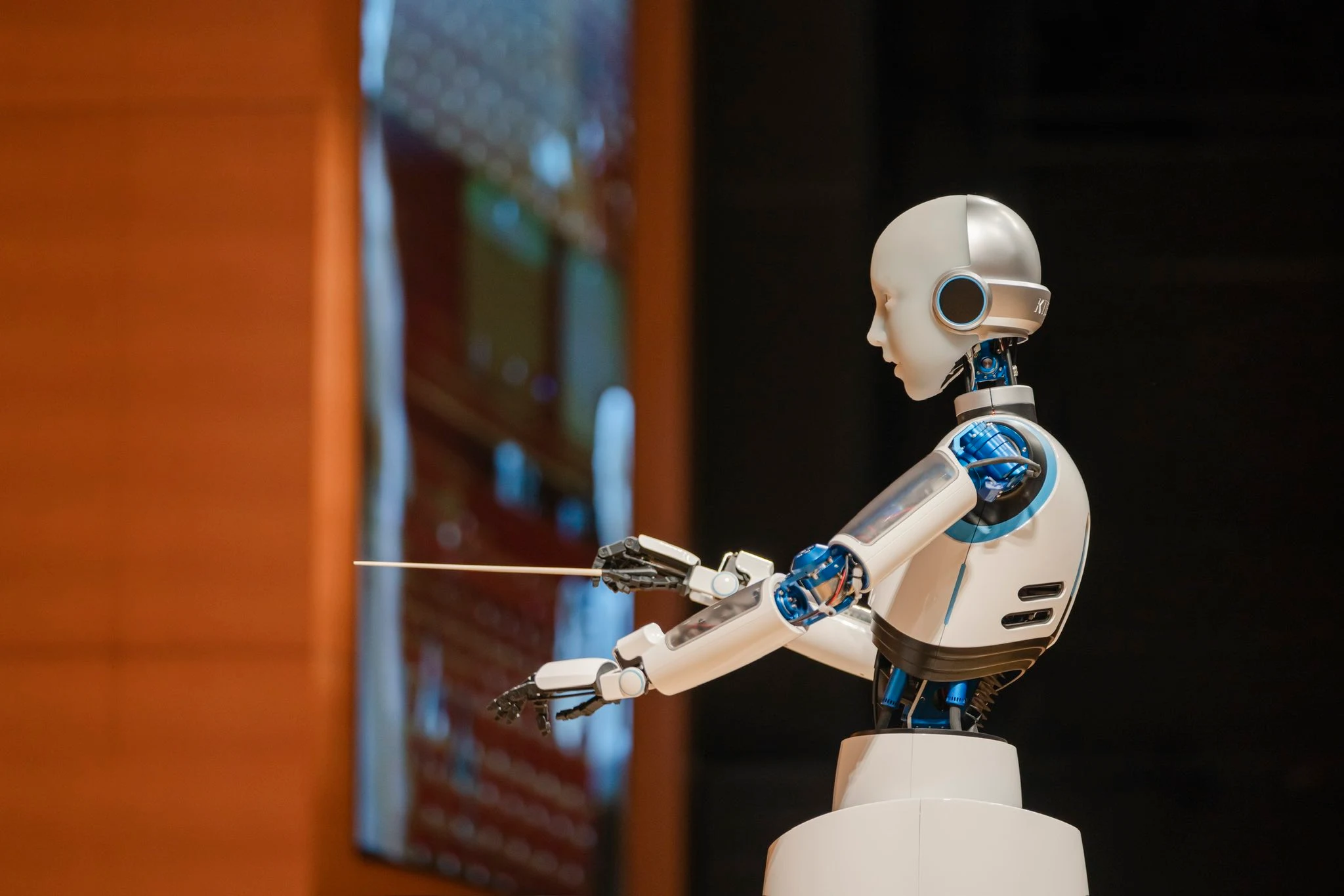
EveR 6, a robot conductor, led a practice session of the Korean National Orchestra at the National Theater of Korea in central Seoul on Monday of last week.

Later on Friday evening, the android robot took the conductor's podium in Seoul to lead a performance by South Korea's national orchestra, marking the first such attempt in the country, reported news agency Reuters.

Leading two of the five musical compositions by itself and another one with a human conductor, the robot, with a humanoid face, first bowed to the audience and started waving its arms to control the tempo of the live show.

EveR 6 was developed by the Korea Institute of Industrial Technology and is now touted as the world's first robotic orchestra conductor.

S. Korea's EveR 6 Becomes World's 1st Robotic Orchestra Conductor

S. Korea's EveR 6 Becomes World's 1st Robotic Orchestra Conductor

The 1.8-meter and two-handed EveR 6 robot guided more than 60 musicians of the National Orchestra of Korea who were playing traditional Korean instruments.

Ironically, EveR 6's critical weakness is that it cannot listen.

Citing Lee Young-ju, an audience member who studies traditional Korean music, the Reuters report further said that "the robot's moves, though impeccable in keeping the rhythm, lacked "breath" - or the ability to keep the orchestra ready to engage collectively and instantly - which he said was essential in performance". "It seemed there was some work to be done for the robot to do the job," Lee said.


All images from — National Theater of Korea@Twitter

Air India SATS Introduces India’s 1st Robotic Cleaning Technique for Aircrafts, That's Sustainable Too

AISATS Introduces India’s First, Innovative and Sustainable Aircraft Dry Washing Solution - AeroWash

Collaborates with AeroTech Support Services Pvt. Ltd to bring India’s first robotic cleaning technique

Air India SATS (AISATS), a leading airport services management company, is proud to introduce India's first Robotic Dry Wash Service for aircraft exterior finish. AISATS launched this revolutionary cleaning technique - 'AeroWash' in collaboration with AeroTech Support Services Pvt. Ltd. a globally renowned name in implementing sustainable aviation solutions. This milestone signifies AISATS' commitment to embracing innovative technologies and sustainable practices that contribute towards development of a sustainable aviation future.

Air India SATS Introduces India’s 1st Robotic Cleaning Technique for Aircrafts, That's Sustainable Too

The AeroWash system harnesses advanced robotic technology to offer mechanized and efficient exterior cleaning for aircraft. With its wireless remote control operation and lightweight, flexible brush, AeroWash ensures superior cleaning results while maintaining the utmost safety for the aircraft and operators. The comprehensive washing program guarantees time efficiency thus reducing ground time, minimum human intervention and safety of critical areas that are not covered under manual cleaning process, offers a holistic solution for maintaining aircraft cleanliness and appearance.

With the introduction of AeroWash, AISATS aims to provide significant cost savings for airlines while aligning with India's vision of sustainability. The advanced cleaning capabilities not only contribute to reduced aerodynamic drag but also result in increased fuel savings and a decreased carbon footprint.

Air India SATS Introduces India’s 1st Robotic Cleaning Technique for Aircrafts, That's Sustainable Too

Commenting at the launch of the innovative solution, Mr Sanjay Gupta, CEO at AISATS, said, "We are delighted to introduce AeroWash, using dry washing solution, in collaboration with AeroTech Support Services, to the Indian aviation industry. The absence of standardized procedures and heavy reliance on manual cleaning systems have posed significant challenges in India. AeroWash will transform aircraft cleaning practices, ensuring higher efficiency and reduced resource consumption. The new addition in our service, exemplifies AISATS' dedication to sustainability and our relentless pursuit of advanced and eco-friendly solutions in the aviation industry."

Dr. Ashwani Khanna, AeroTech Support Services, said, “We are delighted to collaborate with AISATS a leading airport service management company to introduce a state-of-the-art technology “AeroWash” equipment; along with Dry wash Process; to the Indian aviation industry offering an innovative, efficient, and environmental friendly solution. This represents a remarkable leap forward in the way aircraft exterior cleaning will be viewed as a sustainability tool in India. By incorporating AeroWash equipment at periodic intervals as part of exterior cleaning operations, airlines can achieve significant fuel savings, lower carbon emissions, enhances brand image for the airline and improve their overall profitability. AeroWash cleans beyond naked eye visibility and leaves a polished finish which reduces skin friction drag on the aircraft

AISATS has introduced multiple sustainable solutions to the Indian aviation sector. It recently unveiled a pioneering towable solar-powered passenger ramp bridge at Hyderabad and Delhi airports. Additionally, the company deployed EV buses at Bangalore airport, furthering its commitment to environmental sustainability.

About Air India SATS Airport Services Pvt. Ltd (AISATS)

AISATS is a 50:50 joint venture between Air India Limited (TATA Group entity), and SATS Limited, a leading gateway services and food solutions provider in Asia. As part of the Indian Government's initiative to upgrade its airports to world-class facilities and attract more airlines to fly into India, AISATS was formed with the vision to provide world-class airport services in ground and cargo handling that exceed customers’ expectations.

Since the start of its operations in 2008, AISATS has provided hassle-free and comprehensive solutions to its customer airlines in international airports at Bengaluru, Delhi, Hyderabad, Mangalore and Trivandrum. Currently employing over 12,000 staff, AISATS offers end-to-end ground handling services such as passenger and baggage handling, ramp handling, aircraft interior cleaning, load control and flight operations, and cargo handling services for general, perishable, transshipment, express courier and special cargo.

Amazon Developing Game To Study Human-Robot Interaction

Amazon Developing Game To Study Human-Robot Interaction

Tech giant Amazon is developing a computer game called Alexa Arena which involves users interacting with virtual robots to train machines on how to behave around humans. The game involves getting virtual robots to do tasks for you and will gather data on robot-human interactions.

With this computer game, Amazon can train the machines on how best to go about their duties in offices and homes.

Qiaozi Gao, Applied Scientist of the Amazon Alexa AI team, describes Alexa Arena as an initiative supporting the development of gamified robotic tasks readily accessible to general human users.

According to a recent paper prepared by Gao and his team, the game will become publicly available in order to conduct a widespread study related to the creation of such embodied assistants like robots.

The game, yet to be launched, will feature “user-friendly” graphics and control mechanisms. Gao and his team claim that the game will open a new venue for high-efficiency HRI data collection and Embodied AI system evaluation. Embodied AI relates to AI systems which control a physical object, such as a robotic arm or autonomous vehicle.

Last month, Amazon had organised Alexa Prize SimBot Challenge BootCamp in the US, wherein 10 university teams were selected to participate in the live interactions phase of the Alexa Prize SimBot Challenge. These university teams competed to develop a bot that best responds to customer commands in a virtual world.

At last year’s International Conference on Intelligent Robots and Systems (IROS), Gao and his team presented two papers that advance Embodied artificial intelligence (EAI).

In the first paper published, “DialFRED: Dialogue-enabled agents for embodied instruction following”, the team presented DialFRED, an embodied-instruction-following benchmark containing 53,000 human-annotated dialogues that enables an agent to — (1) to engage in an active dialogue with the user and (2) use the resulting information to better complete tasks. 

Last year in August, Amazon unveiled its “first fully autonomous mobile robot” called Proteus, in its industrial robots category. 

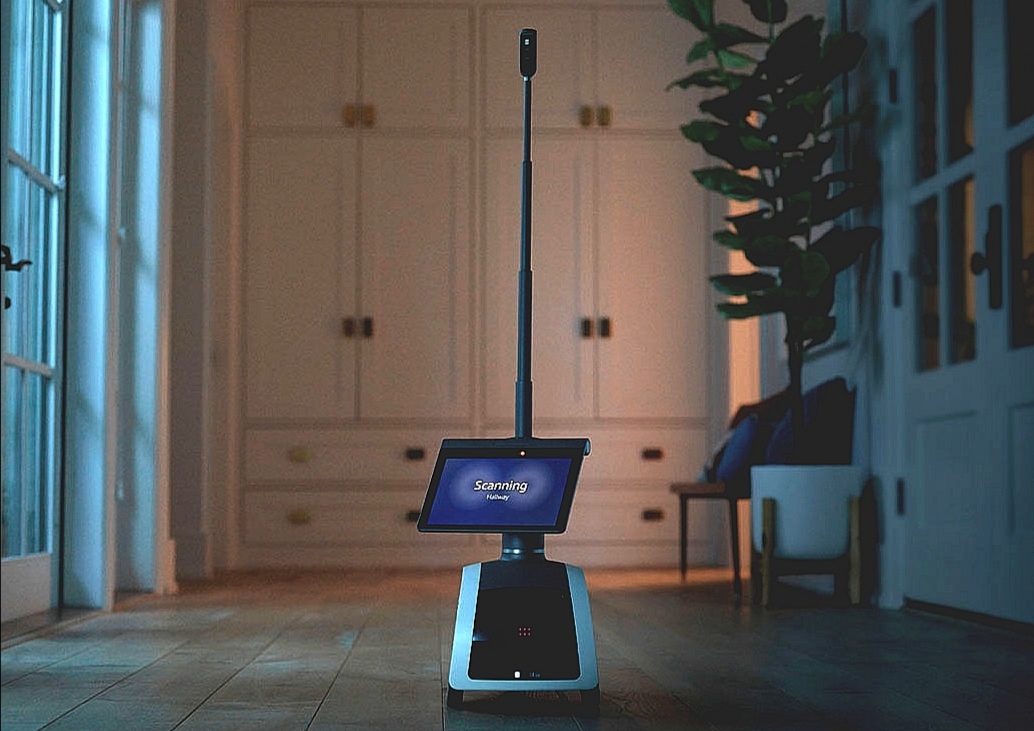
Notably, besides having industrial robots for its vast warehouses, Amazon also develops consumer robots such as the Astro home robot, which was launched in late 2021. 

Astro
Astro home robot

Astro Home robots are Household robot for home monitoring, with Alexa. With Astro robot, users can monitor home, while away from home, using its Astro app that allows to see a live view of users' home, check in on specific areas, and get activity alerts. When you're home, Astro can follow you from room to room playing your favorite music, podcasts or shows, and find you to deliver calls, reminders, alarms, and timers set with Alexa.

Coming back to the computer game, Alexa Arena will be made publicly available to facilitate research in building generalisable and assistive embodied agents such as virtual assistants and robots.

CynLr Launches Cybernetics HIVE - a State-of-the-Art Research Hub for Vision, Intelligence and Robotics

CynLr Launches Cybernetics HIVE - a State-of-the-Art Research Hub for Vision, Intelligence and Robotics
  • The research hub houses country’s highest density of visually intelligent robots dedicated for research & development. 
  • The research space spread across 13,000 sqft accommodates 16 robot research zones, capacity for 25 robots, 50+ engineers, and a futuristic electronics, camera, and vision studio for new camera product research & development. 
CynLr, a robotics deep-tech startup building vision and intelligence for industrial robotics and autonomous navigation, today announced the launch of a new research facility - Cybernetics H.I.V.E in Whitefield in Bengaluru. Cybernetics H.I.V.E – Hub for Intelligence & Vision Excellence - is a state-of-the-art R&D hub spread across 13,000 sq.ft research space and is equipped to accommodate 16 robot research cells, 25 robots, a cutting-edge electronics, camera and vision laboratory, and infrastructure to train and host 50+ research & development engineers.

The new research facility was inaugurated by Chief Guest, Mr. M M Murugappan (Former Chairman of the Board at the $7 billion manufacturing conglomerate, Murugappa Group, current Chairman of the boards of CUMI Ltd, Cyient Ltd and Director at IIT Madras Research Park) on Saturday - 25th February, 2023.

CynLr Launches Cybernetics HIVE - a State-of-the-Art Research Hub for Vision, Intelligence and Robotics

CynLr Launches Cybernetics HIVE - a State-of-the-Art Research Hub for Vision, Intelligence and Robotics

CynLr Launches Cybernetics HIVE - a State-of-the-Art Research Hub for Vision, Intelligence and Robotics

L to R- Sven Schreiner, Nikhil Ramaswamy, Mr  M M Murugappan, Ajay Gopalaswamy, Gokul NA, Rama Bethmangalakar
(L to R) – Sven Schreiner, Nikhil Ramaswamy, Mr  M M Murugappan, Ajay Gopalaswamy, Gokul NA, Rama Bethmangalakar

Industry stalwarts such as Mr. S G Shirgurkar (Founder & Chairman, Ace Micromatic Group), Mr. Kandasamy (Director Global Digital Manufacturing Engineering, Ford Motor Company), Dr, Bharadwaj Amrutur (Director ARTPARK, IISc), and several other leaders from the manufacturing, automation, and technology industry including dignitaries from Ford, General Motors, Aptiv (Delphi), Intel, Ace Micromatic Group, SKF, Kuka, Fanuc, and ABB, were a part of the launch event.

The hub will help the industries reimagine long-unsolved challenges in automating manual tasks, through versatile robots equipped to sense motion and feel the objects, enabling them to manipulate objects in their environment effectively. This will essentially help in enhanced object handling while lowering the overall time of deployment of robots by over 70% and cost by over 30%.

The use-cases for the vision and intelligence technology will also extend beyond manufacturing & robotics, and into areas such as ADAS (Advanced Driver Assistance Systems) and Object Search. Particularly in driver assistance, this has the potential to simplify and accelerate development of cognition by combining the benefits of RADAR (motion detection), LIDAR (depth detection), and CAMERA (colour detection) into one simpler system, much like the human eye, and avoid sensor Con”Fusion” which is the status quo for the industry today.

Today, even a simple task like picking bolts from a bin and placing them in a screw hole is something that robots simply cannot do. Torquing of robots has been automated, but the task of picking and placing bolts requires a level of visual cognition, tactile feedback on the fingers and the wrist, and understanding of the physics of the bolts that current vision systems cannot handle. And what do we manufacture today that doesn’t have screws or bolts in them? Cognition to help robots handle such nimble tasks can fundamentally disrupt how we manufacture, and make factories more adaptable and universal.

M M Murugappan, Chairman of the boards of CUMI Ltd, Cyient Ltd, Director at IIT Madras Research Park, and the chief guest at the event by CynLr said, "CynLr's dedication to creating an innovative and collaborative environment, alongside their customer partners and collaborators, is a glimpse into what India is capable of achieving. I am thrilled to see their progress and know that together they can take their ideas to the world. To those who have given them the opportunity to succeed, you are not just potential business partners, but champions of a vision that inspires confidence and progress for all."

Speaking on the launch, Nikhil Ramaswamy, Co-founder & CEO, CynLr said, “We are quite excited on the launch of Cybernetics H.I.V.E. that houses India’s largest density of visual robots. We hope that it will spur a transformation in robotics and in making them cognitive and adaptable for the universal hyper-automated factories of the future.”

The new facility will help us realize the holy-grail of robotics - universal object manipulation. Our 7D vision systems operate at 10X the speed, and 3x resolution than the industry leading robotics vision cameras. We believe these modern visual robots can trigger a tectonic shift in the manufacturing industry, made possible by the convergence of cutting-edge infrastructure and technology deployment capabilities”, said Gokul NA, Founder – Design, Product & Brand, CynLr.

Gokul further added, “CynLr has robust plans to establish its business presence in the US and Europe in the coming quarters, to build capacity to address the current pipeline of customers and scale to deliver over 100 robots annually. The deep-tech startup has 250+ technology partners and vendors and sources components from 30+ countries of origin.”

The start-up has raised pre-series A funding of about USD 4.5 M in 2022, led by Speciale Invest & growX Ventures with a total funding of USD 5.25M till date.

About CynLr:

Today, even a simple task of putting a screw into a screw hole without slipping a thread remains non-automatable across the globe. Imagine what it would take for a robot to assemble a Smartphone or a car by putting together thousands of parts of varied shapes and weights presented in random orientations. Enabling robots to perform Picking Orienting & Placing of objects straight from its container has been a long-standing unsolved problem – touted as The Holy Grail of Robotics and has remained unsolved over 40 years.

We at CynLr, are building the missing pieces of Visual Intelligence for Robotic Arms to make them Object aware to manipulate with superior agility - adapting to the varying shapes, orientations and weights of the object – (demo here). This we envision could simplify and standardize large, customized factory lines into LEGO blocks of micro-factories, thereby Universalizing Factories.

More about CynLr, in the words of the founders is here.


Overwhelming Response for Robotics-AI Competition 2022 Organized by Robotix

To promote technology literacy and inculcate creativity and critical thinking skills among the Students, a Robotics -AI competition was organized at BVM Global School, Coimbatore, Tamilnadu, India on December 5 and 6, 2022. This competition was conducted by Robotix Learning Solutions. More than 20 schools from Coimbatore and nearly 500 students participated in this two-day competition. The Students from KG to Class 10 were full of enthusiasm while participating in the competition.

Overwhelming Response for Robotics-AI Competition 2022 Organized by Robotix
Robotics - AI Competition 2022 winners

Robotix has been regularly conducting events and Inter-School Competitions in association with various Schools in pan India. Not only this, but Robotix has a global presence and actively participates in various International Events too. Through various courses and competitions on STEM, AI, robotics, and coding, Robotix provides training to Students for developing the necessary 21st century tech and life skills.

Some unique offerings of Robotix include STEM products such as the STEM Maker Kit, the CSTEM Math Kit, and My CSTEM Book; and robotics products such as Robobricks and Phiro. These products were used in some of the competitions as well. The events, such as the one conducted at BVM Global School, Coimbatore by Robotix, train the young minds to become the next-generation of innovators, creators, and problem solvers. Robotix plans to conduct more events and competitions of similar nature in Schools across different states in India in the coming months.

Robotix is on a mission to inspire the next generation, who are the innovators and creators of tomorrow. Robotix specializes in creating STEM learning programs, courses, and kits for children to learn STEM and 21st century learning skills.

The students from various Schools across Coimbatore were offered free training in robotics, which was followed by a series of competitions under different categories.

The competition took place in five different categories.

Little Innovators (a DIY contest for KG)

First, second, and third prizes were won by Odd Buds, Little Ville, and Jack and Jill schools, respectively.

STEM Gurus (a coding activity with bee bots for classes 1–3)

The first three positions were secured by Adhyayana International Public School, Bodhimaram Playschool, and Pristine Public School.

Tinker Ninjas (a STEM maker kit for grades 4 and 5)

Pristine Public School was awarded the first and second prizes, while Adhyayana International Public School stood third.

Tech Tycoons (a play with Phiros for grades 6 and 7)

The Indian Public School got the first prize, while VCV Sishu Vidyodhaya and Adhyayana International Public School obtained the second and third prizes, respectively.

Into the AI Verse contest (For classes 9 and 10)

The Indian Public School secured the first position, while the Air Force School got the second prize.

Mr. Ramana Prasad, the chairman of Robotix, mentioned that such contests and events help children develop various skills like creativity, problem-solving, curiosity, and collaboration.

Market Reports

Market Report & Surveys
IndianWeb2.com © all rights reserved