Showing posts with label Samsung. Show all posts

Samsung Wallet Redefines Digital Payments in India with UPI Onboarding, Biometric Authentication, and Tap & Pay Upgrades

Samsung Wallet Redefines Digital Payments in India with UPI Onboarding, Biometric Authentication, and Tap & Pay Upgrades

Samsung, India’s largest consumer electronics brand, today announced significant innovations to Samsung Wallet - a versatile platform that allows Galaxy users to organize digital keys, payment methods, identification cards and more in one secure application. The breakthrough features are designed to transform how millions of Galaxy users can set up new devices, manage payments and transact digitally. With seamless UPI onboarding as part of device setup, PIN-free biometric authentication, and enhanced Tap & Pay support — including FOREX cards and online card payments — Samsung Wallet is accelerating its mission to become the universal and secure gateway to your digital life.

We are thrilled to introduce these breakthrough innovations to Samsung Wallet. With the new updates, Samsung Wallet is no longer just a digital wallet, it has become a universal and secure gateway for digital payments, travel essentials, identity cards, and digital keys. From the moment users set up their new Galaxy device to the way they pay, transact, and travel, we are removing barriers and redefining convenience, said Madhur Chaturvedi, Senior Director, Services & Apps Business, Samsung India. 

UPI Onboarding Built-In with New Device Setup – Catalysing Rapid Adoption

Samsung is the first Original Equipment Manufacturer (OEM) to enable onboarding of Unified Payments Interface (UPI) accounts through Samsung Wallet as part of the new-device setup experience on Galaxy smartphones. By integrating UPI registration early in the setup journey, users can be payment-ready from the moment they power on their new Galaxy device. This friction-free experience ensures quick and seamless adoption of UPI on Galaxy devices, further boosting digital payments in India and simplifying the path from out-of-box to pay-ready.

Samsung Wallet, Biometric Authentication for UPI — No PIN Needed Every time

Samsung Wallet’s authentication experience has been enhanced with the introduction of biometric verification — device fingerprint and facial recognition — eliminating the need for PIN entry for everyday use. Users will soon be able to access the app and make UPI payments using just their Galaxy device’s fingerprint or face recognition. The upgrade not only streamlines access but also enhances security and convenience, reducing manual input and minimizing friction during payment flows. With this added authentication method, Samsung Wallet makes secure payments as effortless as unlocking your phone.

Online Credit and Debit Card Payments at Key Merchants

Samsung Wallet will soon support direct online usage of stored credit and debit cards across a wide set of key merchants. Users will be able to seamlessly pay for goods and services online using the credit and debit cards safely tokenised in their Samsung Wallet—no need to manually key in card details, making checkout faster and more secure.

FOREX Cards and New Partnerships for Samsung Wallet Tap & Pay

In addition to Samsung Wallet already supporting credit and debit cards from leading banks and card issuers, the digital payments experience is enhanced beyond borders as Samsung Wallet will support FOREX cards for Tap & Pay, powered by WSFx Global Pay Limited, enabling Galaxy users to make seamless international transactions with a simple tap. Additionally, Samsung has onboarded AU Bank cards for Tap & Pay, further expanding its network of banking partners and supported card issuers.

Samsung Wallet & Availability

Samsung Wallet is a versatile platform that allows Galaxy users to organize Digital Keys, Payment methods, Identification cards and more in one secure application. Samsung Wallet features a seamless interface protected by defense-grade security from Samsung Knox. It integrates with the Galaxy ecosystem, providing powerful connectivity and fortified security for users in their everyday lives. The new features will begin rolling out across supported Galaxy devices soon.

Wipro to Acquire Harman’s DTS Unit for $375M, Expanding Global ER&D Capabilities

Wipro to Acquire Harman’s DTS Unit for $375M, Expanding Global ER&D Capabilities

Wipro has announced a landmark agreement to acquire the Digital Transformation Solutions (DTS) business unit of Harman, a Samsung company, for $375 million. This strategic move is set to significantly bolster Wipro’s global Engineering Research & Development (ER&D) capabilities.

Since 2017, Harman has operated as an independent subsidiary of Samsung Electronics, leveraging Samsung’s global scale and R&D capabilities to accelerate innovation. Beyond audio, Harman is deeply involved in connected car systems, enterprise automation, and IoT solutions, making it a key player in the evolution of digital lifestyles and smart mobility.

Key Highlights of the Acquisition

Aspect Details
Deal Value $375 million (approx. ₹3,300 crore)
Expected Closure By December 31, 2025
Employee Transition 5,600+ DTS employees across 14 countries
Strategic Partnership Multi-year collaboration with Harman and Samsung

Why DTS Matters

  • Expertise in AI-native platforms and autonomous agent frameworks
  • Strength in connected products and domain-led design
  • Focus on digital and device engineering
  • Serves high-growth sectors: tech, aerospace, healthcare, industrial, consumer

Strategic Impact for Wipro

  • Expanded ER&D portfolio with consulting-led engineering services
  • Enhanced global footprint across Americas, Europe, and Asia
  • Accelerated innovation and reduced time-to-market
  • Deeper integration of physical and digital systems

Leadership Commentary

“Welcoming DTS into the Wipro family marks a pivotal step in our transformation journey,” said Srini Pallia, CEO of Wipro.
“Together, we’ll accelerate digital innovation, reduce time-to-market, and sharpen competitive advantage.”

“This agreement unlocks the next chapter for DTS,” added Christian Sobottka, CEO of Harman.
“As part of Wipro, DTS will have the scale and ecosystem needed to expand its impact.”

Wipro has steadily built a reputation for strategic acquisitions that expand its capabilities in engineering, consulting, and digital transformation.

Earlier in 2025, Wipro also acquired Applied Value Technologies for approximately ₹339 crore. This acquisition focused on IT modernization and cloud-native solutions, reinforcing Wipro’s commitment to digital infrastructure and agile transformation.

In 2022, Wipro acquired Rizing, a global SAP consulting firm, to deepen its enterprise transformation capabilities. This followed its landmark $1.5 billion acquisition of Capco in 2021, a major consulting firm in the financial services sector. Capco gave Wipro a strong foothold in digital banking and regulatory technology, significantly enhancing its consulting depth.

Wipro’s engineering ambitions were evident in its 2019 acquisition of International TechneGroup Incorporated (ITI), a specialist in digital engineering and CAD interoperability. This complemented its earlier acquisition of Appirio in 2016 for $500 million, which brought in expertise in cloud services and integration with platforms like Salesforce and Workday.

In 2015, Wipro acquired Designit for €85 million, marking its entry into strategic design and customer experience innovation. This acquisition helped Wipro blend design thinking with digital transformation, a capability increasingly sought by global clients.

Together, these acquisitions reflect Wipro’s deliberate pivot toward high-margin, innovation-led services. From cloud and SaaS to ER&D and consulting, Wipro has positioned itself as a global leader in AI-powered engineering, enterprise modernization, and customer-centric digital solutions.

Samsung Expands India Manufacturing with Laptop Production in Greater Noida

Samsung Expands India Manufacturing with Laptop Production in Greater Noida

Samsung has officially begun manufacturing laptops in India at its Greater Noida facility, marking a strategic expansion of its local production portfolio beyond smartphones, wearables, and tablets.

In the coming years, this facility is set to become a hub for cutting-edge electronics manufacturing, contributing to India's Make in India initiative and strengthening domestic production capacity.

Samsung has not yet issued a formal press release on its website regarding the start of laptop manufacturing in Greater Noida. However, the development has been confirmed through multiple credible sources and government statements.

Key Highlights of Samsung’s Laptop Manufacturing Launch
  • Location: Greater Noida, Uttar Pradesh — one of Samsung’s oldest Indian factories, operational since 1996.
  • Product Expansion: The facility now produces laptops alongside feature phones, smartphones, tablets, and wearables.
  • Government Backing: Union IT Minister Ashwini Vaishnaw praised the move, citing it as part of India’s push for electronics self-reliance under the Make in India and Digital Bharat initiatives.
  • Market Strategy:
    • Samsung is already India’s second-largest smartphone and tablet brand.
    • The laptop segment is currently dominated by HP, Dell, Lenovo, and Acer — Samsung aims to challenge this status quo.
  • Economic Impact:
    • Expected to reduce import dependence.
    • Strengthen domestic supply chains.
    • Improve pricing competitiveness for Indian consumers.

What’s Next for Samsung in India?

Samsung has already rolled out its first batch of India-made laptops and plans to scale up production. Analysts expect this move to help Samsung gain a stronger foothold in India’s fast-growing laptop market, which is increasingly driven by demand for affordable, locally manufactured devices.

Samsung in India: Strategic Manufacturing & Market Expansion

Category India Highlights
Manufacturing Footprint Second-largest mobile phone production unit globally, located in Greater Noida
Product Portfolio Smartphones, tablets, wearables, and now laptops—all made in India
Market Share Second-largest smartphone brand by volume and value; 15% share in tablets
Export Role Second-largest handset exporter from India after Apple
Growth Metrics Electronics output rose from $31B (2014–15) to $133B (2024–25); exports up 47% YoY
R&D Presence Over 7,000 engineers in India; strong local innovation pipeline
Consumer Reach Tier 3 & 4 cities driving demand for premium devices like Galaxy Z Fold7

Samsung Globally: Tech Giant with Diverse Dominance

Category Global Highlights
Revenue $211.2 billion in FY 2024; second-largest tech company by revenue after Apple
Smartphone Market Share ~22.9% globally in Q1 2025; leads Android shipments
Semiconductors #1 in DRAM (43.5%) and NAND flash (32.8%) globally
Display Technology 33.1% share in global OLED panel market
R&D Investment $21.4 billion in 2024; second-highest globally
Global Workforce 267,000+ employees across 74 countries
Sustainability Goals Net-zero Scope 1 & 2 emissions by 2050; 93.4% renewable energy transition in DX unit
Strategic Contrast:
  • India Focus: Samsung is deepening its India strategy by localizing production, expanding into laptops, and tapping underserved markets. It’s positioning India as both a consumption and export hub.
  • Global Footprint: Internationally, Samsung dominates in semiconductors, display tech, and premium smartphones, with a diversified portfolio and massive R&D spend driving innovation.

Tesla and Samsung Ink $16.5 Billion Chip Deal to Power Next-Gen AI Ambitions

Tesla and Samsung Ink $16.5 Billion Chip Deal to Power Next-Gen AI Ambitions

In a landmark move that could reshape the global semiconductor landscape, Elon Musk’s Tesla and South Korean tech major Samsung Electronics have signed a US$ 16.5 billion agreement to produce Tesla’s next-generation AI6 chips, marking a deepening alliance between the electric vehicle giant and the South Korean tech powerhouse.

The chips will be manufactured at Samsung’s new Texas fabrication facility, with production slated to run through 2033. These AI6 chips are designed to power Tesla’s expanding AI ecosystem, including its Full Self-Driving (FSD) systems, Optimus humanoid robots, and AI training infrastructure.

Strategic Synergy

The deal reflects Tesla’s growing push toward vertical integration, allowing it to exert greater control over chip design and manufacturing. Notably, Samsung has agreed to let Tesla assist in optimizing fab efficiency, with Elon Musk reportedly taking a hands-on role in the process.

For Samsung, the partnership offers a much-needed boost to its struggling foundry business, which posted $3.6 billion in losses in the first half of 2025. The company’s global foundry market share had dipped to 7.7%, trailing far behind TSMC’s 67.6%. This deal could help Samsung regain momentum and reinforce its position in the high-stakes AI chip race.

Chip Roadmap

Tesla’s chip strategy has evolved rapidly:
  • AI4: Currently in production by Samsung, used in existing FSD systems
  • AI5: Designed by Tesla, manufactured by TSMC in Taiwan and Arizona
  • AI6: A unified chip for vehicles, robots, and data centers, to be produced by Samsung in Texas
The AI6 chip is expected to consolidate Tesla’s hardware stack across its product lines, reducing reliance on external suppliers like Nvidia.

Market Reaction

The announcement sent Samsung shares soaring 6.8% on the Seoul exchange—their biggest single-day gain in months. Tesla stock rose 1.5% in premarket trading, with analysts viewing the deal as a long-term strategic win despite short-term execution risks.

Geopolitical and Industry Impact

The deal aligns with Washington’s push for onshore semiconductor production, reinforcing US–South Korea tech ties amid ongoing tariff negotiations. It also signals Tesla’s intent to become a full-stack AI company, integrating hardware, software, and manufacturing under one roof.

As the race for AI supremacy accelerates, the Tesla–Samsung partnership could become a blueprint for future cross-border tech alliances.

Vodafone Idea Launches 5G Commercial Service in Bengaluru with Samsung’s Versatile Solutions

Vodafone Idea Launches 5G Commercial Service in Bengaluru with Samsung’s Versatile Solutions

Leading telecom operator Vodafone Idea (Vi) today announced the commercial launch of 5G services by partnering with Samsung Electronics Co., Ltd. (Samsung) in Bengaluru region, one of the key telecom markets in India and a global IT hub known as the "Silicon Valley of India". Since 2024, the companies have been working together to deploy a new generation, 5G network and modernize Vi's legacy 2G and 4G networks with Samsung's industry-leading solutions in major telecom circles of India including Bihar, Karnataka and Punjab1.

As part of this collaboration, Vi had already launched 5G commercial services in Chandigarh and Patna in April 2025. Vi has successfully deployed Samsung’s small form-factor, energy-efficient and high transmit power radios for enabling a seamless 5G experience across all the three circles. These solutions offer increased cell capacity and energy savings features to deliver better consumer experience with greener and more sustainable approaches for Vi's customers.

For this deployment, Samsung provided its wide range of radios supporting diverse spectrum bands, including 32T32R Massive MIMO radios, along with Radio Access Network (RAN) solutions that encompass baseband and software functions known as the virtualized Central Unit (vCU).

The companies have also implemented the nation's first virtualized Base Station Controller (vBSC), a key network element for 2G services, thereby modernizing its network with cutting-edge software solutions while still ensuring legacy technology and services are supported.

Virtualization of network functionalities enable Vi to streamline network deployment and facilitate easier management, which results in greater efficiency, lower operational costs, better resource allocation control, and increased customer satisfaction. With this virtualization adoption, operators can build software-based and flexible networks more easily, gaining a competitive edge in bringing future networks.

Jagbir Singh, Chief Technology Officer, Vodafone Idea said: “The launch of Vi’s 5G services in Bengaluru as well as Chandigarh and Patna, marks a key step in introducing Samsung as a new partner in our ecosystem and towards delivering seamless, highly reliable next-generation services to our customers. By partnering with Samsung, our endeavor is to offer the best customer experience and provide our customers with enhanced mobile broadband throughputs and high capacity required in today’s digitally connected world.”

Woojune Kim, President and Head of Networks Business at Samsung Electronics said: “India, especially Bengaluru, stands at the forefront of the global digital transformation, and we are proud to accompany Vi’s innovative journey in delivering next-generation connectivity to its customers in one of the world's most dynamic and advanced IT markets. Samsung always thinks a step ahead, anticipating future needs of mobile operators. Through this collaboration, Samsung is fully committed in supporting Vi to satisfy the demands of mobile users and boost enterprise growth with our innovative spirits."

About Vodafone Idea

Vodafone Idea Limited is an Aditya Birla Group and Vodafone Group partnership. It is amongst India’s leading telecom service providers. The company holds a large spectrum portfolio including mid band 5G spectrum in 17 circles and mmWave spectrum in 16 circles. The Company provides Voice and Data services across 2G, 4G and 5G platforms and is expanding 5G services across 17 circles. To support the growing demand for data and voice, the Company is committed to delivering delightful customer experiences and contributing towards creating a truly ‘Digital India’ by enabling millions of citizens to connect and build a better tomorrow. The Company is developing infrastructure to introduce newer and smarter technologies, making both retail and enterprise customers future ready with innovative offerings, conveniently accessible through an ecosystem of digital channels as well as extensive on-ground presence. The Company’s equity shares are listed on National Stock Exchange (NSE) and the BSE in India.

Google-backed Glance and Samsung Partner to Launch New AI Shopping Experience for Samsung Users in the US

Google-backed Glance and Samsung Partner to Launch New AI Shopping Experience for Samsung Users in the US

Glance, the consumer technology company backed by Google, launches an integrated lock screen version of Glance AI, an AI commerce platform designed specifically for Samsung users in the US. The strategic partnership will allow Samsung users exclusive access to Glance's AI shopping and styling experiences and content discovery.

Glance AI is a new AI Commerce platform that delivers inspirational, Generative AI-led commerce and content discovery. Launched earlier this month, Glance AI is disrupting how consumers shop today, allowing them to instantly visualize themselves in AI-curated stylized looks and purchase their favorites with a tap. Built on Google Gemini's intelligence and Imagen's state-of-the-art image generation capabilities, Glance AI is unveiling its new custom lock screen experience designed for Samsung users through this new partnership.

"Glance AI is driven by a core human truth: we want to become the best version of ourselves. What stands between that aspiration and reality is the awareness of what is possible or access to platforms that enable this," said Naveen Tewari, Founder and CEO, Glance & InMobi. "Glance AI helps consumers discover and visualize what's possible, starting with an outfit that makes them look and feel great, and own it with just a tap on the platform. Samsung's commitment to enable Glance AI across its devices in the US ensures consumers enjoy an experience where inspirational commerce and content converge."

Available as an app and a lockscreen experience, Glance AI is a fully opt-in experience. It trains itself on a single selfie or an image from the image gallery to generate hyper-real images of consumers in outfits best suited for them. Consumers can then make real-time purchase decisions in just a tap; recommendations and order fulfilment are driven by Glance AI's extensive partnership with more than 400 leading brands in the US and beyond. The app further allows users to place the feature directly on their lock screen for easy access and the ability to save each look as either their lockscreen wallpaper or download to share across their network.

Glance AI also leverages trending content, local events, and social media moments to make recommendations fresh, relevant, and engaging. High-speed inferencing helps deliver options such as flash sales and trend-driven commerce, making every shopping experience unique and effortless. By utilizing Samsung's extensive reach alongside the power of AI, Glance aims to redefine user interaction with smartphones, making every moment spent on the device richer and more efficient.

"At Samsung Galaxy Store, we're proud to be more than just an app marketplace – we're a destination for innovation, discovery, and meaningful experiences tailored for Galaxy users," said Jason Shim, Sr. Director and Head of Samsung Galaxy Store USA. "Glance AI is a perfect example of the kind of high-quality and unique content we strive to deliver. By using AI to personalize content and shopping directly on the lock screen, it brings a smarter, more dynamic experience that reflects the forward-thinking spirit of the Galaxy Store."

This collaboration paves the way for a mobile ecosystem that enables users to discover new styles and trends, transforming the smartphone into a dynamic center of styling and commerce.

HCLTech Joins Samsung Advanced Foundry Ecosystem as a Design Solution Partner

HCLTech, a leading global technology company, has been selected as a Design Solution Partner (DSP) under the Samsung Advanced Foundry Ecosystem (SAFE™) program. This strategic partnership between HCLTech and Samsung is set to accelerate semiconductor innovation and development, leveraging HCLTech's extensive expertise in Engineering and R&D services.

Through the SAFE™-DSP program, HCLTech will offer comprehensive application-specific integrated circuit (ASIC) design services to semiconductor customers who wish to use Samsung's state-of-the-art process technologies.

As part of the partnership, Samsung will train HCLTech employees in advanced technologies, offer technical support on turnkey projects and provide enhanced wafer access through Multi-Project Wafer (MPW) programs for efficient prototyping and production.

"HCLTech's presence in India, coupled with its global expertise and capabilities in SoC platforms and IP partnerships, plays a key role in advancing next-generation silicon solutions. The partnership between HCLTech and Samsung underscores our shared commitment to innovation and excellence, accelerating the time-to-market for new silicon technologies," said Taejoong Song, Vice President and the head of the Technology Planning 2 Team at Samsung Electronics.

"The semiconductor industry is experiencing significant growth, and our partnership with Samsung Foundry highlights our dedication to innovation and developing state-of-the-art custom silicon solutions. By leveraging the strengths of both HCLTech and Samsung Foundry, we aim to drive advancements in semiconductor technology and meet the changing demands of the global market," said Sanjay Gupta, Corporate Vice President of North Asia at HCLTech.

Samsung Partners Bengaluru Startup EMBIBE to Transform TVs Into Educational Tools with Personalised Learning Experiences

Samsung Partners Bengaluru Startup EMBIBE to Transform TVs Into Educational Tools with Personalised Learning Experiences
  • The collaboration aims to transform TVs into educational tools with personalised learning experiences for CBSE, ICSE, IB, Cambridge, all State Boards, JEE & NEET students
  • EMBIBE’s integration will provide students access to a comprehensive collection of award-winning 3D explainers and personalised adaptive practice with hints & solutions
  • The Samsung Education Hub app is available on all Samsung Smart TVs and Smart Monitors, offering an exclusive 50% discount on all annual subscriptions, one per EMBIBE profile.
South Korean electronics giant, Samsung, has partnered with Bengaluru-based EMBIBE, an AI-powered personalised learning outcomes platform, to integrate it into the Samsung Education Hub app, a designed-for-TV education app. The collaboration will help TVs become effective educational tools providing personalised learning experiences for students.

Through this partnership, EMBIBE, as part of the Samsung Education Hub app, will offer extensive educational coverage, supporting all major curricula, including CBSE, ICSE, IB, Cambridge, all State Boards and major entrance exams such as IIT JEE and NEET. Students will benefit from a large collection of award-winning, immersive 3D explainer videos, designed to make even the most complex topics easier to understand and more engaging to learn.

The Samsung Education Hub app aims to expand the role of TVs in homes, transforming them from mere entertainment hubs to a seamless platform for online learning. This innovative ‘designed-for-TV’ education app is set to revolutionise the online learning experience, making it engaging and accessible to all. Our vision is to create a future where education knows no boundaries and knowledge is within easy reach at the click of a button,” said Viplesh Dang, Senior Director, Visual Display Business, Samsung India.

Our partnership with Samsung TV marks a significant leap in delivering a truly personal, engaging, learning experience through one of the most trusted and loved mediums. Samsung has partnered with EMBIBE because we’ve solved two critical challenges: creating stunning interactive, multi-modal content and delivering it through a deeply personalized experience powered by AI. The synergy between Samsung’s innovation and EMBIBE’s expertise in edtech is a powerful combination that sets a new standard for educational excellence, creating a transformative learning experience for everyone,” said Aditi Avasthi, Founder & CEO at EMBIBE.

At the heart of EMBIBE’s offering is its personalised, AI-driven adaptive practice, which adjusts to each student’s learning level. Through the Samsung Education Hub, students will be able to access EMBIBE’s video-based learning resources and also its AI-powered adaptive practice in English, Hindi and 10 major regional languages, backed by over 10 years of educational engagement data of more than two crore students. They can choose from 54,000 practice tests and use personalised score-improvement features that will provide useful insights for improvement. In addition, students can avail Samsung’s exclusive discount of a flat 50% on EMBIBE annual subscription purchased on TV.

EMBIBE content will be available on all 2024 Samsung TVs and smart monitors and will be gradually made available on earlier models. Existing subscribers of EMBIBE, who own Samsung TVs will have seamless login and access to this rich educational content, along with Samsung TV users who wish to subscribe to the platform. Earlier this year, Samsung had teamed up with the leading ed-tech platform, Physics Wallah for Samsung Education Hub on 2023 & 2024 Samsung TVs.

Samsung to Buy Back $7.17 Bn Worth of Shares

Samsung to Buy Back $7.17 Bn Worth of Shares

Samsung Electronics has announced a $7.17 billion share buyback program to boost shareholder value. This is the first buyback since 2017 and comes after the company's shares plunged to a four-year low.

The buyback will involve repurchasing 50.14 million common shares and 6.91 million preferred shares over the next three months, i.e. from November 18, 2024, to February 17, 2025, with the remaining amount to be decided by the board of directors.

The repurchased shares will be canceled to enhance shareholder value. The remaining 7 trillion won will be repurchased based on decisions made by the board of directors.

This move is expected to help stabilize Samsung's share performance and address investor concerns following a disappointing quarterly profit.

Following the announcement, Samsung's shares rose by 7.2%, marking the biggest daily jump since March 2024.

Samsung posted a net income of $7.1 billion for the third quarter, with $2.8 billion in profit from its chip division. However, delays in NVIDIA's AI chip certification allowed competitors to gain an edge in high-bandwidth memory sales.

This buyback program is part of Samsung's strategy to address investor concerns and support its share performance in the long term.

Besides Samsung, several other companies have also announced share buyback programs recently.

Apple has a long history of conducting share buybacks . In May 2024, Apple Inc announced a $100 billion buyback program.

India's Tata Consultancy Services (TCS) announced a $2 billion share buyback program in October 2024.

In September this Year, Intel has also announced a $10 billion share buyback program. In early this month, Sony announced a $1 billion share buyback program. In August, LG Electronics announced a $500 million share buyback program.

Samsung Launches Quantum-Powered Secure Smartphone 'Galaxy Quantum 5'

Samsung has recently launched the Galaxy Quantum 5 in South Korea. This smartphone is essentially a fortified version of the Galaxy A55, featuring a Quantum Random Number Generator (QRNG) chip developed by ID Quantique. This chip enhances security by generating truly random numbers, making encryption and decryption processes more secure and reducing the chances of tampering.

A Quantum Random Number Generator (QRNG) is a device that uses quantum mechanics to generate truly random numbers. Unlike classical random number generators, which rely on algorithms and can be predictable, QRNGs leverage the inherent unpredictability of quantum processes.

Samsung Launches Quantum-Powered Secure Smartphone 'Galaxy Quantum 5'


QRNGs typically use quantum phenomena such as the behavior of photons (light particles) passing through a beam splitter or the quantum state of particles. These phenomena are measured, and the results are inherently random due to the principles of quantum mechanics. The measurements are then converted into random numbers, which can be used for various applications.

The QRNG chip in the Galaxy Quantum 5, for example, enhances the security of the device by generating truly random numbers for encryption, making it much harder for hackers to predict or crack the encryption keys.

The Galaxy Quantum 5 secure phone integrates the world’s smallest (width 2.5 x length 2.5mm) Quantum Random Number Generator (QRNG) chipset designed by ID Quantique and Samsung’s powerful security platform, Samsung Knox, enabling trusted authentication and encryption of information, including data storage onto external memory.

Key Features of Samsung Galaxy Quantum 5
  • Display: 6.6-inch Super AMOLED with a 120Hz refresh rate
  • Processor: Exynos 1480
  • RAM: 8GB
  • Storage: 128GB (expandable)
  • Cameras: 50MP main, 12MP ultra-wide, 5MP macro, and 32MP front camera
  • Battery: 5000mAh with 25W fast charging
  • Security: Quantum Random Number Generator (QRNG) chip
  • Other: IP67 dust and water resistance, 5G, Wi-Fi 6, Bluetooth 5.3, NFC, USB Type-C
The Galaxy Quantum 5 is available exclusively in South Korea thrugh SK Telecom and is priced at approximately $465.

This phone is particularly notable for its enhanced security features, making it an excellent choice for users concerned about data privacy and security.

Samsung Launching India-specific AI Washing Machine This Month

Samsung Launching India-specific AI Washing Machine This Month

Samsung, India’s largest consumer electronics brand, today teased its upcoming AI-powered laundry specialist designed specifically for the Indian market. With the new launch, Samsung is set to revolutionize the laundry experience of Indian consumers.

The new, AI-powered washing machine will seamlessly blend advanced technology into daily routines, promising to transform the way laundry is done by making it easier and more efficient. This launch aligns with Samsung’s vision to redefine convenience and empower consumers to “do less and live more.”

Samsung has a stellar legacy of driving washing machine innovation since 1974 when its first washing machine was introduced. The company launched its first automatic washing machine in 1979, which simplified laundry by combining washing and spinning with a single touch. In 1997, Samsung launched the front-loading washing machine, which minimized fabric damage and enabled high-temperature washing, which set a new standard for garment care.

In 2008, Samsung revolutionized cleaning with the launch of the Ecobubble washing machine, the first washing machine to use bubble technology to ensure powerful cleaning. This innovation was followed by the Activ Dualwash technology in 2014, which enhanced convenience for consumers with its unique wobble technology and built-in sink, making pre-treatment of clothes easier than ever.

Continuing its tradition of innovation, Samsung introduced the FlexWash™ washing machine in 2017, offering unprecedented flexibility with dual washers, designed to cater to diverse laundry needs. By 2021, Samsung had set a new benchmark in smart laundry solutions with the launch of India’s first AI-enabled Ecobubble washing machine, integrating advanced AI technology to redefine the laundry experience for Indian households.

Samsung has always been at the forefront of innovations and in its journey to make a difference, it is ready to unveil the next era of laundry care with its latest washing machine expected to launch at the end of this month.


Samsung Launching India-specific AI Washing Machine This Month

Samsung to Acquire Oxford Varsity Professors' Founded AI Startup

Samsung to Acquire Oxford Varsity Professors' Founded AI Startup

Samsung Electronics has signed an agreement to acquire Oxford Semantic Technologies, a UK-based startup specializing in knowledge graph technology. Notably, the knowledge graph technology facilitates a deeper understanding of data, making it valuable for applications across domains.

Founded in 2017 by three Oxford University professors — Ian Horrocks, Boris Motik, and Bernardo Cuenca Grau — Oxford Semantic Technologies excels in knowledge representation and semantic reasoning. 

Oxford Semantic's AI-centric engine, RDFox®, collaborates with organizations across Europe and North America in finance, manufacturing, and e-commerce.

The acquisition will enhance Samsung's on-device AI capabilities, providing ultra-personalized experiences across products like mobile devices, televisions, and home appliances.

Samsung did not disclose the value of the deal.

Combined with on-device AI technology, such as that on Samsung’s Galaxy S24 series, personal knowledge graph technology facilitates hyper-personalized user experiences while ensuring sensitive personal data remains secure on the device. It will be applicable across all of Samsung’s products, extending beyond just mobile devices to televisions and home appliances.

Samsung's VC arm, Samsung Ventures, is an investor in Oxford Semantic and Samsung Electronics has been collaborating with Oxford Semantic on various projects since 2018.

Knowledge graph technology is challenging to implement due to the complex computations used in the process of converting dynamic and extensive real-world data into knowledge graphs and utilizing them. However, Oxford Semantic Technologies has developed and successfully commercialized knowledge graph technology that optimizes data processing and enables advanced reasoning, in the cloud and on-device.

For an uninitiated, Knowledge graph technology is a powerful approach to organizing and representing information. It creates a structured network of interconnected data points, where entities (such as people, places, or concepts) are nodes, and relationships between them are edges. Knowledge graphs use a graph-based model, which allows for flexible and rich representations. Unlike traditional databases, where data is stored in tables, knowledge graphs emphasize relationships.

Oxford Semantic's flagship product, RDFox®, stands out as a rules-based reasoning engine. Unlike traditional databases, RDFox® reasons like a human, deducing new knowledge based on existing facts. It's all about accuracy, truth, and explainability.

RDFox operates in-memory, consistently outperforming other graph technologies by orders of magnitude in benchmark tests. It handles massive knowledge and data stores efficiently. Remarkably efficient and optimized, RDFox can be embedded on edge and mobile devices. It's the brain behind AI applications, ensuring privacy and enabling the next-gen Internet of Things.

Knowledge graphs capture not only the data itself but also the context and semantics. This enables more nuanced understanding and reasoning about the information. Knowledge graphs often incorporate linked data principles, connecting information from various sources (such as databases, APIs, and the web) into a coherent whole.

Google's Knowledge Graph powers search results by understanding entities and their relationships. Netflix, for example, uses knowledge graphs to recommend personalized content.

Knowledge graphs enhance NLP tasks by providing context and disambiguation. Knowledge graphs enable AI systems to infer new facts based on existing ones.

Even in healthcare, the Knowledge Graph finds applications as it help organize medical data, patient records, and drug interactions.

“We are delighted to be working with Samsung,” said Peter Crocker, CEO of Oxford Semantic Technologies. “By integrating Samsung’s expertise in user experience and data with our advanced knowledge graph and reasoning technology, we will provide Samsung’s customers with even more sophisticated personalization. In addition, developing RDFox with Samsung, and being part of the larger group, will provide all of our clients with an even better product, service and support.”

The Oxford Semantic team started working on RDFox® in 2011 at the Computer Science Department of the University of Oxford with the conviction that flexible and high-performance reasoning was a possibility for data-intensive applications without jeopardising the correctness of the results. RDFox is the first market-ready knowledge graph designed from the ground up with reasoning in mind.

Samsung Collaborate With Japanese AI Startup for Producing AI Accelerator Chips

Samsung Collaborate With Japanese AI Startup for Producing AI Accelerator Chips

  • Collaboration with leading Japanese AI company will produce cutting-edge AI accelerator chips
  • Samsung Electronics To Provide Turnkey Semiconductor Solutions With 2nm GAA Process and 2.5D Package to Preferred Networks
Samsung Electronics is collaborating with Preferred Networks to offer turnkey semiconductor solutions. These solutions will feature a 2nm Gate-All-Around (GAA) process and a 2.5D packaging approach. The 2nm GAA process represents an advanced technology node, enabling smaller and more power-efficient chips.

By leveraging Samsung’s leading-edge foundry and advanced packaging products, Preferred Networks aims to develop powerful AI accelerators that meet the ever-growing demand for computing power driven by generative AI.

Since starting mass production of the industry’s first 3nm process node applying Gate-All-Around (GAA) transistor architecture, Samsung has strengthened its GAA technology leadership by successfully winning orders for the 2nm process with further upgrades in performance and power efficiency.

Meanwhile, the 2.5D packaging allows for stacking multiple dies, enhancing performance and miniaturization. This partnership aims to address the growing demand for high-performance chips in various applications, including artificial intelligence, data centers, and edge devices.

Preferred Networks (PFN) is a Japanese startup that focuses on the research and development of deep learning for IoT applications. The company was spun off from Preferred Infrastructure (PFI), which was founded by Toru Nishikawa, Daisuke Okanohara, and others in March, 2014. PFN aims to rapidly realize practical applications of cutting-edge technologies to solve real-world problems that are difficult to address with existing solutions.

Based on this collaboration, Samsung and Preferred Networks plan to showcase groundbreaking AI chiplet solutions for the next-generation data center and generative AI computing market in the future.

Samsung Launches First 200 MP Telephoto Sensor for Smartphones Cameras

Samsung Launches 1st 200 MP Telephoto Sensor for Smartphones Cameras

Samsung Electronics has introduced three new mobile image sensors designed for both main and sub cameras in smartphones — the ISOCELL HP9, the ISOCELL GNJ and the ISOCELL JN5.

Among these, ISOCELL HP9 is the Industry’s First 200MP Telephoto Sensor for Smartphones. 

1. ISOCELL HP9:

ISOCELL HP9

This groundbreaking sensor features an industry-leading 200MP resolution with 200 million 0.56-micrometer pixels in a 1/1.4-inch optical format. Its high-refractive microlens enhances light-gathering capability, resulting in vivid color reproduction and improved focus. Notably, the HP9 performs exceptionally well in low-light conditions and offers in-sensor zoom modes up to 12x while maintaining image quality.

Notably, the HP9 excels in low-light conditions, addressing a common challenge for traditional telephoto cameras. The ISOCELL HP9 is Samsung's groundbreaking mobile image sensor with some impressive features:
  1. High Resolution: It boasts an industry-leading 200MP resolution, featuring 200 million 0.56-micrometer (μm) pixels in a 1/1.4-inch optical format. This makes it one of the most high-resolution sensors available for mobile devices.
  2. In-Sensor Zoom: The HP9 supports in-sensor zoom using Tetra²pixel technology. It can zoom in up to 4x while maintaining crisp detail. When combined with a 3x telephoto module, it can achieve extreme zoom capabilities, going up to 12x with just the camera module.
  3. Pixel Binning: The sensor optimizes pixel array for different lighting conditions. As light dims, it automatically merges neighboring pixels into one, allowing them to operate as a single 1.2µm-sized pixel with 50MP or a 2.4µm-sized pixel with 12.5MP. Even after zooming in at 4x, it still operates at 12.5MP, utilizing more pixels than 12MP sensors before zooming. This results in clearer low-light pictures with less noise.
  4. High Precision Microlens: The HP9 uses a highly refractive material applied to the microlens, allowing it to more precisely collect and guide light toward the photodiode. This reduces crosstalk, increases the signal-to-noise ratio (SNR) by 38% compared to its predecessor, and improves autofocus performance by 10%.
  5. Smart-ISO Pro: It can express over 4 trillion color combinations thanks to its 14-bit color depth, which is 64 times greater than 12-bit sensors. This was achieved by applying higher conversion gain for High ISO and merging two readouts: one with High/Mid ISO and another with Low ISO. Additionally, it uses Staggered HDR to capture images with a wider dynamic range.
Specifications:
  • Effective Resolution: 16,320 x 12,288 (200M)
  • Pixel Size: 0.56μm
  • Optical Format: 1/1.4"
  • Color Filter: Tetra²pixel RGB Bayer Pattern
  • Frame Rate: 7.5 fps @ full 200 MP, 27 fps @ 50 MP, and 120 fps @ 12.5 MP.
The Samsung ISOCELL HP9 sensor has already been incorporated into two smartphones – Vivo X100 Ultra and HONOR Magic6 Pro. However, the HONOR Magic6 Pro employs a cropped version of the HP9, offering a 180MP resolution due to the crop.

These smartphones benefit from the HP9's impressive light sensitivity, vivid color reproduction, and improved focus, making these two smartphones stand out in mobile photography.

2. ISOCELL GNJ

ISOCELL GNJ


The GNJ is a dual pixel sensor with 50 million 1.0-micrometer pixels in a 1/1.57-inch optical format. Each pixel houses two photodiodes, enabling fast and accurate autofocus, similar to human eyes. This sensor enhances overall imaging performance in smartphones.

Each pixel houses two photodiodes, enabling fast and accurate autofocus, similar to the way human eyes focus. The image sensor also simultaneously captures full color information for quick focusing with sustained image quality.

The GNJ combines dual pixel technology with an in-sensor zoom function to deliver clearer footage in video mode and higher-resolution images free from artifacts or moiré2 patterns in photo mode.

3. ISOCELL JN5:

ISOCELL JN5

The ISOCELL JN5 features 50 million 0.64μm pixels in a 1/2.76-inch optical format.

Dual vertical transfer gate (Dual VTG) technology increases charge transfer within pixels, substantially reducing noise in extreme low light conditions for clearer image quality.

Leveraging Super Quad Phase Detection (Super QPD), the JN5 adjusts focus by comparing phase differences both vertically and horizontally, catching even the smallest details of rapidly moving objects with minimal shake.

Additionally, the JN5 incorporates dual slope gain (DSG) technology to enhance its HDR. This technology amplifies the analog light information entering the pixels into two signals, converts them into digital, and then combines them into one data, expanding the range of colors that the sensor can produce.

Samsung To Get $6.4 Bn in Grants from the US for Chip Production To Reduce Dependence on China, Taiwan

Samsung To Get $6.4 Bn in Grants from the US for Chip Production and Reduce Dependence on China, Taiwan

The Biden administration has decided to award South Korea's Samsung up to $6.4 billion in grants to expand its chip production in central Texas as part of a broader effort to enhance U.S. chipmaking. This funding, provided through the 2022 Chips and Science Act, aims to boost chip production for the aerospace, defense, and auto industries, while also bolstering national security.

The grant will support the following initiatives:
  • Two chip production facilities: These facilities will contribute to the production of advanced chips.
  • A research center: Focused on innovation and development.
  • A packaging facility: Responsible for packaging chip components.
Commerce Secretary Gina Raimondo emphasized that these investments will allow the U.S. to regain its leadership position in semiconductor design and manufacturing. Samsung is expected to invest approximately $45 billion in constructing and expanding its Texas facilities by the end of the decade. This move aims to reduce dependence on China and Taiwan for chip production.

The cluster in Taylor, Texas will include factories producing four- and two-nanometer chips. Additionally, an existing Samsung facility in Austin, Texas, will be expanded. The project is projected to create at least 17,000 construction jobs and more than 4,500 manufacturing jobs. By supporting advanced technology domestically, the U.S. aims to enhance its national security in the face of global competition.

Texas has become a hub for U.S. chip manufacturing due to a combination of factors such as low taxes, new subsidies, and geopolitical tensions between China and Taiwan.

Samsung Pushes Apple to 2nd Spot To Get Back on #1 in the World's Top Smartphone Companies – IDC

Samsung Pushes Apple to 2nd Spot To Get Back on #1 in the World's Top Smartphone Maker

According to the International Data Corporation (IDC) Worldwide Quarterly Mobile Phone Tracker, smartphone shipments are expected to reach 1.20 billion units in 2024, growing 2.8% year over year. This growth is followed by further expansion in the low single digits through 2028.

In the first quarter of 2024 (1Q24), global smartphone shipments increased 7.8% year over year to 289.4 million units. This marks the third consecutive quarter of shipment growth, signaling that a recovery is well underway in the smartphone market. While the industry is not completely out of the woods, macroeconomic challenges remain in many markets.


Top 5 Companies, Worldwide Smartphone Shipments, Market Share, and Year-Over-Year Growth, Q1 2024

(Preliminary results, shipments in millions of units)
Company1Q24 Shipments1Q24 Market Share1Q23 Shipments1Q23 Market ShareYear-Over-Year Change
1. Samsung60.120.8%60.522.5%-0.7%
2. Apple50.117.3%55.420.7%-9.6%
3. Xiaomi40.814.1%30.511.4%33.8%
4. Transsion28.59.9%15.45.7%84.9%
5. OPPO25.28.7%27.610.3%-8.5%
Others84.729.3%79.029.4%7.2%
Total289.4100.0%268.5100.0%7.8%
Source: IDC Quarterly Mobile Phone Tracker, April 15, 2024

Notes:
  • Data are preliminary and subject to change.
  • Company shipments are branded device shipments and exclude OEM sales for all vendors.
  • The "Company" represents the current parent company (or holding company) for all brands owned and operated as a subsidiary.
  • Figures represent new shipments only and exclude refurbished units.

"As expected, smartphone recovery continues to move forward with market optimism slowly building among the top brands," said Ryan Reith, group vice president with IDC's Worldwide Mobility and Consumer Device Trackers. "While Apple managed to capture the top spot at the end of 2023, Samsung successfully reasserted itself as the leading smartphone provider in the first quarter. While IDC expects these two companies to maintain their hold on the high end of the market, the resurgence of Huawei in China, as well as notable gains from Xiaomi, Transsion, OPPO/OnePlus, and vivo will likely have both OEMs looking for areas to expand and diversify. As the recovery progresses, we're likely to see the top companies gain share as the smaller brands struggle for positioning."

"The smartphone market is emerging from the turbulence of the last two years both stronger and changed," said Nabila Popal, research director with IDC's Worldwide Tracker team. "Firstly, we continue to see growth in value and average selling prices (ASPs) as consumers opt for more expensive devices knowing they will hold onto their devices longer. Secondly, there is a shift in power among the Top 5 companies, which will likely continue as market players adjust their strategies in a post-recovery world. Xiaomi is coming back strong from the large declines experienced over the past two years and Transsion is becoming a stable presence in the Top 5 with aggressive growth in international markets. In contrast, while the Top 2 players both saw negative growth in the first quarter, it seems Samsung is in a stronger position overall than they were in recent quarters."

Samsung Launches Spatial AI-based 3D Map View in All Countries

Samsung Launches Spatial AI-based 3D Map View in All Countries

Applies to TVs and home appliances to make smart home control much easier, and expands service area worldwide, strengthening SmartThings experiences

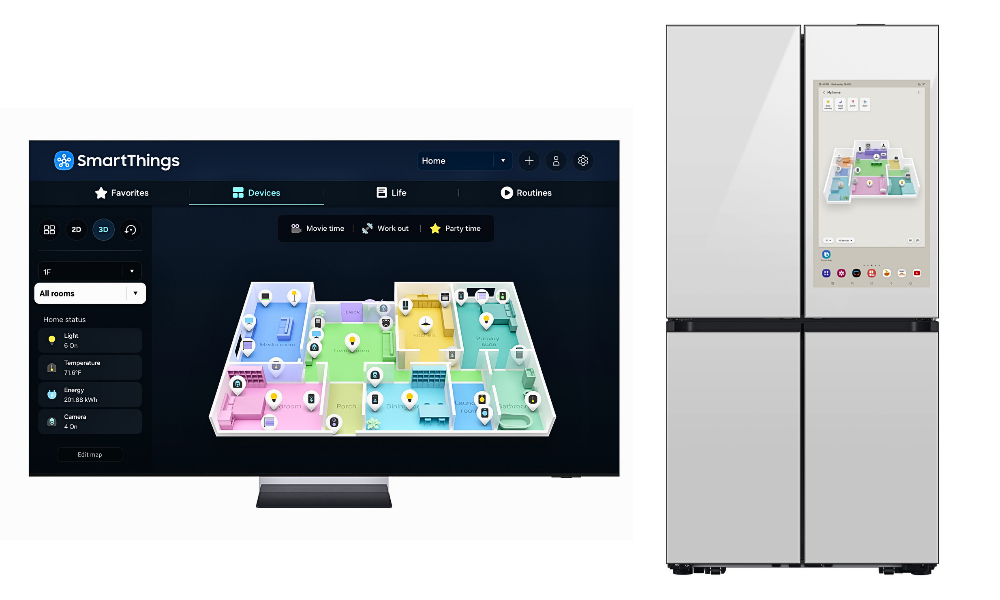
Samsung Electronics today announced that it has launched its 3D Map View feature, which was first unveiled at CES 2024 and is now available in all countries with SmartThings access.

Map View streamlines home management by turning real floor plans into virtual images in the SmartThings app. Users can clearly see their devices and conveniently adjust lighting, temperature, air quality and energy consumption at any time and place.

Map View addresses the challenge of managing the growing number of connected devices in every home worldwide and eases smart home management by eliminating the need to find each device separately before using it. It shows users their entire home at a glance and updates in real time as more devices are connected.

Map View’s previous version was a 2D model that only worked for homes where the floor plan was provided. However, this newly updated 3D Map View takes advantage of Spatial AI in Samsung devices — such as the Bespoke Jet Bot™ — using LiDAR¹ sensors in the device to precisely measure and map a home’s layout. Now, users can more easily understand the shape and spatial conditions of their homes on 3D maps.

The feature has also enhanced its filter function to allow for more efficient monitoring and control of required devices. It aims to offer a more customized and user-friendly smart service by using AI characters, which were also unveiled at CES 2024, by the end of the year.

Availability

Map View is available through the SmartThings app on Android and iOS mobile devices², as well as TVs³. Controls for the feature will also be made available through additional hubs, such as Family Hub™ refrigerators⁴, within the first half of the year.

3D Map View

Samsung Launches 3D Map View Feature Based on SmartThings and AI

Samsung Launches 3D Map View Feature Based on SmartThings and AI


Initially, Map View was rolled out in Korea and the United States last year. But now, it can be used in all countries with access to the SmartThings app.

Samsung is constantly working to enable customers to control their home devices without any inconvenience at any time and place, and Map View is the result of these efforts,” said Seungbeom Choi, Head of Device Platform Center at Samsung Electronics. “We will continue to introduce a variety of relevant services and features so our customers can enjoy optimal smart home experiences with a better life.”

Samsung is currently collaborating with construction companies to expand Map View beyond homes to apartments and office spaces. The company aims to help create smart environments for customers worldwide by adding functionality. These include an optimized user experience (UX) for large screens that assists B2B operators with signage, and Quick Control, which enables users to easily access key functions.

¹ Light Detection and Ranging (LiDAR) sensors use laser light to detect objects in 3D for the accurate representation of environments.

² Android OS 9.0 ↑ with minimum of 6GB RAM / iOS 15↑ with minimum of 6GB RAM and 792 x 828 resolution.

³ Samsung Smart TV released after 2024 (DU 7000↑)

4 Family Hub™ refrigerators; Some models released after 2021/ More detailed required specifications will be disclosed at the time of application.

Samsung R&D Institute Bangalore Forays into its First Deep-Tech Start-up Showcase for R&D Teams

Samsung R&D Institute Bangalore Forays into its First Deep-Tech Start-up Showcase for R&D Teams

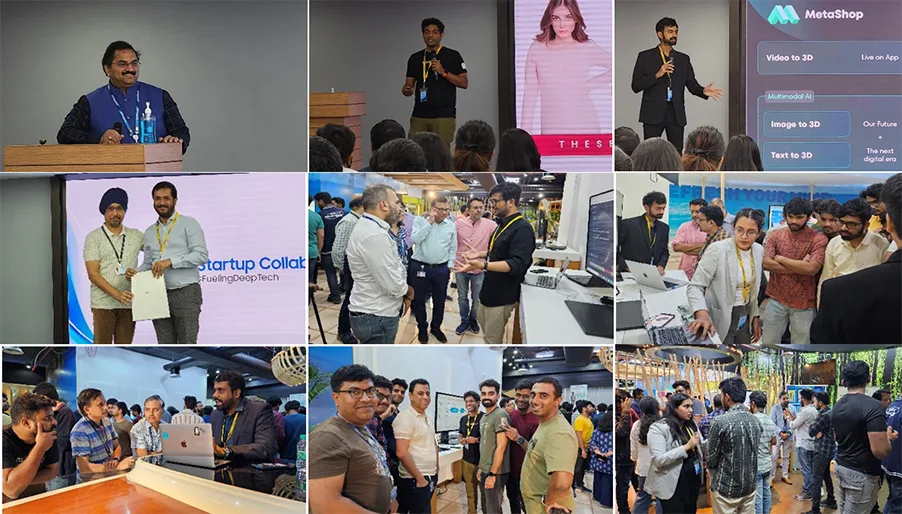
In January, Samsung R&D Institute India – Bangalore (SRI-B) organized ‘The Startup Collab: #FuelingDeepTech’, where 11 startups, working in the field of Generative AI, Responsible AI, Emotion AI, Visual AI, Quantum and Health, participated with great enthusiasm. The startups pitched their unique product offerings and showcased interactive live demos to a large audience consisting of SRI-B’s R&D teams, leaving them highly motivated and mesmerized.

Employees seized this opportunity to understand the startup offerings and explore potential areas of collaboration with them to influence Samsung’s products and services.

The daylong event featured a leadership address, startup pitches, an interactive demo showcase, and Samsung expert talks.

Mohan Rao, CVP & CTO at SRI-B, addressed a packed audience on how Samsung aligns its efforts with ecosystem partners. During the talk, Mohan Rao emphasized the company’s ‘build vs source’ philosophy and how we endeavor to bring about win-win collaboration opportunities.

“At Samsung, we are deeply committed to open innovation and ecosystem collaboration. Collaboration with startups is a symbiotic relationship where startups bring fresh ideas and agility, while Samsung can offer scale and stability. This also infuses the startup’s entrepreneurial spirit within the organization, fostering a culture of risk-taking and innovation. We look forward to collaborating with promising deep-tech startups and creating ground-breaking innovations”, he shared.

The Open Innovation team, operating under the aegis of the CTO Office, collaborates with both R&D teams and the startup ecosystem to identify and align potential collaboration opportunities. As part of their core responsibilities, this team facilitates incubation, partnerships and potential investments into aligned startups. So far, the team has successfully established 30+ partnerships and made around 12 strategic investments.

Traditionally, discussions around R&D, especially in the early exploration phase, have been limited to product owners, technology leaders, and key decision-makers. However, the Startup Collab: #FuelingDeepTech aims to create a platform that opens up startups to a broader audience within SRI-B. This approach enables the identification of high-impact, innovative, and potentially unexpected use cases across various ABC products, fostering collaboration and driving cutting-edge solutions.

“Open Innovation at SRI-B is at the heart of our New Valley Vision. We strongly believe and encourage building Samsung products and services utilizing the power of our partners and the vibrant startup ecosystem”, shared Dr. Balvinder Singh, Head of the Advanced Research Group & Open Innovation at SRI-B.
 
The open format of the event allows Samsung and the startups to explore beyond the boundaries of traditional meeting setups, and enables R&D teams to combine the offerings of multiple startups with Samsung products, creating novel concepts and immersive consumer experiences. This unique approach will lead to many fruitful collaborations in the future, ultimately delivering non-linear value to Samsung users.

Samsung Partners FlexIt To Offer Online Health and Wellness Training on Samsung Daily+

Samsung Partners FlexIt To Offer Online Health and Wellness Training on Samsung Daily+

The partnership will allow users around the globe to access personal training services and more with the FlexIt app on the new Samsung Daily+ lifestyle hub

Samsung Electronics today announced a new partnership with FlexIt, a health and wellness solution that makes exercise more convenient and accessible. Starting this quarter,1 FlexIt will bring personal trainer-based fitness content to Samsung Smart TV users through the new lifestyle hub Samsung Daily+2 on Samsung Tizen OS.

“Wellness should be central to our routines, so building healthy habits through Samsung Daily+ makes it convenient to incorporate health and wellness into all different aspects of daily life,” said Demian Hyun, Vice President and Head of the Experience Planning Group of Visual Display Business at Samsung Electronics. “This new partnership underscores Samsung’s commitment as the leader in the global display industry to promoting thoughtful, interconnected health experiences aimed at bettering the lives of consumers.”

Samsung Partners FlexIt To Offer Online Health and Wellness Training on Samsung Daily+

Samsung Partners FlexIt To Offer Online Health and Wellness Training on Samsung Daily+

On the FlexIt app’s online portal, users can find, book and pay for exclusive one-on-one virtual fitness sessions directly on their TVs. With a camera connected — whether it be via a supported webcam3 or a smartphone — virtual health professionals4 provide real-time feedback, adjust workouts and offer form modifications to foster a supportive, safe and effective workout environment.

The FlexIt app helps users approach their health in a more holistic way; in addition to workout content, FlexIt offers nutrition training, low-impact wellness activities like meditation and yoga, and physical and occupational therapy. By working virtually with a trainer who understands their personal fitness journey and wellness goals, users craft an attainable routine that suits their needs and lifestyle, all from the comfort of their home or any other location with a connected device.

By housing services such as FlexIt, Samsung Daily+ is paving the way for the future of virtual health and wellness experiences through its convenience and accessibility to build productive and convenient daily routines. Samsung Daily+ serves as a new lifestyle hub for Smart TV users, allowing them to conveniently enjoy a wide range of premium lifestyle services and features — such as home fitness, telehealth services, video calls and more — using one single Interface.

“Through the innovative FlexIt app for Samsung, we’re furthering our commitment to making fitness more accessible than ever. By delivering personalized, one-on-one immersive training experiences directly to your living room, we’re extending our reach to a broader audience, empowering individuals to achieve their wellness goals with ease and convenience,” said Austin Cohen, FlexIt’s Founder and CEO.

During CES® 2024, Samsung gave consumers an early look at Samsung Daily+ and the FlexIt app on its 2024 Neo QLED 8K. Richard Friedman, FlexIt’s Senior Vice President of Technology, joined the Samsung team in Las Vegas to showcase how the FlexIt app integrates with Samsung TVs. Samsung Daily+ is also a 2024 CES Innovation Awards Honoree, having been recognized as a unique smart home service with an open ecosystem that integrates third-party services.

For more information on health offerings on Samsung’s TV lineup, visit Samsung.com.


Top 7 Students from AI Course at Nepal's Samsung Innovation Campus Invited for Mentorship Program in India

Top seven students from Artificial Intelligence course at Samsung Innovation Campus Nepal were invited for a mentorship program in India.

Samsung inaugurated its global CSR program, Samsung Innovation Campus, at Pulchowk Engineering Campus, Tribhuvan University Institute of Engineering on December 14, 2022. Youth in Nepal are undergoing training in in-demand tech skills, including Artificial Intelligence, Internet of Things, Big Data, and Coding & Programming. The curriculum challenges students to present projects with social significance, incorporating the learned technologies.


The program includes soft skills training to enhance employability, translating knowledge into practical solutions, and fostering problem-solving capabilities for innovative thinking.

In 2023, the program has certified 63 students in Coding & Programming and 28 students in AI, with the current top 7 students excelling in the AI course.

Given the absence of Samsung Centers in Nepal, the top 7 students and 1 mentor of AI batch were selected to visit Samsung Centers in India. They were offered invaluable exposure to the Samsung environment and to showcase the innovative work undertaken at Samsung, particularly in the realms of SDD & SRI, emphasizing its contribution to society’s greater good through technological development.

Saurav Adhikari, Kailash Pantha, Prakriti Timalsena, Sandesh Thapa, Samikshya Chapagain, Suraj Pathak and Prayag Man Mane were invited to India with Prof. Arun K. Timalsina for a mentorship program where they got to engage with JB Park, MD & CEO, Samsung SWA, KY Roo, Head of SRI-Noida, Shane Cho, MD, SRI-Delhi and KD Park, MD, Samsung Design Delhi.

Samikshya Chapagain, a student of AI at Samsung Innovation Campus, Nepal, seemed overwhelmed with joy of having so many new experiences in such a short span.

Driven by her passion for AI, Samikshya’s mission after completing Samsung Innovation Camous is to instill AI technologies in regular tasks which require immense human effort. She wants to improve the working conditions around her home. Her confidence and resilience at Samsung Innovation Campus has empowered her to dream of being an entrepreneur one day. “My goal is to excel in the field of AI and build solutions that create a better world for all. I am actually very inspired to see what Samsung has done with Galaxy AI and meeting all those people who are behind these innovations was really fascinating and inspiring.”

Samsung Innovation students expressed fascination with technological innovation and appreciate Samsung’s commitments to progress in AI, recognizing its potential to change the world.

Another student from the batch of seven, Prayag was excited that a new journey will begin once they are back in Nepal with all the learnings.

“I am so glad that I made it to the top seven and was included in this cohort. The learnings I got from the senior leadership at Samsung will stay with me for life. I feel really motivated and inspired. Being awestruck with all products is one thing but the knowing how much effort goes into creating them has helped me understand the value of constant hardwork and dedication. My AI journey begins here,” he said.

Aspirations of students visiting India included working in technology companies where they can contribute positively with AI and other emerging technologies.

Market Reports

Market Report & Surveys
IndianWeb2.com © all rights reserved