Showing posts with label satellites. Show all posts

SpaceX's 1,900th Starlink Satellite Launch

SpaceX's 1,900th Starlink Satellite Launch

On Sunday, August 31, 2025, SpaceX is set to launch its 1,900th Starlink V2 Mini satellite aboard a Falcon 9 rocket from Cape Canaveral Space Force Station in Florida. This mission, designated Starlink 10-14, marks SpaceX’s 77th Starlink launch of the year, and its ninth Starlink mission in August alone.

Mission Highlights

  • Date: Sunday, August 31, 2025
  • Mission: Starlink 10-14
  • Launch Site: Cape Canaveral Space Force Station, Florida
  • Launch Time: 7:20 a.m. EDT (11:20 UTC)
    • Rocket: Falcon 9 Booster 1077 (23rd flight)
    • Trajectory: North-easterly path from Florida’s Space Coast
    • Landing Target: Drone ship Just Read the Instructions in the Atlantic Ocean

Network Expansion

  • Over 1,900 Starlink V2 Mini satellites launched in 2025 alone
  • Total active constellation exceeds 8,100 satellites
  • Global coverage spans 130+ countries, including rural India

Reusability Record

  • 489th Falcon 9 landing
  • 454th reflight milestone

Weather Outlook

  • 90% chance of favorable conditions
  • Minor risks from cumulus and anvil clouds
Summary: This launch marks SpaceX’s relentless cadence, operational efficiency, and its vision for global connectivity.

Starlink Launches by Year (2019–2025)

Year Launches Satellites Deployed Key Milestones
2019 6 ~360 First operational batch (v0.9) launched in May
2020 15 ~900 Regular cadence begins; v1.0 satellites dominate
2021 17 ~1,020 Laser interlinks introduced; global coverage expands
2022 25 ~1,500 v1.5 satellites deployed; polar orbit missions begin
2023 30+ ~2,000 v2 Mini satellites debut; constellation crosses 4,500
2024 40+ ~2,400 Direct-to-cell (DTC) satellites begin launching
2025 (Jan–Aug) 77 ~1,900+ Monthly launches peak; global user base hits 7M+

📊 Total Launches (2019–Aug 2025): ~210+
🛰️ Total Satellites Launched: ~9,580
🌐 Active Satellites in Orbit: ~8,280

🔍 Strategic Notes:
  • Reusability: Most launches used Falcon 9 Block 5 boosters, many flying 20+ times.
  • Coverage Expansion: Starlink now serves 150+ countries, including recent additions like Kazakhstan.
  • Tech Evolution: From basic v0.9 satellites to v2 Mini and DTC-enabled units, each year brought major upgrades.

Surya: NASA and IBM Release Largest Open-Source Heliophysics AI Model on Hugging Face


IBM and NASA have unveiled a groundbreaking open-source AI model called Surya, designed to predict solar weather and protect critical infrastructure from space-based disruptions. The powerful AI model is trained on 14 years of observations from NASA’s Solar Dynamics Observatory (SDO).

Here's a breakdown of what makes this initiative so impactful:

What Is Surya?

  • Name Origin: “Surya” is Sanskrit for “Sun,” reflecting its heliophysics focus.
  • Purpose: Predict solar flares, coronal mass ejections, and other solar phenomena that can disrupt satellites, GPS, power grids, and telecommunications.
  • Availability: Open-source and hosted on Hugging Face.

Technical Highlights

  • Foundation Model: Trained on 14 years of high-resolution solar data from NASA’s Solar Dynamics Observatory (SDO).
  • Data Types: Includes solar coronal EUV images, magnetic field maps, and solar surface velocity data.
  • Model Size: 366 million parameters—lightweight enough for broader deployment.

Capabilities & Performance

  • Forecasting Power:
    • Predicts solar flares up to 2 hours in advance.
    • Achieved 16% improvement in flare classification accuracy over previous models.
  • Use Cases:
    • Early warnings for satellite operators.
    • Infrastructure protection for energy grids and aviation.
    • Academic research in heliophysics and space weather.

Why It Matters

  • Economic Risk: A major solar storm could cost the global economy up to $2.4 trillion over five years.
  • Recent Events: Solar storms have already disrupted GPS, diverted flights, and damaged satellites.
  • Future-Proofing: As humanity ventures deeper into space, accurate solar forecasting becomes essential for safety and continuity.

Open Science Impact

  • SuryaBench Dataset: IBM and NASA also released the largest curated heliophysics dataset to support further research.
  • Community Collaboration: Encourages scientists and developers to build on Surya for new applications in space weather prediction.

Summary Table

Feature Details
Model Name Surya
Developed By IBM & NASA
Training Data 14 years of solar observations from NASA's SDO
Parameter Count 366 million
Forecast Window Up to 2 hours before solar flare events
Accuracy Improvement 16% over prior models
Hosted On Hugging Face

IN-SPACe Awards EO-PPP Contract to PixxelSpace-Led Consortium for Indigenous Satellite Constellation

IN-SPACe Awards EO-PPP Contract to PixxelSpace-Led Consortium for Indigenous Satellite Constellation

The Indian National Space Promotion and Authorisation Centre (IN-SPACe), under the Department of Space, Government of India, today announced the selection of a PixxelSpace India-led consortium, comprising of Piersight Space, Satsure Analytics India, and Dhruva Space, to design, build, and operate India’s first fully indigenous commercial Earth Observation (EO) satellite under the pioneering Public-Private Partnership (EO-PPP) model.

The selection follows a competitive bidding process. Three consortia were shortlisted after rigorous technical evaluation:
  1. Astra Microwave Products Limited, Hyderabad (with Bharat Electronics Ltd., Sisir Radar & Spectragaze Systems)
  2. GalaxEye Space, Bengaluru (with CoreEL)
  3. PixxelSpace India Pvt. Ltd., Bengaluru (with Piersight Space, Satsure Analytics India, and Dhruva Space)
Following the financial bid assessment, the PixxelSpace India-led consortium emerged as the successful bidder.

This initiative represents a pivotal point for India’s space sector. For the first time in the history of the Indian space sector, a private consortium would invest more than ₹1,200 crore over the next 5 years to launch a constellation of 12 state-of-the-art EO satellites equipped with panchromatic, multispectral, hyperspectral, and microwave SAR sensors. The constellation will deliver Analysis Ready Data (ARD) and Value-Added Services (VAS) for applications in climate change monitoring, disaster management, agriculture, infrastructure, marine surveillance, national security, and urban planning, while also catering to the global demand for high-quality geospatial intelligence.

By generating high-resolution, indigenous satellite data, the initiative will significantly reduce India’s reliance on foreign sources, ensure data sovereignty, and position the country among the global leader, in space-based data solutions.

Dr. Pawan Goenka, Chairman, IN-SPACe, said, “This initiative signals the coming of age of India’s private space industry in the space sector. It demonstrates the capability and confidence of Indian companies to lead large-scale, technologically advanced, and commercially viable space missions that serve both national and global markets. The EO-PPP model fosters an ecosystem where public and private capabilities reinforce each other to drive growth, innovation, and self-reliance.”

Under the PPP framework, the Government of India will provide strategic, technical, and policy support, while the PixxelSpace India-led consortium will own and operate the EO system, including satellite manufacturing, launches from Indian soil, ground infrastructure, and commercialization of data services.

Shri Rajeev Jyoti, Director, Technical Directorate, IN-SPACe, said: “All three shortlisted bidders submitted excellent technical and business plans, underscoring the growing maturity of India’s private space capabilities. This project is about building India’s own independent and future-ready geospatial infrastructure. It will lead to Atmanirbharta (self-reliance) in high-resolution optical and radar data for India, catalyse innovation, create thousands of high-skill jobs, and contribute directly to our goal of growing India’s space economy from $8.4 billion in 2022 to $44 billion by 2033.”

Awais Ahmed, CEO of Pixxel said: “Being the winning proposal to build India’s national EO constellation is a major milestone for Pixxel and our consortium members in India’s space story. We’re grateful to IN-SPACe and the Government of India for trusting our consortium with this historic mission. Together with our partners Satsure, Dhruva and PierSight, we look forward to building world-class space-tech capabilities that serve the whole planet from Indian soil. This is India’s moment to lead the world in space-powered solutions.”

The EO constellation will be deployed in a phased manner over the next four years to ensure continuous service upgrades and expanded coverage. Once operational, it will be among the most advanced EO systems in the world, designed, built, and operated entirely in India by Indian talent.

This initiative reaffirms the Government of India’s commitment to space sector reforms and to enabling Indian industry to emerge as a major global player in the space economy.

Eclipses on Demand: How ESA Is Casting Shadows in Space to Illuminate the Sun

Eclipses on Demand: How ESA Is Casting Shadows in Space to Illuminate the Sun

For centuries, astronomers have waited patiently for solar eclipses to glimpse the Sun’s ethereal halo. Now? They’re making their own.

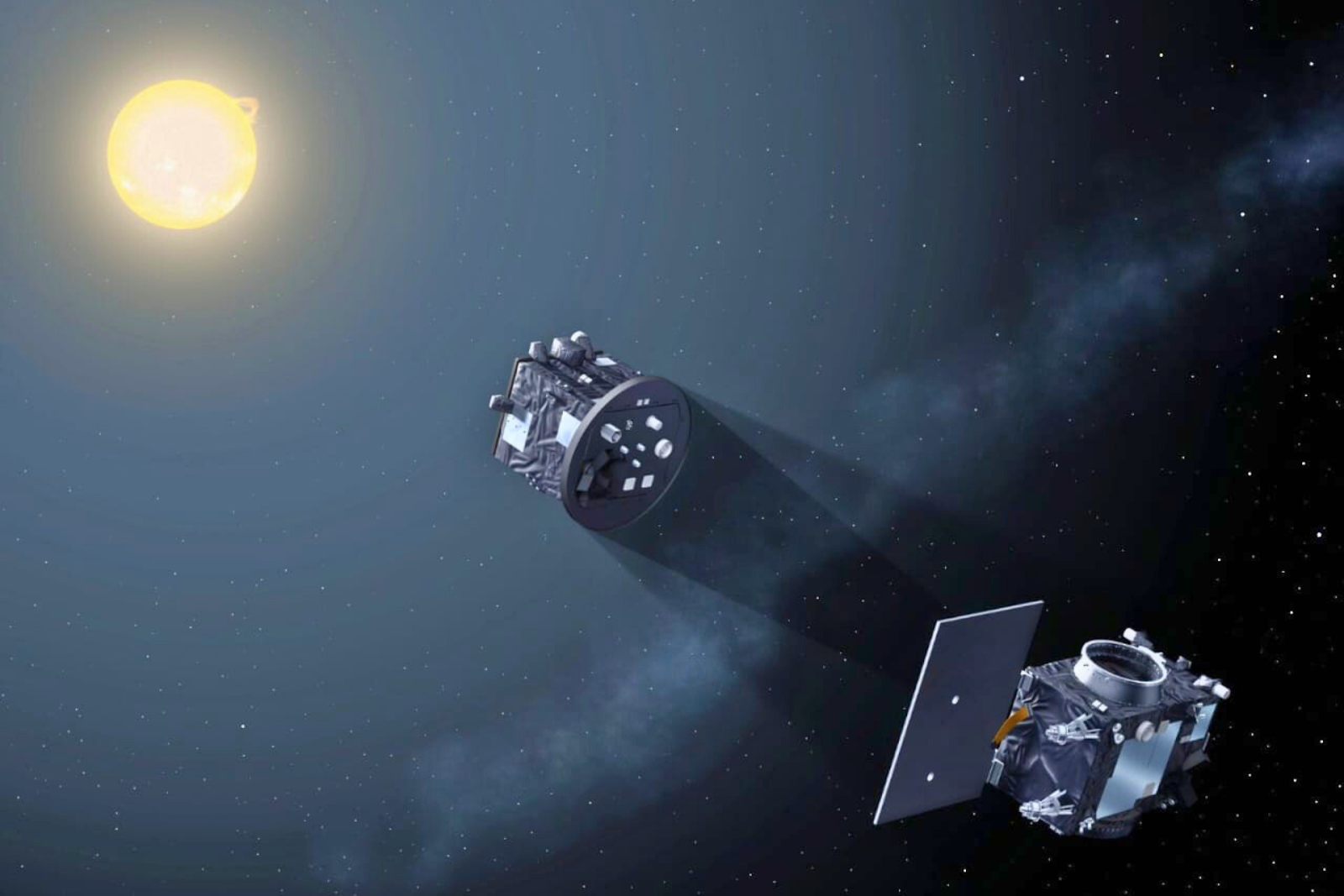
In a move straight from a science fiction script, the European Space Agency (ESA) has created a man-made solar eclipse in space—and it’s not just a one-time show. Using two satellites flying in tight formation, ESA’s Proba-3 mission is rewriting the rules of solar observation.

Scientists have figured out how to make a solar eclipse whenever they want, using two special satellites flying above Earth.

The European Space Agency launched a project called Proba-3. It has two satellites:
  • One blocks the sunlight (like putting your thumb over a torch).
  • The other takes pictures of the Sun’s outer layer, called the corona—a glowing, mysterious area that's hard to see normally.
These two satellites fly in perfect sync, 150 meters apart. That’s how they create a fake or artificial eclipse!

They can do this many times a week, and each eclipse lasts up to six hours—much longer than ones on Earth.

Notably, the Proba-3 mission satellites were launched by the Indian Space Research Organisation (ISRO) using their trusted PSLV-C59 rocket. The launch took place on December 5, 2024, from the Satish Dhawan Space Centre in Sriharikota, India. 

Why Is This a Big Deal?
  • Scientists can now study massive solar blasts that mess with mobile networks, GPS, and power.
  • They can examine the solar wind, which affects satellites and space weather.
  • They're also closer to solving a mystery: Why is the Sun’s outer layer hotter than its surface?
They’ve already taken stunning images—green loops, fire-like arcs, and hidden details of the Sun.

It’s like building a permanent space lab to study our star. Maybe one day, we’ll even see artificial eclipses on Mars!

Precision Shadowplay in Orbit

Eclipses on Demand: How ESA Is Casting Shadows in Space to Illuminate the Sun

At the heart of the mission are two spacecraft with poetic roles: the Occulter, which blocks sunlight using a 1.4-meter disk, and the Coronagraph, trailing behind at a razor-precise 150 meters, poised to observe the Sun’s corona—its wispy, superheated outer atmosphere.

The magic lies in their dance: millimeter-perfect alignment sustained autonomously in space, simulating a solar eclipse for up to six hours. No more relying on fleeting eclipses; now, solar scientists get multiple custom eclipses per week.

And nestled aboard the Coronagraph is ESA’s pride—ASPIICS (Association of Spacecraft for Polarimetric and Imaging Investigation of the Corona of the Sun). This instrument uses layered exposures to pierce the Sun’s glare and reveal its hidden anatomy.

At Least 10 Satellites Working Round-the-Clock to Ensure India's Safety & Security: ISRO Chairman

At Least 10 Satellites Working Round-the-Clock to Ensure India's Safety & Security: ISRO Chairman

ISRO Chairman V Narayanan recently stated that at least 10 satellites are working round-the-clock for strategic purposes to ensure India's safety and security. These satellites help monitor India’s 7,000 km coastline and the northern borders, playing a crucial role in surveillance and defense.

These satellites play a crucial role providing real-time imagery and video footage to track enemy movements and terrorist activities.

The comments from ISRO Chairman come amid escalating tensions between India and Pakistan, following the April 22 Pahalgam terror attack, which led to India launching Operation Sindoor against terror sites in Pakistan and Pakistan-occupied Kashmir. Pakistan responded with drone and missile strikes, which India intercepted. However, both nations have now agreed to halt all military actions on land, air, and sea.

Satellites like Cartosat provide sub-meter resolution images, enabling precise identification of military installations and terrorist hideouts.

Inter-Satellite Links (ISL) allow seamless data relay and coordination between satellites, improving intelligence-sharing. Synthetic Aperture Radar (SAR) used in RISAT satellites, capable of penetrating cloud cover and darkness to provide continuous surveillance.

Electronic Intelligence (ELINT) & Signal Monitoring helps intercept enemy communications and radar signals, aiding in counter-terrorism operations. Satellites work alongside military drones for target tracking and precision strikes.

Following the April 22 Pahalgam terror attack, India launched Operation Sindoor, targeting terrorist infrastructure in Pakistan and Pakistan-occupied Kashmir (PoK). ISRO's satellites provided critical intelligence, helping the Indianneutralize radar systems, disrupt drone strikes, and destroy 11 air bases inside Pakistan.

ISRO’s satellites also contribute to disaster management, telemedicine, agriculture, and environmental monitoring, reinforcing their broader role beyond defense.

India Conducting 'Dogfights' in Space with Satellites

India Conducting 'Dogfights' in Space

India is conducting "dogfights" in space—a sophisticated maneuver where two satellites, a chaser and a target, engage in close-range orbital tactics, much like fighter jets in aerial combat, reported several Indian media outlets including NDTV. This is part of ISRO’s SPADEX mission, which aims to advance satellite docking, proximity operations, and autonomous flight capabilities.

Dogfights in space refer to coordinated, close-range maneuvers between satellites, similar to aerial dogfights between fighter jets. In India's case, ISRO has successfully executed this maneuver using its SPADEX mission, where a chaser and target satellite engage in precision orbital tactics.

The satellites, orbiting 500 km above Earth at speeds of 28,800 km/h, have successfully demonstrated docking, undocking, and power transfer between them.

These advancements position India among the elite nations mastering space docking and orbital maneuvering.

This follows similar exercises by China’s defense satellites in 2024, prompting global interest in space-based maneuverability. Last month, it was reported that the U.S. Space Force observed five Chinese satellites executing synchronized movements, practicing tactics for on-orbit space operations conducted in Low Earth Orbit (LEO), last year.

India’s SPADEX mission relies on cutting-edge rendezvous and docking technology to execute these satellite maneuvers. The key technologies involved include:
  1. Laser Range Finder & Visual Cameras – Used for precise navigation during close-range docking.
  2. Retroreflectors & Real-Time Imaging – Help align satellites during final approach.
  3. Inter-Satellite Communication Link (ISL) – Enables autonomous coordination between spacecraft.
  4. Indigenous Docking Mechanism – Developed by ISRO as part of the Bharatiya Docking System.
  5. Power Transfer Technology – Allows one satellite to supply energy to another, crucial for future space stations.
  6. Autonomous Rendezvous Strategy – Ensures satellites can approach and dock without human intervention.
This breakthrough strengthens India’s position in space warfare and satellite autonomy, showcasing its ability to execute complex orbital maneuvers with precision. What aspect of this technology intrigues you the most?... Or... What do you think this means for India’s future in space defense? Do comment below...

Mumbai-based Deeptech Startup Delivered Its Green Propulsion System to DRDO

Mumbai-based Deeptech Startup Delivered Its Green Propulsion System to DRDO

Manastu Space Technologies, a Mumbai-based deep-tech startup, has delivered its iBooster Green Propulsion System to the Defence Research and Development Organisation (DRDO).


This system is designed for satellites weighing between 100 and 500 kg and will be used for critical operations such as orbit raising, station-keeping, and deorbiting.

Founded in 2017 by Tushar Jadhav and Ashtesh Kumar, Manastu Space Technologies specializes in developing green propulsion systems and satellite technology to address critical challenges in space safety and sustainability.

Key Features of iBooster Green Propulsion System:
  • Proprietary Hydrogen Peroxide-Based Fuel: Safer, more environmentally friendly, and cost-effective compared to conventional toxic fuels
  • Optimized Thruster Design: Ensures enhanced efficiency and precision.
  • High-Temperature Catalyst: Provides seamless ignition and long-term performance in space.
This achievement is the result of four years of intensive research and development, supported by DRDO's Technology Development Fund (TDF). Manastu Space is now preparing for a space test aboard an upcoming PSLV mission by ISRO, which will demonstrate the system's capabilities on a global stage.

iBooster Green Propulsion System
iBooster 

Last year in October, Manastu Space has successfully secured $3 million Pre-Series A round, led by IAN.

Apart from the iBooster Green Propulsion System, Manastu Space has developed several other innovative products and solutions such as Debris Collision Avoidance System, a system designed to prevent satellite collisions and reduce space debris by providing agile and efficient propulsion capabilities.

Vyom 1U Module, a compact propulsion module for small satellites (5U to 24U+), offering specific impulse and thrust capabilities suitable for various mission requirements.

India Plans Launching Quantum Satellite in 2-3 Years

India Plans Launching Quantum Satellite in 2-3 Years

India is gearing up to join the quantum satellite race with the goal of creating a hack-proof communication network. The National Quantum Mission (NQM) is at the forefront of this initiative, aiming to launch a quantum satellite within the next 2-3 years. This satellite will play a crucial role in establishing a secure quantum communications network across the country.

A quantum satellite is a satellite that uses quantum physics to communicate between space and Earth, and to secure information. Quantum satellites use quantum key distribution (QKD) to securely share a secret key between two parties, which can then be used to encrypt and decrypt messages. The security of QKD is based on quantum mechanics, making it resistant to hacking and eavesdropping.

Ajai Chowdhry, Co-founder of HCL and Chairman of the Mission Governing Board for the National Quantum Mission (NQM), told businessline, “Satellite-based communication will be required for securing country-wide or international communication. The Department of Space is planning to launch a quantum satellite in 2-3 years for quantum communications.”

The NQM has established four Section 8 companies, also known as not-for-profit entities, to focus on different verticals of quantum technologies. These Thematic Hubs (T-Hubs) are set up within premier academic institutions and national research and development labs. Below are the four verticals:
  1. Quantum Computing: Developing intermediate-scale quantum computers with 50-1000 physical qubits.
  2. Quantum Communication: Establishing satellite-based secure quantum communications and inter-city quantum key distribution.
  3. Quantum Sensing & Metrology: Creating high-sensitivity magnetometers and atomic clocks for precision timing.
  4. Quantum Materials & Devices: Designing and synthesizing quantum materials for fabrication of quantum devices.
These hubs aim to seed, nurture, and scale up scientific and industrial R&D in quantum technologies, making India a leader in this field.

Key Points of Quantum Satellite
  • Quantum Key Distribution (QKD): The satellite will use QKD technology to transfer encrypted information securely.
  • Complementary to Optical Fibers: While optical fibers are limited to 100-250 km, satellites can transfer quantum data over much larger distances.
  • Geographical Advantage: India's diverse geography, including locations like Hanle in Ladakh, offers unique advantages for setting up quantum communication ground stations.
  • Global Collaboration: India aims to develop satellite-based secure quantum communications between ground stations over a range of 2,000 km within the country and internationally.
This initiative positions India as a key player in the global quantum communications race, enhancing the security and reliability of communication networks.

PM Modi-Chaired CCS Approves 52 Spy Satellites equipped with Artificial Intelligence

PM Modi-Led CCS Approves 52 Spy Satellites equipped with Artificial Intelligence

The Cabinet Committee on Security (CCS), chaired by Prime Minister Narendra Modi, has approved the launch of 52 spy satellites under Phase III of the Space Based Surveillance (SBS-III) project. This project, estimated to cost around Rs 27,000 crore, aims to enhance India's surveillance capabilities, especially along its borders with Pakistan and China.

The satellites will be launched into low Earth and geostationary orbits and will be equipped with artificial intelligence (Al) to improve geo-intelligence and communication between satellites for better threat mitigation.

Additionally, the CCS has also approved the $3.9 billion purchase of 31 weaponized Predator drones from General Atomics, to complement the surveillance capabilities of the SBS-III mission. General Atomics (GA) is a California, US based company that specializes in defense and diversified technologies, including energy, defense, robotics, and unmanned aircraft.

The Space Based Surveillance (SBS-III) project is a significant initiative by the Indian government to enhance its surveillance capabilities through space-based technology.

In Phase-I (2001), 4 satellites were launched, under the aegis of the then prime minister Atal Bihari Vajpayee. In Phase-II, 6 satellites were launched in the year 2013. And, now in 2024, 52 surveillance satellites have been approved by the CCS, to launch. 

Indian Space Research Organisation (ISRO) is responsible for the development and launch of these satellites.

National Security Council Secretariat works alongside the Defence Space Agency under the integrated headquarters in the Defence Ministry to handle the project. Defence Space Agency plays a crucial role in the project, focusing on enhancing India's defense capabilities.

These organizations and entities are working together to enhance India's surveillance and defense infrastructure.

Development of the Spy Satellites

ISRO will follow a comprehensive process to develop these spy satellites. Here's an overview of the steps involved:

1. Design and Development: The satellites will be designed and developed at the U R Rao Satellite Centre (URSC). This involves creating detailed designs, selecting materials, and developing the technology.

2. Assembly and Testing: Once the design is finalized, the satellites will be assembled and rigorously tested to ensure they meet all specifications and can withstand the harsh conditions of space.

3. Launch Vehicle Preparation: The satellites will be launched using ISRO's launch vehicles, such as the Polar Satellite Launch Vehicle (PSLV) or Geosynchronous Satellite Launch Vehicle (GSLV), depending on the payload and orbit requirements.

4. Launch: The satellites will be launched from the Satish Dhawan Space Centre on Sriharikota Island, near Chennai.

5. Deployment and Operation: After launch, the satellites will be deployed into their designated orbits and will start their operational phase, providing surveillance data and enhancing India's national security.

ISRO's expertise in satellite technology and its successful track record in launching and operating satellites make it well-equipped to handle this ambitious project.

Scientists Detect Mysterious Plasma Bubble Over Egyptian Pyramids That Can Disrupt Satellite Communications

Scientists Detect Mysterious Plasma Bubble Over Egyptian Pyramids That Can Disrupt Satellite Communications

Chinese scientists have detected massive plasma bubbles over the Egyptian pyramids and Midway Islands using advanced radar technology developed by the Chinese Academy of Sciences.

These plasma bubbles, which can interfere with satellite communications and GPS, were observed on a large scale following a solar storm in November.

The formation of plasma bubbles is influenced by factors such as geomagnetic activity, atmospheric conditions, and the Earth’s magnetic field. Scientists study these bubbles to better understand and mitigate their impact on communication systems.

The detection was made using the Low Latitude Long Range Ionospheric Radar (LARID), which has an impressive detection range of 9,600 kilometers. This radar system allows scientists to track and observe the movement and formation of plasma bubbles in greater detail than ever before.

It's fascinating how advancements in radar technology are enabling such detailed observations of phenomena that can impact our communication systems.

Why Only Over Egyptian Pyramids?

The answer is No, the plasma bubbles detected over the Egyptian pyramids were not at all exclusive to that location. These bubbles can form in various regions around the equator and are influenced by solar activity and geomagnetic conditions. The detection over the pyramids was likely due to the specific timing and location of the solar storm that triggered the formation of these bubbles.

The word 'Mysterious' is tied to it because it is relatively new phenomena, detected only 83 years ago, and scientists are still understanding these bubbles.

The first irregularities in the ionosphere, now called as "Plasma Bubble", were observed as diffuse echoes in ionosonde observations. These observations were made by Booker and Wells in 1938. The phenomenon was initially referred to as equatorial spread-F.

The radar technology used by Chinese scientists has a wide detection range, allowing them to observe these phenomena over large areas, including the pyramids and other regions like the Midway Islands. The occurrence over the pyramids was coincidental and not unique to that location.

Effect on Satellite Communications

Plasma bubbles can significantly impact communication systems in several ways.

Plasma bubbles can cause rapid fluctuations in the ionosphere’s electron density, leading to signal fading and loss. This affects high-frequency (HF) radio communications, which rely on ionospheric reflection. The irregularities caused by plasma bubbles can distort GPS signals as they pass through the ionosphere. This can lead to errors in position calculations, affecting navigation systems used in aviation, maritime, and personal devices.

Satellites that communicate with ground stations via radio waves can experience signal degradation or loss when plasma bubbles are present. This can impact services like satellite TV, internet, and military communications.

The variability in the ionosphere can cause phase and amplitude scintillation, which disrupts the transmission of data over long distances. This can affect both civilian and military communication networks.

Understanding and predicting plasma bubbles is crucial for space weather forecasting. Accurate forecasts can help mitigate the impact on communication systems by allowing operators to take preventive measures.

Elon Musk, Jeff Bezos' Mega-Constellation of Satellites Threat to Ozone Layer

Elon Musk, Jeff Bezos' Mega-Constellation of Satellites Threat to Ozone Layer

The increasing number of satellites and mega-constellations poses a potential risk to Earth's ozone layer. Satellites, when they reach the end of their service life, burn up during reentry into Earth's atmosphere. This process generates aluminum oxides as a byproduct. These aluminum oxides are catalysts for chlorine activation, which leads to ozone depletion in the stratosphere. 

As of today, nearly 10,000 satellites are orbiting the Earth and 75% or two-thirds of these 10,000 belong to SpaceX’s broadband constellation, Starlink.

SpaceX has launched more than 6,000 Starlink satellites to orbit, and the company’s promoter Elon Musk is hoping to build a massive constellation of 42,000 satellites. Besides SpaceX, Jeff Bezos promoted Blue Origin’s Project Kuiper also plans to send 3,000 satellites to space, while Airbus-owned OneWeb wants to build a constellation of 648 satellites.

With knack of competition, China too is working to send out whopping number of about 13,000 satellites in space, that will encircle the Earth in the lower orbit (LEO).

A typical 250-kg satellite can produce around 30 kg of aluminum oxide nanoparticles during its demise. These particles may persist in the atmosphere for decades.

The entire population of satellites reentering the atmosphere in 2022 generated approximately 17 metric tons of aluminum oxide compounds. Mega-constellations could lead to over 360 metric tons of aluminum oxide compounds per year, significantly affecting ozone levels. Byproducts from reentering satellites may take up to 30 years to settle from the mesosphere into the stratospheric ozone layer.

At the end of their short lifespan, the satellites generate pollutants as they fall through the atmosphere. Satellite re-entry produces tiny particles of aluminum oxide, which trigger chemical reactions that destroy the stratospheric ozone, according to the recent study published in Geophysical Research Letters. The oxides don’t react chemically with the molecules of the ozone layer; instead they set off destructive reactions between ozone and chlorine that end up depleting the protective layer in Earth’s atmosphere.

Mitigating the risk of ozone depletion due to satellite reentry involves several strategies including designing satellites with deorbiting mechanisms to ensure controlled reentry at the end of their operational life. This minimizes the risk of uncontrolled disintegration and aluminum oxide release.

Plan for reentry trajectories also minimizes the altitude at which satellites disintegrate. Lower altitudes reduce the chances of aluminum oxide reaching the stratosphere.

In addition, exploring materials other than aluminum for satellite construction. Choosing materials that don't produce harmful byproducts during reentry can help mitigate ozone depletion.

Cabinet Approves 100% FDI in Space Sector, India Now Liberalised for FDI in Prescribed Space Sub-Sectors/Activities

Cabinet Approves 100% FDI in Space Sector, India Now Liberalised for FDI in Prescribed Space Sub-Sectors/Activities

The FDI policy reform will enhance Ease of Doing Business in the country, leading to greater FDI inflows and thereby contributing to growth of investment, income and employment

The Union Cabinet chaired by Prime Minister Shri Narendra Modi approved the amendment in Foreign Direct Investment (FDI) policy on space sector. Now, the satellites sub-sector has been divided into three different activities with defined limits for foreign investment in each such sector.

The Indian Space Policy 2023 was notified as an overarching, composite and dynamic framework to implement the vision for unlocking India’s potential in Space sector through enhanced private participation. The said policy aims to augment space capabilities; develop a flourishing commercial presence in space; use space as a driver of technology development and derived benefits in allied areas; pursue international relations and create an ecosystem for effective implementation of space applications among all stakeholders.

As per the existing FDI policy, FDI is permitted in establishment and operation of Satellites through the Government approval route only. In line with the vision and strategy under the Indian Space Policy 2023, the Union Cabinet has eased the FDI policy on Space sector by prescribing liberalized FDI thresholds for various sub-sectors/activities.

Department of Space consulted with internal stakeholders like IN-SPACe, ISRO and NSIL as well as several industrial stakeholders. NGEs have developed capabilities and expertise in the areas of satellites and launch vehicles. With increased investment, they would be able to achieve sophistication of products, global scale of operations and enhanced share of global space economy.

The proposed reforms seek to liberalize the FDI policy provisions in space sector by prescribing liberalized entry route and providing clarity for FDI in Satellites, Launch Vehicles and associated systems or subsystems, Creation of Spaceports for launching and receiving Spacecraft and manufacturing of space related components and systems.

Benefits:

Under the amended FDI policy, 100% FDI is allowed in space sector. The liberalized entry routes under the amended policy are aimed to attract potential investors to invest in Indian companies in space.

The entry route for the various activities under the amended policy are as follows:
  • Upto 74% under Automatic route: Satellites-Manufacturing & Operation, Satellite Data Products and Ground Segment & User Segment. Beyond 74% these activities are under government route.
  • Upto 49% under Automatic route: Launch Vehicles and associated systems or subsystems, Creation of Spaceports for launching and receiving Spacecraft. Beyond 49% these activities are under government route.
  • Upto 100% under Automatic route: Manufacturing of components and systems/ sub-systems for satellites, ground segment and user segment.
This increased private sector participation would help to generate employment, enable modern technology absorption and make the sector self-reliant. It is expected to integrate Indian companies into global value chains. With this, companies will be able to set up their manufacturing facilities within the country duly encouraging 'Make In India (MII)' and 'Atmanirbhar Bharat' initiatives of the Government.

SpaceX To Launch India’s 1st Private Spy Satellite Built by Tata Group's TASL, in April

SpaceX To Launch India’s 1st Private Spy Satellite Built by Tata Group's TASL

Elon Musk promoted SpaceX will soon be launching India's first private spy satellite — TSAT-1A, which has been built by Tata Group's Tata Advance Systems Limited (TASL). The launching is slated to happen in April.

TASL has built this military grade spy satellite and it has been shipped to Florida for assembling in the SpaceX rocket. With the help of TSAT-1A Indian defence forces will be able to get more accurate secret information and dependence on foreign vendors will be reduced.

TSAT-1A will have 0.5 meter spatial resolution and can provide sharp imagery. TASL can produce 25 such satellites annually and will develop multiple payloads as per requirements of armed forces.

To date, Indian armed forces have to rely on foreign vendors to obtain accurate co-ordinates and timings. But once the TSAT-1A satellite will be placed successfully in the orbit, the foreign reliance would nearly end. India will monitor this satellite and have full control of this spy satellite.

SpaceX To Launch India’s 1st Private Spy Satellite Built by Tata Group's TASL, in April

For monitoring the satellite, the ground control center is being built in Bengaluru and will be operational very soon. It will be used in the guidance and processing of satellite photographs. The Tata Company is building this center in association with the Latin-American company Satellogic (Satellogic). The imagery obtained from this satellite will also be shared with friendly countries. 

It is to be noted that, the Indian Space Research Organisation (ISRO) has its own satellites capable of capturing images, but their use is somewhat restricted.

TSAT-1A, which is a Low Earth Orbit (LEO) satellite, falls into the category of spy satellites because it has some sophisticated technologies. A spy satellite is essentially a camera in space, circling the Earth and taking detailed pictures of strategic places. These advanced satellites gather important information that’s useful for military and intelligence needs. They give key insights into things like troops’ movements what’s happening with infrastructure development near border areas, and any potential dangers.

ISRO Transfers Satellite Bus Technology To Adani Group’s Alpha Design Technologies


In mid of last month, Indian space agency. ISRO, had invited an expression of Interest (EOI) for the complete Transfer of Technology (ToT) of Small Satellite Launch Vehicle (SSLV). Now, in less than a month, ISRO on Friday announced that it has transferred the IMS-1 Satellite Bus Technology to Adani Group-owned Alpha Design Technologies Pvt. Ltd., a Bengaluru-based company engaged in development / manufacture / supply of almost all types of defence electronics, avionics, simulation, UAVS, AFV equipment & systems.

Alpha Design is one of the two private players identified to receive the transfer of this technology through Interest Exploratory Note (IEN) published by NSIL. The other private entity to receive the technology transfer is yet to be disclosed however.

ISRO's commercial arm NewSpace India Limited (NSIL), facilitated the technology transfer to Alpha Design through an agreement signed during an event held at the NSIL headquarters on August 2, 2023.

ISRO Transfers Satellite Bus Technology To Adani Group’s Alpha Design Technologies
The Technology Transfer Documents were formally handed over by Shri. D Radhakrishnan, Chairman and Managing Director of NSIL to Col. H. S. Shankar (Retd.) VSM, Chairman and Managing Director of Alpha Design. 

"This transfer marks the beginning of satellite-bus technologies developed by ISRO being transferred to private industries," said ISRO in a release.

By transferring the IMS-1 technology to the private sector, ISRO and Department of Space aims to bolster India's industrial growth in the space sector and foster technological self-reliance. The development opens up new avenues for private players to contribute to space research and exploration, in line with India's vision to expand its presence in the global space market.

The IMS-1 (Indian Micro Satellite) satellite bus, developed by the U R Rao Satellite Centre (URSC/ ISRO), is a versatile and efficient small satellite platform designed to facilitate low-cost access to space. IMS-1 is an Earth observation satellite in a sun-synchronous orbit, and is the fourteenth satellite in the Indian Remote Sensing (IRS) satellite series built, launched and maintained by ISRO.

The satellite bus serves as a dedicated vehicle for various payloads, enabling Earth imaging, ocean and atmospheric studies, microwave remote sensing, and space science missions while ensuring a quick turnaround time for satellite launches.

IMS-1 bus, weighing about 100 kg, accommodates a 30 kg payload. Solar arrays generate 330 W power with a raw bus voltage of 30-42 V. It offers a 3-axis stabilized with four reaction wheels with a 1 N thruster that provides +/- 0.1 degree pointing accuracy. It is a forerunner for IMS-2 bus technology, capable of improved features. IMS-1 bus is utilised in previous ISRO missions like IMS-1, Youthsat and Microsat-2D.

Founded in 2003, by Col. H.S. Shankar, Akunuri Mohana Rao and Rakesh Dhar Jayal, Alpha Design Technologies is a leading aerospace and defense company based in India. With expertise in engineering, manufacturing, and system integration, ADTL has been a key player in various projects related to defense, space, and homeland security, contributing significantly to India's technological progress in these domains.

In December 2021, Adani Enterprises, through its subsidiary Adani Defence Systems and Technologies, has made an acquisition of Alpha Design Technologies. According to a 2018 report by Business Standard, Alpha Design was acquired by Adani Enterprises for ₹400 crores. 

During peak of pandemic COVID-19, Alpha Design Technologies was among three Indian companies chose to get free license for manufacturing VITAL – a Ventilator indigenously developed by the US space agency NASA's Jet Propulsion Laboratory, in May 2020.

In year 2018, Alpha Design made a 2-year contract with ISRO for assembly, integration and testing of IRNSS satellites. The Indian Regional Navigation Satellite System (IRNSS), with an operational name of NavIC (acronym for Navigation with Indian Constellation; also, nāvik 'sailor' or 'navigator' in Indian languages), is an autonomous regional satellite navigation system that provides accurate real-time positioning and timing services.

Mexican Space Agency Seeking ISRO's Help to Launch Satellite

Mexican Space Agency Seeking ISRO's Help to Launch Satellite

Mexican space agency, Agencia Espacial Mexicana (AEM), has made a request to Indian Space Research Organisation’s (ISRO) to help build and launch a remote sensing satellite for Mexico.

At a recent meeting between Dr. Salvador Landeros Ayala, Director General of AEM and ISRO Chairman S. Somanath, the the AEM chief sought India’s support in building and launching a remote sensing satellite for Mexico.

Established in 2010, the Mexican space agency is in early stage and does not have infrastructure yet.

ISRO will work on Mexican space agency's proposal with the Ministry of External Affairs’ (MEA) support.

In 2015, AEM signed a launch contract with a U.S. based SpaceTech company Astrobotic Technology for a lunar space mission. However, AEM will now launch it in 2023.

The first "satellite" launched by AEM, and from Mexican territory, was Nanoconect-1, which was launched in December 2017. Nanoconect-1 is a stratospheric balloon flight carrying a gondola.

The Mexican space agency has also thanked ISRO for developing a mobile application for forest fire monitoring and sharing it with Mexican Forest Department.

AEM Chief sought India’s support in building and launching a remote sensing satellite for Mexico. India’s interest in expanding space cooperation in the Latin American and Caribbean region through ALCE was also discussed in a virtual meeting held in late last month.

ISRO's PSLV Launching SpaceTech Startup Pixxel's Hyperspectral Imaging Satellite on Saturday

This month will be in the name of space Technology startups in the country as after Skyroot's Vikram S Rocket launched, an another Spacetech startup Pixxel is set to launch its third hyperspectral satellite Anand on ISRO's Polar Satellite Launch Vehicle from Sriharikota Spaceport on Saturday। Its Alva Indian Space Research Organization ( ISRO) will launch PSLV-C54 (PSLV-C54 ) with Oceansat-3 and 8 nano satellites ( on 26 November ) Oceansat-3 and 8 nano satellites. 

Anand is a hyperspectral microsatellite weighing less than 15 kg। But there are more than 150 wavelengths, which will enable it to capture images of the Earth in more detail than today's non-hyperspectral satellites, Whose wavelength does not exceed 10। Anand hyperspectral microsatellites will monitor the paddle of the earth.

An official statement from Pixxel said on Monday that photographs taken from the satellite were used to detect insect outbreaks, wildfires, Can be done to identify soil depletion and oil splatter। Pixxel founder and CEO Anas Ahmed said on Twitter, 'Delay of more than 18 months, After testing again several times and more than two years of hard work by the team, we are finally launching this week."


Notably, Pixxel is the first Indian company to launch a commercial satellite ( commercial satellite ) Shakuntla using Elon Musk's SpaceX's Falcon-9 rocket in April. The company said Pixxel's hyperspectral satellites are unique in their ability to provide hundreds of bands of information with global coverage at very high frequencies, which gives them disaster relief, agricultural monitoring, making it ideal for energy monitoring and urban planning applications.

More launches by the end of 2024 could enable Pixxel to offer 24-hour coverage and take it closer to creating a constellation of at least 20 satellites that can relay high-resolution earth imagery, which can be used to detect pest infestation, forest fires, soil stress, oil spill and more.

Earlier in April this year, IT giant Accenture, through its venture capital firm arm, Accenture Ventures, made a strategic investment in Pixxel

Founded by Awais Ahmed and Kshitij Khandelwal in 2019, Pixxel raised $25 million in Series A funding from investors such as Radical Ventures, Lightspeed, Blume Ventures and others, as the countdown started for a series of launches with commercial potential

SpaceTech Entrepreneurs, Pitch Your Ideas at India Space Congress 2022

India Space Congress 2022

India Space Congress 2022 – Springboard for SpaceTech Startups

The SpaceTech Entrepreneurs will have a defining moment at the SIA-India’s 'India Space Congress 2022' scheduled to be held between October 26-28, 2022 in New Delhi. At SIA-India’s India Space Congress 2022, 5 finalists of SpaceTech startups will be pitching their ideas to industry leaders and investors at the session ‘Pitch Right for Skyrocketing Start-ups’ on October 27, 2022. With the Government of India encouraging participation of private players and startups in the space sector, the private investment funds geared to pick the best 5 from space tech and the start-ups in the space ecosystem are geared up to claim their own slice of the USD 1.5 trillion pie.

The India Space Congress 2022, provides an opportunity for space entrepreneurs to showcase their business/business ideas on launch capabilities, Satellite systems that bring unique advantages, building communications or remote sensing satellite constellations, generating insights from space-based data, or even working on space sustainability. The start-ups have an opportunity to gain mentors to handhold them through the initial phase and offer their expertise to advise the mentors to help develop future leaders and galvanize personal and career development.

Dr. Subba Rao Pavuluri, President – SIA-India said, “The SpaceTech start-up ecosystem will play a pivotal role in scaling up India’s space program. At the India Space Congress 2022, start-ups will pitch their ideas to investors and mentors. The tenet of this pitch is to provide the SpaceTech entrepreneurs an opportunity to be mentored by some of the biggest names in the space and satellite communication industry. Ever since SIA-India’s formation, our endeavor has been to create an ecosystem where established industry members can mingle with the brightest SpaceTech entrepreneurs.”

Over 45 SpaceTech entrepreneurs have submitted their business ideas and more submissions are expected. The jury members include Vinod Kumar of IN-SPACe, Vivek Virmani, CEO-iDEX, Benjamin Zeituon of Starburst Ventures, Rahul Seth of Antler, and Raghu Das of E2MC.

The India Space Congress 2022 is supported by ISRO, IN-SPACE, NSIL, DoT, MoD, and the NITI Aayog apart from various domestic and international trade bodies.

Registeration & Tickets — https://www.indiaspacecongress.com

About SIA-India:

SIA India
SIA-India is a non-profit association created to represent the interests of the communication satellite ecosystem in India. As a vibrant body, SIA-India represents satellite operators, satellite systems, launch vehicles and ground and terminal equipment manufacturers and application solutions providers to the Government, Regulators, Policymakers, and domestic and international standards bodies. As the apex representative body for the satellite communications ecosystem, we aim to present the industry's interest to the highest Government levels for policy-making and regulatory and licensing matters.

A unified voice for Satellite Communication Industry in India
https://www.sia-india.com/

Interaction Between the Earth and the Sun Made SpaceX To Lose 40 Satellites of Starlink Megaconstellation


Amid a new race for satellite megaconstellation, a group of astronomers is already in protest mode to protect the study of the night sky from the thousands of these mega-constellation of satellites launched by private companies such as SpaceX. Although, even the governments like that of China too are launching there own megaconstellation, to feel less envy with the west, while posing threat to astronomy as these orbiting satellites have even surpassed light pollution hindering the clear night-sky view to astronomers worldwide.

Now in a latest, on last Friday a recent geomagnetic storm from the Sun will destroy 40 of the 49 Starlink satellites SpaceX has launched last week. 

Geomagnetic storms are the result of interactions between activity of the Earth and the Sun. That means -- Solar wind, a stream of charged particles from the sun, and the magnetic field of the Earth.

According to the Center of Excellence in Space Sciences under the Indian Institute of Science Education and Research, the models indicate a very high probability of an Earth impact with the material whizzing past at a whopping speed of 21,60,000 kilometers per hour. "The impact is unlikely to be very hazardous. Moderate geomagnetic storms are likely," CESS said in a tweet.

Interestingly, the satellites were designed in a way to “take cover from the storm” by flying “edge-on (like a sheet of paper)”, however they failed to carry out the maneuvers required to reach their required orbit.


It was just a week after Earth was hit by a moderate geomagnetic storm, the Sun once again hurtled powerful eruptions towards the planet. As activities continue to rise on the solar surface, the Sun blasted off a filament eruption that will hit Earth on February 9-10, triggering another geomagnetic storm.

The Elon Musk promoted firm launched the satellites into low-Earth orbit on 3 February from the Kennedy Space Center in Florida, United States. but 80% of them are now expected to burn up instead of reaching their intended orbit. "Unfortunately, the satellites deployed on Thursday were significantly impacted by a geomagnetic storm on Friday," SpaceX said in a statement. 

The storm, which was caused by solar activity, made the Earth's atmosphere warm and expand. The denser atmosphere at the initial orbital altitude for SpaceX's satellites caused atmospheric drag to increase up to 50% higher than the company had seen in previous launches.

This resulted to phenomenon that "up to 40 of the satellites will re-enter or already have re-entered the Earth's atmosphere".

Musk said: "We think this is a key stepping stone on the way towards establishing a self-sustaining city on Mars and a base on the moon."

SpaceX has already launched 2,000 satellites and has permission from the US authorities to send up 12,000 in total.

Europe Space Agency Creating Robotic Space Servicing Vehicle Capable of Servicing and Re-Fuelling of Satellites in Orbit

ESA’s proposed e.Deorbit mission, shown left, using a robotic arm to catch a derelict satellite. [Image credits  ESA–David Ducros, 2016/ www.esa.int]

European Space Agency (ESA) is working on a project of making a space servicing vehicle equipped with robotic arm that can perform satellites-servicing tasks like refueling, refurbishing, and boosting of satellites already in orbit.

Called as 'e.Deorbit', the space-vehicle would be a ‘Swiss Army knife’ of a satellite with the agility, capability and autonomy to perform all kinds of complex tasks in space, such as refuelling high-value satellites reaching the end of their lives, adding new equipment to them, or attaching to them to move them to new orbits.

According to the ESA press announcement, the proposed e.Deorbit was first introduced in 2013 to safely deorbit the derelict [unused or abandoned] ESA-operated satellite called 'Envisat', which is still orbiting in highly trafficked low-Earth orbit (LEO). Envisat stopped working in 2012 without any notice. After losing contact with the satellite on 8 April 2012, ESA formally announced the end of Envisat's mission on 9 May 2012.

e.Deorbit will be the first-ever active debris removal mission - capturing the satellite in a net attached to a tether (as in image below).

A capture concept being explored through ESA's e.Deorbit [Image credits  ESA–David Ducros, 2016/ www.esa.int] 

The e.Deorbit mission is conceived under the Clean Space initiative, through which ESA aims to remove active space debris. The aim of this mission is to remove a single large ESA-owned debris from orbit, which will be the first-ever active debris removal mission. The mission was presented at ESA's Council meeting at Ministerial level, Lucerne, 1-2 December 2016.

[Image credits  ESA–David Ducros, 2016/ www.esa.int]

In current ongoing race for megaconstellation of satellites, any failing satellite that breaks ranks might threaten the entire constellation around it, so dedicated space servicing vehicles especially tailored for the role could well play an essential ‘sheepdog’ role within megaconstellations, says ESA.

"Active debris removal is seen as particularly valuable for the imminent age of megaconstellations, when hundreds or even thousands of satellites will be formation flying in low orbits to offer low-latency telecommunications or global high-repeat Earth observation coverage.", ESA added.

“Today we have the funding to develop relevant technologies but not to actually remove a defunct satellite,” explained in a statement Luisa Innocenti, head of the Clean Space initiative. “Instead, we have asked industry to make proposals to remove a defunct ESA object while demonstrating in-orbit servicing – the new path to a potentially very valuable business.”

China Launching 13,000 Satellites into Low-Earth-Orbit

Representational Image

China plans to send out whopping number of about 13,000 satellites in space, that will encircle the Earth in the lower orbit (LEO), similar to Elon Musk promoted SpaceX's Starlink, said a report by the Daily Mail.

This "megaconstellation" made up of thousands of satellites will work together to cover all areas of the Earth, most operating a few hundred miles above the surface of the planet, to deliver internet services.

The report further said that it will to be part of the Chinese 5G mobile internet rollout, with the first firms given contracts to begin development work in the city of Chongqing. China plans to send about 12,992 satellites into in low earth orbit. These satellites will be placed between 498.89 kilometres to 1144.24 kilometres above the surface of the Earth.

This fresh move from China comes amid international rush for frequencies, that allow data to flow from Earth to space. China is concerned over western dominance of satellite constellation.

Notably, SpaceX's Startlink constellation has grown to over 1,700 satellites through 2021, and will eventually consist of many thousands of mass-produced small satellites in LEO, which communicate with designated ground transceivers.

A 2019 report also suggested that SpaceX Starlink is aiming to put out nearly 12,000 satellites into LEO, with a possible later extension to massive 42,000 satellites, eventually. As of December last year, SpaceX has launched 1,892 Starlink satellites, including demo satellites Tintin A and B.

Besides SpaceX, Amazon -- with its Kuiper project -- also plans to launch thousands of satellites in LEO, and the European Union is exploring its options too.

With this mega-constellation of satellites, China aims to plans to operate across a range of frequency bands and potentially operate around the world, providing services to different countries.

In addition to this, China has also completed the rollout of BeiDou, its answer to the U.S.-owned GPS navigation system, making it available globally. The Beidou -related products have been exported to about 120 countries, serving more than 100 million users worldwide.

Market Reports

Market Report & Surveys
IndianWeb2.com © all rights reserved