Showing posts with label Space Junk. Show all posts

India’s Space Debris Problem: Can We Keep Our Orbits Clean?


Imagine looking up at the night sky, expecting to see twinkling stars, only to realize that what you’re actually gazing at is junk —defunct satellites, spent rocket stages, and thousands of shattered fragments drifting through space like cosmic litter.

This isn’t science fiction. In 2024 alone, more than 3,600 new pieces of space debris entered Earth's orbit, an alarming sign of an increasingly crowded celestial highway. The Indian Space Situational Assessment Report (ISSAR) for 2024, released by ISRO, paints a sobering picture of the challenges ahead. 

The Growing Danger Above Us 

Space Junk
Image - NASA

From the ground, space seems limitless. But in reality, Earth’s orbits—especially Low Earth Orbit (LEO) and Geostationary Orbit (GEO)—are running out of room. The past year saw 261 launch attempts, adding 2,578 new satellites, but also contributing significantly to the debris problem.

Some of this junk isn’t just floating harmlessly—it’s traveling at speeds 10 times faster than a bullet. Even a stray bolt from a shattered satellite can destroy an operational spacecraft upon impact.

Historical growth of space objects (data sourced from Space-Track)

 
And India isn’t just watching from the sidelines. The country had 22 active satellites in LEO and 31 in GEO by the end of 2024, making it critical for ISRO to protect its assets from collisions. 

The Space Junk Problem Hits Home 

The Space Junk Problem Hits Home

ISRO’s Space Situational Awareness (SSA) division faced 10 high-risk collision scenarios in 2024 alone, forcing last-minute orbital adjustments to prevent catastrophic crashes. In one instance, a weather satellite had to dodge debris from a Chinese rocket explosion—a tense reminder that no country is immune to the hazards of orbital debris.

And the problem isn’t just confined to satellites. Over 2,095 catalogued objects re-entered Earth's atmosphere, with 335 defunct Starlink satellites burning up on their way down.

The implications? While controlled de-orbiting ensures safe disposal, uncontrolled debris re-entries pose a potential risk to both infrastructure and human life.

A Case of Mistaken Identity in Bihar 

The space junk problem isn’t just affecting satellites—it’s also causing confusion on the ground. In Jayanagar, Bihar, residents were startled when they spotted drone-like luminous objects hovering in the night sky. 

Given the area’s proximity to the India-Nepal border, concerns about surveillance drones quickly spread.

However, after an investigation by the Sashastra Seema Bal (SSB) and the Indian Air Force, the mystery was solved—the objects weren’t drones at all. They were low-flying Starlink satellites, reflecting moonlight as they passed overhead. 

This incident highlights how satellite constellations are becoming increasingly visible, sometimes leading to mistaken sightings. With Starlink gearing up for its India launch, such sightings may become more common.

India’s Fight for a Debris-Free Space 

As space debris levels hit record highs, India is stepping up. ISRO’s roadmap for debris mitigation and sustainable space exploration includes:
  • Collision Avoidance Alerts: A staggering 53,000 alerts were issued in 2024, warning satellite operators of potential crashes.
  • Laser-Based Debris Removal: Plans are underway to zap hazardous debris out of orbit using ground-based laser systems.
  • Post-Mission Disposal Regulations: New guidelines require satellites to deorbit themselves responsibly, minimizing long-term clutter. India has set an ambitious goal: Achieve a “Debris-Free Space Mission” by 2030

What’s Next?

Space exploration is thrilling. But as humans push deeper into the cosmos, the space junk problem can no longer be ignored. Every satellite we launch must come with an end-of-life plan, ensuring that it either burns up safely upon re-entry or moves to a designated graveyard orbit.

To recall, in April 2022, Indianweb2.com reported that ISRO is going under the process of going self-reliant in monitoring foreign space objects through Project Netra, India's initiative for Space Situational Awareness (SSA).

In a latest, the key development is the establishment of India’s first space debris monitoring radar in Chandrapur, Assam, which will enhance tracking capabilities for objects as small as 10 cm within a 2,000 km range.

The question is: Can India—and the world—clean up space before it’s too late? If ISRO’s 2024 report tells us anything, it’s that time is running out

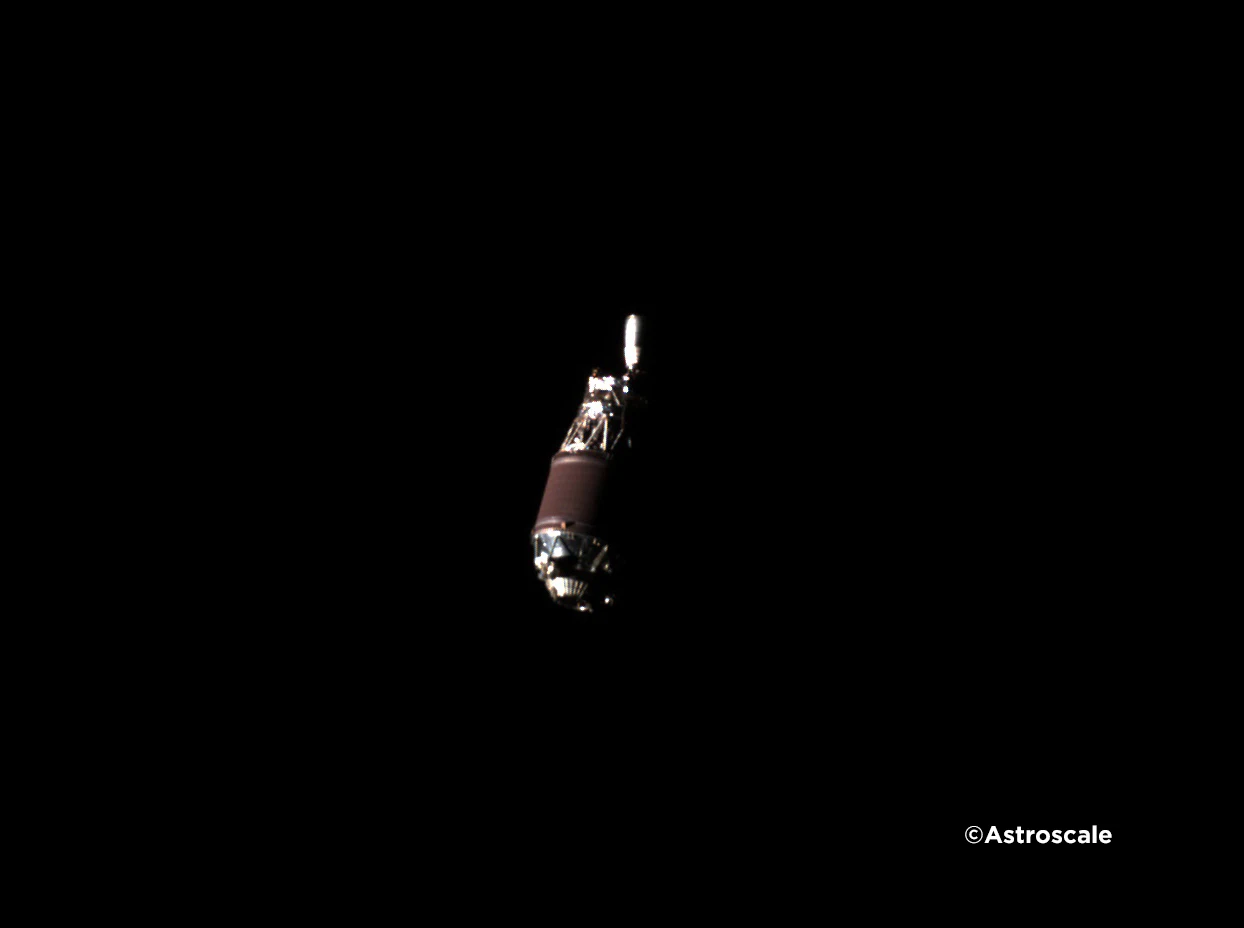
World’s First Image of Space Debris Captured By Japan's AstroScale

World’s First Image of Space Debris Captured By Japan's AstroScale

Astroscale Japan Inc., a subsidiary of Astroscale Holdings Inc., has unveiled the first publicly released image of space debris captured through rendezvous and proximity operations (RPO).

This historic image was taken by their commercial debris inspection demonstration satellite called Active Debris Removal by Astroscale-Japan (ADRAS-J).

The ADRAS-J spacecraft was selected by Japanese space agency JAXA for Phase I of its Commercial Removal of Debris Demonstration (CRD2) program. Astroscale Japan is responsible for the design, manufacture, test, launch and operations of ADRAS-J.

ADRAS-J is designed to demonstrate the feasibility of capturing and removing space debris from orbit. Its primary goal is to test technologies and techniques for safe and efficient debris removal.


The ADRAS-J spacecraft successfully approached a rocket upper stage, which is a piece of space debris, from several hundred meters behind it. This achievement marks a crucial step toward understanding and addressing the challenges posed by space debris, driving progress toward a safer and more sustainable space environment.

ADRAS-J uses advanced sensors, navigation systems, and robotic arms for its operations. These technologies are crucial for safe and precise maneuvers around space debris.

Astroscale collaborates with space agencies, industry partners, and international organizations to promote responsible space practices and develop effective debris removal strategies.

How ADRAS-J capture and remove space debris?

The ADRAS-J spacecraft employs innovative techniques to capture and remove space debris as depicted below —

1. Rendezvous and Proximity Operations (RPO)

ADRAS-J approaches the target space debris object using precise navigation and control systems. It performs close flybys to inspect the debris and assess its condition.

2. Capture Mechanism

ADRAS-J spacecraft is equipped with a robotic arm or a net system. The robotic arm can grapple onto the debris, securing it for removal. Alternatively, the net system envelops the debris, capturing it.

3. Deorbit Maneuvers

Once captured, ADRAS-J initiates deorbit maneuvers. These maneuvers alter the debris' orbit, gradually bringing it closer to Earth.

Eventually, the debris re-enters Earth's atmosphere and burns up.

4. Safe Disposal

ADRAS-J ensures that the debris re-enters over uninhabited areas (such as oceans) to minimize risk. The controlled re-entry prevents the debris from becoming additional space junk.

While active debris removal is still an ongoing challenge, there have been some notable efforts and achievements. The RemoveDEBRIS mission, led by the University of Surrey in collaboration with industry partners, successfully demonstrated several debris removal technologies. In 2018, it deployed a net to capture a simulated piece of space debris and used a harpoon to pierce a target panel. These tests validated the feasibility of capturing and deorbiting debris.

Elon Musk's SpaceX Starlink Satellite actively manages its satellites to avoid collisions and reduce space debris. When a defunct Starlink satellite (Darksat) was no longer operational, SpaceX intentionally deorbited it to prevent it from becoming space junk.

Similarly, the European Space Agency (ESA) is planning the e.Deorbit mission. e.Deorbit aims to capture a defunct satellite and safely deorbit it. The mission will demonstrate key technologies for active debris removal.

International organizations, space agencies, and private companies are increasingly working together to address space debris.

Initiatives like the Space Data Association (SDA) facilitate coordination among satellite operators to prevent collisions.

Chinese Space Rocket Junk Fell in Maharashtra ?

Chinese Space Junk Fell in Maharashtra, ISRO Officials

Last Saturday night, citizen in certain parts of Madhya Pradesh, Maharashtra and Telangana border witnessed lightshow in the sky, believing it to be a Meteor shower while astronomers believed its may be satellite debris from space.

Experts says that it is most likely to be a Chinese rocket body debris. Indian space agency ISRO's officials said that as per alerts from the U.S.-based USSPACECOM, there were four space debris objects expected to re-enter Earth’s atmosphere on Saturday - 1) The CZ-3B R/B (Chinese rocket body from Long March launch vehicle); 2nd is from SpaceX's Starlink 1831 and the remaining two were small objects from the debris of Kosmos-Iridium satellites collision, a collision accident that happened in 2009.


According to a Times of India report, a senior ISRO official explained about this incident, saying - The CZ-3B was originally predicted to have a re-entry time of 4.37pm IST and impact location close to Myanmar. However, in its post event prediction, USSPACECOM put the re-entry time as 7.42pm IST with impact location as Arabian Sea. With the latest orbital information from USSPACECOM, the closest match to the observed re-entry over India has to be from Chinese CZ-3B, which was launched on February 4 last year.

Even a minor error in latitude-longitude analysis could mean a difference of tens of kilometers and “given the time (post 7.40pm IST) of spotting of the object and its landing, it is most likely to be the Long March", ISRO official further said.

When rocket bodies survive atmospheric re-entry, the rocket parts such as nozzles, rings and tanks can impact on Earth.

Such incidents deliberately /or accidently happens because Indian space agency relies on America's USSPACECOM to get alerts on space junks/objects entering India's atmosphere. ISRO therefore has recently exoressed concern over this dependency and showing a determination to be self-reliant. ISRO recently announced that it will establish Space Surveillance and Tracking network with RADARS and Optical Telescopes under the project Network for Space Objects Tracking and Analysis (NETRA).

An another Video from Twitter

ISRO Plans Self-Reliance in Monitoring Foreign Space Objects

ISRO Plans Self-Reliance in Monitoring Foreign Space Objects
Representational Image

While increasing space junk is growing concern for every space agencies across the globe. Space  objects in Low Earth Orbit (LEO) including mega-constellation of satellites deployed by SpaceX's Starlink and China is making a close flyby -- less than a kilometer -- to India-owned Space objects. 

ISRO regularly carries out close approach monitoring for all space objects with Indian Space assets.In last year alone, ISRO monitored 4382 events with close approach distance less than 1 km to Indian LEO space assets and 3148 close approach events less than 5 Km with GEO objects during the year 2021.

The maximum number of threats objects were from fragments of Fengyun 1C (Chinese ASAT test in 2007) and Cosmos – Iridium Collision. While, 84 close approaches less than1 km were observed between Elon Musk promoted SpaceX-operated Starlink satellites and Indian Space Assets. 

Such close encounters of space objects leads to losses and penalties as in order to avoid collision with such space objects, Collision Avoidance Manoeuvre (CAM) needs to be carried out by thrusting the satellite with the fuel stored in the spacecraft that reduces the life of the spacecraft, due to fuel expenditure and disruption of payload operations.

Number of such manoeuvres (CAM) carried out by ISRO, to avoid collision, has increased over the last few years.

CAM is done by ISRO when the Indian space agency gets alerted by America's USPACECOM (United States Space Command), a unified combatant command of the U.S. Department of Defense, responsible for military operations in outer space, specifically all operations 100 kilometers (62 miles) above the Earth's mean sea level.

On 20 October 2021, Chandrayaan-2 Orbiter (CH2O) and NASA's Lunar Reconnaissance Orbiter (LRO) were predicted to come critically close to each other in lunar orbit. NASA and ISRO agreed that the situation merited a collision avoidance manoeuvre which was executed by Chandrayaan-2 on 18th October, 2021, well before the conjunction.

USPACECOM currently tracks using Space surveillance tracking Network and catalogues more than 25,000 space objects including debris and functional spacecraft in Earth’s Orbits. The number of debris that are too small to track are a few millions. 

According to ISRO, USPACECOM issued 543 conjunction alerts regarding the close approaches to the Indian operational assets. The number of alerts is expected to increase significantly in the coming years with the increase in the number of space objects especially due to proliferation of the large satellite constellations.

To analyze and assess such potential threats to India's operational spacecraft and to attain self-reliance in safeguarding the valuable space assets, ISRO will establish Space Surveillance and Tracking network with RADARS and Optical Telescopes under the project Network for Space Objects Tracking and Analysis (NETRA).

Radar and optical telescopes are the main ground based facilities for tracking space objects including space debris. ISRO said, "In order to track closely and frequently the operational spacecraft and the threat objects for estimation of their positions accurately, it is essential to have a network of observational facilities with wide geographical distribution."

The above data are given by ISRO's Space Situational Awareness (SSA) centre, which was launched in December 2020,  in view of ever-growing population of space objects and the ongoing trend towards mega-constellations of satellites.

Source - ISRO

Counting Space Debris - More Than 9800 Tonnes of Space Junk Objects Orbiting Around The Earth


While on Earth, humans are polluting the air, the land and the oceans, the space around the earth too is no different for them since the "Space-Age" has started. Space Pollution -- according to Wikipedia -- is space waste/debris/junk i.e. defunct artificial & man-made objects in space — principally in Earth orbit— which no longer serve a useful function.

Since the start of the space age in 1957, about 6170 (excluding failed missions) rockets have been launched putting about 12,450 satellites into Earth orbit however only 5,000 of these satellites are still functioning, according to the data by European Space Agency (ESA) 's Space Debris Office at ESOC, Darmstadt, Germany.

How Much Space Debris Is There ?

According to the ESA, there are 128 million objects the size of 1 mm to 1 cm, 9,00,000 objects the size of 1 cm to 10 cm, and 34,000 objects greater 10 cm currently whizzing around our planet. Many of these objects are traveling around our planet at roughly 28,163.52 kph, or about 10 times faster than a bullet. 

Total mass of all space objects in Earth orbit is more than 9800 tonnes, reported ESA. The data is latest updated till January 5.


via GIPHY

According to the NASA data, there are approximately 23,000 pieces of debris larger than a softball orbiting the Earth. They travel at speeds up to 17,500 mph, fast enough for a relatively small piece of orbital debris to damage a satellite or a spacecraft. There are half a million pieces of debris the size of a marble or larger (up to 0.4 inches, or 1 centimeter) or larger, and approximately 100 million pieces of debris about .04 inches (or one millimeter) and larger. There is even more smaller micrometer-sized (0.000039 of an inch in diameter) debris.

The NASA Orbital Debris Program Office has gathered pictures and graphics of space debris, as of January 1, 2019. In the below NASA video the dots represent the current location of each orbital debris -


Space debris can be hazardous to active satellites and spacecraft in the Earth's orbit. It has been theorized that Earth orbit could even become impassable to travel along, if the risk of collision grows too high.

A number of space shuttle windows were replaced because of damage caused by tiny flecks of peeling paints. In fact, millimeter-sized orbital debris represents the highest mission-ending risk to most robotic spacecraft operating in low Earth orbit.

In 1996, a French satellite was hit and damaged by debris from a French rocket that had exploded a decade earlier.

Space Junk Record Holders

In a latest this year, astronomers have predicted that an old space junk, which is of Elon Musk promoted company SpaceX's rocket called "Falcon 9" that was launched nearly 7-years ago, will now crash into the moon on March 4, 2022, at a blistering speed of 5,771 mph (9,288 km/h).

China's 2007 anti-satellite test, which used a missile to destroy an old weather satellite, added more than 3,500 pieces of large, trackable debris and many more smaller debris to the debris problem.

On Feb. 10, 2009, a defunct Russian spacecraft collided with and destroyed a functioning U.S. Iridium commercial spacecraft. The collision added more than 2,300 pieces of large, trackable debris and many more smaller debris to the inventory of space junk.

In A First of Earth's Lifetime, A Space Junk May Collide with the Moon at 9,288 Km/Hour Speed

Representational Image (credits - Pixabay)

An old space junk, which is of Elon Musk promoted company SpaceX's rocket that was launched nearly 7-years ago, will now crash into the moon, predicts astronomers.

Launched in February 2015, SpaceX's Falcon 9 rocket ran out of fuel and now the 4.4-ton (4 metric tons) rocket has been moving around fast in the space, in a chaotic orbit. It was supposed to be the part of a mission to send a climate observation satellite 930,000 miles (1.5 million kilometers) from Earth.

On January 5, 2022, Falcon 9 rocket's debris made a close flyby of the moon.

This all was predicted by Bill Gray, a developer of software that tracks near-Earth objects. In a blog post, he stated, "The rocket's upper stage is now expected to hit the far side of the moon while traveling at a blistering speed of 5,771 mph (9,288 km/h) on March 4, 2022."

"There are still several bits of junk we're tracking that may eventually hit the earth or moon or be ejected into orbit around the sun.", Bill says in his blog post.

Further, the data from observers helped scientists pinpoint its orbit of Falcon 9 rocket, discovering it would hit the Hertzsprung crater on the moon’s far side on March 4 at approximately 12:25 UTC. 

The effects of the collision impact will be minimal, aside from a new, albeit small, crater on the moon.

Jonathan McDowell, an astrophysicist at Harvard University, also confirmed that Falcon 9 space debris will hit the Moon. In a tweet, he said, "yes, an old Falcon 9 second stage left in high orbit in 2015 is going to hit the moon on March 4. It's interesting, but not a big deal."

Though, SpaceX may not be held responsible for this collision as it's apparently unintentional. In the past there are few space probes which have been deliberately destroyed at their objects of study, like the moon or other planets, typically by hard landings or crash landings at the end of their respective missions and/or functionality.

For an instance, several rocket stages utilized during the Apollo space program were deliberately crashed on the Moon to aid seismic research, and four of the ascent stages of Apollo Lunar Modules were deliberately crashed onto the Moon after they had fulfilled their primary mission.  

The moon saw intentional crashing of space probes objects, into its surface, for more than 15 times. 

It is to be noted that sometimes, the components of space probes intentionally crashed in order to prevent the hazards of orbital space junk/debris and planetary contamination.

But, Falcon 9 is a first "space junk", wandering in the space with no control from the earth, will crash into the moon. In other words, this is the first known unintentional impact of space junk with the moon.

Besides the moon, the Mercury too has saw intentional crashing when MESSENGER, a NASA robotic space probe that orbited the planet Mercury between 2011 and 2015, for studying Mercury's chemical composition, geology, and magnetic field, intentionally crashed into Mercury on April 30, 2015, in order to end the mission.

Market Reports

Market Report & Surveys
IndianWeb2.com © all rights reserved