Showing posts with label SpaceX. Show all posts

Starlink Begins Hiring in India, Sets Bengaluru as Hub Ahead of 2026 Broadband Launch

Starlink Begins Hiring in India, Sets Bengaluru as Hub Ahead of 2026 Broadband Launch

Elon Musk’s satellite internet venture, Starlink, opens finance and compliance roles in Bengaluru as it seeks DoT approvals, gateway stations, and prepares to challenge Jio Satellite and OneWeb in India’s fast-emerging satellite broadband market.  

Key highlights

  • Hiring drive: Payments manager, accounting manager, senior treasury analyst, and tax manager.
  • Location: Bengaluru as the operational hub in India.
  • Launch timeline: Commercial satellite broadband rollout targeted for early 2026, subject to approvals.

Regulatory and infrastructure plans

  • Licensing: Working with India’s Department of Telecommunications (DoT) on approvals and security requirements.
  • Gateway stations: Permissions sought for three ground stations in Mumbai, Chennai, and Noida.
  • Competition: Facing Jio Satellite (Reliance Jio) and OneWeb (Bharti-backed) in the Indian market.

Strategic importance

  • Market potential: LEO satellites to deliver low-latency, high-speed connectivity to underserved rural regions.
  • Global expansion: India positioned as a critical growth market.
  • Investor signal: Shift from regulatory negotiations to on-ground operational buildout.

Who’s behind it

  • Parent company: SpaceX, founded by Elon Musk.
  • Global footprint: Starlink operates across numerous countries with a rapidly growing subscriber base.

Takeaway

Starlink’s India hiring marks a strategic milestone—building a local finance and compliance backbone in Bengaluru, pursuing gateway approvals, and aiming for a 2026 launch to compete with Jio and OneWeb in satellite broadband.

From Mumbai to Kolkata: Starlink to Establish 9 Gateway Stations Across India

From Mumbai to Kolkata: Starlink to Establish 9 Gateway Stations Across India

Starlink is gearing up for its satellite internet debut in India by establishing nine gateway earth stations across key cities. This infrastructure is crucial for enabling high-speed, low-latency satellite broadband access nationwide—even in remote areas with limited mobile coverage.

Key Highlights

  • Cities targeted: Mumbai, Noida, Chandigarh, Hyderabad, Kolkata, Lucknow, and others
  • Purpose: These stations will serve as ground infrastructure to connect Starlink’s Gen 1 satellite constellation with users across India
  • Spectrum access: Starlink has applied for 600 Gbps capacity and received provisional spectrum clearance to begin testing
  • Regulatory status: The Department of Telecommunications (DoT) has allowed Starlink to import 100 satellite terminals for testing
  • Launch timeline: Full-scale rollout expected by late 2025 or early 2026

Gateway Station Deployment Overview

Feature Details
Number of Stations 9 planned across major cities
Cities Identified Mumbai, Noida, Hyderabad, Lucknow, Chandigarh, and Kolkata among others
Purpose To connect Starlink’s satellite constellation to India’s terrestrial internet backbone
Spectrum Clearance Provisional approval for 600 Gbps capacity from the Department of Telecommunications (DoT)
Terminal Imports 100 satellite user terminals approved for testing (not commercial use)
Launch Timeline Commercial rollout expected in late 2025 or early 2026
Regulatory Status Awaiting full licensing under India’s new satellite communication framework

Strategic Implications

  • Rural Connectivity Boost: Enables coverage in remote and underserved areas, bypassing the need for fiber or mobile towers
  • Competitive Landscape: Starlink will compete with Bharti-backed OneWeb and Jio’s satellite JV with SES
  • Security & Sovereignty: Government monitoring for compliance with national security and data localization norms
  • Tech Stack: Gen 1 satellites use Ku-band; Gen 2 may introduce laser interlinks and higher throughput
This move positions India as a major market for Starlink’s global expansion, potentially transforming connectivity for underserved regions.

Last month, Starlink received trial spectrum clearance from the DoT to conduct tests at its Navi Mumbai terminal. Starlink has applied for high-capacity spectrum (600 Gbps Spectrum Request) to support its Gen 1 satellite constellation.

The company has received approval to import 100 satellite terminals for testing purposes. Services are expected to begin by early 2026, pending final SATCOM licensing and spectrum allotment.

Starlink Begins Internet Trials in Navi Mumbai, Plans 20 Satellite Hubs Across India

Starlink Begins Internet Trials in Navi Mumbai, Plans 20 Satellite Hubs Across India

Elon Musk’s satellite internet venture, Starlink, is gearing up for a major infrastructure push in India. Starlink has received trial spectrum clearance from the DoT to conduct tests at its Navi Mumbai terminal. These tests aim to meet security compliance and regulatory standards before commercial rollout.

This move positions Starlink to compete with players like Jio-SES and Eutelsat OneWeb, who are also racing to build satellite broadband infrastructure in India.

Union Minister Jyotiraditya Scindia publicly confirmed that Starlink has received its operating license to launch satellite internet services in India. He shared details of his meeting with Gwynne Shotwell, President & COO of SpaceX, calling it a “great start to the journey”.

The Department of Telecommunications (DoT) granted temporary spectrum approval, allowing Starlink to begin trial runs and set up ground stations across India.

20 Earth Stations Planned

  • Starlink plans to set up 20 earth stations across India, including Noida, Chennai, and Navi Mumbai.
  • Three sites are already under construction.
  • Deployment will require at least 50,000 user terminals imported from Texas, LA, and Seattle.

Regulatory Landscape

  • Starlink holds a GMPCS licence and has IN-SPACe authorization to operate satellites in India.
  • DoT and TRAI are still finalizing spectrum pricing and long-term licensing terms.

Comparison Table: Satellite Internet Players in India


Company Key Moves Status
Starlink 20 earth stations, Navi Mumbai trials Testing phase
Jio-SES Joint venture with SES for satellite broadband Infrastructure buildout underway
Eutelsat OneWeb Merger completed, targeting enterprise and rural markets Operational in select regions

Interestingly, Jio has signed a strategic agreement with SpaceX to integrate Starlink into its broadband ecosystem. The partnership aims to extend Jio’s reach into underserved regions and offer Starlink hardware via Jio retail outlets.

Airtel has also inked an agreement with SpaceX to bring Starlink’s high-speed internet to its customers in India. The collaboration explores retail distribution, enterprise solutions, and rural connectivity, pending SpaceX’s full commercial authorization.

Starlink has identified 17 ground station sites across India and is working with data center operators like Equinix, Sify, and CtrlS.

Expected pricing includes — ₹30,000–₹35,000 one-time equipment cost. And, ₹3,000–₹4,200 monthly subscription fee. 

Internet speeds will range from 25 Mbps to 220 Mbps. 

No Mobile Towers Needed: Starlink to Bring Internet Directly to Phones

No Mobile Towers Needed: Starlink to Bring Internet Directly to Phones

SpaceX CEO Elon Musk has announced a major technological milestone for Starlink, the company’s satellite internet division. Within the next two years, Starlink will enable standard mobile phones to connect directly to its satellite network, bypassing traditional cell towers and regional carriers.

This innovation marks a transformative leap in global connectivity, promising high-bandwidth internet access anywhere on Earth, including remote, rural, and disaster-stricken regions.

Key Highlights
  • Direct-to-Cell Technology: Phones will connect directly to Starlink satellites without hardware modifications, using standard LTE protocols.
  • Global Coverage: Seamless internet access across five continents, including areas currently underserved by mobile networks.
  • Spectrum Acquisition: SpaceX has secured a $17 billion deal with EchoStar, acquiring 50 MHz of S-band spectrum in the U.S. and global Mobile Satellite Service licenses.
  • Technical Milestone: On January 8, 2024, Starlink successfully sent and received text messages using T-Mobile spectrum via its new Direct-to-Cell satellites.

Technology Behind the Breakthrough

Direct-to-Cell Technology

Starlink’s Direct-to-Cell satellites are equipped with:
  • Custom silicon optimized for low-power mobile signals
  • Advanced phased array antennas for precise beam steering
  • Regenerative networking to support voice, video, and IoT services
These satellites orbit at 360 km, lower than competing constellations, enabling stronger and faster links to mobile devices.

The top six Direct to Cell Satellites stacked and ready for launch

Global Partnerships

Starlink has partnered with major mobile operators including:
  • T-Mobile (USA)
  • Optus & Telstra (Australia)
  • Rogers (Canada)
  • KDDI (Japan)
  • Salt (Switzerland)
These alliances allow Starlink to act as a roaming partner, extending coverage into previously unreachable geographies.

Impact & Outlook

Musk stated, “You’ll be able to watch videos anywhere on your phone,” underscoring the potential to revolutionize mobile connectivity. The service is expected to roll out:
  • Text messaging in 2024
  • Voice, data, and IoT services by 2025
This development could disrupt legacy telecom providers and redefine how billions access the internet.

SpaceX's 1,900th Starlink Satellite Launch

SpaceX's 1,900th Starlink Satellite Launch

On Sunday, August 31, 2025, SpaceX is set to launch its 1,900th Starlink V2 Mini satellite aboard a Falcon 9 rocket from Cape Canaveral Space Force Station in Florida. This mission, designated Starlink 10-14, marks SpaceX’s 77th Starlink launch of the year, and its ninth Starlink mission in August alone.

Mission Highlights

  • Date: Sunday, August 31, 2025
  • Mission: Starlink 10-14
  • Launch Site: Cape Canaveral Space Force Station, Florida
  • Launch Time: 7:20 a.m. EDT (11:20 UTC)
    • Rocket: Falcon 9 Booster 1077 (23rd flight)
    • Trajectory: North-easterly path from Florida’s Space Coast
    • Landing Target: Drone ship Just Read the Instructions in the Atlantic Ocean

Network Expansion

  • Over 1,900 Starlink V2 Mini satellites launched in 2025 alone
  • Total active constellation exceeds 8,100 satellites
  • Global coverage spans 130+ countries, including rural India

Reusability Record

  • 489th Falcon 9 landing
  • 454th reflight milestone

Weather Outlook

  • 90% chance of favorable conditions
  • Minor risks from cumulus and anvil clouds
Summary: This launch marks SpaceX’s relentless cadence, operational efficiency, and its vision for global connectivity.

Starlink Launches by Year (2019–2025)

Year Launches Satellites Deployed Key Milestones
2019 6 ~360 First operational batch (v0.9) launched in May
2020 15 ~900 Regular cadence begins; v1.0 satellites dominate
2021 17 ~1,020 Laser interlinks introduced; global coverage expands
2022 25 ~1,500 v1.5 satellites deployed; polar orbit missions begin
2023 30+ ~2,000 v2 Mini satellites debut; constellation crosses 4,500
2024 40+ ~2,400 Direct-to-cell (DTC) satellites begin launching
2025 (Jan–Aug) 77 ~1,900+ Monthly launches peak; global user base hits 7M+

📊 Total Launches (2019–Aug 2025): ~210+
🛰️ Total Satellites Launched: ~9,580
🌐 Active Satellites in Orbit: ~8,280

🔍 Strategic Notes:
  • Reusability: Most launches used Falcon 9 Block 5 boosters, many flying 20+ times.
  • Coverage Expansion: Starlink now serves 150+ countries, including recent additions like Kazakhstan.
  • Tech Evolution: From basic v0.9 satellites to v2 Mini and DTC-enabled units, each year brought major upgrades.

Kerala Startup HEX20's 'Nila' Satellite Takes Flight, Powered by SpaceX

Kerala Startup HEX20's 'Nila' Satellite Takes Flight, Powered by SpaceX

The launch of the 'Nila' satellite is a groundbreaking achievement for HEX20, a Kerala-based space startup. Named after Kerala's longest river, 'Nila' was launched aboard SpaceX's Transporter-13 mission on March 15, 2025. This satellite is designed to control critical components like solar arrays and antennas in space missions.

HEX20, founded in 2020 and operating from Technopark since 2023, collaborated with the German firm Decubed for this mission. The satellite's payload included Release Actuators, showcasing HEX20's commitment to fostering global partnerships. The mission was supported by the Indian National Space Promotion and Authorisation Centre (IN-SPACe) and received assistance from ISRO for testing and tracking facilities.

This marks a significant step forward for India's private space sector, and HEX20 is already planning future missions, including a 50kg satellite launch with ISRO next year.

The 'Nila' satellite employs advanced technology to control critical components in space missions, such as solar arrays and antennas. It features Release Actuators, developed by the German firm Decubed, which were integrated into the satellite by HEX20. This innovative payload demonstrates HEX20's commitment to fostering global partnerships and advancing space technology.

The satellite's operations are managed from HEX20's ground station at Marian Engineering College in Thiruvananthapuram, where students and faculty are being trained to handle satellite tracking and mission management. This marks a significant step forward in India's private space sector.

Elon Musk's SpaceX Inks Deal With Airtel to Launch Starlink Satellite in India

Elon Musk's SpaceX Inks Deal With Airtel to Launch Starlink Satellite in India

Bharti Airtel has signed a deal with Elon Musk's SpaceX to launch Starlink satellite internet in India. This partnership aims to bring high-speed internet to even the most remote parts of the country, enhancing connectivity for businesses, schools, health centers, and communities.

The collaboration will also explore how Starlink can complement and expand Airtel's offerings, utilizing Airtel's ground network infrastructure.

This move comes after the Indian government sided with Musk on the spectrum allocation issue, favoring administrative allocation over auctions. The deal is still subject to regulatory approvals for SpaceX to operate Starlink in India.

Airtel and SpaceX will explore offering Starlink equipment in Airtel's retail stores and providing Starlink services to business customers. They also plan to use Starlink to bring high-speed internet to rural schools, health centers, and remote areas.

Additionally, the Airtel-Starlink collaboration will explore how Starlink can complement and expand Airtel's offerings, utilizing Airtel's ground network infrastructure. This includes leveraging Airtel's expertise in the Indian market to enhance SpaceX's direct offerings to consumers and businesses.

By adding Starlink to its portfolio, Airtel aims to expand its coverage into regions with little to no internet. This will provide businesses and communities in remote areas with more choices for high-speed internet connectivity, thereby improving their digital experience.

Gopal Vittal, Managing Director and Vice Chairman of Bharti Airtel, expressed excitement about the partnership, highlighting its significance in bringing next-generation satellite connectivity to India.

Gwynne Shotwell, President and Chief Operating Officer of SpaceX, emphasized the transformative impact Starlink can bring to the people of India and praised the collaboration with Airtel.

Starlink delivers high-speed, low-latency internet to users all over the world. As the world's first and largest satellite constellation using a low Earth orbit, Starlink delivers broadband internet capable of supporting streaming, online gaming, video calls and more.  Starlink is engineered and operated by SpaceX. As the world’s leading provider of launch services, SpaceX is leveraging its deep experience with both spacecraft and on-orbit operations to deploy the world’s most advanced broadband internet system.

SpaceX Plans To Launch 25 Starship Rockets Per Year, Starting in 2025

SpaceX Plans To Launch 25 Starship Rockets Per Year, Starting from 2025

SpaceX is aiming to significantly increase the launch frequency of its Starship rockets. Currently, SpaceX is allowed up to five launches per year at its Boca Chica facility in Texas. However, the Elon Musk promoted space firm is now planning to ramp up to 25 launches per year starting in 2025.

This increase is part of SpaceX's broader ambitions to make space travel more frequent and accessible, including missions to the moon and Mars.

The Federal Aviation Administration, or FAA, recently released an environmental assessment draft of SpaceX's proposal to boost the number of annual launches, as it continues to ramp up its test flights.

To operate at a faster cadence, SpaceX must obtain a new license or a license modification from the FAA to launch and land the Starship, as well as its Super Heavy booster.

The Revised Draft Tiered Environmental Assessment (EA) for SpaceX's proposal to increase the launch frequency of its Starship/Super Heavy vehicle at the Boca Chica Launch Site in Cameron County, Texas, was released by the Federal Aviation Administration (FAA) in November 2024.

The FAA is currently reviewing SpaceX's proposal and conducting an environmental assessment to ensure that the increased launch frequency will not have significant negative impacts. The review evaluates the potential environmental impacts of increasing the number of launches and landings from the current limit of five per year to up to 25 per year starting in 2025.

Although the launches would start at the company's Starbase, landings could happen on a floating platform in various locations, including the Gulf of Mexico, the Pacific Ocean or the Indian Ocean, according to the draft.

The FAA is considering issuing a new license or modifying the existing license for SpaceX to operate the Starship/Super Heavy Vehicle.

The completion of the environmental review process does not guarantee that the FAA will issue a license modification to SpaceX, as the application must also meet safety, risk, and financial responsibility requirements.

Notably, this year in July-August Texas Commission on Environmental Quality (TCEQ) has found that SpaceX repeatedly polluted waters in Texas, violating the Clean Water Act. This could impact SpaceX's plans to increase Starship launches from its Starbase facility.

Environmental Protection Agency (EPA) has also notified SpaceX of violations related to wastewater discharge, which could also affect their launch operations.

In 2024, SpaceX conducted two Falcon Heavy launches and three Starship test flights. The Falcon Heavy is one of SpaceX's most powerful rockets, designed for heavy-lift missions, while the Starship is being developed for future missions to the Moon, Mars, and beyond.

ISRO and SpaceX Collaborate to Launch GSAT-20 Communications Satellite Tomorrow

ISRO and SpaceX Collaborate to Launch GSAT-20 Communications Satellite This Week

SpaceX, led by Elon Musk, is collaborating with the Indian Space Research Organisation (ISRO) to launch the GSAT-20 communications satellite.

This launch, which is estimated to cost between $60-70 million, is scheduled for November 19, 2024, from Cape Canaveral in the US using SpaceX's Falcon 9 rocket.
This marks the first commercial collaboration between ISRO and SpaceX. Previously, ISRO relied on European launch services for heavy satellites.

GSAT-20 (GSAT N-2) weighs 4,700 kg, which exceeds the lift capacity of ISRO's heaviest rocket, the LVM-3 (Bahubali), that can carry up to 4,000 kg. This necessitated the partnership with SpaceX.

GSAT 20 Satellite
GSAT-20 Satellite

The satellite is equipped with a Ka-band high-throughput communication system, capable of delivering data at an impressive rate of 70 Gbit/s. It uses 40 beams with dual polarization, effectively doubling the number of beams to 80.

The launch comes at a time when geopolitical tensions have limited ISRO's options for launch services. With Arianespace's Ariane 5 retired and Ariane 6 not yet available, SpaceX emerged as the most viable option.

The satellite is designed to provide vital services like internet connectivity for remote areas and in-flight internet. GSAT-20 uses the advanced Ka-band frequency, which allows for higher bandwidth and better communication services. GSAT-20 will support initiatives like the Smart Cities program and provide in-flight internet connectivity, enhancing India's communication infrastructure.

The satellite is expected to remain operational for 14 years.

This ISRO–SpaceX collaboration marks a significant milestone for both ISRO and SpaceX, showcasing their commitment to enhancing communication infrastructure and technological capabilities.

This collaboration not only strengthens the ties between the US and India in space exploration but also showcases the innovative solutions both organizations bring to the table.

SpaceX to Shoot for the Mars in 2 Years

SpaceX to Shoot for the Mars in 2 Years

Elon Musk recently announced that SpaceX plans to launch its first uncrewed Starships to Mars in two years, during the next Earth-Mars transfer window. These missions aim to test the reliability of landing intact on Mars. If successful, SpaceX plans to follow up with crewed missions in about four years.

This is an exciting step towards Musk's long-term vision of building a self-sustaining city on Mars within the next 20 years.

SpaceX’s Starship is claimed to be a fully reusable spacecraft and rocket system designed to carry both crew and cargo to a variety of destinations, including Earth orbit, the Moon, Mars, and beyond. At 120 meters tall, it can carry up to 150 metric tonnes in a fully reusable configuration.

With SpaceX Starship, Musk envisions building a self-sustaining city on Mars within the next 20 years. This city would rely on local resources for water, oxygen, and building materials, and would be designed to support a growing population.

This year in June, a Starship rocket survived a fiery, hypersonic return from space and achieved a breakthrough landing demonstration in the Indian Ocean, completing a full test mission around the globe on the rocket's fourth try.

Living on Mars presents several significant challenges and the major one is Harsh Environment. Mars has an extremely thin atmosphere, about 100 times less dense than Earth’s, which offers little protection from cosmic and solar radiation. The average temperature is around -81°F (-63°C), making it incredibly cold.

Besides, Transporting supplies and equipment to Mars is a significant challenge due to the long distance and the need for precise landing. Any mission would require careful planning and substantial resources.

Musk's Mars mission will use the Starship spacecraft, which is designed to be fully reusable and capable of carrying both crew and cargo. Starship will be refueled in orbit before heading to Mars and can use local resources on Mars to produce fuel for the return trip.

SpaceX To Launch India’s 1st Private Spy Satellite Built by Tata Group's TASL, in April

SpaceX To Launch India’s 1st Private Spy Satellite Built by Tata Group's TASL

Elon Musk promoted SpaceX will soon be launching India's first private spy satellite — TSAT-1A, which has been built by Tata Group's Tata Advance Systems Limited (TASL). The launching is slated to happen in April.

TASL has built this military grade spy satellite and it has been shipped to Florida for assembling in the SpaceX rocket. With the help of TSAT-1A Indian defence forces will be able to get more accurate secret information and dependence on foreign vendors will be reduced.

TSAT-1A will have 0.5 meter spatial resolution and can provide sharp imagery. TASL can produce 25 such satellites annually and will develop multiple payloads as per requirements of armed forces.

To date, Indian armed forces have to rely on foreign vendors to obtain accurate co-ordinates and timings. But once the TSAT-1A satellite will be placed successfully in the orbit, the foreign reliance would nearly end. India will monitor this satellite and have full control of this spy satellite.

SpaceX To Launch India’s 1st Private Spy Satellite Built by Tata Group's TASL, in April

For monitoring the satellite, the ground control center is being built in Bengaluru and will be operational very soon. It will be used in the guidance and processing of satellite photographs. The Tata Company is building this center in association with the Latin-American company Satellogic (Satellogic). The imagery obtained from this satellite will also be shared with friendly countries. 

It is to be noted that, the Indian Space Research Organisation (ISRO) has its own satellites capable of capturing images, but their use is somewhat restricted.

TSAT-1A, which is a Low Earth Orbit (LEO) satellite, falls into the category of spy satellites because it has some sophisticated technologies. A spy satellite is essentially a camera in space, circling the Earth and taking detailed pictures of strategic places. These advanced satellites gather important information that’s useful for military and intelligence needs. They give key insights into things like troops’ movements what’s happening with infrastructure development near border areas, and any potential dangers.

Indo-German Space Tech JV Azista BST Aerospace Successfully Orbited Its 1st Satellite Through SpaceX

Indo-German Space Tech JV Azista BST Aerospace Successfully Orbited Its 1st Satellite Through SpaceX

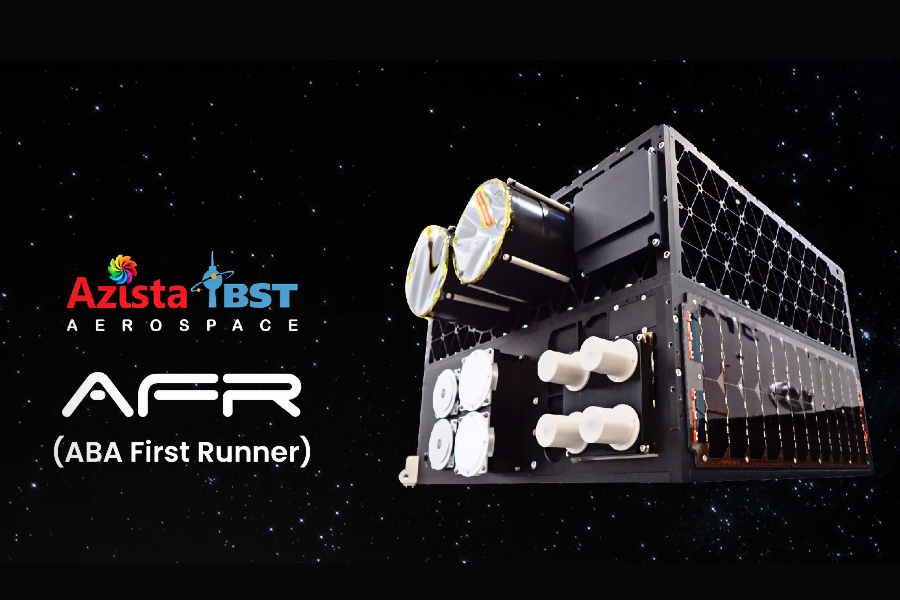
Ahmedabad-based, Azista BST Aerospace has launched its first satellite ABA First Runner (AFR), aboard a SpaceX Falcon 9 rocket on 13th June 2023, 02:49 AM IST as part of the Transporter 8 Mission. This was followed by successful separation of satellite from the rocket and making first contact with the satellite from the earth, with Indian & German teams actively engaged in LEOPS (Launch and Early Orbit Phase). 

The SpaceX rocket, which was on a dedicated rideshare mission, carried 72 spacecraft that includes CubeSats, Micro Sats among others and included Azista BST Aerospace's 80 kg satellite AFR.

AFR is an 80kg satellite built on a modular bus platform and hosts a wide-swath optical remote sensing payload with both panchromatic & multispectral imaging capabilities. AFR represents the first satellite of its size and performance built by the private space industry in India, capable of supporting various critical applications for civilian and defense purposes.

ABA First Runner Satellite
ABA First Runner satellite

Azista BST Aerospace is an Indo-German satellite manufacturing joint venture floated by Hyderabad, India's Azista Industries Pvt. Ltd (holding 70% stake) and Germany based Berlin Space Technologies GmbH (holding 30 % stake).

The JV aims to create a unique production facility for small satellites that would make a big difference. The company claims that it is the first private scale satellite production house in India and one of the first production lines for satellites anywhere in the world. In the words of one of the founders of BST it's the "Henry Ford moment for satellites !"

With support from the Indian Space Research Organisation (ISRO), the Indian National Space Authorization Center (IN-SPACe), and the Indian Space Association, Azista BST Aerospace factory in Ahmedabad is already geared up to produce 10 of these satellites in 2024.

Azista BST Aerospace is an Indo-German satellite manufacturing joint venture floated by India's Azista Industries Pvt. Ltd (holding 70 per cent stake) and Berlin Space Technologies GmbH (holding 30 per cent stake).

Currently the company is funded by Azista Industries and isn't backed by any venture capital funds, according news agency IANS, citing Sunil Indurti, Director of Azista BST Aerospace.


IISc-Incubated SpaceTech Co. Digantara Launches Satellite Aboard SpaceX Rocket

IISc-Incubated SpaceTech Co. Digantara Launches Satellite Aboard SpaceX Rocket

Digantara, an Indian Space Technology Company incubated at Indian Institute of Science (IISc), has successfully launched its second satellite named Pushan-Alpha onboard SpaceX's Transporter 6 mission on January 3.

The satellite reached low Earth orbit from Cape Canaveral in Florida, US. The nano-satellite will operate precisely in a sun-synchronous orbit (SSO) and monitor space weather.


Digantara's first mission was launched on June 30 last year by ISRO's PSLV-C53. It is the world's first commercial space-based space weather monitoring system. The Pushan-Alpha mission is named after the Hindu Vedic solar deity — Pushan, who is considered the god of travel and protector of travelers.

Digantara's Pushan-Alpha in the SSO will be used for enhancing space situational awareness (SSA) applications.

Space Situational Awareness (SSA) refers to the knowledge of the space environment, including location and function of space objects and space weather phenomena. SSA is generally understood as covering three main areas: Space Surveillance and Tracking (SST) of man-made objects.

Digantara is establishing a space-based surveillance platform with global realtime earth coverage by deploying a constellation of cost-efficient nanosatellites in LEO (Low Earth Orbit) along with precise modelling through an AI-ML based algorithm to provide predictive and robust space-based situational awareness services.

Last year, Pixxel launched its Anand satellite from another SpaceX rocket, and Dhruva Space launched their Thybolt satellites from an ISRO launch vehicle. 

In November, Hyderabad based Skyroot launched its indigenously built Rocket Vikram S, with support from Indian National Space Promotion and Authorization Center (IN-SPACe), the commercial arm of ISRO. 

Elon Musk’s SpaceX Raises $750 Mn in Funding, at Valuation of $137 Bn

Elon Musk’s SpaceX Raises $750 Mn in Funding, at Valuation of $137 Bn

Elon Musk’s commercial rocket company SpaceX has raised $750 million in its latest funding round led by the venture capital firm Andreessen Horowitz, who also invested in Musk’s $44 billion buyout of Twitter, according to the report by CNBC.

However, there is no official confirmation from SpaceX or the investors.

The latest funding of SpaceX put the SpaceTech startup's valuation at $137 billion, an increase from the $127 billion that SpaceX was valued at in May 2022, when it raised around $1.7 billion.

The funding comes at time when Elon Musk comes under pressure from shareholders as Tesla’s stock price falls almost 70% in 2022.

The funds raised is expected to help push forward on development of the Starship program, which is expected be used to launch the first manned mission to Mars.

In November last year, SpaceX was in talks about an offering of mostly secondary shares that could value the company at up to $150 billion, representing a 20% increase in valuation.

In June, SpaceX raised about $1.68 billion through equity financing.

Last year, SpaceX carried out 61 launches of its Falcon reusable rockets while its satellite internet service crossed 1 million subscribers.

Last month, the U.S. Federal Communications Commission (FCC) granted approval to launch up to 7,500 of SpaceX's next-generation satellites in its Starlink internet network. 


Interaction Between the Earth and the Sun Made SpaceX To Lose 40 Satellites of Starlink Megaconstellation


Amid a new race for satellite megaconstellation, a group of astronomers is already in protest mode to protect the study of the night sky from the thousands of these mega-constellation of satellites launched by private companies such as SpaceX. Although, even the governments like that of China too are launching there own megaconstellation, to feel less envy with the west, while posing threat to astronomy as these orbiting satellites have even surpassed light pollution hindering the clear night-sky view to astronomers worldwide.

Now in a latest, on last Friday a recent geomagnetic storm from the Sun will destroy 40 of the 49 Starlink satellites SpaceX has launched last week. 

Geomagnetic storms are the result of interactions between activity of the Earth and the Sun. That means -- Solar wind, a stream of charged particles from the sun, and the magnetic field of the Earth.

According to the Center of Excellence in Space Sciences under the Indian Institute of Science Education and Research, the models indicate a very high probability of an Earth impact with the material whizzing past at a whopping speed of 21,60,000 kilometers per hour. "The impact is unlikely to be very hazardous. Moderate geomagnetic storms are likely," CESS said in a tweet.

Interestingly, the satellites were designed in a way to “take cover from the storm” by flying “edge-on (like a sheet of paper)”, however they failed to carry out the maneuvers required to reach their required orbit.


It was just a week after Earth was hit by a moderate geomagnetic storm, the Sun once again hurtled powerful eruptions towards the planet. As activities continue to rise on the solar surface, the Sun blasted off a filament eruption that will hit Earth on February 9-10, triggering another geomagnetic storm.

The Elon Musk promoted firm launched the satellites into low-Earth orbit on 3 February from the Kennedy Space Center in Florida, United States. but 80% of them are now expected to burn up instead of reaching their intended orbit. "Unfortunately, the satellites deployed on Thursday were significantly impacted by a geomagnetic storm on Friday," SpaceX said in a statement. 

The storm, which was caused by solar activity, made the Earth's atmosphere warm and expand. The denser atmosphere at the initial orbital altitude for SpaceX's satellites caused atmospheric drag to increase up to 50% higher than the company had seen in previous launches.

This resulted to phenomenon that "up to 40 of the satellites will re-enter or already have re-entered the Earth's atmosphere".

Musk said: "We think this is a key stepping stone on the way towards establishing a self-sustaining city on Mars and a base on the moon."

SpaceX has already launched 2,000 satellites and has permission from the US authorities to send up 12,000 in total.

In A First of Earth's Lifetime, A Space Junk May Collide with the Moon at 9,288 Km/Hour Speed

Representational Image (credits - Pixabay)

An old space junk, which is of Elon Musk promoted company SpaceX's rocket that was launched nearly 7-years ago, will now crash into the moon, predicts astronomers.

Launched in February 2015, SpaceX's Falcon 9 rocket ran out of fuel and now the 4.4-ton (4 metric tons) rocket has been moving around fast in the space, in a chaotic orbit. It was supposed to be the part of a mission to send a climate observation satellite 930,000 miles (1.5 million kilometers) from Earth.

On January 5, 2022, Falcon 9 rocket's debris made a close flyby of the moon.

This all was predicted by Bill Gray, a developer of software that tracks near-Earth objects. In a blog post, he stated, "The rocket's upper stage is now expected to hit the far side of the moon while traveling at a blistering speed of 5,771 mph (9,288 km/h) on March 4, 2022."

"There are still several bits of junk we're tracking that may eventually hit the earth or moon or be ejected into orbit around the sun.", Bill says in his blog post.

Further, the data from observers helped scientists pinpoint its orbit of Falcon 9 rocket, discovering it would hit the Hertzsprung crater on the moon’s far side on March 4 at approximately 12:25 UTC. 

The effects of the collision impact will be minimal, aside from a new, albeit small, crater on the moon.

Jonathan McDowell, an astrophysicist at Harvard University, also confirmed that Falcon 9 space debris will hit the Moon. In a tweet, he said, "yes, an old Falcon 9 second stage left in high orbit in 2015 is going to hit the moon on March 4. It's interesting, but not a big deal."

Though, SpaceX may not be held responsible for this collision as it's apparently unintentional. In the past there are few space probes which have been deliberately destroyed at their objects of study, like the moon or other planets, typically by hard landings or crash landings at the end of their respective missions and/or functionality.

For an instance, several rocket stages utilized during the Apollo space program were deliberately crashed on the Moon to aid seismic research, and four of the ascent stages of Apollo Lunar Modules were deliberately crashed onto the Moon after they had fulfilled their primary mission.  

The moon saw intentional crashing of space probes objects, into its surface, for more than 15 times. 

It is to be noted that sometimes, the components of space probes intentionally crashed in order to prevent the hazards of orbital space junk/debris and planetary contamination.

But, Falcon 9 is a first "space junk", wandering in the space with no control from the earth, will crash into the moon. In other words, this is the first known unintentional impact of space junk with the moon.

Besides the moon, the Mercury too has saw intentional crashing when MESSENGER, a NASA robotic space probe that orbited the planet Mercury between 2011 and 2015, for studying Mercury's chemical composition, geology, and magnetic field, intentionally crashed into Mercury on April 30, 2015, in order to end the mission.

China Launching 13,000 Satellites into Low-Earth-Orbit

Representational Image

China plans to send out whopping number of about 13,000 satellites in space, that will encircle the Earth in the lower orbit (LEO), similar to Elon Musk promoted SpaceX's Starlink, said a report by the Daily Mail.

This "megaconstellation" made up of thousands of satellites will work together to cover all areas of the Earth, most operating a few hundred miles above the surface of the planet, to deliver internet services.

The report further said that it will to be part of the Chinese 5G mobile internet rollout, with the first firms given contracts to begin development work in the city of Chongqing. China plans to send about 12,992 satellites into in low earth orbit. These satellites will be placed between 498.89 kilometres to 1144.24 kilometres above the surface of the Earth.

This fresh move from China comes amid international rush for frequencies, that allow data to flow from Earth to space. China is concerned over western dominance of satellite constellation.

Notably, SpaceX's Startlink constellation has grown to over 1,700 satellites through 2021, and will eventually consist of many thousands of mass-produced small satellites in LEO, which communicate with designated ground transceivers.

A 2019 report also suggested that SpaceX Starlink is aiming to put out nearly 12,000 satellites into LEO, with a possible later extension to massive 42,000 satellites, eventually. As of December last year, SpaceX has launched 1,892 Starlink satellites, including demo satellites Tintin A and B.

Besides SpaceX, Amazon -- with its Kuiper project -- also plans to launch thousands of satellites in LEO, and the European Union is exploring its options too.

With this mega-constellation of satellites, China aims to plans to operate across a range of frequency bands and potentially operate around the world, providing services to different countries.

In addition to this, China has also completed the rollout of BeiDou, its answer to the U.S.-owned GPS navigation system, making it available globally. The Beidou -related products have been exported to about 120 countries, serving more than 100 million users worldwide.

SpaceX Makes Space Delivery of Ice Cream for Astronaut's 50th Birthday

Image Credits - Rubi Lian@Twitter

After a day in transit, a SpaceX’s cargo ship showed up on August 30 at the International Space Station (ISS), carrying ice cream and other birthday treats for NASA astronaut Megan McArthur's 50th birthday.

"No one’s ever sent me a spaceship for my birthday before. I appreciate it," Megan radioed after the capsule arrived.

Launched on August 29 from NASA’s Kennedy Space Center, the capsule contains lemons, cherry tomatoes, avocados and ice cream for McArthur and her six crewmates, along with a couple tons of research and other gear.


Megan is currently serving as Pilot of the NASA SpaceX Crew-2 mission to the ISS, which launched on April 23, 2021. In completing her first space mission, McArthur has logged almost 13 days in space.

Advertisements in Space: SpaceX Launching Space-Ad Satellite into Orbit

Representative Image

Elon Musk promoted space technology company SpaceX is partnering a Canadian tech startup, Geometric Energy Corporation (GEC), to launch a small advertisement satellite into space, reported Business Insider

In an interview with the Business Insider, GEC co-founder and CEO Samuel Reid said the company is developing a CubeSat satellite that’s equipped with a selfie-stick and a pixelated display screen on one side to show advertisements, logos, and other art. 

The space-ads satellite will have a screen on one side where people and companies can bid to have their logos and advertisements displayed, along with a “selfie stick” that'll snap photos of the ads with the Earth in the background. However, this system won’t be visible from the ground.

The CubeSat will be launched for space on SpaceX’s Falcon 9 rocket. The rocket will release the satellite into orbit before it reaches the moon. Once there, the selfie stick will capture footage of the display screen and livestream it on YouTube or Twitch for anyone to watch. 

According to Reid, the space-ads satellite is slated for an early 2022 release.

Buying Ads on CubeSat

In order to buy ads on satellite, a buyer has to bid for the digital space on the satellite and for same tokens is required to be purchased in order to claim pixel space on the satellite. 

There are 5 tokens a buyer will be able to purchase for space ads, these are -- 
  1. Gamma, which determines the brightness of the display; 
  2. Kappa, which determines the color; 
  3. Beta, which determines the X coordinate; 
  4. Rhoe, which determines the Y coordinate; 
  5. Xi, which determines the time your ad will be displayed. 
Among the payments for purchasing these tokens, cryptocurrencies is one of the options to purchase tokens and place bid.

In 2019, a media report said that a Russian startup StartRocket wanted to display enormous billboard-style advertisements in the night sky using arrays of cubesats, which it even depicted in a concept video. However, the startup eventually dropped this plan and is now working on technologies related to removing space debris.

Launching 143 Satellites in One-Go, SpaceX breaks ISRO’s Record


In February last year, Indian Space Research Organization (ISRO) set a world record by launching 104 satellites on board a Polar Satellite Launch Vehicle (PSLV) flight. Jump cut to 25th January, Elon Musk-promoted SpaceX broke this record by launching 143 small satellites.

SpaceX successfully launched its ambitious rideshare mission called Transporter-1, carrying 143 small satellites, and created a new record of launching many satellites from a single rocket. With this launch, SpaceX broke the record set by ISRO in February 2017 for deploying 104 satellites onboard PSLV in a single mission.

The 143 satellites included 133 commercial and government satellites and 10 Starlink satellites of SpaceX.

The launch was part of SpaceX’s SmallSat Rideshare Program mission and the firm’s social media handles shared pictures from the launch. Falcon 9 which has taken part in numerous SpaceX missions in the past flew from Florida to take the 143 satellites of different shapes and sizes to their orbits.

SpaceX is offering to transport packages to earth-orbit for just $1 million.

In a separate development, SpaceX CEO Elon Musk and Amazon founder Jeff Bezos, the two richest people in the world, are fighting over altitude of satellites of their own respective ambitious projects related to satellites constellation.

Market Reports

Market Report & Surveys
IndianWeb2.com © all rights reserved