Showing posts with label Sun. Show all posts

Eclipses on Demand: How ESA Is Casting Shadows in Space to Illuminate the Sun

Eclipses on Demand: How ESA Is Casting Shadows in Space to Illuminate the Sun

For centuries, astronomers have waited patiently for solar eclipses to glimpse the Sun’s ethereal halo. Now? They’re making their own.

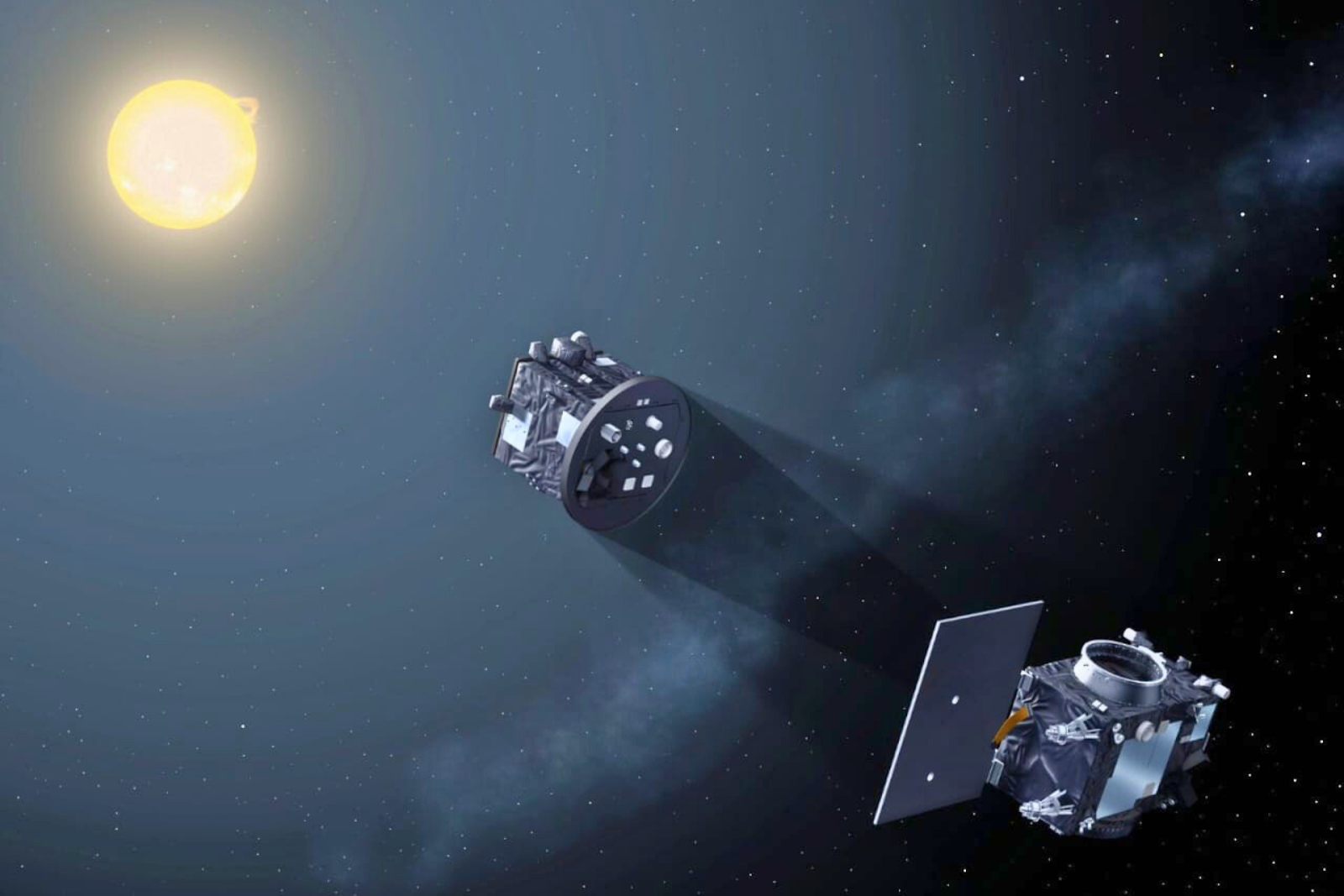
In a move straight from a science fiction script, the European Space Agency (ESA) has created a man-made solar eclipse in space—and it’s not just a one-time show. Using two satellites flying in tight formation, ESA’s Proba-3 mission is rewriting the rules of solar observation.

Scientists have figured out how to make a solar eclipse whenever they want, using two special satellites flying above Earth.

The European Space Agency launched a project called Proba-3. It has two satellites:
  • One blocks the sunlight (like putting your thumb over a torch).
  • The other takes pictures of the Sun’s outer layer, called the corona—a glowing, mysterious area that's hard to see normally.
These two satellites fly in perfect sync, 150 meters apart. That’s how they create a fake or artificial eclipse!

They can do this many times a week, and each eclipse lasts up to six hours—much longer than ones on Earth.

Notably, the Proba-3 mission satellites were launched by the Indian Space Research Organisation (ISRO) using their trusted PSLV-C59 rocket. The launch took place on December 5, 2024, from the Satish Dhawan Space Centre in Sriharikota, India. 

Why Is This a Big Deal?
  • Scientists can now study massive solar blasts that mess with mobile networks, GPS, and power.
  • They can examine the solar wind, which affects satellites and space weather.
  • They're also closer to solving a mystery: Why is the Sun’s outer layer hotter than its surface?
They’ve already taken stunning images—green loops, fire-like arcs, and hidden details of the Sun.

It’s like building a permanent space lab to study our star. Maybe one day, we’ll even see artificial eclipses on Mars!

Precision Shadowplay in Orbit

Eclipses on Demand: How ESA Is Casting Shadows in Space to Illuminate the Sun

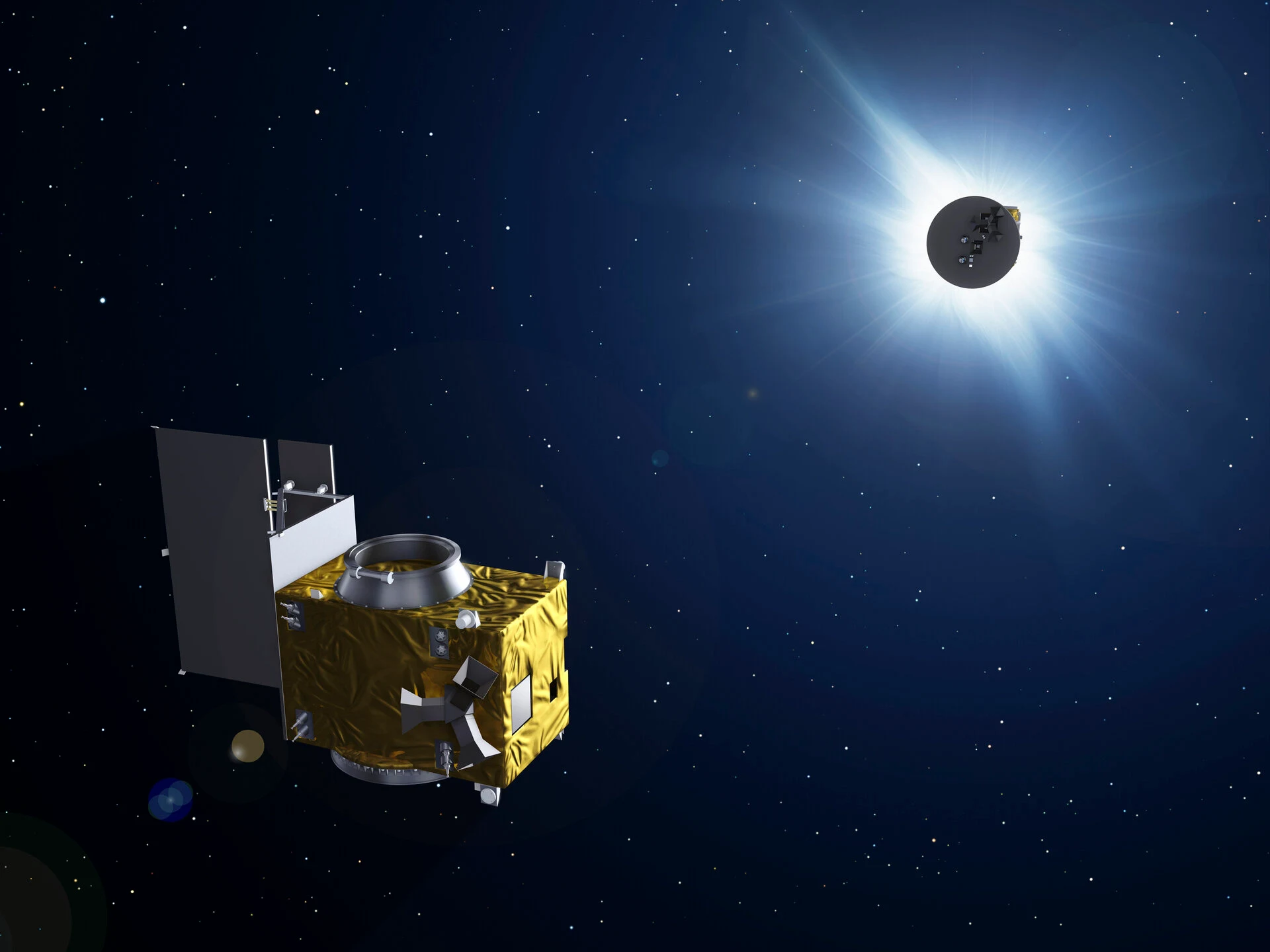
At the heart of the mission are two spacecraft with poetic roles: the Occulter, which blocks sunlight using a 1.4-meter disk, and the Coronagraph, trailing behind at a razor-precise 150 meters, poised to observe the Sun’s corona—its wispy, superheated outer atmosphere.

The magic lies in their dance: millimeter-perfect alignment sustained autonomously in space, simulating a solar eclipse for up to six hours. No more relying on fleeting eclipses; now, solar scientists get multiple custom eclipses per week.

And nestled aboard the Coronagraph is ESA’s pride—ASPIICS (Association of Spacecraft for Polarimetric and Imaging Investigation of the Corona of the Sun). This instrument uses layered exposures to pierce the Sun’s glare and reveal its hidden anatomy.
ISRO To Launch Europe's Proba-3 Spacecraft that Artificially Creates Solar Eclipse in Space

ISRO To Launch Europe's Proba-3 Spacecraft that Artificially Creates Solar Eclipse in Space

Following the recent Total Solar Eclipse, India's space agency, ISRO, is preparing to launch Europe's Proba-3 spacecraft. This mission aims to artificially create solar eclipses in space.

The mission will involve two small satellites that will launch together and then separate to fly in tandem. The goal is to prepare for future multi-satellite missions that fly as one virtual structure. 

The Indian Space Research Organisation (ISRO) will launch the Proba-3 spacecraft. The mission will involve a pair of satellites that will fly together to form a 144-meter long solar coronagraph. The coronagraph will enable closer study of the Sun's corona, a mysterious layer usually only visible during solar eclipses.

Proba-3 is part of a series of PROBA satellites that are used to validate new spacecraft technologies and concepts while also carrying scientific instruments.

The purpose of Proba-3 is to conduct precision formation flying to create a solar coronagraph, enabling closer study of the Sun's corona.

Proba-3 will be the world’s first mission to conduct precision formation flying in space. A pair of satellites will not only fly together but also form a 144-meter-long solar coronagraph.

The Sun's corona, hotter than the Sun itself, is the origin of space weather. Proba-3 aims to bridge the observational gap between the low and high corona, offering insights into this enigmatic region. The corona is usually visible only during solar eclipses. Proba-3 will study it closer to the solar rim than ever before.

European Space Agency (ESA) has developed cutting-edge technologies for precise positioning and coordination of the spacecraft, including cold gas thrusters and vision-based detection systems, ensuring millimeter-scale accuracy.

ISRO's Polar Satellite Launch Vehicle (PSLV) will carry Proba-3 into a high Earth orbit from Satish Dhawan Space Centre. The launch date is yet to be finalized.

ESA's another spacecraft, Proba-2, captured two instances of the Total Solar Eclipse on April 8, providing valuable data from its Sun-synchronous orbit around 700 km above Earth's surface.

ISRO's collaboration with the European Space Agency (ESA) for the Proba-3 mission marks a significant step in space exploration. It offers new possibilities for studying the Sun's corona and advancing our understanding of solar phenomena.

How Proba-3 maintain its formation flying?

Proba-3, the world's first precision formation flying mission, demonstrates cutting-edge technologies for highly-precise satellite coordination. Proba-3's precision formation flying relies on coordinated maneuvers between the Coronagraph and Occulter, allowing unprecedented observations of the Sun's elusive corona.


The goal of this mission is to prove formation flying technologies and conduct rendezvous experiments.

Coronagraph and Occulter

Proba-3 Formation Flying
Proba-3 Formation Flying 

Proba-3 consists of a pair of small satellites that fly together, maintaining a fixed configuration as a large rigid structure' in Space. The two satellites — the Coronagraph and the Occulter — work in tandem. During their orbits, they form a straight line in space with the Sun exactly 144 meters apart.

The Occulter spacecraft, equipped with a round disk, casts a shadow onto the Coronagraph spacecraft. By doing so, the Occulter blocks out the brilliant solar disk, allowing the Coronagraph to image the Sun's wispy outer atmosphere, known as its corona, for up to six hours at a time.

Ground and space observatories often incorporate Sun-blocking coronagraphs, but their effectiveness is limited by light spilling around disk edges, a phenomenon called diffraction. Proba-3's approach reduces diffraction by hosting the coronagraph on a separate spacecraft. The Occulter's edge has been precisely curved to further minimize diffraction effects.

While Proba-3 is primarily a technology-testing mission, its main payload is a science instrument focused on the Sun.

Once in orbit, the Occulter and Coronagraph satellites will autonomously perform precision formation flying, maintaining a distance of 150 meters apart, enabling six hours of observation per orbit.

Sustained observation of the corona will address mysteries such as why it is a million degrees Celsius hotter than the Sun's surface.

The ESA has collaborated with Belgium's Centre Spatial de Liège (CSL), and other European partners to ensure a successful mission.

ISRO To Launch an Europe's Proba-3 Spacecraft that Artifically Create Solar Eclipse in Space


ISRO Launching Aditya-L1, India’s 1st Solar Mission This Week

ISRO Launching Aditya-L1, India’s 1st Solar Mission This Week

The first Indian space-based observatory-class solar mission to unlock the mysteries of the Sun

ISRO today announced that Aditya-L1, India's first space-based observatory to study the Sun, will be launched on this week on Saturday (September 2) at 11.50 AM from Andhra Pradesh's Satish Dhawan Space Centre, Sriharikota.

Late last week, ISRO Chairman S. Somnath, told reporters that the satellite had been integrated with the PSLV launch vehicle at Sriharikota. The spacecraft would take 125 days to reach the Lagrangian Point L1.

Initially, Aditya-L1 was scheduled to launch on August 26, but as per the latest update, the mission will now be launched on 2nd September.

The Aditya-L1 mission, aimed at studying the Sun from an orbit around the L1, would be launched by PSLV-C57 rocket and will be carrying 7 payloads to observe the photosphere, chromosphere and the outermost layers of the Sun, the corona, in different wavebands. Aditya-L1 is a fully indigenous effort with the participation of national institutions.

ISRO Launching Aditya-L1, India’s 1st Solar Mission This Week

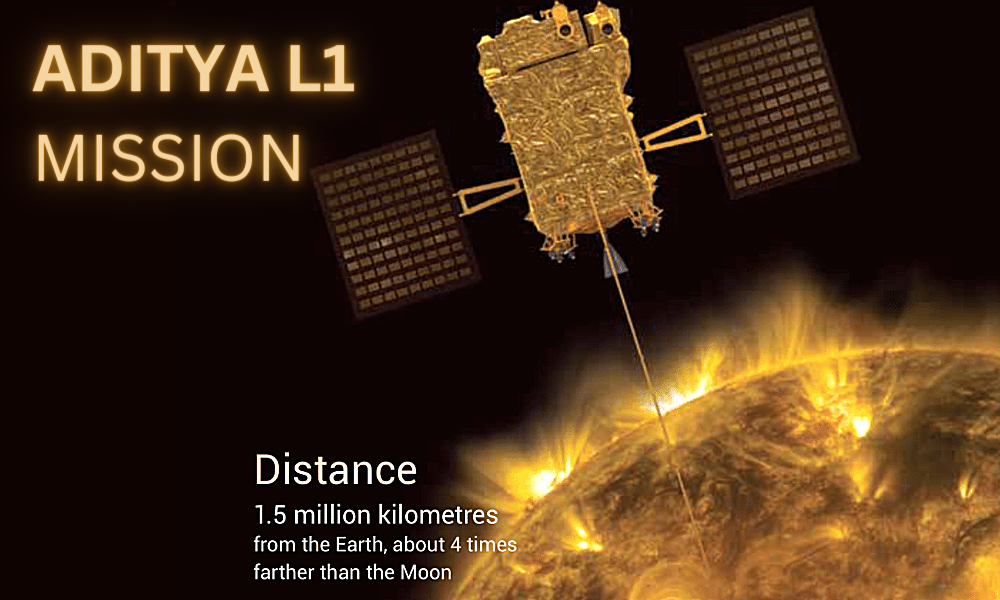
The spacecraft is planned to be placed in a halo orbit around the Lagrangian point 1 (L1) of the Sun-Earth system, which is about 1.5 million km from the Earth.

The Aditya L1 spacecraft will be equipped with a Visible Emission Line Coronagraph (VELC) which will be used for imaging and spectroscopy of the Sun to better understand the science powering the star.

Uniqueness of Aditya-L1

  • First-time spatially resolved solar disk in the near UV band
  • CME dynamics close to the solar disk (~from 1.05 solar radius) thereby providing information in the acceleration regime of CME, which is not observed consistently
  • Onboard intelligence to detect CMEs and solar flares for optimised observations and data volume
  • Directional and energy anisotropy of solar wind using multi-direction observations
ISRO Launching Aditya-L1, India’s 1st Solar Mission This Week

ISRO Prepares for Its Next Launch 'Aditya-L1', India's 1st Space-based Mission To Study the Sun

After the sucessful launch of the Chandrayaan-3, the Indian Space agency, Indian Space Research Organisation (ISRO), is now preparing for its next launch — Aditya-L1— the first space-based Indian observatory to study the Sun.

ISRO Prepares for Its Next Launch 'Aditya-L1', India's 1st Space-based Solar Mission

The mission is scheduled to launch on 26th of this month or early next month, aboard a PSLV-XL launch vehicle.

ISRO has shared the first images of the Aditya-L1 satellite. 


On Monday ISRO announced that the spacecraft was assembled and integrated at the UR Rao Satellite Centre (URSC) in Bengaluru and has arrived at Satish Dhawan Space Centre in Sriharikota in Andhra Pradesh.

According to ISRO, the satellite shall be placed in a halo orbit around the Lagrange point 1 (L1) of the Sun-Earth system, which is about 1.5 million km from the Earth. A satellite placed in the halo orbit around the L1 point has the major advantage of continuously viewing the Sun without any occultation/eclipses. This will provide a greater advantage of observing the solar activities, and its effect on space weather in real time.

The Aditya-L1 mission will take around 109 Earth days after launch, to reach the halo orbit around the L1 point.

The mission will obtain near simultaneous images of the different layers of the Sun's atmosphere, which reveal the ways in which the energy may be channeled and transferred from one layer to another. Thus the Aditya-L1 mission will enable a comprehensive understanding of the dynamical processes of the Sun and address some of the outstanding problems in solar physics and heliophysics.

India's 1st Solar Mission 'Aditya L-1' Launching By December

India's 1st Solar Mission 'Aditya L-1' Launching By December

By the end of this year ISRO will launch the Aditya L1 mission. It is India's first solar mission.

IIT-BHU astronomers are also involved in this project.

Workshop on India's first solar mission 'Aditya L-1' satellite began at IIT-BHU. The workshop stated that the 'Aditya L1' satellite will be launched from ISRO by the end of December month. This will bring out the hidden secrets of the sun. Many astronomers of IIT-BHU are also involved in this 'Aditya L1' satellite mission project. IIT BHU scientists have earlier designed several satellite devices.

Aditya L1 is the first space based observatory class Indian solar mission to study the Sun. The spacecraft is planned to be placed in a halo orbit around the Lagrangian point 1 (L1) of the Sun-Earth system, which is about 1.5 million km from the Earth.

During the workshop, astronomers at IIT-BHU reported that it would be projected at the Lagarajian-1 point of space. It has a number of devices installed that will explain the physical and their raels of plasma processes equipped with a variety of energies in solar environments. This will provide information about the weather of the space and the entire conditions. Space will also predict the weather. At the same time, there will also be many new information about coronal heating, explosions on the surface of the sun and solar wind.

Scientist of Physics at IIT-BHU, Dr. Abhishek Srivastava said that in view of this huge potential of 'Aditya-L1' mission, a scientific workshop is being held in the institute on — "What are the challenges in solar physics and heliospheric physics" and "How we will solve them during the missio".

The Aditya-L1 mission carries a suit of seven scientific payloads to carry out systematic study of the Sun. This suit of Aditya L1 payloads are expected to provide most crucial information to understand the problems of coronal heating, Coronal Mass Ejection, pre-flare and flare activities, and their characteristics, dynamics of space weather, study of the propagation of particles, and fields in the interplanetary medium etc.

The science payloads of Aditya-L1 are being indigenously developed by different laboratories in the country.

The VELC instrument is being developed at the Indian Institute of Astrophysics, Bangalore; SUIT instrument at Inter University Centre for Astronomy & Astrophysics, Pune; ASPEX instrument at Physical Research Laboratory, Ahmedabad; PAPA payload at Space Physics Laboratory, Vikram Sarabhai Space Centre, Thiruvananthapuram; SOLEXS and HEL10S payloads at UR Rao Satellite Centre, Bangalore, and the Magnetometer payload at the Laboratory for Electro Optics Systems, Bangalore. All the payloads are being developed with the close collaboration of various centres of ISRO.

Interaction Between the Earth and the Sun Made SpaceX To Lose 40 Satellites of Starlink Megaconstellation


Amid a new race for satellite megaconstellation, a group of astronomers is already in protest mode to protect the study of the night sky from the thousands of these mega-constellation of satellites launched by private companies such as SpaceX. Although, even the governments like that of China too are launching there own megaconstellation, to feel less envy with the west, while posing threat to astronomy as these orbiting satellites have even surpassed light pollution hindering the clear night-sky view to astronomers worldwide.

Now in a latest, on last Friday a recent geomagnetic storm from the Sun will destroy 40 of the 49 Starlink satellites SpaceX has launched last week. 

Geomagnetic storms are the result of interactions between activity of the Earth and the Sun. That means -- Solar wind, a stream of charged particles from the sun, and the magnetic field of the Earth.

According to the Center of Excellence in Space Sciences under the Indian Institute of Science Education and Research, the models indicate a very high probability of an Earth impact with the material whizzing past at a whopping speed of 21,60,000 kilometers per hour. "The impact is unlikely to be very hazardous. Moderate geomagnetic storms are likely," CESS said in a tweet.

Interestingly, the satellites were designed in a way to “take cover from the storm” by flying “edge-on (like a sheet of paper)”, however they failed to carry out the maneuvers required to reach their required orbit.


It was just a week after Earth was hit by a moderate geomagnetic storm, the Sun once again hurtled powerful eruptions towards the planet. As activities continue to rise on the solar surface, the Sun blasted off a filament eruption that will hit Earth on February 9-10, triggering another geomagnetic storm.

The Elon Musk promoted firm launched the satellites into low-Earth orbit on 3 February from the Kennedy Space Center in Florida, United States. but 80% of them are now expected to burn up instead of reaching their intended orbit. "Unfortunately, the satellites deployed on Thursday were significantly impacted by a geomagnetic storm on Friday," SpaceX said in a statement. 

The storm, which was caused by solar activity, made the Earth's atmosphere warm and expand. The denser atmosphere at the initial orbital altitude for SpaceX's satellites caused atmospheric drag to increase up to 50% higher than the company had seen in previous launches.

This resulted to phenomenon that "up to 40 of the satellites will re-enter or already have re-entered the Earth's atmosphere".

Musk said: "We think this is a key stepping stone on the way towards establishing a self-sustaining city on Mars and a base on the moon."

SpaceX has already launched 2,000 satellites and has permission from the US authorities to send up 12,000 in total.

China's "Artificial Sun" Nuclear Reactor Ran at 160 Million °C for 100 Seconds


China has successfully completed the second test of its nuclear fusion reactor, known as "Artificial sun", because it mimics the energy-generation process of the Sun.

The so called 'artificial sun' nuclear fusion reactor has set a new world record after running at 216 million degrees Fahrenheit (120million°C) for 100 seconds, according to state media. Fusion is a nuclear technology that can produce very high levels of energy without generating large quantities of nuclear waste

The 'artificial sun' machine, called as Experimental Advanced Superconducting Tokamak (EAST), also achieved a peak temperature of 288 million °F (160million°C) – more than ten times hotter than the sun.

Chinese scientists hope that EAST machine will unlock a powerful green energy source in Beijing's quest for 'limitless clean power'. EAST is China's largest and most advanced nuclear fusion experimental research device, which uses a powerful magnetic field to fuse hot plasma.

The Sun in our galaxy produces energy through a nuclear fusion reaction. Inside the Sun, the hydrogen atoms collide with each other and fuse at extremely high temperatures – around 15 million degrees centigrade – under enormous gravitational pressure. Every second, 600 million tons of hydrogen are fused to create helium. During this process, part of the mass of the hydrogen atoms becomes energy.

China's fusion reactor device was first fired up last December, with a plasma temperature of 180 million°F (100 million°C) for 100 seconds.

China's next goal could be to run at a consistent temperature for a week, according to Li Miao, director of the physics department of the Southern University of Science and Technology in Shenzhen.

Solar Storm Travelling At 1,800,000km/h To Hit Earth Tomorrow


A solar storm travelling at 1.8 million km/h is due to hit Earth this weekend, potentially impacting our satellite technology.

Categorized as a G1 class storm, the impacts are expected to be minor but could include power grid fluctuations, impact on satellite operations, and even impacts on migratory animals when it hits tomorrow, May 2.

While this solar storm is largely isnignificant, some experts have warned a major solar storm is a matter of "when not if". Every so often, the Sun releases a solar flare which in turn blasts energy into space. Some of these solar flares can hit Earth, and for the most part, are harmless to our planet.

However, the Sun can also release solar flares so powerful that they can cripple Earth's technology.


It comes as a hole in the equatorial region of the sun’s atmosphere has appeared, researchers have said, which is emitting solar particles directly towards Earth at a speed of 500km/s, or 1,800,000km/h.

NASA explains that solar storms themselves can last from anywhere between a few minutes to several hours, though the affects of geomagnetic storms can linger in the Earth’s magnetosphere and atmosphere for days to weeks.

Solar flares that hit Earth are mostly harmless, but the sun is capable of releasing flares that are so powerful they could cripple Earth’s technology. In 1989, for example, a solar storm caused an electrical power blackout in the entire province of Quebec, Canada.

Market Reports

Market Report & Surveys
IndianWeb2.com © all rights reserved