Showing posts with label Water. Show all posts

D2C Brand Waterscience Secures ₹1.4 Crores in Investment from Peter Thiel-backed Velocity

D2C Brand Waterscience Secures ₹1.4 Crores in Investment from Peter Thiel-backed Velocity
  • The company aims to utilise the funds to drive growth, marketing campaigns and new product category expansion
WaterScience, India’s leading brand in non-drinking water filtration, today announced that it has secured ₹1.4 crores in funding from Velocity, a growth capital platform backed by Peter Thiel’s Valar Ventures.

The investment will enable WaterScience to accelerate its growth trajectory, strengthen brand marketing initiatives, and introduce new product categories to become a 360-degree water solutions company.

Founded in 2014, WaterScience pioneered the shower and tap filter category in India, addressing critical water quality issues that affect over 95% of household water use beyond drinking. Today, the company offers more than 40 products across categories including shower & tap filters, appliance filters, kitchen filters, water softeners, and whole-house filtration systems for hard water, chlorine & other contaminants.

D2C Brand Waterscience Secures ₹1.4 Crores in Investment from Peter Thiel-backed Velocity
Range of solutions for Hard-water, chlorine & sediments

Currently, WaterScience products are present in over 2 million Indian homes, and the company is aiming to add 1 million more homes in FY25-26.

Commenting on the announcement, Pavithra Rao, Co-Founder, WaterScience, said, “This funding is a strong validation of our mission to make water safer and healthier for every Indian home. With Velocity’s support, we will scale faster and innovate across new categories, ensuring that WaterScience continues to set the benchmark for water solutions in India. Having already reached 2 million homes, we are excited to add another 1 million this year.”

Atul Khichariya, Co-Founder and COO Velocity, added, “We have a long-standing partnership with WaterScience, a true category creator in India’s water solutions space. Their growth trajectory and focus on innovation demonstrate a strong commitment to addressing the vast need gap in non-drinking water filtration. We are proud to have been part of their journey and look forward to supporting their next phase of expansion.

The non-drinking water filtration segment which accounts for 95% of household consumption through bathing, washing, and cleaning activities largely remains unaddressed. With hard water affecting 70% of Indian homes and causing widespread skin, hair, and appliance damage, the market for whole-home water solutions is projected to grow at 15% CAGR through 2028, creating a significant opportunity for specialized players.

With a 70% Year-on-Year growth and strong presence across marketplaces like Amazon, Flipkart, Shopify, and more than 1,000 offline retailers, WaterScience has established itself as the one of the leading brands in non-drinking water filtration in India. The fresh capital will fuel expansion into new markets, strengthen its digital and offline presence, and power innovation for the next phase of growth.

About WaterScience

WaterScience is India’s No. 1 brand in non-drinking water filtration. Headquartered in Bengaluru, the company designs and manufactures innovative products for hard water, chlorine & other contaminants at every point of use in the home. Its vision is to become a 360-degree water solutions brand, addressing both drinking and non-drinking water needs.

For more information, visit: https://www.waterscience.in/

About Velocity

Velocity is India’s leading e-commerce enablement platform, empowering digital-first businesses with fast, flexible non-dilutive capital, logistics, and AI-powered tools to scale efficiently. Founded in 2020 by IIT Bombay alumni Abhiroop Medhekar, Atul Khichariya, and Saurav Swaroop, Velocity’s mission is to accelerate the growth of India’s e-commerce ecosystem.

Backed by Peter Thiel's Valar Ventures, Velocity has partnered with 4,000+ D2C and digital-first brands, disbursing over ₹1,100 crore in funding. Beyond capital, the company offers a comprehensive suite of products Shipfast for AI-driven shipping and logistics, Velocity Insights for actionable business intelligence and Vani AI, an award-winning AI-powered telecalling solution for personalized customer engagement. Some of the leading D2C brands Velocity has supported include Soulflower, Rynox Gears, NasherMiles, Hammer, Zlade, The Bear House, Off Duty, and Chumbak.

For more information, visit: https://www.velocity.in/

Japan’s First Osmotic Plant Signals a New Era of Water-Based Energy

Japan’s First Osmotic Plant Signals a New Era of Water-Based Energy

In a quiet corner of southern Japan, something revolutionary is happening beneath the surface. No smoke. No noise. Just the silent push and pull of salt and fresh water generating clean electricity. Welcome to Japan’s first osmotic power plant—a bold step into the future of renewable energy.

What Is Osmotic Power?

Osmotic Power

Imagine placing freshwater and seawater side by side, separated by a special membrane. Nature wants balance, so freshwater flows toward the saltier side, creating pressure. That pressure can spin a turbine—and voilà, you’ve got electricity. It’s called osmotic energy, or more poetically, “blue energy.”

Unlike solar or wind, osmotic power doesn’t care if it’s cloudy or calm. It runs 24/7, quietly converting water chemistry into clean power.

Japan’s First Plant: Small but Mighty

Osmotic power plant by Fukuoka District Waterworks Agency
Launched in August 2025 by the Fukuoka District Waterworks Agency, the plant uses treated wastewater and concentrated seawater—both byproducts of desalination—to generate power. It’s expected to produce 880,000 kilowatt-hours annually, enough to run a desalination facility and supply clean water to nearby communities.

That might not sound like much, but it’s a proof of concept with global implications.

This is next-generation renewable energy, says Akihiko Tanioka, a leading researcher in osmotic systems. It’s clean, constant, and scalable.

Why It Matters

Always On: Unlike solar panels or wind turbines, osmotic power doesn’t depend on weather.

Eco-Friendly: No emissions, no fuel, no noise—just water doing what it naturally does.

Global Potential: Countries like Norway, South Korea, and Australia are exploring similar tech.

What’s Next?

Japan’s move could spark a wave of innovation. Coastal cities, desalination hubs, and wastewater treatment plants might soon double as power stations. And with climate change demanding cleaner solutions, osmotic energy offers a tantalizing new option.

It’s not just science—it’s strategy. Turning water into power without harming the planet? That’s the kind of quiet revolution the world needs.

DeepTech Startup Aeronero Secures $1.5M to Scale Breakthrough Air-to-Water Technology

DeepTech Startup Aeronero  Secures $1.5M to Scale Breakthrough Air-to-Water Technology

Aeronero, a Chennai-based deep-tech startup focused on solving global water scarcity, has raised $1.5 million in a landmark funding round led by Callapina Capital and Rezwan Razack of Prestige Group. Here's a breakdown of what makes this round—and the company—so compelling:

Key Highlights of the Funding Round

  • Lead Investors: Callapina Capital and Rezwan Razack (MD, Prestige Properties) 
  • Co-Investors: SAN ANGELS, Jamwant Ventures, and prominent HNIs including:
    • Kiran Deshpande (Former CEO, Tech Mahindra)
    • S. Ramadorai (Former CEO & Vice Chairman, TCS)
  • Purpose: To scale Aeronero’s patented Air Water Generators (AWGs)—devices that extract clean, alkaline drinking water directly from the atmosphere.

Why It Matters

  • 13 Global Patents: Many already commercialized, backing a robust tech platform.
  • 400% YoY Growth: Driven by demand across homes, offices, and military outposts.
  • ₹30 Crore Order Book: With ambitions to hit a ₹100 crore topline.
  • Production Scale-Up: Targeting 2,000 units/month from in-house manufacturing

Impact & Vision

  • Mission: “Water for All, Always”—a decentralized, sustainable approach to water access.
  • Technology: AWGs use a 5-step filtration system including Biovitae™ and mineralization to produce alkaline water (pH 7–8.5) free of bacteria, viruses, and chemicals.
  • Smart Features: IoT-enabled systems offer real-time monitoring, alerts, and performance tracking.

Investor Endorsements

Vinod Jose, Callapina Capital: “The most disruptive innovation the water sector has seen in a century.”

Rezwan Razack, Prestige Group: “Aeronero’s tech is key to sustainable infrastructure.”

Kiran Deshpande: “We are proud users of Aeronero’s ‘Bubble’ system.”

S. Ramadorai: “Drinkable water from thin air—visionary and scientific in equal measure.”

Carlsberg India and Water.org Unite to Boost Clean Water Access Across Ganges Basin

The partnership will empower more than 112,000 people with access to safe water or sanitation, providing an estimated 247 million liters of water across the region.

Carlsberg Group in India today announced a new partnership with Water.org to improve access to safe water and sanitation in communities across the Ganges River Basin, including the states of Haryana, Rajasthan, Uttar Pradesh and Bihar. The collaboration reinforces Carlsberg’s commitment to responsible water stewardship by investing in sustainable, measurable solutions that empower local communities.

Water.org helps tackle India’s water and sanitation crisis by making access affordable. Through its WaterCredit solution, launched in India in 2004, the organization partners with microfinance institutions, banks, and government programs to provide small, affordable loans for water and sanitation improvements to families in need. This approach has enabled more than 30 million people to get access to safe water or sanitation. Water.org continues to scale its impact by developing financial solutions at both household and community levels, supporting India’s goal of providing tap water for all.


Through this initiative, Carlsberg Group and Water.org will enable access to 247 million liters of water in the Ganges River Basin, helping people in areas that need safe water the most. The partnership aims to provide safe water or sanitation solutions to more than 112,000 people by March 2028. In addition to providing access to safer water, the partnership will engage communities in awareness efforts to drive long-term behavior change and local impact.

The partnership is an important step towards Carlsberg Group’s target of replenishing 100% of the water consumed at its breweries and beverage production sites in high water risk areas by 2030.

"At Carlsberg India, we understand that water is not just a resource — it’s a lifeline for communities," said Nilesh Patel, Managing Director, Carlsberg India. "Our partnership with Water.org reflects our commitment to sustainable water management and community well-being. By supporting access to safe water, we’re helping families build healthier lives, strengthen their resilience, and secure a better future. Investing in water is, ultimately, an investment in people, in sustainability, and in long-term progress."

"This collaboration with Carlsberg helps scale the impact of our proven solution. One that’s empowered millions of people to finance their own safe water and sanitation solutions," said Gary White, CEO and Co-founder, Water.org. "As part of an important network of partners, Carlsberg is helping accelerate that momentum in India, where access to safe water or sanitation can change everything for families in need: improving health, regaining time, and building bright futures."

Water access drives measurable improvements in health, household resilience, and gender equity. This partnership will help create lasting impact across the Ganges River Basin, ensuring that local communities can thrive, even in the face of climate challenges.

Amazon Taps Yamuna Watershed for India’s Biggest Replenishment Push

Amazon Taps Yamuna Watershed for India’s Biggest Replenishment Push

Amazon is funding its first-ever water replenishment project in the Yamuna River watershed, upstream from New Delhi, tackling water scarcity and over-extraction of groundwater.

This initiative adds to Amazon's growing portfolio of water conservation projects across India, which already includes major lake restoration efforts and community water solutions benefiting over 1 million people since 2020. The project is expected to replenish more than 400 million litres of water annually once completed, and will help Amazon make progress toward its commitment to return more water to communities in India than it uses in its direct operations by 2027.

New Delhi faces significant water management challenges, with water supply issues impacting the daily lives of residents and operations of businesses throughout the capital region. Amazon’s project in New Delhi, featuring a groundwater recharge programme, was announced at Amazon's inaugural Water Dialogues today. The event is a thought leadership initiative that puts together key stakeholders in the water industry, such as Ramveer Tanwar, The Pondman of India, Sheeba Sen, co-founder of Hasten Regeneration, Manoj Singh, Associate Director - Climate, Agriculture & Food Systems, The Nature Conservancy among others, to deliberate on challenges and initiatives regarding water as a scarce resource. The event also featured a keynote address by Sasmit Patra, Member of Parliament (Rajya Sabha).

The New Delhi water project, in cooperation with social enterprise and developer of ecosystem restoration projects, Hasten Regeneration, combines the rehabilitation of existing infrastructure—including check dams and ponds—with the construction of new water-saving structures, like percolation pits and recharge shafts. Additionally, planting vegetation around these structures can help to prevent erosion, increase the moisture in soil, and improve local landscapes. Sites will be selected within the Yamuna River watershed with the goal of maximizing direct benefits to New Delhi's water security.

Sasmit Patra, Member of Parliament (Rajya Sabha) said, “The inaugural Water Dialogues 2025 in Delhi marks an important step in advancing collaboration around India’s pressing water challenges. Amazon’s funding of its first water replenishment project in the Yamuna River watershed, expected to return more than 400 million litres of water annually is a commendable contribution. It reflects the growing recognition that water stewardship is a shared responsibility. We welcome this effort and see it as an opportunity to encourage greater private sector engagement in delivering inclusive, community-driven solutions, especially in water-stressed urban and peri-urban regions.”

"Our country faces critical water challenges, with groundwater levels in New Delhi declining at an alarming rate," said Abhinav Singh, Vice President, Operations, Amazon India & Australia. "Our project with Hasten Regeneration focuses on revitalizing the Yamuna basin through strategic infrastructure rehabilitation and new construction. This watershed-level approach not only aims to capture monsoon runoff and replenishes critical aquifers but also empowers local communities as stewards of these vital resources. This initiative represents a significant step toward our goal to replenish more water than we use in India by 2027."

For this groundwater recharge water project, Hasten Regeneration will collaborate with India-based non-governmental organization Arpan Seva Sansthan, winner of India’s ‘National Water Award’ in 2023, and Clear Water Dynamics, a Bangalore based consultancy firm specialising in water engineering infrastructure projects.

This collaborative action is exactly what New Delhi needs to help address its water crisis. By blending traditional wisdom with scientific rigour, we're building both water systems and community resilience,” said Sheeba Sen, co-founder of Hasten Regeneration. “Our aim is to ensure Amazon’s funding is at its catalytic best, inviting communities as active participants and not just beneficiaries. The 400 million litres we expect to replenish annually represents a vital lifeline for communities across the Yamuna watershed.”

In 2024, Amazon announced a goal to return more water to communities in India than it uses in its direct operations by 2027. The new goal builds on Amazon’s work over the last several years to improve water efficiency at its sites in India, and on investments in projects that return water to critically water-stressed communities. For example, Amazon is collaborating with SayTrees, a local environmental organisation, to undertake a comprehensive restoration of Yamare and Sai Reddy Lakes.

The projects, undergoing since January 2025, involve desilting the lakes, restoring bund formations, and repairing inlet and outlet structures. These efforts, once finished, are expected to replenish annually more than 270 million litres of water to Yamare Lake, and close to 300 million litres of water to Sai Reddy Lake, tripling its size. Investments previously made by Amazon in India since 2020 have already enabled long-lasting, climate-resilient water and sanitation solutions to benefit more than 1 million people.

More information about Amazon’s commitment to water conservation and restoration can be found on Amazon’s Water Stewardship website

Tata Motors Signs MoU with Govt of Maharashtra to Restore 1000 Water Bodies in Over 20 Districts

Tata Motors Signs MoU with Govt of Maharashtra to Restore 1000 Water Bodies in Over 20 Districts

Reinforcing its commitment to safeguard water resources and uplift rural communities, Tata Motors today signed a Memorandum of Understanding (MoU) with Government of Maharashtra to restore 1000 water bodies in over 20 districts in the water-stressed regions of the state. In 2024, Tata Motors rejuvenated and restored 356 water bodies in Maharashtra by leveraging the Gal Mukt Dharan Gal Yukt Shivar Yojana, a community-based de-siltation programme, in partnership with the Soil and Water Conservation Department of Government of Maharashtra, NAAM Foundation, and local communities.

Strengthening its collaboration, Tata Motors intends to scale the water conservation initiative to over 20 districts in the state, including the water deprived regions of Vidarbha and Marathwada. The proposed collaboration aims to rejuvenate and revive 1000 water bodies in Amravati, Latur, Chandrapur, Nagpur, Nanded, Parbhani, Akola, Gadchiroli, Yavatmal, Dharashiv, Chhatrapati Sambhaji Nagar, Ahilya Nagar, Sangli, Solapur, Pune, Palghar, Thane & other districts of the state. NAAM Foundation will be the implementation partner for the programme.

Tata Motors Signs MoU with Govt of Maharashtra to Restore 1000 Water Bodies in Over 20 Districts
Tata Motors signed a MoU with the Government of Maharashtra to restore 1000 water bodies in the presence of Devendra Fadnavis – Chief Minister, Maharashtra, Nana Patekar – Chairman, NAAM Foundation, Sushant Naik – Global Head – Government & Public Affairs, Tata Motors and Vinod Kulkarni – Head CSR, Tata Motors


Commenting on the initiative, Vinod Kulkarni, Head of Corporate Social Responsibility at Tata Motors says,
We are immensely proud to have strengthened our partnership with the Government of Maharashtra and NAAM Foundation to address the impact of droughts and water scarcity in the state. The successful rejuvenation and restoration of 356 water bodies in 2024 has encouraged us to scale up the programme to over 20 districts and reach many more villages in Maharashtra. This programme strives to raise the water table, provide access to potable water, make irrigation water available throughout the year, thus improving livelihood for villagers.


Speaking on the initiative, Priya Khan, Officer on Special Duty – Chief Minister’s Office, Government of Maharashtra, said—
The Government of Maharashtra launched the ‘Gal Mukt Dharan, Gal Mukt Shivar Yojana’ to increase water capacity of existing dams and water bodies. This programme has evolved into a people’s movement thanks to the invaluable support of our partner organisations like Tata Motors and NAAM Foundation. Together, we are not just restoring water bodies; we are fostering resilience and sustainability to reduce the impact of recurring droughts in the state.


Ganesh Thorat, CEO – NAAM Foundation, adds, 
The NAAM Foundation began addressing Maharashtra’s acute water shortage in 2015. Our partnership with Tata Motors and the Government of Maharashtra is a significant milestone towards these efforts. Last year we collectively expanded our work to ten districts. We are happy to see that the positive impact of the water conservation efforts will now reach more districts.

In 2024, Tata Motors and NAAM Foundation successfully rejuvenated and revived 356 water bodies, excavating ~ 60 lakh cubic meters of silt across 10 districts of Pune, Palghar, Thane, Satara, Dhule, Solapur, Chandrapur, Ahmednagar, Beed and Latur. This collaborative effort has created a capacity of approximately 7000 million litres of water, benefitting 7,000 farmers and significantly raised the water table and improved access to potable water in rural Maharashtra.

Gal Mukt Dharan Gal Yukt Shivar Yojana provides preapproved funds to the farmer for the silt transportation to their farms, which enhances fertility of the soil. The end-to-end digital monitoring mechanism ensures agility and transparency in project implementation.

The success and impact of the rejuvenation of water bodies in Maharashtra is a testament of Tata Motors’ commitment to sustainable development and upliftment of rural communities.

CWC and IIT Roorkee Forge Pioneering Partnership for Water Resources and Urban Flood Management

Two MoUs Signed to Enhance Water Resources Management and Urban Flood Resilience

Joint Efforts to Address Irrigation Efficiency, Climate Change, and Advanced Flood Risk Management

Combining Expertise to Develop Data-Driven Solutions for Water and Flood Challenges

Focus on Innovative Research and Technological Solutions for Societal Benefit

Today, two significant Memorandums of Understanding (MoUs) were signed between the Central Water Commission (CWC) and the Indian Institute of Technology Roorkee (IIT Roorkee). These MoUs aim to address critical challenges in Water Resources Management and Urban Flooding, leveraging the combined expertise of both institutions.

The agreements were signed by Shri Kushvinder Vohra, Chairman, CWC, and Prof. Kamal Kishore Pant, Director, IIT Roorkee, in the presence of key officials and dignitaries from both organizations. The collaboration underscores a mutual commitment to develop innovative solutions for efficient water management and urban flood resilience.

CWC and IIT Roorkee Forge Pioneering Partnership for Water Resources and Urban Flood Management

The collaboration between the Central Water Commission (CWC) and IIT Roorkee in Water Resources Management will address critical areas such as irrigation efficiency assessment with actionable suggestions for improvement, comprehensive water accounting studies, and detailed cropped area mapping under the Pradhan Mantri Krishi Sinchai Yojana (PMKSY).

Additionally, the partnership will develop a certificate program for Water Auditors and assess the impact of climate change on the water resources sector. These initiatives align with government efforts to enhance water management practices and bolster agricultural productivity. Leveraging IIT Roorkee's 176-year legacy of excellence and innovation in technological education and research, this collaboration aims to deliver robust, data-driven solutions that will benefit society by ensuring sustainable water resource management and resilience against environmental challenges.

The collaboration between the Central Water Commission (CWC) and IIT Roorkee in Urban Flooding encompasses pivotal areas such as urban flood forecasting, numerical urban flood inundation and hazard mapping, and urban flood risk management. This partnership also focuses on leveraging data analytics, artificial intelligence, and machine learning for precise flood susceptibility mapping in urban areas, as well as developing robust urban flood resilience mechanisms. These efforts align with government initiatives aimed at enhancing urban infrastructure and disaster preparedness.

IIT Roorkee, with its excellence in technological education and research, brings unparalleled expertise to this collaboration, promising innovative, data-driven solutions that will significantly benefit society by improving urban flood management practices and safeguarding communities against the increasing threat of urban flooding.

Reflecting on the significance of the MoUs, Prof. Ashish Pandey, Bharat Singh Chair Professor for Water Resources (MoJS, DoWR, GR&RD, GOI), Department of Water Resources Development and Management said, "expertise of water resources management of IIT Roorkee in water sector may be helpful in Irrigation efficiency assessment, Water accounting studies, training for Water Auditors and Impact of climate change on the Water Resources Sector. It will also promote collaboration in Urban Flood Forecasting studies employing Artificial Intelligence and Machine Learning for Flood susceptibility mapping in Urban areas. Collaborating with Central Water Commission and leveraging the expertise of IIT Roorkee, we can foster a culture of innovation that drives efficient water resources management".

Shri Kushvinder Vohra, Chairman, Central Water Commission, remarked, "These MoUs with IIT Roorkee mark a significant advancement in our efforts to manage water resources and urban flooding effectively. By combining CWC's extensive experience in water resources management with IIT Roorkee's cutting-edge research capabilities, we aim to develop solutions that will benefit society and improve resilience against natural disasters."

Prof. Kamal Kishore Pant, Director, IIT Roorkee, added, "We are excited to collaborate with the Central Water Commission on these crucial issues. Our interdisciplinary research approach, coupled with the practical insights provided by CWC, will enable us to create robust, data-driven strategies for water management and urban flood mitigation. This collaboration highlights our commitment to leveraging technology for societal benefit and advancing the nation's preparedness against environmental challenges."

IIT Roorkee, one of the foremost institutes of national importance in India's higher technological education and engineering, is dedicated to fostering the growth of intellectually capable, innovative, and entrepreneurial professionals. Through this collaboration, IIT Roorkee aims to contribute significantly to the development of science and technology, benefiting the nation's welfare and humankind.

The Central Water Commission (CWC) and IIT Roorkee have signed agreements to work together for five years, potentially longer, on improving water management and urban flood control in India. They will focus on key areas like making irrigation more efficient, studying water usage, mapping crop areas, and understanding the effects of climate change. They will also work on predicting urban floods, mapping flood risks, and using advanced technology to make cities more resilient to flooding. This partnership aims to support government initiatives and use IIT Roorkee's expertise to create solutions that benefit society by better managing water resources and protecting against floods.

Flipkart Group Says It Recycled Over 67 Million Liters of Wastewater in One Year

Flipkart Group Says It Recycled Over 67 Million Liters of Wastewater in One Year

Flipkart's water conservation efforts have also resulted in the reduction of freshwater consumption and potential recharge of rainwater at scale

It has also received the Net Zero Water certification by IGBC for its facilities, validating its conservation efforts

Flipkart Group has announced significant strides in its water conservation efforts by successfully recycling over 67 million liters of wastewater in a year across four of its facilities in Rewari and Sanpka (Haryana), Ludhiana (Punjab) and Malur (Karnataka).

The organization’s water conservation initiatives are aimed towards promoting a judicious approach to water consumption, driven by key focus areas to reduce, reuse, and recycle. These conservation efforts have also resulted in the reduction of over 14 million liters of freshwater consumption, thereby playing a key role in the conservation of the nation’s natural resources. This has been enabled by a 30% reduction in the average LPCD (liter per capita per day) at all four facilities.

In addition to this, through the establishment of groundwater recharge infrastructure, Flipkart is also prioritizing the potential recharge of rainwater while fostering a strong sense of environmental conservancy.

In alignment with the government's ‘Jal Shakti Abhiyan: Catch the Rain’ campaign, aimed at encouraging water conservation at the grassroots level, Flipkart is proactively implementing a series of strategic measures dedicated towards water conservation.

Speaking about Flipkart Group’s water conservation initiatives, Rajneesh Kumar, Chief Corporate Affairs Officer, Flipkart Group, said, “At the Flipkart Group, we acknowledge the importance of natural resources and are taking conscious steps to preserve them. We believe that it is our responsibility to ensure that we set in place best practices that can have a positive impact on the environment and business ecosystem at large. Our current efforts on water conservation are aligned with this intention to not only ensure conscious usage, but to also deploy the right systems to enable recycling and recharging. The Net Zero Water certification underscores our dedication to environmental stewardship and sets a new standard for water conservation in the e-commerce sector. We are committed to continuing our efforts towards achieving this status across all our operations, contributing to a more sustainable future for generations to come."

Mr. Gurmit Singh Arora, National Chairman, Indian Green Building Council, congratulated Flipkart on this milestone achievement, stating, "Flipkart's commitment to achieving IGBC Net Zero Water ratings for four of its facilities exemplifies their leadership in sustainability. By implementing effective water management strategies, Flipkart sets a commendable example for the industry. By adopting water-efficient practices, Flipkart becomes the first e-commerce organization to achieve Net Zero Water status for four of their facilities at different locations; thereby reducing their environmental footprint and setting a precedent for fostering a more water- resilient future."

Flipkart is the first e-commerce organization to partner with the CII’s Indian Green Building Council (IGBC) and has received the Net Zero Water certification for four of its facilities. Awarded by IGBC, this certification highlights Flipkart’s position as an environmentally-conscious organization and emphasizes its strong stance in promoting sustainable practices, thereby contributing to a greener future.

Flipkart Group’s efforts towards achieving Net Zero Water status are aligned with its broader sustainability goals. The Flipkart Group aims to expand these initiatives to more facilities across India, demonstrating its responsible approach towards the environment.

What is Flipkart's approach towards water conservation at its four facilities in Rewariand Sanpka (Haryana), Ludhiana (Punjab) and Malur (Karnataka)?

REDUCE WATER DEMAND

Water Meter Installation: Water monitoring ensured across all critical measurementpoints through installation of water meters

Flow Restrictors Installation: Reduction of the flow rate of water for all the taps Improvement in water filtration process: Increased RO output efficiency leading to lesswater wastage

Empowerment through Education: Building awareness on water conservation for all employees via creative showcases

USE OF ALTERNATE WATER

  • Usage of treated wastewater for flushing purposes, thereby saving fresh water
  • Usage of excess treated wastewater for landscaping purposes, thereby saving fresh
  • Water Usage of RO reject water for floor cleaning purposes which saves on fresh water usage

WATER BACK TO SOURCE

Establishment of adequate water recharging infrastructure to cater water from roof and non roof spaces to recharge.

The Flipkart Group is one of India’s leading digital commerce entities and includes group companies Flipkart, Myntra, Flipkart Wholesale, Flipkart Health+, and Cleartrip.

Established in 2007, Flipkart has enabled millions of sellers, merchants, and small businesses to participate in India's digital commerce revolution. With a registered user base of more than 500 million, Flipkart's marketplace offers over 150 million products across 80+ categories. Today, there are over 1.4 million sellers on the platform, including Shopsy sellers. With a focus on empowering and delighting every Indian by delivering value through technology and innovation, Flipkart has created thousands of jobs in the ecosystem while empowering generations of entrepreneurs and MSMEs.

Flipkart has pioneered services such as Cash on Delivery, No Cost EMI, Easy Returns, and UPI. These customer-centric innovations focus on enhancing digital payment offerings for all customers while making online shopping more accessible and affordable for millions of Indians.


HCL Group and UpLink Announce 10 Winning Aquapreneurs of Zero Water Waste Challenge

HCL Group and UpLink Announce 10 Winning Aquapreneurs of Zero Water Waste Challenge

  • The Aquapreneur Innovation Initiative is a five-year $15 million investment to drive freshwater sector innovation from HCL, a leading global conglomerate.
  • The 10 winning Aquapreneurs were selected from a pool of 192 global applicants
  • The winners will receive a financial award from a total pool of 1.9 million CHF in funding to scale their start-ups and deliver freshwater solutions worldwide.
  • Witnessed participation from diverse regions, with notable contributions from Africa (16%), Asia (18%), Europe (13%), and other global regions
  • Of the winners this year, two are from India, four are from Europe, two from South America and two are from the United States of America.
HCL Group and UpLink, the open innovation platform of the World Economic Forum, have together announced the top 10 water-focussed entrepreneurs who will receive a financial award from a total pool of 1.9 million CHF as part of the Zero Water Waste Challenge. HCL Group committed $15 million investment in total to drive freshwater sector innovation for five years until 2027. In less than a year, HCL Group’s commitment saw a 10x return on its investment as the first cohort of ‘Aquapreneurs’ collectively raised $54.5 million after joining the UpLink Innovation Ecosystem.

The Zero Water Waste Challenge is the second out of five innovation challenges, under HCL Group and UpLink’s Aquapreneur Innovation Initiative. The focus of this year’s challenge aimed at capturing and protecting freshwater supply, water reuse and recycling of materials and saving water in agriculture.

Top 10 water-focused entrepreneurs or “Aquapreneurs” were selected from a pool of 192 global applicants. Out of these, most of the applications were from Africa (16%), Asia (18%) and Europe (13%). These Innovators come from eight different countries and are bringing cutting edge innovative solutions in areas such as greywater reuse, rainwater capture, advanced filtration, precision agriculture, and data analytics and AI.

Announcing the winners, Roshni Nadar Malhotra, Chairperson of HCLTech said, "In light of the current global climate change crisis and increasing scarcity of freshwater resources, the urgent need for innovative solutions to manage our freshwater supplies cannot be overlooked. These innovations reshape our approach to water, optimizing its use and conservation. HCL stands committed to supporting these innovations for a positive global impact. Congratulations to the winners of the Aquapreneur Innovation Initiative 2024.

Climate change, pollution and overuse pose a grave threat to the planet’s freshwater supplies”, said Olivier Schwab, Managing Director of the World Economic Forum. “UpLink and HCL are building an innovation ecosystem around early-stage, water-focused entrepreneurs that will provide them with the resources, expertise and vital funding they need to thrive. The solutions created by these 'Aquapreneurs' will play a crucial role in bringing about the transformative change required to shape a sustainable, water-resilient future for all.

Two of the top 10 innovators were selected to present their solutions at the World Economic Forum’s Annual Meeting in Davos in 2023:


  1. “We are thrilled and humbled to be recognized as a Zero Water Waste challenge winner,” said Karina Peña, CEO and Co-founder of FieldFactors, “joining this cohort will allow us to bring our technology to the global stage, increasing community resilience to the impacts of climate change.” FieldFactors is a water technology start-up providing circular solutions for urban water management and climate adaptation. Specializing in climate change adaptation, the company designs and implements integrated solutions to combat urban flooding, drought, and heat stress, fostering biodiversity with green space.
  2. “Being named an Aquapreneur is validation for our vision to eliminate urban water pollution” said Asim R. Bhalerao, CEO of Fluid Analytics, “we look forward to working with HCL and UpLink, World Economic Forum to bring our vision to life globally.” Fluid Analytics Inc. is a water analytics company committed to addressing urban water pollution. With unique mathematical and machine-learning models trained on diverse datasets, Fluid Analytics Inc. has successfully deployed solutions, monitoring over 1.5 billion litres of urban water pollution and enabling the treatment and reuse of 800 million litres daily.
The other entrepreneurs that were awarded prize money from HCL Group and support from UpLink are:
  1. Juan Carlos Escobar, CEO and Co-Founder and Rina Martínez, Co-Founder of AQUAKIT SRL, (Bolivia) – A grey water treatment technology that enables the recycling of household greywater for non-potable uses and reduces wastewater emissions.
  2. Amira Cheniour, Co-Founder and CEO and Taher Mestiri, Co-founder, Chief Technology Officer of SEABEX SAS (France) – An AI-powered precision irrigation solution that uses a digital twin to help farmers produce more food with less water.
  3. Gokul Krishna Govindu, CEO of SmartTerra (India) – An AI-powered analytics software designed to analyse data and reduce water losses in city-scale and built environment networks.
  4. Trupti Jain, co-founder of Naireeta Services Private Ltd (India) - A community-based rainwater harvesting technology that filters, injects and stores rainwater for use in dry seasons.
  5. Mulundu Sichone, CEO at PYDRO (Germany) – A cost-effective self-powered smart flow meter for water pipes, helping to reduce water leaks, prevent pipe bursts and perform quality checks in real-time and 24/7.
  6. Laurence Battaille, CEO and Gregoire de Hemptinne, Co-founder of SHAYP (Belgium) - An IoT-enabled SaaS solution that monitors water consumption in real estate buildings in real-time helping building managers to eliminate leaks and related damages.
  7. Greg Newbloom, CEO and founder of Membrion (United States) – A ceramic desalination technology that removes metals, minerals and salts from harsh industrial wastewater - enabling the water to be recycled in a cost-effective and energy efficient manner.
  8. Jaime de la Cruz Gonzales, CEO of Kran Nanobubble, (Chile) – A nanobubble technology solution optimizing water efficiency in agriculture, water treatment, and aquaculture.
In addition to the financial reward, winners will receive exclusive access to events, projects, and communities led by the World Economic Forum and partners.

About UpLink

UpLink is the open innovation platform of the World Economic Forum, designed to unlock an ‘entrepreneur revolution’ for people and planet by supporting start-ups with innovative solutions for the world’s most pressing issues, as outlined by the United Nations Sustainable Development Goals (SDGs). Launched at the World Economic Forum’s 2020 Annual Meeting in Davos in partnership with Deloitte and Salesforce, UpLink builds bridges between entrepreneurs and the investors, experts and partners who can help scale their ventures. UpLink sources innovations through a competition framework known as innovation challenges. UpLink has now run more than 50 challenges and identified over 450 entrepreneurs with innovative solutions across critical SDG areas including freshwater, health, food, ocean, plastics, education, climate and more.

IISc Researcher Develops Zero-Electricity based Sustainable Water Pumping System

IISc Researcher Develops Zero-Electricity based Sustainable Water Pumping System

An Indian Institute of Sciences (IISc) researcher has developed a sustainable water pumping system that requires zero electricity.

Punit Singh, Associate Professor at the Centre for Sustainable Technologies (CST), Indian Institute of Science (IISc), has been working on a solution to address the problem of irrigation scarcity for the past 10 years in Chhattisgarh.

Prof. Singh developed this zero-electricity water pumping solution using low-head check dams and cascades of such dams along rivers, with turbine pumps installed to pump water without any electricity.

The novelty lies in the precise design of the system.

Chhattisgarh receives river water supply from the Ganga, Godavari, and Mahanadi basins. While canal networks have been developed to cover a substantial portion of the region north of Raipur, a large part of the tribal-majority areas in southern Chhattisgarh lack reservoir-based irrigation. Many farmers in the region primarily rely on Kharif-based (monsoon) crop yields. Alternative methods like pipe-based irrigation have been explored but have not gained popularity or acceptance.

Prof. Singh’s efforts started with a field survey to understand the soil and terrain of Taipadar village in Bastar district. Due to his efforts, Taipadar has now been equipped with this zero-elecricity water pumping system.
 
IISc Researcher Develops Zero-Electricity based Sustainable Water Pumping System

IISc Researcher Develops Zero-Electricity based Sustainable Water Pumping System

The turbine uses about 90% of the river water flow at low head (which is then recycled back to the river) to generate power, specifically torque and speed, which is then used to drive standard submersible multi-stage pumps. The novelty lies in the precise design of the system. Depending on specific site conditions, where the water head ranges from 2-4 metres, the objective is to lift and transport water to different elevations, usually between 15 and 25 metres, or even up to 30 metres as required.

IISc Researcher Develops Zero-Electricity based Sustainable Water Pumping System

IISc Researcher Develops Zero-Electricity based Sustainable Water Pumping System

Prof. Singh started working on developing turbine pumps for electricity generation during his PhD at the Karlsruhe Institute of Technology, Germany. When he returned to India in 2009, he started exploring the deployment of ram pumps in Chhattisgarh, starting with Taipadar. “Two turbine pumps with power generation capabilities were generously sponsored by the KSB Pumps Trust in Germany. I invested about Rs 50 lakh in the ram pump sourced from Rife, USA, and in the construction work which spanned three years,” Singh says. Apart from Taipadar, similar systems were also set up in Girdalpara in the Sukma district and Karhani in the Gourella-Pendra-Marwahi (GPM) district, the impact of which is visible in the field, adds Prof. Singh.

In December 2022, the Foundation for Science Innovation and Development (FSID) at IISc joined hands with the Chhattisgarh Water Resources Department (WRD) to scale up the water resource management and irrigation infrastructure in Chhattisgarh. The areas covered under this collaboration include Karhani, Neelawaram (Sukma district), and Pongro (Jashpur district).

This collaboration supports the project at large. For instance, the responsibility of site work, civil works, and delegating logistical implementation of the turbine will be handled by the state. So, IISc can focus on designing the turbine, and ensuring the proper working of the turbine at the site. The other support is that now we can procure funds and allocate that to vendors,” adds Prof. Singh.

Under the collaboration, IISc will test the quality of turbines manufactured by various vendors at a designated simulation facility.

Vikram Jayaram, Professor at the Department of Materials Engineering, IISc, says, “This partnership [with the government officials] eases the administrative process behind irrigation projects. As we get the funds from the government, we can distribute the funds to our partners providing the services. Moreover, IISc’s role includes inviting the irrigation engineers to witness the tests and providing essential training. These engineers will further train a local resource person at the specific project site.

The other people involved in this project include B Gurumoorthy (Chief Executive, FSID) as well as officials from Chhattisgarh, including Anbalagan P, Water Resources Secretary (IAS); Richa Prakash Choudhary, Collector (IAS); Ajay Somawar, Chief Engineer; and Madhuchandra, Executive Engineer.

Over the next few years, the collaboration will focus on installing one or two pumps on each dam, along with piping, storage, and canal networks. “Building 25 per year is the first target and then based on the success, it could be scaled up to all the 400 or more dams,” Prof. Singh says. Each project will irrigate about 100-150 acres for rabi and summer crops depending on the conditions and design of the turbine and pumps. “The greatest benefit is that this will free the farmers near the banks from using groundwater, allowing levels to rise,” adds Prof. Singh. “This technology is capable of being reproduced in large parts of India that offer perennial water flow.”

Source — IISc

IIT Ropar Launches Deeptech Startup Accelerator Program for Innovation in Agriculture and Water Technology

IIT Ropar Launches Deeptech Startup Accelerator Program for Innovation in Agriculture and Water Technology

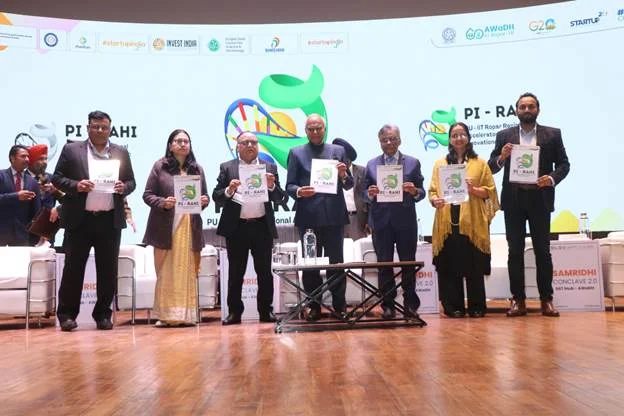
SAMRIDHI Conclave, a deeptech startup acceleration drive inaugurated at IIT Ropar

IIT Ropar has announced the launch of SAMRIDHI, a Deeptech Startup Accelerator Program. SAMRIDHI, is a Holistic Initiative for ICPS Startups, focusing on the transformative domains of agriculture and water.

The Governor of Punjab and Administrator of Chandigarh, Mr. Banwarilal Purohit, inaugurated a Deeptech Startup Accelerator Program dedicated to catalyzing innovation in agriculture and water technology called SAMRIDHI (Strategic Acceleration for Market, Research, Innovation & Development: a Holistic Initiative for ICPS Startups) hosted by iHub AwaDH, a Technology and Innovation Hubs set up UNDER National Mission on Interdisciplinary Cyber-Physical Systems (NM-ICPS).

The SAMRIDHI conclave in which five strategic collaborations were formalized, featured five deep-tech innovations. A total of 13 startups shortlisted through rigorous evaluation, presented their ideas while 25 startups showcased their solutions at the exhibition. More than 30 experts spoke on strategic acceleration for market research, innovation, and development.

Dr Akhilesh Gupta, Secretary of the Science and Engineering Research Board; Senior Adviser, DST, GoI, reinforced the efforts taken by the NMICPS to orchestrate the Technology Self-reliant Atmanirbhar Bharat. Mission Director of NM on ICPS Dr Ekta Kapoor, projected the key highlights of the mission leading to CPS technology interventions across sectors such as agriculture infrastructure health, defence, and environment.

Prof. Rajeev Ahuja, Director of IIT Ropar, Prof. Renu Vig, Vice Chancellor of Panjab University, Chandigarh, Dr Pushpendra Pal Singh, Project Director, AwaDH and Mr. Amitabh Nag, CEO of Bhashini Digital India were also present on the ocassion. The event emphasized DST's pivotal role in shaping the future of technology in the region through NMICPS. The Mission has led to the generation of 311 technologies, 549 technology products and created 1613 CPS research bases and contributed to more than 60000 cps skilling.

The conclave organised by IIT Ropar’s Technology and Innovation Hub AwaDH was supported by 46 investment partners, and over 50 jury members evaluated and mentored the startups. Over 110 partners nationwide actively contributed to driving innovation and fostering technological self-reliance. The program is executed with the Department of Science & Technology (DST), Government of India, under the National Mission on Interdisciplinary Cyber-Physical Systems (NM – ICPS), reinforcing DST's commitment to advancing technology and innovation.

NASA and Google Arts To Digitally Show the Climate Change Impact on The Earth's Water Cycle

NASA and Google Arts To Digitally Show the Climate Change Impact on The Earth's Water Cycle

The US space agency NASA has partnered with Google Arts to create a digital experience that shows how climate change is impacting Earth’s water cycle. “A Passage of Water” uses data from NASA’s SWOT and GRACE missions and will be featured at COP28 .

As part of the long-standing partnership between NASA and Google, NASA worked with Google Arts & Culture and artist Yiyun Kang to create an interactive digital experience around global freshwater resources titled “A Passage of Water.” This immersive experience leverages data from the Gravity Recovery and Climate Experiment (GRACE) satellites and new high-resolution data from the Surface Water and Ocean Topography (SWOT) mission to illustrate how climate change is impacting Earth’s water cycle.

A digital version of “A Passage of Water” will be released online on Thursday, Nov. 30, ahead of the beginning of the United Nations’ Climate Change Conference of Parties (COP 28) in Dubai, United Arab Emirates. Google also will host a physical installation of the visualization project in the Blue Zone at COP 28.

“NASA is the U.S. space agency that provides end-to-end research about our home planet, and it is our job to inform the world about what we learn,” said Kate Calvin, NASA’s chief scientist and senior climate advisor in Washington. “Highlighting our Earth science data in the installation of ‘A Passage of Water’ is a unique way to share information, in a digestible way, around the important connection between climate change and the Earth’s water cycle.”

The international Surface Water and Ocean Topography (SWOT) satellite, as shown in this illustration, is the first global mission surveying Earth's surface water. SWOT's high-resolution data helps scientists measure how Earth's bodies of water change over time. Credit: CNES.

For six decades, NASA has been collecting data on Earth's land, water, air, and climate. This data is used to inform decision-makers on ways to mitigate, adapt and respond to climate change. All of NASA’s Earth science data is available for scientists and the public to access in a variety of ways.

"NASA studies our home planet and its interconnected systems more than any other planet in our universe,” said Karen St. Germain, director of NASA’s Earth Science Division. “’A Passage of Water’ provides an opportunity to highlight the public availability of SWOT data and other NASA Earth science data to tell meaningful stories, improve awareness, and help everyday people who have to make real decisions in their homes, businesses, and communities.”

A collaboration between NASA and the French space agency CNES (Centre National d’Études Spatiales), SWOT is measuring the height of nearly all water on Earth’s surface, providing one of the most detailed, comprehensive views yet of the planet’s freshwater bodies. SWOT provides insights into how the ocean influences climate change and how a warming world affects lakes, rivers, and reservoirs.

LTIMindtree Partners UK-based Metasphere to Deliver Smart Sewers Solutions

LTIMindtree Partners UK-based Metasphere to Deliver Smart Sewers Solutions

LTIMindtree [NSE: LTIM, BSE: 540005], a global technology consulting and digital solutions company, announced that it has been selected as a strategic partner by Metasphere, a wastewater application specialist, to scale their Smart Sewers management platform. As a part of this engagement, LTIMindtree will transform Metasphere’s next-generation wastewater monitoring solution portfolio, and enable scalable delivery and platform to their customers.

Metasphere, part of Grundfos, provides smart network management solutions to the global utility industry. The company helps customers prevent leaks and spills for a cleaner, greener world and has deployed more than 200K sensors for their customers worldwide. By leveraging cutting-edge technology, the company offers intelligent, innovative, all-in-one wastewater application solutions. These solutions provide full network visibility, performance and forecasting that reduce telemetry ownership cost for customers to manage time-critical remote assets and system.

Sudhir Chaturvedi, President and Executive Board Member, LTIMindtree, said, “We are excited to partner with Metasphere, a Grundfos company, in their modernization program. With increasing focus on utilities worldwide, it has become critical to improve service delivery, reduce accidents and deliver real time insights to customers. After careful consideration by our team of experts, LTIMindtree took Metasphere’s cloud architecture and optimized it for AWS scale and cost. This transformation is enabling Metasphere in optimizing up to 25% of the total cost, while delivering almost unlimited scale and enhanced performance.”

Tim O’Brien, Chief Executive Officer, Metasphere, said, “This engagement is key to our ability to deliver modern, scalable solutions to all our utility clients worldwide. In LTIMindtree, we found an expert partner to support our diverse needs and bring in additional innovative offerings that we can integrate in our system in the future. We are confident that this partnership will bring us closer to our vision of leveraging our solutions to serve at least 10% of world’s population by 2040.

The modernised solutions designed by LTIMindtree and built on AWS have significantly reduced Metasphere’s customer onboarding time from days to minutes and activated faster rollout of new features.

Paddy Fitzpatrick, UKI ISV Head, AWS, said, “We are excited to see organisations like LTIMindtree deliver innovative solutions for the water industry by building on AWS. This collaboration between LTIMindtree and Metasphere will give the utility industry access to new solutions such as real-time network visibility and wastewater monitoring to help reduce costs and enhance performance. Together, we can help the utility industry leverage the power of cloud to drive business value.”

Germany's Water Tech Firm SKion Water Acquires Majority Stake in Hyderabad-based Sanpure

Germany's Water Tech Firm SKion Water Acquires Majority Stake in Hyderabad-based Sanpure

Water technology investment company, SKion Water, a subsidiary of SKion GmbH founded by German entrepreneur Susanne Klatten, has acquired majority stake in Hyderabad-based Sanpure Systems Pvt Ltd, which provides high purity water systems to pharma and biopharma companies.

According to a Times of India report, the acquisition deal is expected to be sealed for about $9-10 million and will mark SKion Water’s entry into the high purity water and process equipment business.

The report quoted SKion Water CEO Dr Rei-nhard Huebner saying — the firm has acquired 51% stake in the Hyderabad-based firm with the remaining held by Sanpure founder Basavaraj Nekar.

Founded in 2012, by Basavaraj Nekar, Sanpure Systems Pvt. Ltd. is a company fully dedicated for providing custom engineered solutions for pharmaceutical High purity water systems.

Post acquisition, Sanpure will integrate with SKion Water and the German water technology group will be using the combination of Sanpure and an another SKion group company, Paques, to develop a footprint in the Indian market.

With in-house electropolishing facility, Sanpure is amongst very few with fully integrated facility in India. The Hyderabad based water tech company is among the very few in India, with an automated polishing machines that can deliver high surface finish uniformly and very fast.

With over 36000 Sq. Ft of manufacturing area, Sanpure is well equipped to provide highly customized Process Equipment and Systems for the development and manufacturing of biopharmaceutical products like vaccines,mAB, rDNA protiens, blood fractionation among others. Sanpure caters to industries like –Pharmaceuticals , Bio-Pharmaceuticals, API, Food & Beverages Semi-Conductors.

About SKion Water, it was started in 2011 by Sussane Klatten and is an international water and wastewater technology solution platform which provides reliable and efficient water and wastewater treatment solutions to municipal utilities as well as industrial and commercial water users. It also aims at the development and implementation of innovative water technologies.

In April this year, EnviroWater Group, which belongs to SKion Water, acquired 100% of the company shares of Schweitzer‑Chemie GmbH, a German firm that offers cooling water systems as well as steam boiler systems, ventilation and air conditioning systems, drinking water installations, and other water-carrying systems.

Boson Whitewater Partners with SGBS Unnati Foundation to Install Water ATMs Across Villages in Karnataka

Boson Whitewater Partners with SGBS Unnati Foundation to install Water ATMs Across Villages in Karnataka

The projects have been funded by ExxonMobil Services & Technology Pvt. Ltd and Broadridge under their CSR initiative and it has been executed by social venture (NGO) SGBS Unnati Foundation and water startup Boson Whitewater

With an aim to povide easy access to safe and clean drinking water, Bengaluru-based Boson Whitewater has partnered with NGO SGBS Unnati Foundation to install water ATMs across villages in Karnataka. The projects have been funded by ExxonMobil and Broadridge under their CSR initiative. Till date, 10 water ATMs have been installed in Malur and Doddaballapur villages on the outskirts of Bengaluru and and over 1500+ families now have access to clean drinking water.

Unnati Foundation is a skilling organization for underprivileged youth across various States. Their program equips youth and guarantees them jobs in corporates in 35 days. They have trained over 28000 youth in the last financial year 2022-23. In addition, they assist villages in setting up Water ATMs to provide safe drinking water to rural communities.

Recently, a few village panchayats in Malur and Doddaballapur villages approached Unnati for help in enabling safe drinking water for their communities. Few of the areas were affected by heavy fluoride water contamination causing health issues in many families. In response, Unnati reached out to Boson Whitewater, a company that has experience in similar projects, particularly in school settings. Boson Whitewater decided to join the effort to contribute and work towards achieving the goal of providing safe water to various rural villages. After assessing the location proposed by Unnati Foundation, Boson Whitewater installs the water ATMs and provides Water ATM cards to the Panchayat. Each family is issued a Water Card with Rs.50 preloaded on it, which can be swiped to dispense 20 litres of water. In order to ensure the sustainability of the program, a nominal charge of Rs.5 per 20-litre per can of water is levied. The financial support for the project has been provided by ExxonMobil and Broadridge.

Commenting on the initiative, Ramesh Swamy, Director, Unnati Foundation, said, “We would like to thank ExxonMobil and Broadridge for their financial support for the projects. This collaboration is a great example of how social ventures and private players can collaborate for the greater good of the community. Through our joint efforts, more people in rural communities can now have easy access to safe and clean drinking water, which is essential for health and well-being. We look forward to working closely with Boson Whitewater to reach many more rural communities across India”

Commenting on this, Vikas Brahmavar, CEO and Co-Founder, Boson Whitewater, said, “At Boson Whitewater, our overarching goal is to use our technology to create easy access to clean water. We look for opportunities like this that allows us to make a huge difference to communities that find it difficult to access clean water. We are excited about our partnership with Unnati Foundation and look forward to implementing more projects together in the future."

Over the next few months, more Water ATMs will be installed across various villages in Karnataka.

About Boson Whitewater

Boson Whitewater, a water utility company, was founded with the aim to change the way industries, IT Parks, malls, and apartment communities recycle their wastewater. Founded in 2011 by Vikas Brahmavar and Gowthaman Desingh, Boson Whitewater converts water from sewage treatment plants into potable high quality water that can be used for household purposes, centralized air conditioning in commercial buildings, and even for drinking.

Water Utility Startup Boson Whitewater Partners With Sustainability-focused Fintech Platform PYSE

Water Utility Startup Boson Whitewater Partners With Sustainability-focused Fintech Platform PYSE

PYSE will invest in water infrastructure assets and lease it to Boson, enabling them to execute, and scale sustainable water projects

Boson Whitewater, a water utility company that converts STP water into high-quality potable water, has partnered with PYSE, a fintech company that allows retail investors to invest in green and sustainable projects. Through this collaboration with PYSE, Boson Whitewater will be able to implement and scale its sustainable water infrastructure projects, while also prioritizing and supporting the environmental goals of Pyse’s investors.

Pyse is a specialized sustainability funding platform that helps individual investors participate in special assets. The concept of sustainability is often associated with an "elite-only" standard or philanthropy, but Pyse aims to bring that model down to the average retail investor. By investing in sustainable assets like water management, Pyse allows everyone to participate in making their cities resourceful and sustainable in terms of water.

Over the last several years, Boson Whitewater has been actively working towards promoting sustainable water infrastructure by converting STP treated water into highest quality potable water. The Boson Whitewater system offers an 11-step filtering system and is equipped with IoT to allow real-time monitoring of water quality and quantity, as well as remote access for minimal manual intervention.

Commenting on the partnership, Vikas Brahmavar, CEO and Co-Founder, Boson Whitewater, said, “We are thrilled to partner with a brand like Pyse that is striving to make sustainable investments accessible to everyone. This partnership will help us scale our projects and create truly sustainable water infrastructure on a large scale, while also making it a profitable investment for everyone. We hope that this partnership will inspire more corporations and individuals to invest in sustainable assets and help build better water management systems in our cities

Commenting on the partnership, Kaustubh Padakannaya, Co-Founder, PYSE, said, “We are happy to partner with Boson Whitewater and support them in their efforts to rethink urban water management and promote circular water infrastructure. Our investment in their project aligns with our mission of investing in sustainable projects that contribute to environmental, social and economic impact.”

About Boson Whitewater

Boson Whitewater, a water utility company, was founded with the aim to change the way industries, IT Parks, malls, and apartment communities recycle their wastewater. Founded in 2011 by Vikas Brahmavar and Gowthaman Desingh, Boson Whitewater converts water from sewage treatment plants into potable high quality water that can be used for household purposes, centralised air conditioning in commercial buildings, and even for drinking.

Australia and India Partnering to Address India’s Water Challenges

Australia and India Partnering to Address India’s Water Challenges
The first batch of the Young Water Professionals Program at their graduation

Sustainable management of water is a key challenge for both Australia and India. Collaboration in water research, training, and education between the two countries is growing rapidly through several activities supported by the Ministry of Jal Shakti, the Australian Water Partnership, Western Sydney University, and the Indian Institute of Technology, Guwahati.

In this pursuit, the National Hydrology Project, Department of Water Resources, RD & GR, Ministry of Jal Shakti has initiated an innovative Young Water Professional Program in collaboration with Western Sydney University and Indian Institute of Technology, Guwahati, lead of the Australia India Water Centre. The objectives of this program are to build the capacity of Young Water Professionals (YWPs) and to provide them with the required knowledge, skills, attitude, and aptitude to offer their best in the country's water sector by accepting leadership roles and responsibilities.

The Young Water Professional Program focuses on gender equality and diversity. The first phase of this Programme has selected 20 young officers (10 men and 10 women) from the National Hydrology Project's central and state implementing agencies. This 11-month YWP program is getting successfully completed. While conducting this program, the Australia India Water Centre brought together eight universities and one State Government Department from Australia and 16 IITs and key universities of India.

On the occasion of the concluding event of the Young Water Professional Programme on 23rd November, 2022 in New Delhi, Western Sydney University, with the Ministry of Jal Shakti and the Australian Water Partnership also launched an app for farmers and ordinary citizens, ‘My Well’. It is a citizen science tool for participatory monitoring and visualisation of groundwater, surface water, rainfall, water quality, check dam water levels, and other parameters. This app will be used by villagers trained to manage their groundwater resources. These citizen scientists, called Bhujal Janakaar- “BJs’’ - are part of the ’Managing Aquifer Recharge and Sustaining Groundwater Use through Village-level Intervention’ (MARVI) project. The app will help BJs and ordinary citizens to make sense of what is happening to water availability in their villages.

MARVI is already transforming lives and farming communities through its unique approach of engaging and training villagers to monitor and manage groundwater. The concept of MARVI to engage citizens to manage village groundwater has been adapted for the Ministry’s ambitious national project, the Atal Bhujal Yojana’, said Ms. Debashree Mukherjee, Special Secretary, DOWR, RD & GR, Ministry of Jal Shakti. “The expansion of MARVI through the national project, together with MyWell, will empower BJs and ordinary citizens across India to self-manage water sustainably”, she said. She also emphasized the need to integrate the validated crowd-sourced data in the central database being managed by NWIC for generating analytics and dissemination to the masses."

"India and Australia are natural partners and this collaboration to train young water professionals is an important step in the right direction’, said Ms. Debashree Mukherjee. “I am particularly inspired by the equal participation of women. These will be our female leaders in future water management.”

The future of water security in India is also in the hands of the future leaders in water management,” said Sarah Ransom, General Manager of the Australian Water Partnership. “I am pleased that the first cohort of 20 Young Water Professionals are graduating today from a 10-month training program delivered by the Australia-India Water Centre, led by Western Sydney University and the Indian Institute of Technology, Guwahati.”

The YWP program is unique as 70 percent of the program focuses on project-based learning with real-world situations and clients”, said Professor Barney Glover, Vice-Chancellor and President of Western Sydney University. “It not only provides technical capacity building, but it also develops the critical thinking, problem-solving, leadership, and project management skills needed for management of water resources and water management reforms in India”, he said.

Emphasizing the need for collaboration between Australia and India, Professor Barney Glover said, “Collaboration is the key for Australia and India, and partnerships drive our SDG impact, including through this important network which brings together key players to tackle the significant water challenges of our two countries.”

Western Sydney University, ranked Number One in the world for SDG impact in the latest Times Higher Education (THE) University Impact Rankings, is also rolling out a Joint Master’s program in Sustainable Water Futures, in collaboration with the Indian Institute of Technology, Guwahati.

This degree is based on short courses - micro-credentials - and provides a great opportunity to build the capacity of water professionals through the joint delivery by Australian and Indian partners of the Australia-India Water Centre,” said Professor T.G. Sitharam, Director, Indian Institute of Technology, Guwahati.

About Western Sydney University

Western Sydney University began operations on 1st January 1989, under the terms of the University of Western Sydney Act, 1988 which had been passed by the New South Wales Parliament in December 1988. Located in Western Sydney, the heart of the nation's third largest economy and one of the fastest growing population and employment centres in Australia, the University offers unlimited potential to students with the talent, drive and ambition to succeed. Ranked amongst the top two per cent of universities in the world, Western Sydney University values academic excellence, integrity and the pursuit of knowledge. The University is globally focused, research-led and committed to making a positive impact on the communities it engages with.

Market Reports

Market Report & Surveys
IndianWeb2.com © all rights reserved